
Revolutionizing Facial Reconstruction: Swansea University Pioneers 3D Printed Cartilage
The field of plastic and reconstructive surgery stands on the brink of a monumental transformation, thanks to groundbreaking research conducted by scientists at Swansea University in Wales. They have developed an advanced additive manufacturing technology that promises to redefine how facial features are reconstructed: the creation of functional 3D printed artificial cartilage. This innovative project offers a beacon of hope for countless individuals who have suffered the devastating loss of facial parts, such as a nose or an ear, often as a result of severe accidents, traumatic injuries, or the aggressive progression of cancer. Beyond restoring physical form, this pioneering approach aims to fundamentally alter the surgical landscape, moving away from conventional, often suboptimal, methods towards solutions that are more patient-friendly and yield superior, long-lasting outcomes.
Traditionally, reconstructive interventions have involved a complex and arduous process: surgeons would extract cartilage from a patient’s ribs to sculpt a new structure for the affected facial area. While this technique has been the standard for decades, it is fraught with significant limitations and drawbacks. The extracted rib cartilage, though a viable donor material, often proves to be weaker and less resilient than the original native cartilage. This can lead to a reconstructed area that is more susceptible to damage, less flexible, and generally compromises the natural feel and function of the facial part. Furthermore, this method introduces a secondary surgical site, leading to increased pain, potential scarring, and prolonged recovery times for the patient, in addition to the inherent risks associated with any major surgical procedure. The quest for a more effective, less invasive, and biologically superior alternative has long been a driving force in regenerative medicine, and Swansea University’s breakthrough represents a significant leap forward in addressing these critical challenges.
The Genesis of Hope: The 3D Bioface Project
This ambitious and profoundly impactful initiative, aptly named “3D Bioface,” has garnered substantial financial backing from The Scar Free Foundation, a prestigious medical charity dedicated to advancing scar-free healing technologies. The Foundation’s support underscores the immense potential of this project to mitigate some of the most pressing issues currently confronting the plastic and reconstructive surgery sector. Brendan Eley, chief executive of The Scar Free Foundation, eloquently articulated the significance of this research, stating, “This life-changing research is part of our commitment to achieving scar-free healing for the millions of people living with scars in the UK and around the world.” His words highlight not only the immediate clinical applications but also the broader humanitarian implications of a technology that could dramatically improve the quality of life for individuals grappling with disfigurement and the psychological burden of scars. The promise of not requiring actual surgery for cartilage harvesting is a cornerstone of this project, poised to dramatically reduce patient morbidity and enhance recovery pathways.
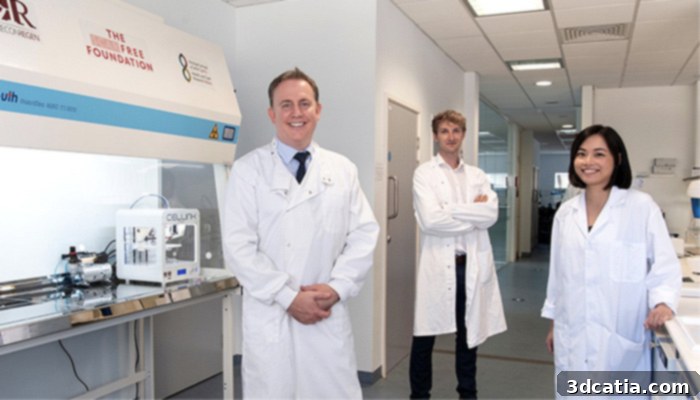
In the middle, Professor Whitaker, a scientist involved in the project (photo credits: Swansea University)
Unveiling the Science: How 3D Printed Artificial Cartilage is Made
The innovation at the heart of Swansea University’s project lies in its sophisticated approach to biomaterial engineering and additive manufacturing. To meticulously craft structures like a human nose or ear, the scientists leverage their cutting-edge technology to produce cartilage from a unique composite material. This material begins with nanocellulose hydrogel, a remarkable substance derived from resinous wood pulp. Nanocellulose, known for its exceptional biocompatibility and mechanical strength, forms the structural backbone of the artificial cartilage. To further enhance its biological integration and functional properties, this hydrogel is carefully blended with hyaluronic acid. Hyaluronic acid is a naturally occurring molecule found abundantly in human epidermal and connective tissues, celebrated for its remarkable ability to retain moisture, provide lubrication, and impart firmness and elasticity to the skin and cartilage. This synergistic combination of nanocellulose hydrogel and hyaluronic acid results in a pliable yet robust bio-ink, perfectly suited for precise 3D printing applications.
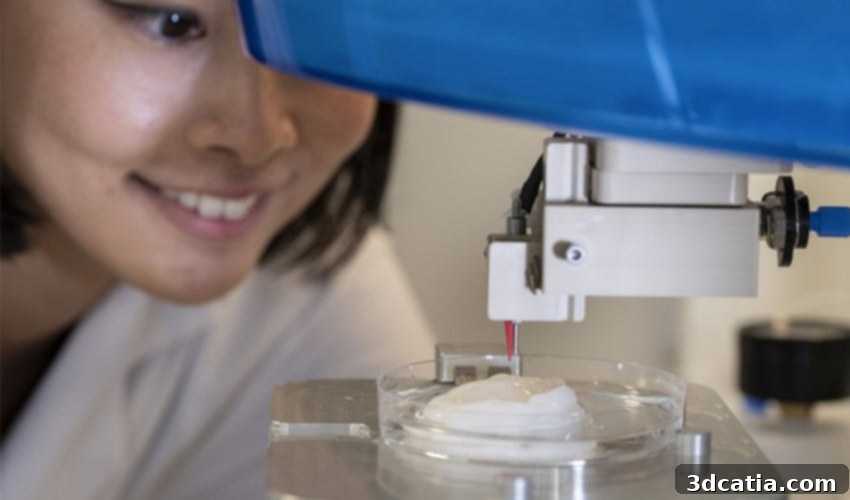
Once the sophisticated blend of nanocellulose hydrogel and hyaluronic acid is prepared, it is fed into a specialized bioprinter. This additive manufacturing device precisely deposits layers of the material, following a digital blueprint derived from patient-specific anatomical data, to achieve the desired intricate shape of a nose or an ear. The precision offered by 3D printing allows for custom-fitted implants that perfectly match the patient’s unique facial contours, a significant advantage over manually sculpted grafts. After the printing process, a biological catalyst is introduced to harden the delicate, newly formed mixture, solidifying its structural integrity. This step is critical in ensuring the implant maintains its intended form and mechanical properties. The hardened artificial cartilage then undergoes a crucial biological maturation phase: it is immersed in a specialized solution teeming with cartilage cells harvested from the patient’s own body. This immersion allows the patient’s cells to effectively colonize the 3D printed scaffold, integrate with its structure, and begin to stiffen and vascularize the artificial construct. This cellular integration is paramount, as it transforms the inert printed material into a living, dynamic tissue that can thrive within the patient’s body, reducing the risk of rejection and promoting long-term viability. Finally, once the cellular colonization and maturation are complete, the new nose or ear is ready for the final phase: surgical implantation onto the patient’s face, promising a restoration that feels and functions more naturally than ever before.
Beyond Cartilage: A Glimpse into the Future of Regenerative Medicine
The potential impact of the 3D Bioface project extends far beyond the realm of facial cartilage reconstruction. Professor Iain Whitaker, a distinguished surgical specialist at Swansea University and a key figure in this transformative research, shared an inspiring vision for the future. He stated, “Although our current focus is on cartilage, the scientific concepts and technologies on which our work is based can be applied to tissue types such as blood vessels, nerves, bone, skin and fat, which will greatly increase the impact.” This forward-looking perspective underscores the foundational nature of their work; the principles of biomaterial selection, 3D bioprinting, and guided tissue regeneration could unlock solutions for a vast array of medical conditions. Imagine the possibilities for patients requiring vascular grafts, nerve conduits for spinal cord injuries, or even complex bone structures for orthopedic reconstruction. This research paves the way for truly personalized medicine, where implants are not only custom-designed but also biologically tailored to integrate seamlessly with the patient’s own body, minimizing complications and maximizing functional recovery. The expansion of this technology to other tissue types could revolutionize treatment paradigms across numerous medical specialties, offering unprecedented hope for patients facing a wide spectrum of tissue damage and loss.
While the initial results are highly promising, the research journey continues with crucial next steps. A paramount concern for any implanted material is ensuring biological compatibility and preventing adverse reactions. Therefore, the immediate focus of the research team is to rigorously verify that the developed material does not trigger an immune response within the host body. This involves extensive in vitro studies, followed by preclinical trials, to meticulously assess the material’s safety profile and efficacy. Only after successfully navigating these rigorous testing phases can the technology advance to human clinical trials. The successful validation of this innovative approach would not only cement its role in facial reconstruction but also open doors for its application in replacing a multitude of other body parts, as Professor Whitaker alluded to. This journey from lab to clinic is often long and complex, but the potential rewards—restoring form, function, and dignity to patients—make every step worthwhile. To delve deeper into the intricacies of this pioneering project and stay updated on its progress, you can click HERE for more information directly from The Scar Free Foundation.
The development of 3D printed artificial cartilage by Swansea University marks a profound advancement in both additive manufacturing and regenerative medicine. It heralds a new era of possibilities for plastic surgery, offering less invasive, more effective, and aesthetically superior solutions for facial reconstruction. As this technology continues to evolve, its potential to transform lives and reshape medical practice is undeniable. What are your thoughts on the revolutionary application of 3D Printing in surgical procedures and regenerative medicine? We invite you to share your perspectives and engage in the conversation by leaving a comment below. You can also connect with us and join the discussion on our LinkedIn, Facebook, and Twitter pages. For the very latest updates, news, and insights from the world of 3D printing, don’t forget to sign up for our free weekly Newsletter here, delivered straight to your inbox. Additionally, immerse yourself in our video content and explore comprehensive demonstrations by visiting our YouTube channel.
*Cover photo credits: The Scar Free Foundation