

Discover Top American Desktop FDM 3D Printers Under $5000: Innovation for Every Enthusiast and Educator
The landscape of additive manufacturing is continuously evolving, and at its heart, the United States remains a dominant force. Not only does the country boast the largest installed base of 3D printers globally, but it also leads in the number of innovative 3D printer manufacturers. While we’ve previously explored the American pioneers in metal 3D printing solutions, our focus now shifts to the expansive world of polymer 3D printing. Specifically, this comprehensive guide delves into American manufacturers offering accessible desktop Fused Deposition Modeling (FDM) 3D printers priced under $5000. These machines are making 3D printing more attainable than ever for hobbyists, educators, small businesses, and professional users alike, fostering innovation and learning across various sectors. The FDM process, known for its versatility and cost-effectiveness, uses a continuous filament of thermoplastic material, heated and extruded layer by layer to build a three-dimensional object. This article highlights the key players that are shaping the domestic market for affordable and reliable FDM technology. Stay tuned for future installments in this series, which will explore composite materials and more industrial-grade solutions.
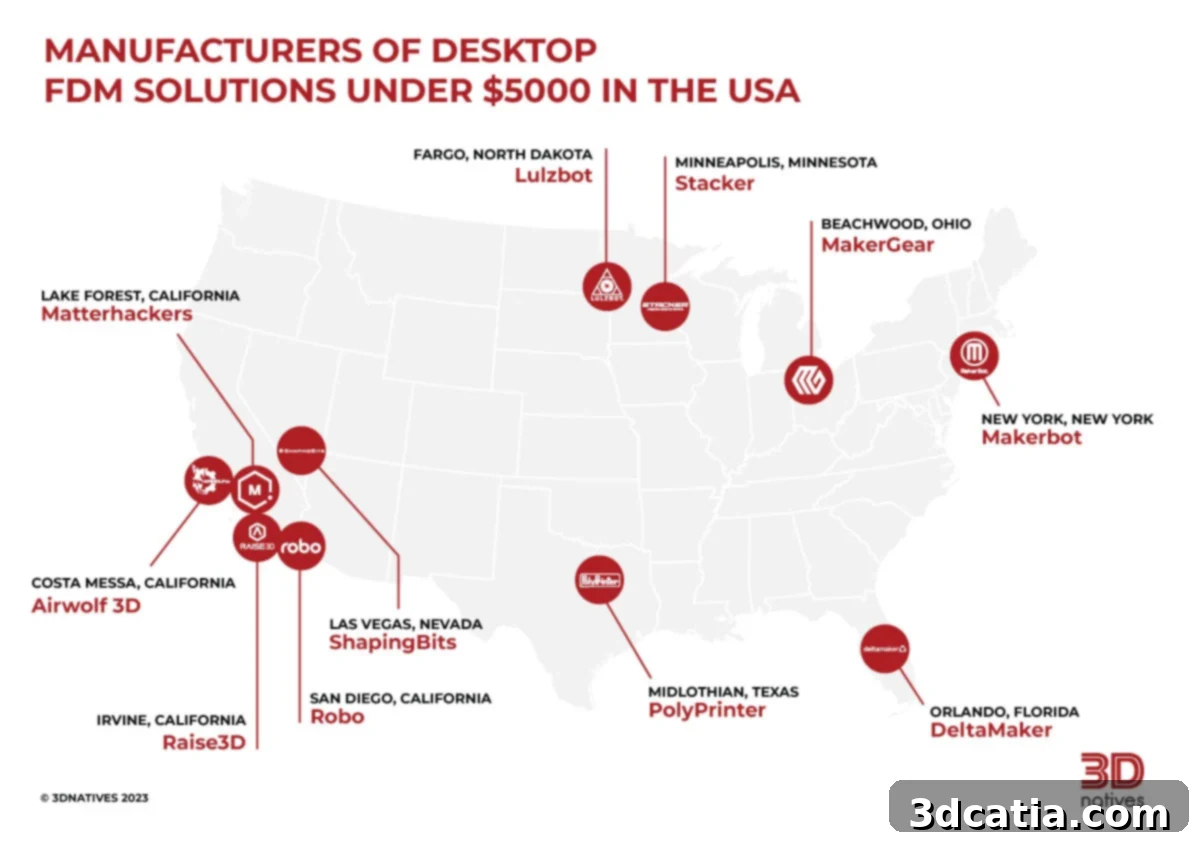
MakerBot: Empowering Education Through 3D Printing
MakerBot, a seminal name in the 3D printing industry, emerged from the RepRap project in 2009. Known for making 3D printing accessible to a broader audience, the company has undergone significant evolution. Following its merger with Ultimaker last year, forming UltiMaker, MakerBot has redefined its mission, becoming “the only 3D printing ecosystem dedicated to education.” This strategic rebranding underscores its commitment to fostering innovation and STEM learning in classrooms worldwide. The company’s Sketch series exemplifies this focus, offering two robust and user-friendly options, both priced under $2500. The standard Sketch model is ideal for individual student projects, while the Sketch Large 3D printer caters to bigger classroom initiatives, featuring a generous build volume of 220mm x 200mm x 250mm (8.66in x 7.87in x 9.84in). While the base Sketch model starts at an affordable $1299, the Sketch Large is priced at $2399, offering increased capacity without breaking educational budgets. Both printers integrate seamlessly with accompanying software designed to simplify the 3D printing process in educational settings. Educators gain access to a rich library of lesson plans and tools to craft personalized curricula, making 3D printing an engaging and impactful learning experience for students.

Image Credits: MakerBot
Airwolf 3D: High-Performance FDM for Diverse Applications
Established in 2012, Airwolf 3D is a prominent California-based manufacturer that has carved a niche in providing high-performance FDM printers for industrial, professional, and educational environments. While offering large-format solutions, Airwolf 3D also provides specific desktop models that fit within our sub-$5000 criteria, balancing power and accessibility. The company’s product portfolio includes two distinct lines, EVO and AXIOM, each featuring a range of models with varying build sizes, single or dual direct-drive extrusion systems, and specialized configurations for educational institutions. A notable recent addition to their lineup is the EVO 2X, an advanced system engineered for commercial applications, boasting an impressive 24” x 12” x 22” build volume. Beyond its robust printers, Airwolf 3D distinguishes itself by producing its own extensive range of high-quality filaments. One of their most innovative offerings is HydroFill, a patent-pending, water-soluble support material that is both environmentally friendly and compatible with a wide array of popular thermoplastics such as ABS, PLA, and nylon. The company also manufactures its own in-house ABS filament, including the highly regarded MG94, and polycarbonate. Complementing their material range, Airwolf 3D offers Wolfbite, a specialized adhesion solution available for ABS, PC, PLA, and nylon, ensuring reliable prints. Their commitment to user support is evident through their website, which provides a wealth of easily accessible resources, from troubleshooting tutorials and comprehensive user manuals to detailed how-to guides for each machine, empowering users to maximize their 3D printing experience.
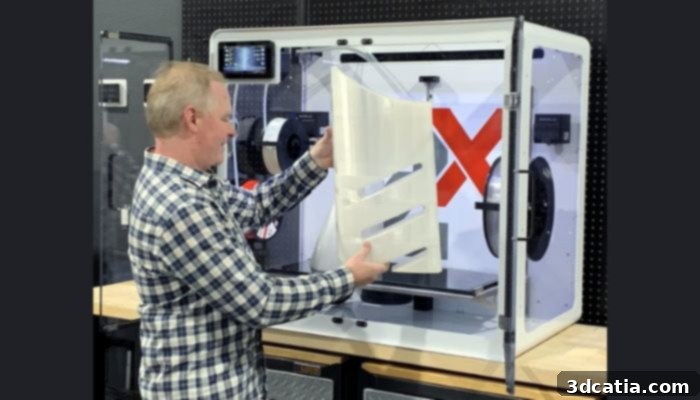
The Airwolf 3D EVO 2X (Image credits: Airwolf 3D)
Dremel: Accessible and Versatile 3D Printing Solutions
Dremel, under its DigiLab brand, has long been a recognized name in providing user-friendly 3D printers, particularly those tailored for educational environments. While the Dremel DigiLab brand is now licensed to 3PI Tech Solutions, ensuring continuity, the popular and reliable printers from the brand remain readily available. This arrangement means users can continue to acquire Dremel’s filaments, printers, and other accessories from 3PI Tech Solutions. Among their most popular models suitable for various users, the 3D40-FLX and 3D45 3D printers are excellent choices. The 3D40-FLX is available starting at $1,499, while the more advanced 3D45 begins at $1999. Although education has always been a core focus for Dremel, these printers are designed to cater to a broad spectrum of users, from first-time enthusiasts to advanced professionals. They feature essential enhancements like flexible build plates for easy print removal and robust, all-metal, clog-resistant extruders. The 3D40-FLX’s extruder can reach temperatures up to 230°C, while the 3D45 pushes the limits further to 280°C. This expanded thermal capability allows for printing with a wider range of polymers, including engineering-grade materials like ABS and Nylon, in addition to standard PLA. Such versatility makes these Dremel printers exceptional solutions for both schools looking to integrate STEM education and professionals requiring reliable prototyping tools.
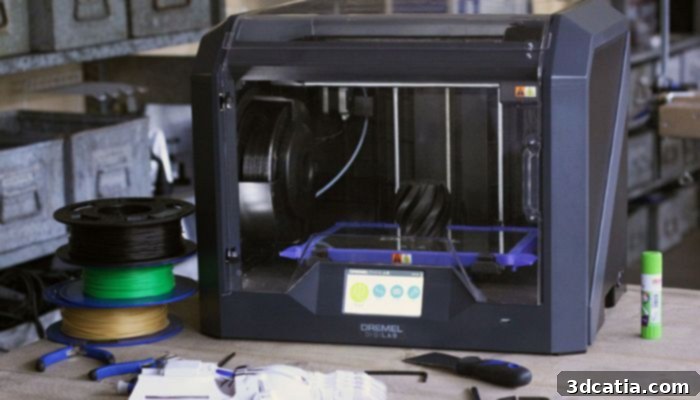
Image Credits: 3Dnatives
Lulzbot: Open Source Innovation and Community Support
Founded in 2011, Lulzbot has established itself as a leading American manufacturer specializing in open-source FDM 3D printers and related equipment. Renowned for their robust construction and reliability, Lulzbot machines are versatile tools found in diverse settings, from STEM classrooms and hobbyists’ workshops to professional design studios and light industrial environments. The company offers an impressive range of FDM printers, accommodating various project sizes. Their machines feature build volumes ranging from a compact 160mm x 160mm x 180mm for their smallest models up to a spacious 282mm x 582mm x 287mm for their larger offerings. Lulzbot also empowers users with extensive customization and upgrade options, selling a variety of tool heads that can enhance machine quality, precision, and material compatibility. A core pillar of Lulzbot’s philosophy is its strong emphasis on education. Beyond supplying classrooms with high-quality 3D printers, the company provides a wealth of freely accessible lesson plans online. These resources enable students to explore new topics, engage in hands-on learning, and print functional objects while following expertly curated course plans. Furthermore, Lulzbot cultivates an active and supportive community of users and educators, offering a platform for advice, collaborative projects, and ongoing technical support, making it an excellent choice for those valuing flexibility and communal knowledge.
Robo3D: Integrated STEM Learning with Reliable FDM
A recurring trend among American FDM 3D printer manufacturers offering models under $5000 is their dedication to the educational sector, and Robo3D is no exception. Now operating under its parent company, Boxlight Inc., Robo3D continues to offer its highly regarded Robo E3 and E3 Pro FDM printers. These machines are specifically designed to integrate seamlessly into educational curricula, making them invaluable tools for K-12 STEM education. Both the Robo E3 and E3 Pro come equipped with the MyStemKits integrated 3D printable STEM curriculum, providing educators with a ready-to-use resource for engaging students. Additionally, each printer includes a 2-year warranty and a 2-hour online training session delivered by EOS education, ensuring users can confidently maximize their machine’s potential. Common features across both models include a heated print bed, essential for successful printing with various materials, and filament run-out detection, preventing failed prints due to material depletion. The primary difference lies in their build volumes and print temperatures. The Robo E3 offers a compact build volume of 150 x 150 x 150 mm (approximately 5.9 x 5.9 x 5.9 inches), perfect for individual student projects. The Robo E3 Pro, on the other hand, provides a larger build volume of 250 x 280 x 300mm (approximately 9.8 x 11 x 11.8 inches) and a higher maximum print temperature of 300°C, compared to the E3’s 250°C. This elevated temperature capability enables the E3 Pro to print with a much wider array of engineering-grade materials beyond standard PLA and ABS, including PVA, HIPS, PETG, TPE, PP, and many others, offering greater versatility for advanced projects.
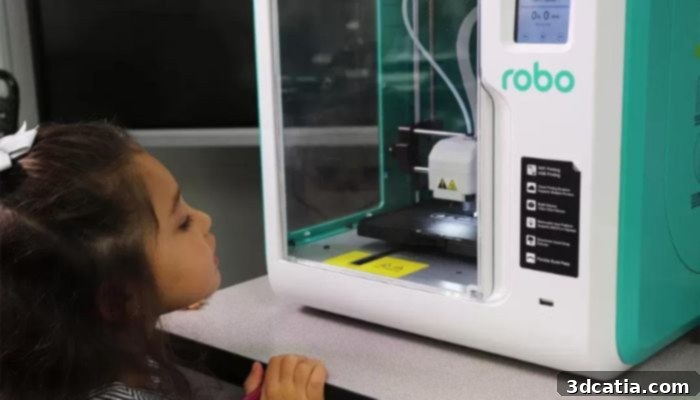
Image Credits: Robo3D
Raise3D: Global Reach with Strong American Presence
While Raise3D might not fit the traditional definition of a purely “U.S. company,” having been founded in Shanghai, China, in 2015, its substantial and growing presence in the United States makes its inclusion in this list highly pertinent. Raise3D has strategically established three global headquarters, with a key location situated in Irvine, California, demonstrating a strong commitment to the American market. The company has rapidly gained renown for its portfolio of high-quality and rapid FDM 3D printers, its intuitive IdeaMaker slicing software, and its specialized line of high-speed filaments. Beyond FDM, Raise3D has also ventured into metal 3D printing and, as of November 2023, announced its exciting first foray into the resin 3D printing market, showcasing its continuous innovation across additive manufacturing technologies. The company’s extensive catalog features a wide array of FDM/FFF printers. This includes industrial-grade machines like the RMF500, designed for printing high-performance composite, end-use parts, alongside its popular Pro 3 series of dual-extruder FDM printers, which offer reliability and precision for professional applications. For those seeking advanced desktop capabilities, the E2CF stands out as a desktop 3D printer specifically optimized for printing carbon fiber filament, bringing industrial-grade material capabilities to a more accessible format. Increasingly, Raise3D’s reputation is built upon its Hyper FFF® technology, a groundbreaking innovation capable of achieving staggering print speeds of up to 350 mm/s. Through this advanced technology, the company aims to significantly boost user productivity without compromising the exceptional quality that Raise3D printers are known for, making it a compelling choice for both professional desktop users and advanced enthusiasts.
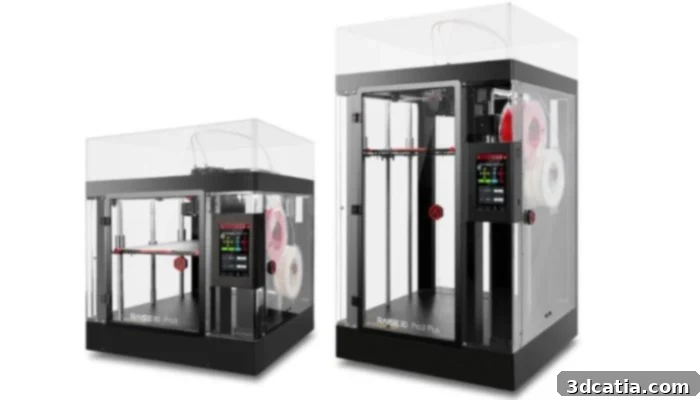
The Raise3D Pro3 series (image credits: Raise3D)
Matterhackers: Materials Expertise Meets Printer Innovation
Matterhackers, an Orange County-based company founded in 2012, is widely recognized as a premier retailer for 3D printing materials, tools, and accessories. However, fewer people realize that this materials expert also designs and manufactures its own line of high-quality 3D printers. The Pulse series from Matterhackers offers fully assembled and highly customizable 3D printers, with starting prices comfortably under $1000, making them incredibly accessible. Their current flagship offering in this series is the Pulse XE – NylonX Advanced Materials 3D Printer. This machine is lauded as a reliable workhorse FDM 3D printer, particularly for those looking to explore more technical and challenging materials. What sets the Pulse XE apart is its compatibility with advanced filaments like NylonX, while still maintaining an emphasis on user-friendliness with easy setup and straightforward bed-leveling. It boasts the capability to print with fine resolutions down to 20 microns, ensuring intricate details and smooth finishes. Furthermore, its hotend can reach temperatures up to 290°C, enabling it to handle a broad spectrum of engineering-grade thermoplastics. For users seeking an inexpensive, high-performance 3D printer manufactured in the USA that can reliably process advanced materials, the Matterhackers Pulse XE presents an outstanding value proposition.
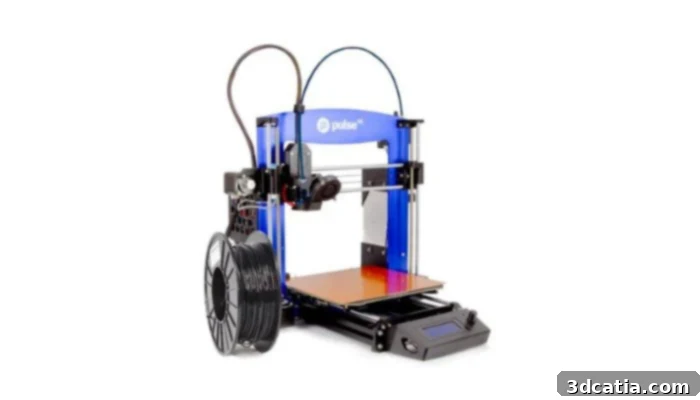
Image Credits: Matterhackers
Stacker: Industrial Quality, American Craftsmanship
Stacker is a Minnesota-based American 3D printer manufacturer that prides itself on delivering industrial-grade machines with a strong emphasis on quality, durability, and safety. While many of their flagship models are designed for larger-scale industrial applications, their commitment to robust engineering and innovation offers valuable insights for desktop users seeking reliability and high performance. The company currently showcases three of its newest large-format industrial 3D printers, which incorporate cutting-edge safety features, such as the advanced thermal runaway protection found on the F285 printer. Another unique offering is the S4, which stands out with its ability to print four objects simultaneously, thanks to its innovative quad-print head configuration available in standard or XL formats. Stacker’s dedication to superior craftsmanship is evident in the construction of its machines, which are built from high-strength steel and finished with a powder coating for enhanced, environmentally friendly durability. This meticulous approach results in machines that offer exceptionally high precision, from the printer chassis to the building jig. While their primary focus leans towards professional and industrial markets, Stacker’s principles of reliability and precision resonate with prosumers and small businesses looking for robust, long-lasting FDM solutions, perhaps even influencing the design of future desktop-oriented models with similar build quality and safety features, offering a glimpse into what high-end American manufacturing brings to the FDM space.
DeltaMaker: The Advantage of Delta Kinematics
Diverging from the more common Cartesian and CoreXY systems, DeltaMaker stands out as one of the few American manufacturers specializing in Delta FDM 3D printers. As its name suggests, DeltaMaker leverages the unique kinematic structure of Delta printers, known for their speed, vertical build capabilities, and often sleek, compact designs. The DeltaMaker Pro, currently in its pre-production phase, is their latest FDM 3D printer, with all its current models priced under $5000, making advanced Delta technology accessible. This innovative machine is engineered to offer a remarkably spacious cylindrical build area while maintaining exceptional portability, making it easy to set up, operate, and stow away after use. Its build area measures an impressive 18 inches in diameter, and the machine can be adapted to various build heights, ranging between 12 and 32 inches, providing immense flexibility for diverse projects. In addition to the Pro model, DeltaMaker also offers the DeltaMaker 2, DeltaMaker2T, and DeltaMaker 2XT, which primarily differ in their maximum build heights. The company proudly highlights the benefits of its compact design combined with an increased build volume, a hallmark of Delta printers. Other key features include the integration of Simplify3D software, a renowned slicing solution for superior print control, a convenient removable build plate for easy print retrieval, and built-in Wi-Fi access points for seamless connectivity and remote management. DeltaMaker provides a compelling option for users seeking a high-performance FDM printer with a unique approach to design and functionality.
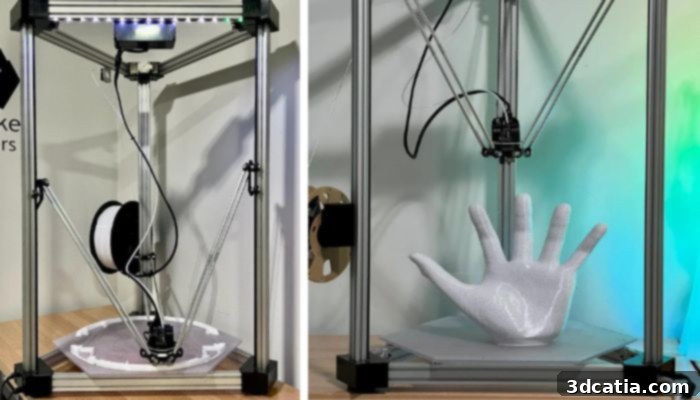
Image Credits: Deltamaker
ShapingBits: Dedicated to Pushing AM Boundaries
Based in Albuquerque, ShapingBits has previously articulated its ambition to advance the capabilities of additive manufacturing. While the company has maintained a relatively low profile in recent years, it continues to offer a selection of three distinct FDM printers, catering to different user needs. Their entry-level model, the 3FXTRUD 20 UNO, is equipped with a fifth-generation hotend and features a build area of 200mm x 200mm x 175mm, making it suitable for a wide range of desktop projects. The other two printers in their lineup are distinguished by their dual extruder configurations and larger build volumes, offering enhanced functionality and material versatility. All ShapingBits printers are designed to be compatible with a diverse range of materials, including standard PLA and an extensive selection of thermoplastics, allowing users to experiment and create with different properties. It’s worth noting that their third, largest, and most versatile printer, the 3FXTRUD 30 DUO EXTMAT, is currently available only for pre-order. Information regarding its expected release date or specific updates on its development has been limited. Interested parties are encouraged to visit their official website or contact ShapingBits directly for the latest information on this promising machine, which aims to push the boundaries of accessible dual-extrusion FDM printing.
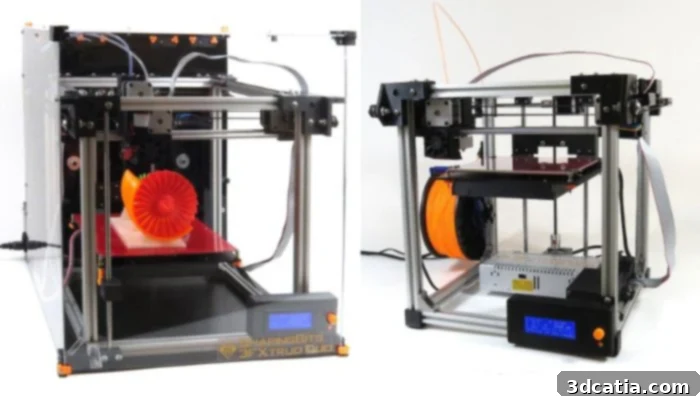
The ShapingBits 3FXtrud 25 Duo (L) and 3FXtrud 20 Uno (R) (Image credits: ShapingBits)
PolyPrinter: Quality, Service, and Consumer Focus
Rounding out our list is PolyPrinter, a dedicated 3D printer manufacturer based in Midlothian, Texas. PolyPrinter distinguishes itself through a strong commitment to quality in both its machines and its customer service. The company offers a line of FDM 3D printers characterized by several user-centric features, including an enclosed build space for improved thermal regulation and safety, a heated build plate for enhanced adhesion and warp prevention, an integrated webcam monitor for remote print supervision, and an automatic filament runout sensor to prevent print failures. Their range of PolyPrinters is named after their build volumes, starting with the single-extruder Model 229, which boasts a generous build volume of 229 x 229 x 299 mm. For users requiring multi-material capabilities or complex support structures, the lineup extends to the dual-extrusion Model 456dx, offering a build volume of 456 x 229 x 229 mm. PolyPrinter takes customer satisfaction a step further by offering comprehensive support services, including specialized new customer training, professional machine installation, and convenient on-site service for their clients. This robust support infrastructure, coupled with an optional warranty, solidifies PolyPrinter’s image as a consumer-focused company. They are dedicated to facilitating education, expanding the reach of additive manufacturing into new businesses, and ensuring a seamless, high-quality 3D printing experience for all their users.
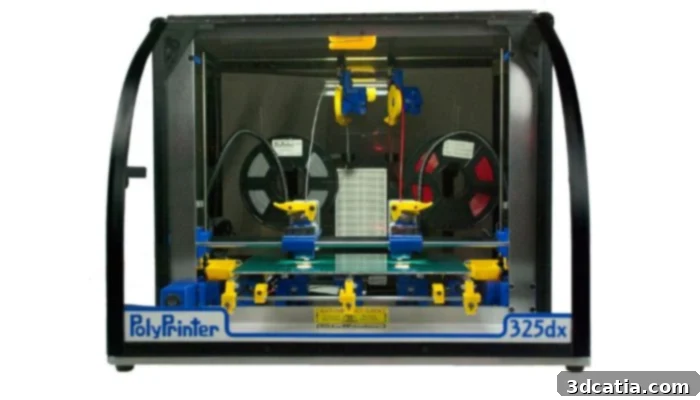
The PolyPrinter 325dx (Image credits: PolyPrinter)
This extensive overview highlights the vibrant innovation within the American desktop FDM 3D printer market, particularly for models under $5000. From dedicated educational solutions to versatile machines for professionals and advanced hobbyists, U.S. manufacturers are continuously pushing the boundaries of accessibility, performance, and user experience in additive manufacturing. We hope this guide provides valuable insights for your next 3D printer purchase. What are your thoughts on our list of American FDM 3D printer manufacturers? Are there any other notable brands you believe should be featured? We invite you to share your feedback in a comment below or connect with us on our Linkedin, Facebook, and Twitter pages! Don’t forget to sign up for our free weekly Newsletter here to receive the latest 3D printing news directly to your inbox. You can also explore all our engaging videos on our YouTube channel for more insights into the world of additive manufacturing.
*Cover Photo Credits: Airwolf 3D, MakerBot, Dremel