
South Korea’s Medical 3D Printing Leap: UNIST and PNUH Forge Advanced Device R&D Partnership
The integration of additive manufacturing within the medical sector represents one of the most transformative developments in modern healthcare. As researchers and companies worldwide relentlessly pursue innovative and efficient solutions for healing and patient care, the adoption of advanced 3D printing technologies has become increasingly prevalent. Among the global leaders spearheading this revolution, South Korea has consistently emerged as a prominent hub for research and development, expertly blending medical science with cutting-edge 3D printing capabilities. This strategic focus positions the nation at the forefront of biomedical innovation, driving forward the next generation of patient-specific treatments and medical tools.
In a significant move poised to further solidify its leadership, the Ulsan National Institute of Science and Technology (UNIST) recently announced a landmark joint collaboration agreement with the esteemed Pusan National University Hospital (PNUH). This powerful partnership is explicitly aimed at advancing research and development in sophisticated 3D printed medical devices. The alliance brings together UNIST’s renowned expertise in materials science and advanced manufacturing with PNUH’s extensive clinical knowledge and patient care infrastructure, creating a synergy expected to accelerate the development and commercialization of revolutionary medical solutions.
The transformative potential of additive manufacturing in medicine lies in its ability to produce highly customized, complex, and functional devices tailored precisely to individual patient needs. Traditional manufacturing methods often struggle with the intricate geometries required for anatomical conformity or the rapid prototyping necessary for iterative design. 3D printing overcomes these limitations, offering unprecedented precision and customization for everything from patient-specific implants and prosthetics to surgical guides and intricate anatomical models for pre-operative planning. This enables medical professionals to deliver more effective, less invasive, and personalized care, ultimately leading to improved patient outcomes and a higher quality of life.
South Korea’s proactive stance in fostering this innovation is well-documented. The nation has invested heavily in creating an ecosystem conducive to technological breakthroughs, particularly in fields like biotechnology, robotics, and advanced manufacturing. This includes robust government funding for research, the establishment of specialized technology centers, and a strong emphasis on academic-industrial collaboration. Institutions like UNIST, known for their scientific rigor and interdisciplinary research, have been instrumental in pushing the boundaries of what’s possible with 3D printing, especially in biocompatible materials and advanced fabrication techniques suitable for medical applications. This strategic foresight has cultivated a fertile ground for partnerships like the one between UNIST and PNUH, promising significant advancements for both domestic and global healthcare.
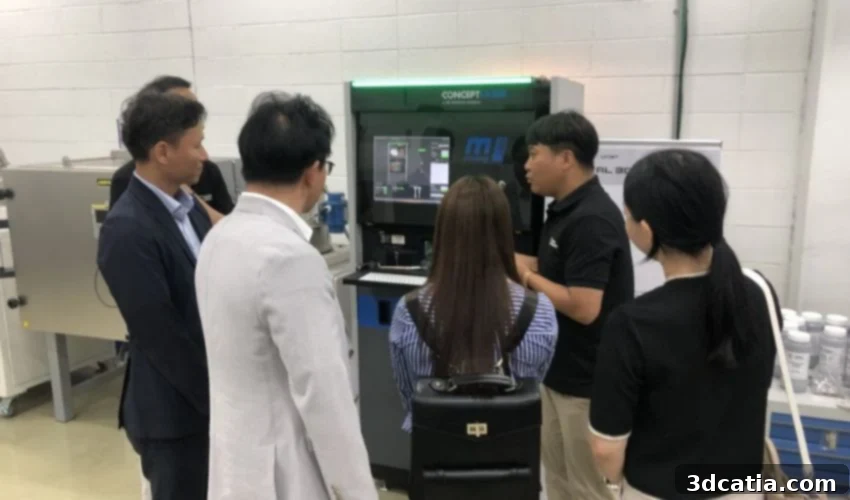
The agreement specifically harnesses the strengths of two highly specialized entities within the partner organizations. The UNIST 3D Printing Convergence Technology Center, a well-established hub of innovation, has dedicated several years to promoting the research and application of additive manufacturing across a diverse array of industries. Its mission extends to actively seeking out collaborative opportunities that push the boundaries of 3D printing technology, making this medical partnership a natural fit for its forward-thinking agenda. The Center brings to the table a wealth of knowledge in advanced materials, printing processes, and digital design, crucial for the development of next-generation medical devices.
Complementing UNIST’s research prowess is the PNUH Medical Device Usability Evaluation Center. This facility holds a unique distinction as the first specialized testing and evaluation center of its kind to be located in a non-metropolitan area in South Korea. Its strategic placement underscores a commitment to decentralizing high-tech medical infrastructure and ensuring robust evaluation capabilities are accessible beyond major urban centers. The Usability Evaluation Center plays a critical role in ensuring that newly developed medical devices are not only scientifically sound but also practical, safe, and effective for clinical use. Their expertise in evaluating device functionality, user interface, and overall clinical applicability provides a crucial bridge between laboratory innovation and real-world patient benefit.

Pusan National University Hospital (Photo credits: PNUH)
Positioned within the country’s largest comprehensive medical cluster, the collaborative teams will benefit from unparalleled access to state-of-the-art specialized facilities and a broad network of medical experts. This environment is ideal for conducting the most comprehensive and rigorous tests possible, from material biocompatibility and mechanical strength assessments to clinical trials and usability studies. While specific details regarding the exact research projects or the particular 3D printing methods to be employed by the teams are yet to be fully disclosed, the formidable combination of location, available resources, and profound expertise strongly indicates a wide array of potential applications. These could range from highly customized implants requiring advanced metal powder bed fusion 3D printing to bioprinted tissues or complex surgical guides, demonstrating the breadth of possibilities within this cutting-edge partnership.
Beyond foundational research and development for 3D printed medical equipment, a critical aspect of this collaboration will be its dedicated focus on supporting the commercialization of domestically developed 3D printed medical devices. The journey from a promising prototype in a lab to a market-ready product is often fraught with challenges, including navigating complex regulatory landscapes, securing funding, and scaling production. This partnership aims to streamline that process, ensuring that innovative devices developed within South Korea can quickly and effectively reach patients who need them. By emphasizing commercialization, the collaboration seeks to translate scientific breakthroughs into tangible healthcare solutions and economic growth for the nation.
Should this ambitious study yield fruitful results, it holds the potential to catalyze the large-scale utilization of additive manufacturing across both the private and public healthcare sectors in South Korea in the near future. This could lead to a significant domestic industry for medical devices, reducing reliance on imports and positioning South Korea as a self-sufficient and leading exporter of advanced 3D printed medical technologies. The economic implications are substantial, fostering job creation, attracting further investment, and solidifying the nation’s reputation as a global leader in biomedical innovation. Ultimately, the success of this venture could transform patient access to highly customized and effective medical treatments across the country and beyond.
The formalization of this groundbreaking partnership took place at the UNIST Industry-University Convergence Campus, where a memorandum of understanding (MoU) was officially signed. Director Ji-Uk Yoon of the PNUH Medical Device Usability Evaluation Center lauded the collaboration, highlighting its profound significance. He expressed his strong belief that this joint study into 3D printed medical devices will not only foster a greater understanding of the complex and rapidly evolving medical 3D printing field but also significantly advance the industry throughout the entire region. This forward-looking perspective emphasizes the partnership’s potential to establish new standards and best practices, inspiring further innovation.
Namhun Kim, director of the UNIST 3D Printing Convergence Technology Center, echoed Director Yoon’s optimistic sentiments, adding his profound excitement at the prospect of expanding the 3D printing process beyond the realms of experimental research and testing, directly into mass production. This transition is a monumental step, marking the maturation of medical 3D printing from a niche technology to a scalable solution capable of meeting widespread clinical demands. Moving into mass production involves overcoming significant hurdles related to cost-efficiency, quality control, standardization, and robust supply chain management, but the directors’ shared vision underscores a collective commitment to realizing this ambitious goal for the benefit of patient care and technological advancement. For more detailed information about this pivotal joint venture announcement, interested parties can read further HERE.
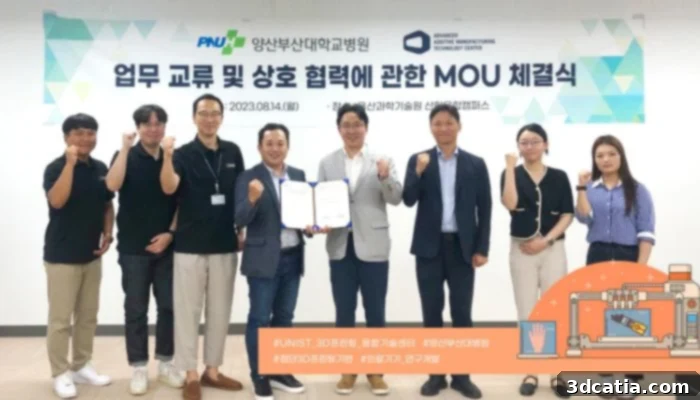
Signing of the memorandum of understanding took place between the divisions of UNIST and PNUH (Photo credits: UNIST 3D Printing Convergence Technology Center)
What are your thoughts on South Korea’s latest joint venture into advancing medical 3D printing technology? We encourage you to share your insights and opinions in a comment below or engage with us on our LinkedIn, Facebook, and Twitter pages! Don’t miss out on the latest advancements and breaking news in the additive manufacturing world; make sure to sign up for our free weekly Newsletter here, delivering the most current 3D printing news straight to your inbox! You can also find all our comprehensive videos and interviews on our YouTube channel, offering deeper dives into the industry’s most exciting innovations.
*Cover Photo Credits: UNIST 3D Printing Convergence Technology Center