

Manta Ray-Inspired Water Filters: Revolutionizing Sustainable Filtration Through Biomimicry and 3D Printing
The intricate designs found in nature have long served as a profound wellspring of inspiration for human innovation. From ancient architects emulating the strength of natural structures to Leonardo da Vinci’s visionary flying machines, which drew inspiration from the flight of bats, biomimicry—the practice of innovating based on biological designs—has consistently propelled technological advancements. In our contemporary era, engineers are harnessing this philosophy more than ever, frequently integrating models inspired by the natural world into sophisticated 3D printed designs. This fusion of nature’s wisdom with advanced manufacturing techniques is particularly evident in a groundbreaking new project from the Massachusetts Institute of Technology (MIT). Researchers at MIT have successfully 3D printed advanced water filters that are directly inspired by the highly efficient filtration systems of manta rays. By meticulously deriving and applying the unique design principles observed in these magnificent marine creatures, which transcend the limitations of conventional filtration systems, the MIT team has engineered a new generation of water filtration devices that promise enhanced performance and sustainability.
Manta rays are renowned filter-feeders, a classification that signifies their method of sustenance: they efficiently strain microscopic organisms and other particulate matter from vast quantities of seawater. This natural ability caught the attention of MIT engineers, who quickly identified a particular family of manta rays—the mobula ray—as possessing a unique and highly effective filtration method. This method, they theorized, held immense potential for adaptation in industrial water purification systems. Mobula rays navigate the plankton-rich regions of the ocean with their mouths wide open, continuously drawing in seawater. As they swim, plankton and other food particles are captured within their specialized gullets, while the filtered water flows seamlessly out through their gills. This seemingly simple process conceals an ingenious mechanism that allows for simultaneous feeding and breathing, a balance rarely achieved in engineered systems.
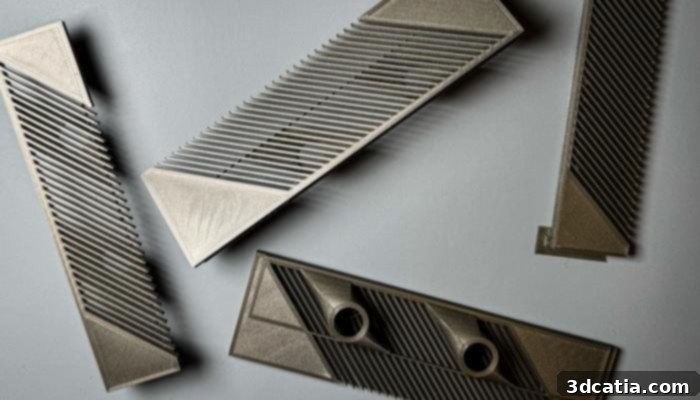
MIT’s 3D printed filtration devices inspired by mobula rays (Photo credits: Jennifer Chu, MIT)
Understanding the Mobula Ray’s Natural Filtration Excellence
A crucial question arises when observing the mobula ray’s feeding process: what prevents the captured plankton from simply escaping through the gills along with the outgoing water? The answer lies in the remarkably evolved anatomy of the mobula ray’s mouth. Each side of its mouth is lined with intricate, comb-like structures, scientifically referred to as filter plates. These plates are instrumental in directing the incoming water towards the ray’s gills. The MIT team’s research unveiled a critical insight: the precise dimensions and arrangement of these plates play a pivotal role. They hypothesize that due to their specific geometry, incoming plankton particles, even those smaller than the gaps between the plates, are effectively prevented from exiting through the gills. Instead, they bounce off these structures and are guided deeper into the ray’s feeding cavity. Simultaneously, the gills perform their vital function of absorbing oxygen from the outflowing water, enabling the ray to breathe continuously while feeding. Anette “Peko” Hosoi, a distinguished professor of mechanical engineering at MIT and one of the study’s authors, eloquently articulated this evolutionary marvel, stating, “We show that the mobula ray has evolved the geometry of these plates to be the perfect size to balance feeding and breathing.” This remarkable biological optimization offers a profound lesson for engineering effective and efficient industrial filtration systems.
The Industrial Filtration Dilemma: Permeability vs. Selectivity
In the realm of industrial filtration, engineers constantly grapple with a fundamental trade-off between two critical performance metrics: permeability and selectivity. Permeability refers to the ease with which a fluid can pass through a filter medium. A highly permeable filter allows for rapid fluid flow, which is often desirable for high-volume applications. Selectivity, on the other hand, measures how effectively a filter can retain particles of a specific size or type, ensuring that only the desired fluid passes through. These two qualities are inversely correlated in traditional filter designs, presenting a significant challenge. For instance, a filter membrane designed with larger pores will naturally allow a greater volume of water to pass through, making it highly permeable. However, this increased permeability comes at the cost of reduced selectivity, as smaller undesirable particles might also pass through. Conversely, a membrane with very small pores will be highly selective, capable of filtering out even the tiniest particles, but it will inevitably restrict fluid flow, resulting in lower permeability. Achieving an optimal balance between these two factors is a persistent hurdle in designing efficient and cost-effective industrial filters.
Considering this inherent dilemma, the advanced filtration system of the mobula ray offers a paradigm-shifting solution. Industrial cross-flow filters, which are commonly used in various sectors for separating solids from liquids, operate on principles that bear a striking resemblance to the mobula ray’s feeding mechanism. This functional similarity suggests that industrial filters could be significantly optimized by adopting the bio-inspired design principles observed in these marine creatures. Xinyu Mao PhD, the lead author of the MIT study and a postdoctoral associate, emphasized this potential, stating, “We want to expand the design space of traditional cross-flow filtration with new knowledge from the manta ray. People can choose a parameter regime of the mobula ray so they could potentially improve overall filter performance.” This indicates a clear pathway for engineers to leverage nature’s blueprint to overcome long-standing limitations in filtration technology.
What Makes the Mobula Ray’s Filter-Feeding System Exceptionally Effective? The Role of Vortices
The authors of the study aptly described the mobula ray’s simultaneous ability to breathe and feed as “an elegant balance,” and the secret to this extraordinary efficiency lies in a phenomenon known as vortices. To unravel this mechanism, the MIT team engineered a specialized device designed to mimic the ray’s oral filtration system. At one end of a channel through which water would flow, they precisely placed a 3D printed structure that accurately replicated the grooved, comb-like plates found on the floor of the mobula’s mouth.
The researchers then initiated a series of experiments, pumping water through this meticulously designed channel at varying flow rates. To visualize the fluid dynamics, colored dye was introduced into the water stream. Their observations revealed a fascinating pattern: when the water was pumped at a slow, deliberate rate, it flowed smoothly and unimpeded through the 3D printed filter structure, allowing particles to pass through with the water. However, a dramatic change occurred as they incrementally increased the pumping speed. At higher flow rates, the water no longer moved through effortlessly. Instead, it exhibited a swirling motion at the entrance of each groove within the filter structure, conspicuously creating miniature whirlpools, or vortices.
Anette Hosoi provided crucial insight into this discovery: “This vortex is not blocking water, but it is blocking particles.” She further elaborated, “Whereas in a slower flow, particles go through the filter with the water, at higher flow rates, particles try to get through the filter but are blocked by this vortex and are shot down the channel instead. The vortex is helpful because it prevents particles from flowing out.” This elucidates a key principle: the vortices act as dynamic, fluid barriers. They effectively redirect unwanted particles away from the filter’s exit points and deeper into the collection channel, all while allowing the primary fluid to pass through. These sophisticated fluid dynamics allow the filter to be permeable to water while maintaining high selectivity for particles, even those smaller than the physical gaps in the filter.
For the mobula rays themselves, these self-generated vortices are absolutely critical to their filter-feeding success. By precisely controlling their swimming speed, the rays can induce the formation of these beneficial vortices between their grooved plates. These fluidic barriers are incredibly efficient, effectively blocking plankton particles from escaping their mouths—a remarkable feat, especially considering that many of these plankton particles are significantly smaller than the physical spaces between the plates themselves. This natural mechanism offers an unprecedented level of control over particle separation, showcasing nature’s ability to solve complex engineering problems with elegant simplicity.
Implementing This Ingenious Design in Advanced Water Filters
The detailed understanding of the mobula ray’s filtration model now opens up transformative possibilities for improving industrial cross-flow filters. Armed with the invaluable experimental results and precise measurements of the mobula ray’s filtering features, the MIT team has developed a comprehensive design framework for future cross-flow filtration systems. Mao confidently stated, “We have provided practical guidance on how to actually filter as the mobula ray does.” This means that the research goes beyond theoretical understanding, offering actionable strategies for engineers and manufacturers.
While the specific 3D printing technology employed by the researchers for this project has not been explicitly disclosed, it is clear that they significantly benefited from the inherent advantages of additive manufacturing, particularly its on-demand and highly customizable aspects. 3D printing allows for the rapid creation of complex, intricate geometries that precisely replicate the biological structures found in the mobula ray, a feat that would be incredibly challenging, if not impossible, with traditional manufacturing methods. This capability is paramount for prototyping, testing, and ultimately producing these bio-inspired filters. With this foundational research, manufacturers globally can now recreate industrial filters using these innovative principles, leveraging advanced 3D printers to bring these designs to life. Hosoi further elaborated on the practical implications: “Our guidelines tell you: If you want your plant to pump at a certain rate, then your filter has to have a particular pore diameter and spacing to generate vortices that will filter out particles of this size. The mobula ray is giving us a really nice rule of thumb for rational design.” This guidance empowers engineers to custom-design filtration systems tailored to specific flow rates and particle sizes, leading to unprecedented levels of efficiency and performance.
The Broader Impact of Biomimicry in Sustainable Engineering
The implications of MIT’s mobula ray-inspired filtration technology extend far beyond just water purification. This research underscores the immense potential of biomimicry as a pathway to develop more sustainable and efficient engineering solutions across various industries. From industrial fluid processing and chemical separation to microplastic removal and even air filtration, the principles derived from the mobula ray’s vortex-generating system could be universally applied. Such advanced filters could lead to reduced energy consumption, longer operational lifespans for filter elements, and significantly lower maintenance costs, contributing to more environmentally friendly and economically viable industrial processes. The marriage of deep biological understanding with cutting-edge manufacturing techniques like 3D printing is truly paving the way for a future where engineered solutions are not only effective but also inherently harmonious with natural processes. This project serves as a compelling example of how looking to nature can provide elegant and powerful answers to some of humanity’s most pressing technological challenges. To delve deeper into the specifics of this remarkable innovation, you can read MIT’s official press release here.
What are your thoughts on MIT’s revolutionary mobula ray-inspired, 3D printed filtration plans? We invite you to share your insights and comments below, or join the conversation on our LinkedIn, Facebook, and Twitter pages! Don’t forget to subscribe to our free weekly Newsletter here to receive the very latest 3D printing news directly in your inbox. You can also explore all our engaging videos and content on our YouTube channel.