
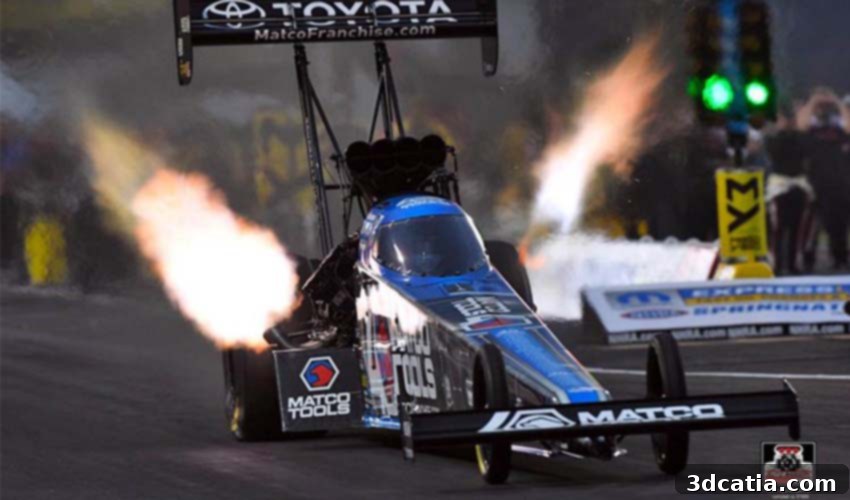
Revolutionizing Racing: Stratasys Powers Don Schumacher Racing with Advanced 3D Printing
The world of competitive motorsports is a relentless arena where every millisecond, every ounce, and every design iteration can mean the difference between victory and defeat. In this high-stakes environment, innovation is not just an advantage; it’s a necessity. Recognizing this imperative, Stratasys, a global leader in additive manufacturing solutions, has announced a significant collaboration with one of the sport’s most elite teams: Don Schumacher Racing (DSR). This partnership is set to empower DSR with cutting-edge Fused Deposition Modeling (FDM) 3D printing technology, marking a pivotal step towards accelerating design cycles, streamlining workflows, and enhancing the production of critical final parts. By integrating advanced additive manufacturing into their operations, Don Schumacher Racing joins a growing list of high-performance organizations leveraging 3D printing to gain a decisive competitive edge.
Don Schumacher Racing: A Legacy of Excellence and Innovation
Don Schumacher Racing stands as the largest and most successful organization in professional drag racing, boasting a storied history filled with countless championships and records. Their relentless pursuit of speed and precision necessitates constant technological evolution. To maintain their position at the pinnacle of the sport, DSR consistently seeks out advancements that can push the boundaries of vehicle design, aerodynamics, and component performance. The demands of complex, high-requirement racing mean that traditional manufacturing methods often struggle to keep pace with the rapid iteration cycles and custom part needs of an elite racing team. This is where the adoption of Stratasys’ FDM technology proves invaluable, offering a flexible, fast, and cost-effective solution to meet these rigorous demands.
Leveraging Advanced Stratasys FDM Printers for Peak Performance
Don Schumacher Motorsports, the dedicated production segment of Don Schumacher Racing, has seamlessly integrated Stratasys’ state-of-the-art 3D printers into its fabrication shop. Specifically, they are utilizing both the industrial-grade Stratasys Fortus 450mcTM and the versatile F370TM 3D printer. These machines are complemented by high-performance materials engineered to withstand the extreme conditions encountered in motorsports. The Fortus 450mc is renowned for its ability to produce robust, functional prototypes and end-use parts from engineering-grade thermoplastics, making it ideal for demanding applications where durability and precision are paramount. The F370, on the other hand, offers an exceptional balance of capability, accessibility, and material versatility, perfect for rapid prototyping and tooling. Together, these systems provide DSR with an unparalleled ability to conceptualize, test, and produce components with unprecedented speed and accuracy.
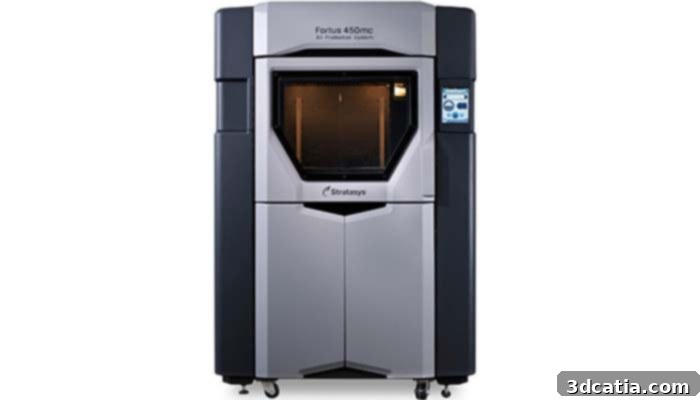
The Fortus 450mc 3D printer from Stratasys has been imagined for demanding applications and high-performance materials, perfectly suited for motorsports challenges | Source: Stratasys
Accelerating Innovation and Reducing Costs
The impact of Stratasys’ 3D printing technology on DSR’s operations is transformative. Scott Cutler, Senior Manufacturing Engineer at Don Schumacher Motorsports, highlighted the profound benefits: “With Stratasys 3D printing in place, anytime a crew chief has an idea for a project or concept part, we can design it, print it out, and test fit and function rapidly at a low cost – whether it’s a prototype or final part. Thanks to 3D printing, we’re able to be more innovative – which equals consistent performance on the track.” This statement encapsulates the core value proposition of additive manufacturing in racing. The ability to quickly translate an idea into a tangible part for immediate testing dramatically shortens design cycles. This rapid iteration capability not only accelerates problem-solving but also significantly reduces the costs associated with traditional prototyping methods, which often involve expensive tooling and longer lead times. DSR can now experiment with more designs, validate concepts faster, and fine-tune components without the prohibitive financial and time investments previously required.
The immediate availability of functional prototypes allows engineers and crew chiefs to physically assess designs for fit, form, and preliminary function. This hands-on validation process is critical in motorsports, where even minor discrepancies can impact performance or safety. By printing parts in-house, DSR gains unprecedented control over their manufacturing process, ensuring that every component meets their exacting standards. Furthermore, the low cost associated with producing these prototypes empowers the team to explore unconventional ideas and push creative boundaries, fostering a culture of continuous innovation. This agile approach directly translates to a competitive advantage, as optimized parts and validated concepts quickly make their way from the design studio to the racetrack, directly influencing race day performance.
What Parts Will Benefit from 3D Printing?
The versatility of FDM 3D printing means a wide array of components within DSR’s racing operations will benefit. These applications span across several critical areas:
- Chassis or Weldment Fixturing: Precision jigs and fixtures are essential for ensuring accurate welding and assembly of critical chassis components. 3D printing allows DSR to rapidly produce custom, lightweight, and highly precise fixtures tailored to specific design requirements, speeding up fabrication and improving consistency.
- Prototype Development: From aerodynamic components like scoops and ducts to internal engine covers and ergonomic driver controls, prototyping is crucial. 3D printing enables quick iteration of these parts, allowing engineers to test multiple designs for optimal performance, fit, and weight distribution without committing to expensive production methods.
- Final Design Proof-of-Concept: Before moving to final production, complex designs often require physical validation. 3D printed models can serve as robust proof-of-concept parts, verifying assembly clearances, stress points, and overall integration with other vehicle systems.
- Finished Ultralight Usable Components: Beyond prototyping, the Stratasys Fortus 450mc, using high-performance thermoplastics, can produce actual end-use parts. These could include custom brackets, mounting hardware, specialized air ducts, or even certain aerodynamic elements. The ability to optimize geometry for weight reduction and strength, combined with the quick turnaround, offers a significant advantage in a sport where every gram counts.
With Stratasys’ 3D printers already fully integrated into the team’s fabrication shop, all these applications are not just theoretical but actively enhancing DSR’s capabilities. Pat Carey, Senior Vice President at Stratasys, elaborated on this synergy: “Competitive motorsports demand technology that can not only handle the design complexity of these environments, but also rapidly create prototypes and parts to withstand the high-performance requirements of racing.” This perfectly describes the strategic alignment between Stratasys’ robust technology and DSR’s need for uncompromising performance and agility.
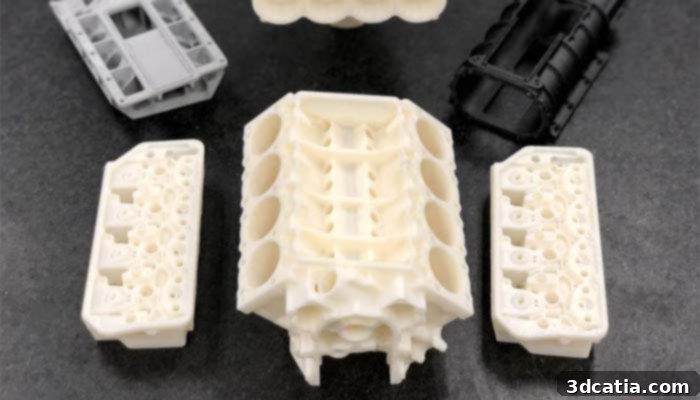
Don Schumacher Racing is leveraging both the Stratasys Fortus 450mc and F370 3D Printers to accelerate prototype development, proof-of-concept and finished ultralight usable components, enhancing their competitive edge | Source: Stratasys
Stratasys: A Proven Leader in Diverse High-Performance Industries
Stratasys’ involvement with Don Schumacher Racing is not an isolated case but rather a testament to its long-standing commitment to enabling innovation across a wide spectrum of industries. As a pioneering manufacturer of FDM and PolyJet 3D printers, Stratasys has a rich history of collaborating with leaders in aerospace, automotive, healthcare, consumer products, and education sectors. Their technologies are frequently chosen for applications requiring precision, durability, and the ability to produce complex geometries that would be impossible or cost-prohibitive with traditional manufacturing methods.
A prime example of Stratasys’ broader impact can be seen in their collaboration with Angel Trains, a leading UK rolling stock company. Back in January, Stratasys partnered with Angel Trains to integrate 3D printed parts into the railway sector. This initiative aimed at offering cheaper, faster, lighter, and more efficient components for train interiors and maintenance, particularly for obsolete parts where traditional supply chains were cumbersome or non-existent. This successful venture demonstrated how additive manufacturing can revolutionize logistics, reduce operational costs, and improve sustainability in critical infrastructure. The parallels between the challenges faced by Angel Trains (need for custom, durable, efficient parts, often with short lead times) and those of Don Schumacher Racing (need for custom, high-performance, rapidly iterated parts) underscore Stratasys’ versatility and the universal benefits of their technology. As Pat Carey further emphasizes regarding the DSR collaboration, “Don Schumacher Racing is a great example of the power of additive manufacturing at work – and we’re excited to work alongside the team and tackle the most extreme challenges across their production environment.” This partnership is yet another proof point of how Stratasys continues to push the boundaries of what’s possible with additive technology.
The Future of Motorsports with Additive Manufacturing
The collaboration between Stratasys and Don Schumacher Racing represents more than just a technological upgrade for one team; it’s a powerful indicator of the future trajectory of motorsports. As competition intensifies, the ability to rapidly innovate, test, and implement new designs will become increasingly crucial. Additive manufacturing offers a paradigm shift in how racing teams approach design and production, allowing for unprecedented customization, optimization for performance (lighter, stronger, more aerodynamic parts), and a dramatic reduction in the time from concept to track. The insights gained from DSR’s implementation of Stratasys technology will undoubtedly pave the way for broader adoption across other racing disciplines, further cementing 3D printing’s role as an indispensable tool for achieving peak performance.
This strategic alliance underscores Stratasys’ commitment to enabling its customers to overcome their most demanding challenges, whether it’s on the railway or the drag strip. The continuous advancement in 3D printing materials and printer capabilities promises even greater potential for motorsports teams to unlock new levels of performance, efficiency, and innovation in the years to come. The partnership with Don Schumacher Racing is a thrilling chapter in the ongoing story of how additive manufacturing is not just changing industries, but redefining them.
What do you think of this exciting collaboration and the impact of 3D printing on motorsports? Let us know what you think in a comment below or on our Facebook and Twitter pages! Don’t forget to sign up for our free weekly Newsletter, with all the latest news in 3D printing delivered straight to your inbox!