
Top 5 3D Printing Innovations: From Robotics to Sustainable Manufacturing and Beyond
The world of 3D printing, also known as additive manufacturing, continues to evolve at an astonishing pace, pushing the boundaries of what’s possible across a myriad of industries. From groundbreaking advancements in medical robotics to revolutionary steps towards sustainable manufacturing, and from enhancing the magic of movie sets to forging robust metal components, 3D printing is undeniably shaping our future. This week, we dive into five remarkable video demonstrations that highlight the incredible versatility and transformative power of this technology. Join us as we explore how 3D printing is not just fabricating objects, but creating new paradigms in design, production, and innovation. Get ready to witness the cutting edge of additive manufacturing, showcasing its profound impact on everything from entertainment to environmental sustainability and advanced engineering.
TOP 1: A 3D-Printed Robot Arm Mastering Nintendo and Offering Medical Potential
Imagine a robot arm that can not only play a classic video game but also holds profound implications for medical applications. Researchers at the University of Maryland have achieved just that, utilizing the power of advanced 3D printing to design a “soft” robotic arm. This innovative creation is capable of flawlessly navigating the first level of the iconic Super Mario Brothers video game in a mere 90 seconds. Unlike traditional rigid robots, this arm is crafted from flexible materials like plastic and silicone, making it inherently safer and more adaptable. Its movements are controlled by precise air pressure, a method that allows for nuanced, organic motion, setting it apart from electrically powered conventional robots. The true marvel lies in additive manufacturing’s ability to develop this complex robotic hand as a single, integrated component, minimizing assembly and maximizing efficiency. This approach to soft robotics opens doors to a future where machines can interact more gently and safely with their environment, particularly in sensitive fields.
Beyond its impressive gaming prowess, the potential applications of such a soft, 3D-printed robotic arm in medicine are vast and exciting. Consider the development of highly adaptable prosthetics that can conform more naturally to the human body, offering enhanced comfort and functionality for amputees. Surgical tools could become more flexible and precise, allowing surgeons to perform intricate procedures with greater dexterity and minimal invasion. Furthermore, in rehabilitation, soft robots could assist patients with physical therapy, providing gentle yet effective support for movement and recovery. The ability to customize each component through 3D printing means that medical devices can be tailored exactly to an individual’s unique anatomy, promising a new era of personalized healthcare solutions. This technological gem showcases not just engineering ingenuity, but a glimpse into how additive manufacturing can revolutionize human-machine interaction and improve quality of life.
TOP 2: Achieving 100% Re-Used Powder in 3D Printing with Bluesint PA12
Sustainability is a critical concern across all industries, and 3D printing is no exception. Traditionally, a significant challenge in Selective Laser Sintering (SLS) has been the considerable amount of unsintered powder that becomes waste after each print job. It’s estimated that in conventional SLS processes, up to 70% of the powder remains unused and cannot be fully repurposed for new parts without compromising mechanical properties. This not only represents a substantial material loss but also contributes to environmental burdens, with the production of just one kilo of traditional PA12 generating an alarming 7.78 kilos of CO2 emissions. Recognizing this pressing issue, Materialise, a leader in the additive manufacturing space, introduced a groundbreaking solution a few months ago: Bluesint PA12.
Bluesint PA12 is a revolutionary powder designed for the SLS process that boasts 100% recyclability. This means that every single gram of unsintered powder from a print job can be effectively re-used to build brand new, high-quality parts without degradation of material properties. Materialise achieved this feat by developing a sophisticated process that manages the thermal history of the powder, ensuring consistent performance even after multiple cycles of use. The implications of this innovation are monumental for the entire additive manufacturing ecosystem. By virtually eliminating powder waste, Bluesint PA12 significantly reduces material costs, enhances the economic viability of SLS for large-scale production, and most importantly, dramatically lowers the carbon footprint of 3D printed parts. This development marks a pivotal step towards a more circular economy in manufacturing, demonstrating how technological innovation can align with environmental responsibility. The video below delves deeper into the main advantages of this sustainable polymer, illustrating how it can transform current manufacturing practices and drive the industry towards a greener future.
TOP 3: Fonco Studios Streamlines Workflow with Stratasys J55 for Realistic Movie Props
The magic of cinema often relies on intricate details and stunning visual effects, and in recent years, the film industry has increasingly embraced 3D printing to achieve unparalleled realism and efficiency. From fantastical creatures and elaborate costumes to highly detailed backdrops and functional props, additive manufacturing offers filmmakers unprecedented creative freedom and speed. However, creating movie-quality props often requires not only complex geometries but also precise color replication, which traditionally involved laborious painting and finishing processes.
Enter the Stratasys J55 3D printer, a game-changer for studios like Fonco. This advanced multi-material, full-color 3D printer allows Fonco Studios to produce high-quality, Pantone-accurate color parts directly from digital designs. The ability to print in over 500,000 unique colors, textures, and gradients ensures that props and models perfectly match the vision of art directors and designers, eliminating guesswork and multiple iterations. This dramatically streamlines the workflow, significantly reducing the time and cost associated with traditional prop-making methods. Instead of sculpting, molding, painting, and repainting, artists can quickly prototype and produce final pieces with intricate details and photorealistic colors in a single print job. This efficiency not only accelerates production schedules but also allows for greater experimentation and refinement of designs, ultimately leading to more immersive and visually stunning cinematic experiences. The next video demonstrates how printing in full, accurate color with the Stratasys J55 provides transformative benefits for creative industries, pushing the boundaries of what’s achievable on screen.
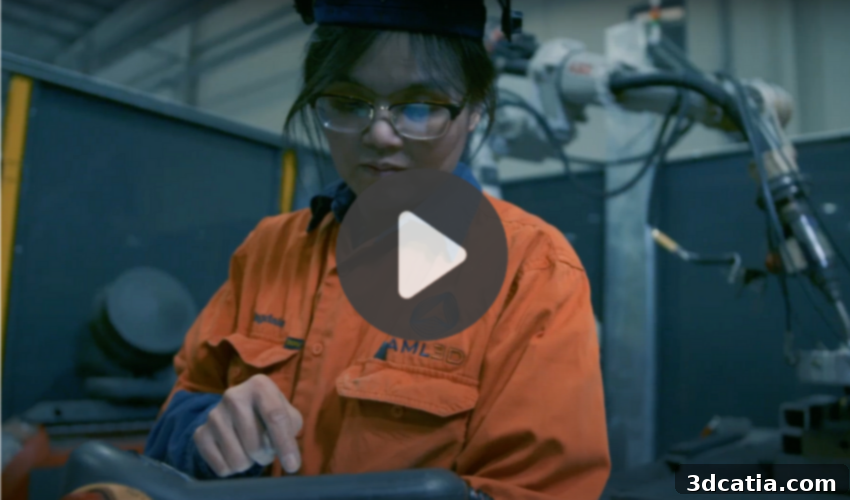
TOP 4: AML3D’s Wire Additive Manufacturing (WAM) for Robust Metal Components
While powder-based metal 3D printing has made significant strides, another innovative approach is gaining traction for its efficiency, sustainability, and robust material properties: Wire Additive Manufacturing (WAM). AML3D stands at the forefront of this technology, relying on its patented wire feedstock process instead of traditional metal powders. This method offers several distinct advantages, positioning WAM as a more environmentally friendly and cost-effective additive manufacturing solution for producing large-scale, high-strength metal components.
WAM’s core strength lies in its use of metal wire, which is melted and deposited layer by layer using an electric arc, similar to welding. This process, integrated into AML3D’s Arcemy printers, allows for significantly higher deposition rates compared to powder-bed systems, making it ideal for larger parts and faster production cycles. Furthermore, using wire feedstock greatly reduces material waste as there’s no loose powder to handle or dispose of, improving safety and cleanliness in the workshop. The material efficiency also contributes to a lower overall cost of production. A key benefit of AML3D’s WAM technology is its ability to manufacture across a broad range of metal alloys, including exotic materials often used in demanding industries like aerospace, defense, marine, and oil & gas. This versatility, combined with the structural integrity of the parts produced, makes WAM a compelling choice for critical applications.
Perhaps one of the most transformative aspects of AML3D’s approach is its capacity to bring manufacturing directly to the customer. By deploying Arcemy printers, companies can reduce their reliance on complex, often vulnerable, outsourced supply chains. This localized manufacturing capability enhances agility, reduces lead times, and offers greater control over production, especially for custom or on-demand parts. In essence, WAM represents a powerful evolution in metal additive manufacturing, offering a robust, sustainable, and economically viable pathway for producing high-performance metal parts where and when they are needed.
TOP 5: Markforged Celebrates its IPO on the NYSE with a 3D-Printed Bell
The ringing of the opening and closing bells at the New York Stock Exchange (NYSE) is a tradition steeped in history, dating back to the 1870s. It symbolizes the start and end of the trading day, a moment of global attention. For a company to be invited to ring the bell is a significant milestone, often marking a public listing or a major corporate event. In a compelling demonstration of the growing prominence and industrial acceptance of additive manufacturing, Markforged, a leading developer of industrial 3D printers, celebrated its IPO (Initial Public Offering) by participating in this time-honored tradition with a unique twist.
For this momentous occasion, Markforged didn’t just attend; they brought a piece of their innovation directly to the trading floor. The company created a reverse-engineered replica of the iconic NYSE ticker bell using its own cutting-edge 3D printing technology. This wasn’t merely a decorative piece; it was a fully functional bell, showcasing the capabilities of Markforged’s industrial printers in producing strong, precise, and complex parts from advanced materials like carbon fiber and metals. By ringing a bell that they themselves had manufactured with their proprietary systems, Markforged made a powerful statement about the reliability, strength, and real-world applicability of 3D printing as a core manufacturing process.
This event symbolized more than just a company going public; it highlighted the maturation of the 3D printing industry itself. It underscored the confidence of the financial markets in additive manufacturing as a key driver of future industrial growth and innovation. The 3D-printed NYSE bell was a tangible representation of how digital manufacturing can bridge tradition with groundbreaking technology, creating a powerful narrative of progress and potential. It served as a beacon, signaling to the world that 3D printing is no longer a niche technology but a robust, investable force reshaping global manufacturing.
What do you think of our selection of videos highlighting the diverse and impactful applications of 3D printing? From innovative soft robotics pushing the boundaries in medicine and gaming, to sustainable manufacturing solutions reducing environmental impact, and from streamlining creative workflows in the film industry to revolutionizing metal part production and demonstrating market confidence through a historic IPO, these examples underscore the immense potential of additive manufacturing.
We’d love to hear your thoughts on these groundbreaking advancements! Let us know in a comment below or join the conversation on our Facebook and Twitter pages. Don’t forget to sign up for our free weekly newsletter to stay informed with all the latest news, trends, and innovations in the fast-paced world of 3D printing, delivered straight to your inbox every week!