
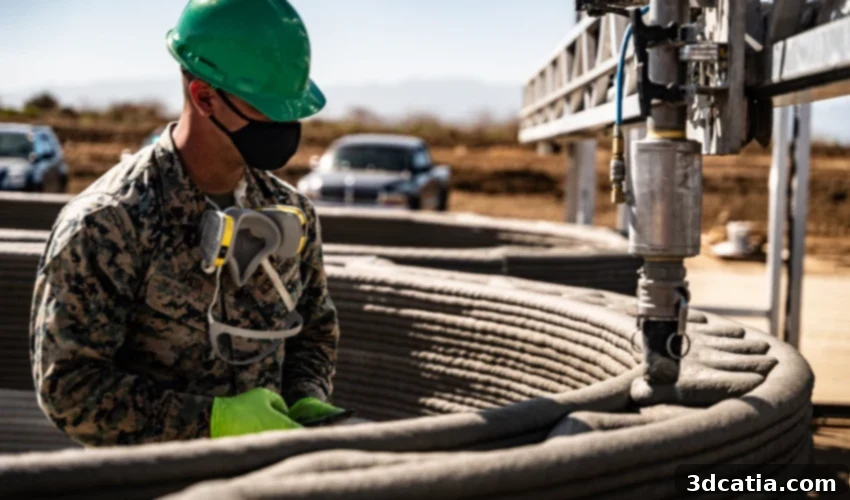
ICON Pioneers Rapid 3D Printed Construction for US Marine Corps: A New Era in Military Deployment
ICON, a trailblazer in construction technologies based in Austin, Texas, is fundamentally reshaping the building industry. Leveraging proprietary 3D printing robotics, advanced software, and innovative materials, the company is on a mission to make construction more efficient, sustainable, and notably, more cost-effective. ICON has consistently pushed boundaries, achieving significant milestones such as becoming the first company in America to secure a building permit for a 3D printed home and initiating the world’s first 3D printed community. Their latest triumph marks a pivotal moment: a successful collaboration with the US Marine Corps and the Defense Innovation Unit (DIU), showcasing the immense potential of additive manufacturing in defense applications.
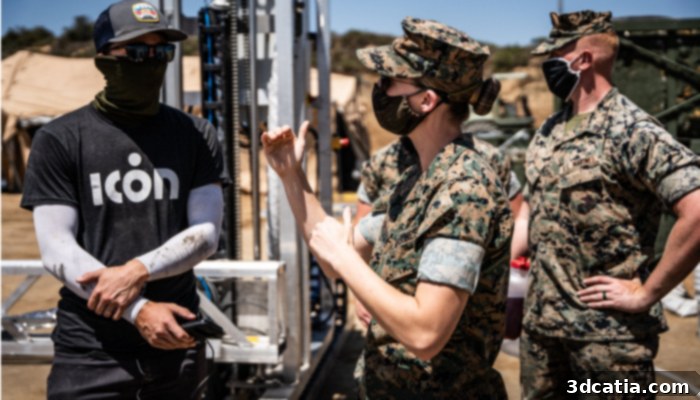
This strategic partnership with the Defense Innovation Unit aimed to seamlessly integrate 3D printing technologies into critical military operations. The overarching objective was to establish a rapid construction capability that could significantly bolster military crisis response efforts and enhance logistical flexibility in the field. For this groundbreaking project, ICON’s innovative 3D printing system was deployed to construct a robust vehicle hide structure for the US Marine Corps at Camp Pendleton, a crucial testbed for future military applications. To ensure operational readiness, an elite team of eight Marines underwent intensive training to proficiently operate ICON’s formidable Vulcan 3D printer. This training was meticulously designed to equip the troops with the skills necessary for a live field demonstration, where they would be tasked with rapidly erecting essential structures for potential army expeditions, highlighting the direct impact of advanced construction technology on defense readiness.
All image credits: ICON
One of the standout features of ICON’s technology is its intuitive, tablet-based system controls, meticulously engineered to allow even novice operators to achieve high-quality 3D printing results. This user-friendly interface proved invaluable during the Marine Corps training. After merely a few hours of hands-on field instruction, the Marines quickly mastered the intricate equipment from initiation to completion, with ICON’s experts primarily serving in a supervisory capacity. Initially, ICON and the USMC had set a pragmatic goal: to complete the 3D print within 40 to 48 hours, factoring in an anticipated loss of productivity for troubleshooting as the Marines gained proficiency. However, thanks to recent, significant automation upgrades that dramatically enhanced the precision of the material delivery system, the printing process was astonishingly completed in just 36 hours – with virtually zero troubleshooting required. This remarkable efficiency underscores the maturity and reliability of ICON’s additive manufacturing solution, proving its readiness for demanding military applications.
Michael Harper, Director of Field Operations for ICON, expressed his enthusiasm for the collaboration, stating, “We were thrilled to have the opportunity to hand over the controls of our technology to the USMC. This marked the first time non-ICON employees were the primary operators of our equipment and they did an incredible job printing the Vehicle Hide Structure.” His comments highlight a crucial aspect of this partnership: the successful transfer of advanced construction technology into the hands of military personnel, demonstrating the system’s operational simplicity and robustness even under challenging field conditions. This successful handover opens doors for broader adoption and integration of 3D printed structures within various military deployments, enhancing self-sufficiency and reducing logistical burdens.
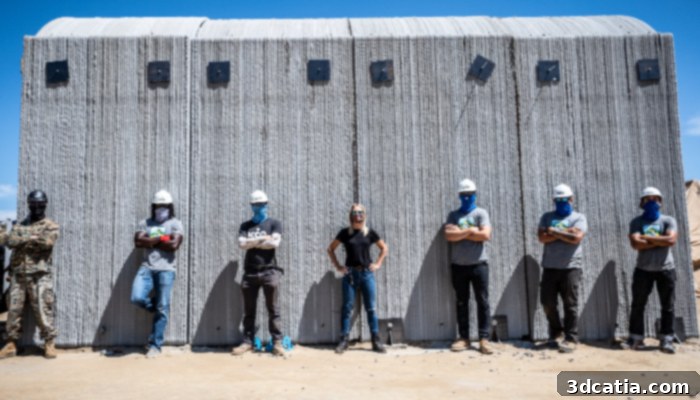
The 3D printed vehicle hide structure for the US Marine Corps. (All image credits: ICON)
For its diverse construction projects, ICON typically employs Lavacrete, a proprietary cement-based material celebrated for its durability and rapid setting properties. This military initiative was no exception. Utilizing Lavacrete as the primary printing material, the trained Marines meticulously constructed four individual arches. These arches were subsequently interconnected to form the final robust vehicle hide structure, measuring an impressive 26 feet in length, 13 feet in width, and 15 feet in height. The continuous nature of 3D printing – operating 24 hours a day to meet the project deadline – necessitated a well-coordinated effort. Out of the eight Marines trained on ICON’s Vulcan operations, a minimum of three had to be actively involved in rotations at all times to ensure the uninterrupted progress of the construction project. This demonstrated not only the efficiency of the technology but also the dedication and adaptability of the Marine Corps personnel.
Dmitri Julius, VP of Operations at ICON, conveyed immense pride in the achievement, particularly as a retired USMC Veteran. “The unique opportunity to provide cutting-edge tools to improve the mission capabilities of the Marine Corps and watch them take the reins with the technology this past month makes us proud,” he remarked. Julius’s personal connection to the Corps deepens the significance of this collaboration, underscoring a shared vision for innovation in defense. He further elaborated on ICON’s long-term aspirations: “As a retired USMC Veteran, I am honored to work with this storied organization. Our desire is to have a continued long term partnership to put 3D printers in the hands of Marines in garrison and down range. The humanitarian applications are also endless and the ability to build useful structures for our bravest service men and women is truly tremendous.” This vision extends beyond mere military installations, pointing towards a future where rapid 3D printed construction can support disaster relief, humanitarian aid, and critical infrastructure development in remote or challenging environments globally. The ability to quickly and efficiently produce essential structures offers transformative potential for both military logistics and global humanitarian efforts.
The successful deployment of ICON’s 3D printing technology by the US Marine Corps at Camp Pendleton marks a new chapter in defense innovation. This partnership not only demonstrates the tangible benefits of additive manufacturing for rapid military construction but also paves the way for future advancements in logistical resilience, operational flexibility, and humanitarian response. The ability to quickly erect complex, durable structures in austere environments transforms conventional construction timelines and resource requirements, offering significant strategic advantages. From establishing forward operating bases to providing emergency shelters, the implications of this technology are far-reaching, promising a future where construction is no longer a bottleneck but a rapid enabler for mission success.
What are your thoughts on the US Marines utilizing ICON’s revolutionary 3D printing technology for critical infrastructure? We invite you to share your perspective in the comments section below or join the conversation on our Facebook and Twitter pages! Don’t miss out on the latest advancements in the world of additive manufacturing; sign up for our free weekly Newsletter to receive all the breaking news in 3D printing straight to your inbox.