
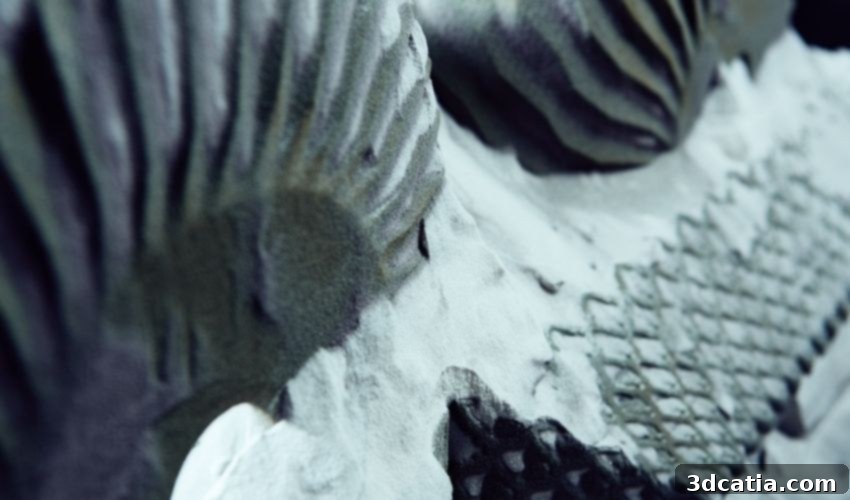
SANDHELDEN and ExOne: Pioneering Sustainable Luxury with Advanced Sand Binder Jetting 3D Printing
The landscape of manufacturing is continually evolving, with additive manufacturing (AM) at the forefront of innovation. Among the various AM technologies, binder jetting is rapidly gaining prominence, particularly for the production of end-use parts. This surge in popularity can be attributed to several compelling factors. Binder jetting is renowned for being one of the fastest additive manufacturing processes available today. When specifically applied to sand, the technology becomes even more efficient than its metal counterpart, largely due to significantly reduced post-processing requirements.
Beyond speed, sand binder jetting offers substantial environmental and economic advantages. Utilizing sand as a primary building material is not only more cost-effective than many traditional manufacturing options but also considerably more environmentally friendly. These crucial benefits, among others, have led SANDHELDEN, a global leader celebrated for its exquisite 3D printed design elements crafted from sand, to forge a powerful partnership. To realize its vision of innovative and sustainable products, SANDHELDEN has partnered with ExOne, the undisputed leader in sand binder jetting technology. This collaboration underscores a shared commitment to pushing the boundaries of design and sustainable production.
SANDHELDEN: Defining Sustainable Luxury in Bathroom Design
SANDHELDEN has carved a niche for itself in the market by focusing on sustainable luxury bathroom products. Their unique collection features striking sinks and bathtubs, all meticulously created using advanced sand 3D printing techniques. This innovative approach aligns perfectly with the growing demand for eco-conscious yet high-design consumer goods. The company’s journey with sand binder jetting began in 2016, establishing a long-term and fruitful collaboration with the experts at the ExOne Adoption Center. Located in Gersthofen, in the heart of Germany, this expansive 1,800 m² facility serves as a hub for advanced research, development, and industrial application of ExOne’s binder jetting solutions.
While ExOne’s sand 3D printing technology is widely recognized for its critical role in traditional industrial applications, such as producing complex metal casting molds and cores or specialized tooling, the partnership with SANDHELDEN represents an exciting new frontier. This collaboration has allowed both companies to explore and significantly advance the strengths of the technology beyond its conventional uses, demonstrating its immense versatility for consumer products and artistic design. It highlights how robust industrial technology can be adapted to create visually stunning and highly functional items for everyday living, all while maintaining a strong commitment to sustainability.
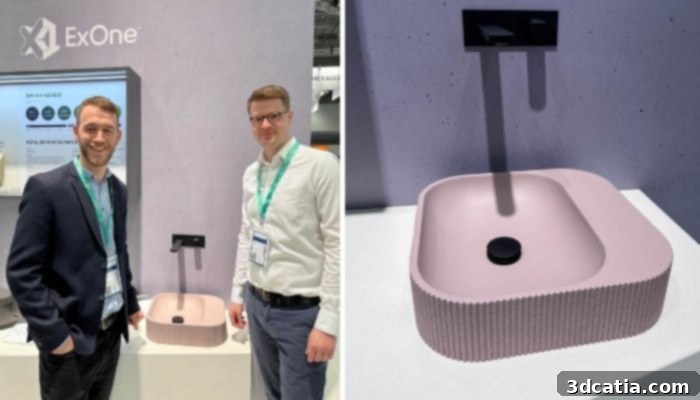
SANDHELDEN showcased their exquisite creations at ExOne’s booth at Formnext, highlighting their innovative partnership (photo credits: SANDHELDEN)
The Power of Precision: SANDHELDEN Leverages ExOne’s S-Max 3D Printer
A fundamental question arises: how are these robust, waterproof sinks and bathtubs meticulously crafted from sand? The journey, much like any advanced 3D printing process, commences with a sophisticated CAD (Computer-Aided Design) model. This digital 3D image serves as the blueprint, containing all the intricate details and precise dimensions required for the printed molds. Once finalized, this digital design is seamlessly transferred to one of the high-performance 3D printers housed at the ExOne Adoption Center.
The S-Max 3D printer from ExOne is the preferred choice for SANDHELDEN, offering a suite of unparalleled benefits that are critical for their specialized production needs. These advantages include highly efficient and flexible batch production capabilities, ensuring that diverse product lines can be manufactured simultaneously without compromising quality or design integrity. The S-Max boasts exceptional productivity, allowing for rapid iteration and high-volume output, which are crucial for meeting market demand. Furthermore, its customizable platform provides the adaptability necessary for SANDHELDEN to experiment with unique designs and varying scales, truly unleashing their creative potential. All these features are indispensable in the meticulous creation of SANDHELDEN’s distinctive sand products.
In addition to its core capabilities, the S-Max 3D printer is engineered for maximum operational efficiency. It comes equipped with both a double job box and a Jobmatic system, which collectively streamline the entire production workflow, significantly reducing manual intervention and enabling automated post-processing. The binder jet 3D printing process itself is a marvel of precision. It begins within the job box, where a recoater mechanism carefully applies a thin, perfectly even layer of sand across the build plate. Following this, the printhead, akin to a high-precision inkjet, strategically distributes the furan binder—in this specific application—with pinpoint accuracy. This binder is applied only to the precise points that will ultimately form the solid structure of the printed part, effectively surrounding each individual sand grain within the layer. Once the binder is applied, the build plate is incrementally lowered, and the process repeats: another layer of sand is spread, followed by another precise application of binder. This meticulous, layer-by-layer construction continues until the entire mold has been fully created. Upon completion, the Jobmatic system ensures that the job box is automatically moved out of the printer, ready for the next stages of processing, thereby enhancing throughput and operator safety.
The generous build volume of the S-Max system is a game-changer for SANDHELDEN, facilitating the simultaneous production of a diverse range of products. This includes multiple items from the same series or even entirely different designs all at once, optimizing machine uptime and production efficiency. For instance, the S-Max can impressively print up to 48 molds of SANDHELDEN’s popular Basin “S-01” from the SIMBIOSIS Collection in a single printing procedure. This capability dramatically accelerates manufacturing cycles and allows for unmatched flexibility in production planning. Following the 3D printing phase, the raw sand designs undergo a crucial post-processing stage. They are expertly infiltrated with specialized resins, which penetrate the porous sand structure, imparting significantly enhanced strength and rigidity. Subsequently, the parts receive further coating treatments, meticulously applied to create truly unique shapes that are not only aesthetically pleasing but also fully waterproof and exceptionally durable. This comprehensive treatment ensures they can withstand the rigorous daily demands of modern bathroom environments, embodying both luxury and longevity.
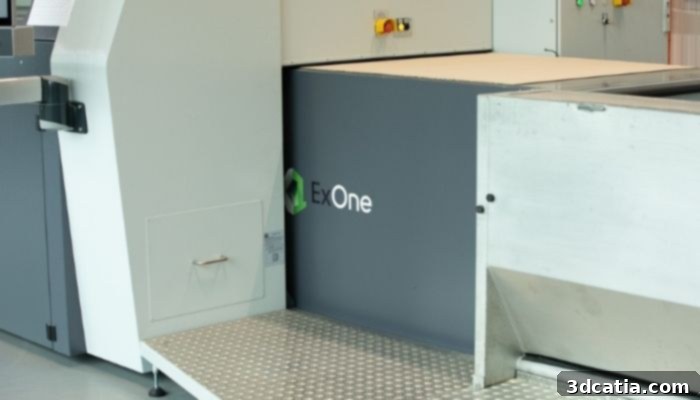
ExOne’s S-Max 3D printer is instrumental in creating SANDHELDEN’s innovative projects, enabling complex and sustainable designs (photo credits: ExOne)
The Unrivaled Advantages of Sand Binder Jetting for SANDHELDEN
Sand binder jetting stands out as the quintessential production method for SANDHELDEN’s exquisite pieces, offering a multitude of benefits that are simply unattainable through conventional manufacturing processes. Firstly, SANDHELDEN fully harnesses the unparalleled flexibility of this technology across several key dimensions: materiality, size, and geometric freedom. The ability to utilize different types of sand or aggregates, combined with specialized binders, allows for diverse material properties and aesthetic finishes. The large build platform of the S-Max system accommodates substantial product dimensions, enabling the creation of full-sized sinks and bathtubs.
Crucially, SANDHELDEN specifically emphasizes that ExOne’s binder jetting technology empowers them to craft geometrically complex and intricate shapes that would be utterly impossible or prohibitively expensive to produce using traditional molding, casting, or machining methods. This design freedom opens up new avenues for artistic expression and functional integration, allowing SANDHELDEN to offer truly unique and innovative products that differentiate them in the luxury market.
Secondly, and perhaps most importantly for SANDHELDEN’s brand ethos, binder jetting enables a significantly more sustainable operational footprint. This is a pivotal advantage for an environmentally-conscious company dedicated to reducing its ecological impact. The sustainability benefits extend far beyond simply reducing waste by only building the material that is needed, a hallmark of additive manufacturing. A major contributing factor to their eco-friendliness is the ability to use silica sand as the fundamental base material for the binder jetting process. This abundant natural resource is exclusively sourced from regional suppliers within Germany, minimizing transportation emissions and supporting local economies.
Furthermore, the unbound sand, which constitutes the majority of the sand in the job box, is not wasted. It can be meticulously collected, sieved, and subsequently reused for future builds if it was not bonded into a design during the initial production process. This remarkable reusability feature drastically reduces material consumption and waste generation, making sand binder jetting an incredibly resource-efficient and circular manufacturing method. This holistic approach to sustainability, from material sourcing to waste reduction and energy efficiency, reinforces SANDHELDEN’s commitment to responsible production.
A Vision for the Future: ExOne’s Perspective on Innovation
The success of this partnership resonates deeply within ExOne, as articulated by Eric Bader, Managing Director. “We’re familiar with traditional foundry applications for our sand 3D printers, which have been a cornerstone of industrial manufacturing for decades. However, we are incredibly excited to see the new opportunities companies are discovering with this technology beyond its conventional uses,” commented Bader. This statement underscores the evolving nature of additive manufacturing and its burgeoning potential across diverse sectors.
He continued, “We’ve partnered closely with SANDHELDEN from the very beginning, collaborating to enable this truly innovative application of binder jetting for high-end consumer products. We are immensely proud to witness their business prospering, built upon the strong foundational values of offering unique product designs, uncompromising quality, and steadfast sustainability.” This quote encapsulates the essence of the collaboration: a shared vision for innovation, a commitment to quality craftsmanship, and a deep-seated belief in environmentally responsible manufacturing. The partnership with SANDHELDEN not only demonstrates the versatility and adaptability of ExOne’s sand binder jetting solutions but also highlights how additive manufacturing can be a powerful catalyst for sustainable design in consumer goods. It represents a significant step forward in integrating advanced manufacturing techniques with artisanal quality and ecological responsibility, setting a new benchmark for the industry. You can delve deeper into ExOne’s comprehensive sand binder jetting solutions by visiting their website HERE.
What are your thoughts on SANDHELDEN’s groundbreaking use of ExOne’s binder jetting machines to create their innovative, sustainable sinks and bathtubs? We invite you to share your insights in a comment below or join the conversation on our Linkedin, Facebook, and Twitter pages! Don’t miss out on the latest 3D printing news and innovations – remember to sign up for our free weekly Newsletter here, delivering cutting-edge information straight to your inbox! For an engaging visual experience, you can also explore all our videos on our dedicated YouTube channel.
*Cover Photo Credits: SANDHELDEN