
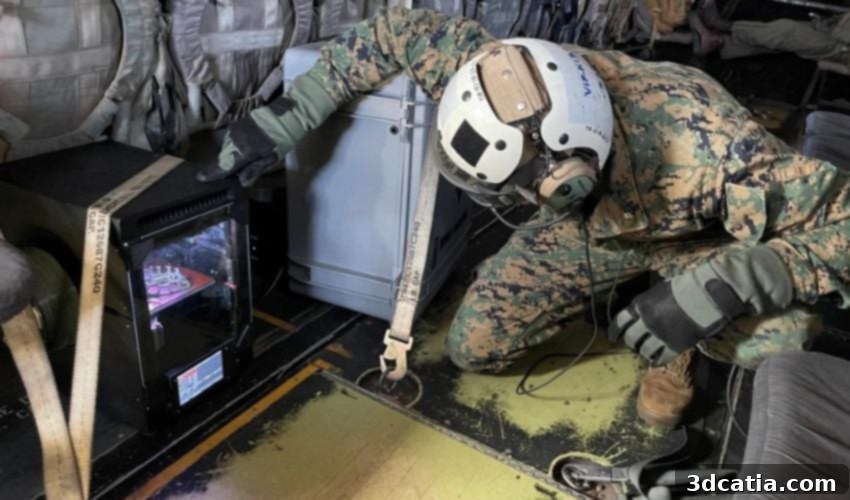
In-Flight 3D Printing Takes Off: U.S. Marines Revolutionize On-Demand Manufacturing for Enhanced Mission Readiness
The integration of cutting-edge 3D printing technology into the U.S. military’s operational framework is no longer a secret; it’s a rapidly accelerating reality. Across various branches, additive manufacturing is being adopted for a diverse range of critical applications within the defense sector. In recent years, we’ve witnessed significant advancements, from the utilization of additive manufacturing in submarine manufacturing to the implementation of dental 3D printing aboard Navy ships, and its growing presence within the Marines for various maintenance and repair tasks. This transformative trend reached an unprecedented milestone with the recent announcement from the Consortium for Additive Manufacturing Research and Education (CAMRE) at the Naval Postgraduate School (NPS). In a groundbreaking press release, CAMRE, in collaboration with the Marine Innovation Unit (MIU) and Marine Aircraft Group (MAG) 39, successfully conducted the first demonstration of in-flight 3D printing aboard a U.S. Marine Corps MV-22 Osprey tiltrotor aircraft. This achievement marks a pivotal moment for military logistics and operational readiness, signaling a new era for on-demand manufacturing in dynamic environments.
The Naval Postgraduate School (NPS), a public graduate school based in California and operated by the United States Navy, stands at the forefront of defense-focused education and innovative research. Its mission to provide advanced graduate education to its students often involves pushing the boundaries of technology to address critical military challenges. In the realm of additive manufacturing, NPS has long been recognized as a trailblazer, consistently exploring and expanding the limits of what’s possible. Indeed, it was NPS that initially spearheaded research into the capabilities of additive manufacturing for both the Navy and Marine Corps, notably by integrating systems like the ElemX from Xerox to identify and define future military applications. Given this history of pioneering innovation, it comes as no surprise that this latest, remarkable advancement in in-flight 3D printing originates from their dedicated efforts. Chris Curran, program manager at CAMRE, articulated the strategic importance of their work, stating, “We are in a unique position to rapidly support the joint force and accelerate the adoption of advanced manufacturing. This is just one of many events we are committing resources to where we share our research and deliver equipment and know-how to service members.” This successful in-flight 3D printing demonstration is a powerful testament to their belief that additive manufacturing holds the key to fundamentally revolutionizing the capabilities and operational efficiency of the American armed forces, moving towards a future where critical parts can be produced precisely when and where they are needed.
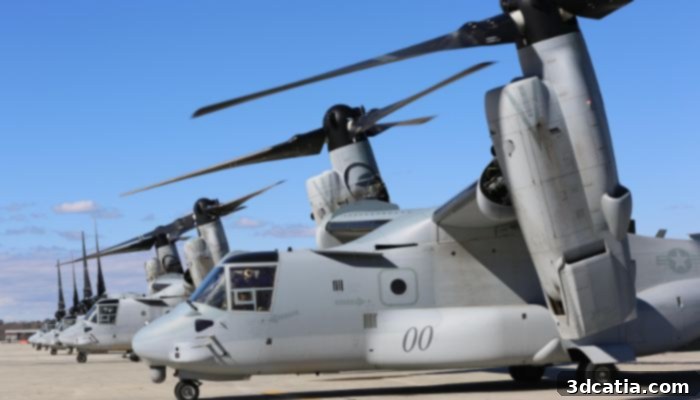
The part was printed aboard a U.S. Marine Corps MV-22 Osprey tiltrotor aircraft like those pictured above (photo credits: Lance Cpl. Mackenzie Gibson)
Why In-Flight 3D Printing is a Game Changer for the Marines
The allure of 3D printing for military applications stems from the same core advantages that make additive manufacturing revolutionary across numerous civilian sectors: unparalleled flexibility, speed, and the ability to produce complex, customized parts on demand. For military operations, these benefits translate directly into drastically increased mission readiness, particularly for scenarios demanding rapid responses and immediate solutions. The technology is especially valued for its potential in creating swarm robotics, custom tools, and, crucially, medical devices directly in the field. This capability to decentralize manufacturing and move it closer to the point of need is profoundly impactful, reducing reliance on lengthy supply chains and traditional logistics. Imagine a scenario where a critical component for a piece of equipment breaks in a remote location, or a soldier sustains an injury requiring an immediate, custom medical device. In-flight 3D printing allows these needs to be met almost instantaneously, minimizing downtime and potentially saving lives.
The specific item chosen for this historic in-flight demonstration perfectly illustrates this potential: a medical cast. This cast was not just any off-the-shelf item; it was custom-designed for a Marine’s arm, initiated by a precise 3D scan. This scan data was then seamlessly converted into a printable design with the assistance of generative design software, showcasing the full digital workflow inherent in modern additive manufacturing. The printing process itself was rigorously tested, with the cast being produced on the Osprey while the aircraft engaged in various operational modes, including taxiing, takeoff, and complex in-flight maneuvers. This successful trial under dynamic conditions validates the robustness and reliability of the technology, proving that additive manufacturing can function effectively in challenging, mobile environments. The ability to create such personalized medical devices on the spot offers immense advantages, from faster recovery times for injured personnel to enhanced morale and operational continuity for units deployed in isolated or austere conditions. This flexibility extends beyond medical applications, promising to accelerate maintenance, repair, and even the creation of bespoke tactical equipment, profoundly altering how the military addresses urgent logistical and operational challenges.
The 3D printer central to this groundbreaking demonstration is equally noteworthy. Named the Advanced Manufacturing Operational System (AMOS), this specialized unit was developed by Spencer Koroloy, an engineer at the Naval Information Warfare Center (NIWC) Pacific in San Diego. The press release highlights AMOS’s exceptional attributes: speed, reliability, and expeditionary ruggedness. These qualities are absolutely paramount for any equipment destined for military missions, where operational environments can be harsh, unpredictable, and demand unwavering performance. The ability of AMOS to withstand the vibrations and variable conditions of an MV-22 Osprey tiltrotor aircraft, while still producing precise parts, underscores its advanced engineering. While the exact 3D printing technology employed by AMOS has not been publicly disclosed, its focus on critical applications such as medical devices suggests a range of possibilities. Given the existing landscape of additive manufacturing in the defense sector, it could certainly leverage common industrial technologies like material extrusion (FDM), selective laser sintering (SLS), or vat photopolymerization (SLA/DLP). Each of these technologies offers distinct advantages in terms of material versatility, part strength, and resolution, making them suitable for different military needs. The key takeaway, however, is the successful integration of a robust, military-grade 3D printer into a dynamic airborne platform, setting a new precedent for mobile additive manufacturing.
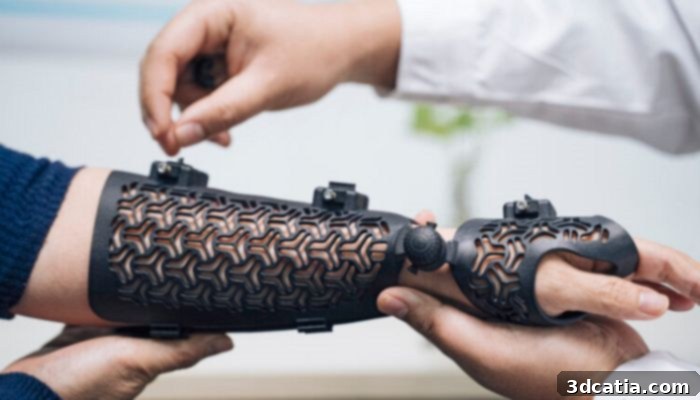
Medical devices, notably orthotics like casts are a growing 3D printed application such as this one from HP (photo credits: HP)
This pioneering achievement is just the beginning of a transformative journey. Lt. Col. Michael Radigan, a liaison to NPS from the MIU, succinctly captured the immense future potential, concluding, “We are just scratching the surface on the capabilities that will come from being able to 3D print in flight. Dozens of printers being installed in a modular fashion aboard aircraft brings the ability for mobile production at a scale we have not experienced before.” This vision extends far beyond individual medical casts, hinting at a future where entire fleets of military aircraft are equipped with modular 3D printing capabilities. Such a paradigm shift promises to revolutionize military logistics, reducing the vast and costly supply chains currently required to support global operations. Imagine expeditionary forces capable of printing spare parts for vehicles, drones, or communication equipment on demand, directly at forward operating bases or even mid-mission. This not only enhances self-sufficiency and operational agility but also significantly reduces the logistical footprint and associated risks. The ability to rapidly innovate and deploy custom solutions, from specialized tools to humanitarian aid supplies, directly from an airborne platform opens up unprecedented possibilities for quick response, disaster relief, and sustained combat operations. This marks a profound move towards truly decentralized, agile, and resilient manufacturing in the defense sector, ensuring that the U.S. military remains at the cutting edge of technological advantage.
The successful demonstration of in-flight 3D printing by the U.S. Marines represents a monumental leap forward in military additive manufacturing. This capability to produce critical components and personalized medical devices while airborne offers unparalleled advantages in terms of speed, flexibility, and mission readiness. It underscores the profound value of additive manufacturing in enhancing operational resilience, streamlining logistics, and empowering service members with on-demand solutions in the most challenging environments. As this technology continues to evolve, we can anticipate a future where mobile 3D printing platforms become an integral part of defense strategies, fundamentally altering how military forces operate and sustain themselves globally.
What are your thoughts on the Marines’ first successful demonstration of in-flight 3D printing? Do you envision the significant value of these technologies for military applications and beyond? We invite you to share your perspectives in a comment below or engage with us on our LinkedIn, Facebook, and Twitter pages! Don’t forget to sign up for our free weekly Newsletter here to receive the latest 3D printing news straight to your inbox! You can also explore all our insightful videos on our YouTube channel.