
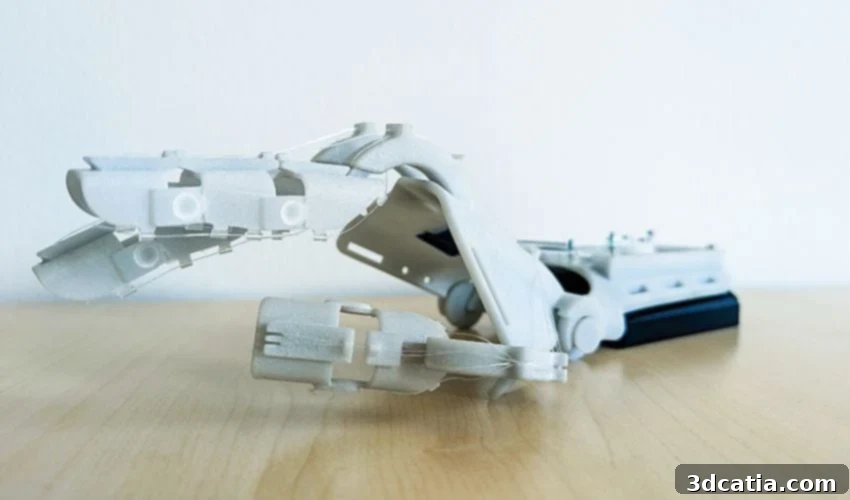
Revolutionizing Hand Rehabilitation: Fraunhofer IWU’s Custom 3D-Printed Exoskeletons
Following accidents that result in tendon damage, a patient’s mobility is often severely impaired, significantly impacting their quality of life. Hand injuries, in particular, can be challenging and prolonged, frequently requiring extensive physiotherapy for full recovery. To enhance the effectiveness of therapeutic interventions, medical experts are increasingly integrating advanced tools like exoskeletons. These innovative devices are worn over the hand, providing targeted support for hand and finger movements, thereby accelerating the rehabilitation process. A groundbreaking development in this field comes from Fraunhofer IWU, which has engineered a sophisticated exoskeleton that leverages cutting-edge 3D printing technologies to offer unparalleled customization for each individual patient.
The Fraunhofer IWU team’s creation stands out due to its innovative integration of several advanced technologies: shape-memory alloys, precision stepper motors, and state-of-the-art 3D printing. A paramount focus during the development phase was ensuring that the exoskeleton achieves a perfect, ergonomic fit for the patient’s hand. This objective, though seemingly simple, presents a significant challenge because every human hand possesses a unique anatomical structure and size. An exoskeleton that is uncomfortable or ill-fitting can not only discourage patient compliance but can also actively hinder the rehabilitation process, potentially causing discomfort or even further injury. This is precisely where the transformative capabilities of additive manufacturing become indispensable. By utilizing 3D printing technologies for production, the exoskeleton’s structure can be customized to an almost limitless degree, guaranteeing an optimal and comfortable fit tailored to individual needs.
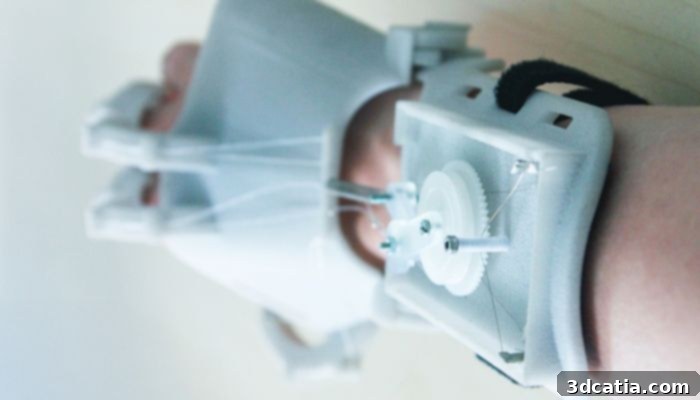
A stepper motor and wires assist the hand’s movements.
The Technology Powering the Custom 3D-Printed Exoskeleton
To achieve this remarkable level of personalization and precision, the Fraunhofer IWU team specifically opted for Selective Laser Sintering (SLS) technology. SLS is an additive manufacturing process where a component is meticulously built layer by layer from powdered material, in this particular application, plastic powder. The choice of SLS is critical for its ability to produce complex geometries with high accuracy and mechanical strength, essential for a functional medical device. The customization process begins with a precise digital scan of the patient’s hand, capturing every unique contour and dimension. This detailed 3D scan then serves as the foundation for design. A parametric CAD (Computer-Aided Design) model of the exoskeleton is subsequently overlaid onto this digital hand scan. This sophisticated approach allows therapists and engineers to precisely adapt every single parameter of the exoskeleton’s design – from finger length and joint alignment to overall device curvature – to match the exact individual dimensions extracted from the 3D scan. This ensures an ergonomic and effective fit that maximizes patient comfort and therapeutic benefit.
The flexibility offered by this 3D printing workflow extends beyond initial fitting. It empowers therapists to make crucial adjustments to the exoskeleton during the ongoing course of rehabilitation. For instance, if the patient is a child who is still growing, the device can be easily modified or reprinted to accommodate changes in hand size, ensuring continuous optimal support. This adaptability is a significant advantage over traditional, rigid manufacturing methods. Furthermore, a remarkable benefit of producing these exoskeletons with 3D printing is their impressively lightweight construction. This reduced weight enhances patient comfort, minimizing fatigue and allowing for longer, more effective therapy sessions, thereby contributing significantly to a smoother and faster recovery journey.
Artificial Tendons and Dynamic Control for Enhanced Recovery
Beyond achieving a perfect anatomical fit, the development of this advanced exoskeleton also meticulously accounts for each patient’s unique hand strength and functional capabilities. Recognizing that individuals possess varying levels of grip strength and dexterity, the force and specific range of motion provided by the exoskeleton are engineered to be individually adjustable. This personalized approach is critical for effective rehabilitation, ensuring that the assistance provided is neither too strong nor too weak for the patient’s current stage of recovery. The researchers have achieved this dynamic control through the innovative use of a bidirectional stepper motor coupled with wires fabricated from specialized shape-memory alloys. These sophisticated wires function much like artificial “tendons,” precisely mimicking the natural actions of biological tendons within the hand. They are meticulously controlled by the stepper motor, allowing for fine-tuned movements and resistance. This level of precision means that therapeutic exercises can be performed with optimal assistance. If required, these movements can also be manually fine-tuned by a therapist or the patient themselves, allowing for on-the-fly adjustments to maximize therapeutic benefit and patient comfort during exercise routines.
In a practical clinical setting, the Fraunhofer IWU team anticipates that this custom 3D-printed exoskeleton will primarily be deployed for patients recovering from severe accidents resulting in tendon injuries. However, its utility extends far beyond this initial focus. The device holds immense potential to significantly support recovery for individuals affected by strokes or various forms of paralysis, where regaining fine motor control and hand strength is paramount. Another crucial advantage of this exoskeleton is its remarkable effectiveness and applicability in often hectic clinical environments. Therapists frequently face time constraints, making it challenging to perform every single necessary therapy exercise with each patient during a session. This is where the exoskeleton offers invaluable assistance: exercises can be carried out with the automatic, consistent support of the motor, even without the constant, direct presence of a therapist. This automation frees up therapists to focus on more complex assessments and interventions, while patients benefit from consistent, high-quality exercise repetition, which is vital for neurological and muscular retraining. This integration of technology not only optimizes therapist time but also ensures that patients receive the most consistent and beneficial therapeutic input possible. For those interested in delving deeper into this innovative project, more comprehensive information can be found HERE.
The Fraunhofer IWU’s development represents a significant leap forward in personalized medical devices, specifically for hand rehabilitation. By harnessing the power of 3D printing, advanced materials, and intelligent mechanical systems, they have created an exoskeleton that is not only custom-fit and comfortable but also highly effective in supporting and accelerating patient recovery across a range of debilitating conditions. This innovation promises to improve patient outcomes, enhance the efficiency of therapeutic practices, and ultimately contribute to a better quality of life for individuals striving to regain their independence after hand injuries or neurological impairments.
What are your thoughts on this revolutionary customizable exoskeleton and its potential impact on hand rehabilitation? We invite you to share your insights in a comment below or connect with us on our LinkedIn or Facebook pages! Don’t forget to sign up for our free weekly Newsletter to receive the latest 3D printing news directly in your inbox. You can also find all our videos on our YouTube channel. Interested in more medical and dental 3D printing news? Visit our dedicated page HERE.
All photo credits: Fraunhofer IWU