
Understanding the Health Risks of Home 3D Printing: A Deep Dive into Emissions and Safety
Since the advent of the RepRap movement in the early 2000s, 3D printing technology has transcended its niche origins to achieve widespread commercial success globally. While a significant portion of the market remains dedicated to industrial additive manufacturing solutions, the proliferation of more affordable desktop 3D printers has captivated a rapidly expanding segment of hobbyists, educators, and small businesses. This growth has been particularly pronounced since the onset of the COVID-19 pandemic, as people sought new creative outlets and tools for home-based projects.
The global desktop 3D printing market size was valued at an estimated $3.96 billion in 2022, according to Grand View Research, and is projected to continue its rapid upward trajectory in the coming years. This expansion is especially notable in regions like China, where numerous manufacturers offer low-cost 3D printers specifically designed for home users, making the technology more accessible than ever before. However, with this growing accessibility comes an increasingly pertinent question: Is operating a 3D printer at home truly safe for users’ health? Recent research from Dublin City University (DCU) suggests that the answer may not be a straightforward yes, raising crucial awareness about potential indoor air quality concerns.
Unpacking the Dublin City University Study: Emissions from Desktop 3D Printers
The findings that shed light on these health considerations stem from a recent comprehensive study titled “Characterization of Volatile and Particulate Emissions from Desktop 3D Printers.” This seminal work, published by Melissa Finnegan, Collen Lee Thach, Shirin Khaki, Emma Markey, David J. O’Connor, Alan F. Smeaton, and Aoife Morrin, delves into a critical aspect of modern indoor environments: air pollution. The researchers’ interest was piqued by the fact that individuals spend the vast majority of their lives within indoor spaces, making the emissions released by common consumer devices, such as 3D printers, a significant factor in overall indoor air quality.
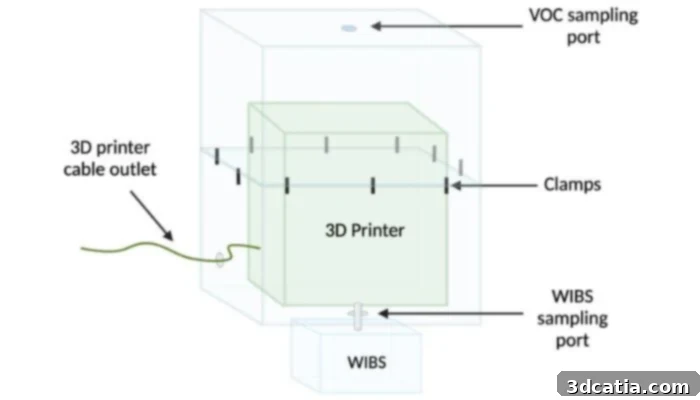
A schematic of the 3D printer with the VOC sampling and the sampling ports, which together was used to collect the particle samples (image credits: Finnegan M, Thach CL, Khaki S, Markey E, O’Connor DJ, Smeaton AF, Morrin A 2023)
Exploring the Impact of 3D Printing on User Health Through Emission Analysis
To investigate the potential health implications of home 3D printing, the research team focused on two primary types of emissions: volatile organic compounds (VOCs) and particulates. These substances have become increasingly recognized as indoor air pollutants of concern, with rising questions about their safety and potential long-term health effects. Specifically, the study concentrated on Fused Deposition Modeling (FDM) 3D printers, which are the most common type used in domestic settings, and examined the emissions generated when printing with popular filaments like PLA (Polylactic Acid) and ABS (Acrylonitrile Butadiene Styrene).
The scientific methodology employed was robust. Gas chromatography-mass spectrometry (GC-MS) was utilized to meticulously profile the VOC emissions, allowing for the identification and quantification of various chemical compounds released during the printing process. To characterize particulate emissions, including their size, shape, and quantity, a particle analyzer (WIBS – Wideband Integrated Bioaerosol Sensor) was directly attached to the 3D printer. This comprehensive approach enabled the researchers to gather detailed data on the invisible byproducts of desktop 3D printing.
The study’s abstract clearly summarized the critical findings, confirming that “3D printing processes release a wide range of VOCs, including straight and branched alkanes, benzenes, and aldehydes.” These compounds are known to have various health impacts, ranging from eye and respiratory tract irritation to more serious long-term effects depending on exposure levels and duration. Furthermore, the research highlighted a crucial nuance: “Emission profiles depend on filament type but also, importantly, the brand of filament.” This suggests that even within the same filament material (e.g., PLA), different manufacturers’ formulations can lead to varying emission characteristics.
Beyond VOCs, the study also thoroughly characterized particulate emissions. For PLA-based printing, the researchers found that “the size, shape, and fluorescent characteristics of particle emissions… were found to vary depending on the filament employed.” Ultrafine particles, in particular, are a significant concern because their minuscule size allows them to penetrate deep into the human respiratory system, potentially causing respiratory issues, exacerbating existing conditions like asthma, and even impacting cardiovascular health over time. The variability across different brands and types of filaments underscores the complexity of assessing the overall health risks and the need for consumers to be more informed about their material choices.
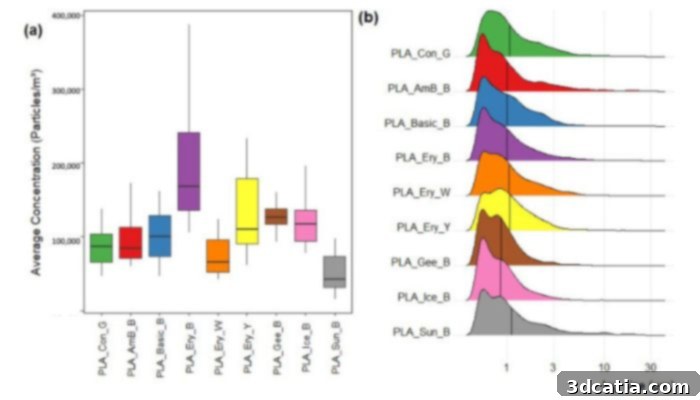
(a) Total average minute particle count and (b) particle density size distribution (black line illustrates mean particle size and y-axis is density) per filament type (image credits: Finnegan M, Thach CL, Khaki S, Markey E, O’Connor DJ, Smeaton AF, Morrin A 2023)
Bridging the Gap: Safety Measures for Home 3D Printing
In essence, the Dublin City University researchers concluded that implementing robust safety measures is crucial in all 3D printing environments. This includes necessities such as improved ventilation systems and the careful selection of filament brands. While these results are applicable to all 3D printers, regardless of their industrial or domestic setting, Dr. Morrin, one of the lead researchers, eloquently articulated the critical differences when it comes to the cheaper, at-home 3D printers that have flooded the consumer market.
She observed, “In an industry setting, there will be enclosures, ventilators in the room, and the emissions will be monitored. When we bring them into the home – these printers cost about €200 or so – and these come without any of that enclosure, ventilation, and are typically operated in less ventilated environments. The best thing you have is a window which may or may not be open.” This stark contrast highlights the potential for significantly higher exposure to harmful emissions for home users who often lack dedicated safety infrastructure.
Industrial 3D printing operations are typically governed by strict occupational health and safety regulations. These environments often feature purpose-built enclosures around printers, sophisticated ventilation systems designed to capture and filter airborne pollutants, and continuous air quality monitoring. Operators are also frequently provided with personal protective equipment (PPE), and the facilities are often physically separated from general workspaces. Such measures are standard practice to minimize worker exposure and ensure compliance with health regulations.
Conversely, the typical home 3D printing setup is vastly different. Many desktop printers, particularly the budget-friendly models, do not come with integrated enclosures or filtration systems. They are often operated in common living areas, bedrooms, or small workshops that lack adequate airflow or dedicated exhaust. The reliance on simply opening a window, while better than nothing, is often insufficient to effectively disperse or remove the fine particulate matter and VOCs generated, especially in colder climates where windows remain closed for extended periods.
Empowering Users: Awareness and Simple Solutions for Safer Printing
It is crucial to emphasize that the researchers are not aiming to dissuade anyone from enjoying the benefits of 3D printing. Instead, their primary objective is to foster awareness, particularly among novices who might purchase inexpensive printers that often come with fewer inherent safety features, such as built-in enclosures or active ventilation. The accessibility and creative potential of 3D printing are undeniable, and with the right precautions, it can remain a safe and rewarding hobby.
Dr. Morrin further underscored in a recent interview with the Irish Independent that even simple, accessible measures can be highly effective in mitigating the risks posed by 3D printer emissions in a home setting. These include:
- Ventilation: Always operate your 3D printer in a well-ventilated area. If possible, use an exhaust fan to direct air outdoors. When a dedicated system isn’t feasible, opening windows and doors to create cross-ventilation is a good starting point.
- Printer Placement: Position your 3D printer away from main living spaces, bedrooms, and areas where people spend significant amounts of time, especially children and pets. A dedicated workshop or garage, with proper ventilation, is ideal.
- Enclosures: Consider investing in or building an enclosure for your 3D printer. Enclosures help contain emissions, and many can be easily modified to include basic filtration or exhaust systems.
- Filament Choice: Be mindful of the type and brand of filament you use. Research indicates that some filaments, like ABS, tend to release more harmful VOCs and ultrafine particles than others, such as PLA, though even PLA is not entirely emission-free. Look for low-emission filaments or brands with transparent safety data sheets.
- Air Filtration: Utilize air purifiers equipped with HEPA and activated carbon filters in the room where your printer operates. HEPA filters are effective at capturing airborne particles, while activated carbon filters can absorb many VOCs.
- Personal Protective Equipment (PPE): For prolonged printing sessions or when working with materials known for higher emissions, wearing a respirator mask with appropriate particulate and organic vapor filters can provide an additional layer of protection.
These practical steps can significantly reduce exposure to potentially harmful substances, allowing hobbyists and small businesses to continue leveraging the incredible capabilities of 3D printing safely.
The Dublin City University study serves as an important reminder that while technology offers incredible advantages, it also demands our attention to its potential environmental and health impacts. By being informed and proactive, the 3D printing community can ensure that innovation and safety go hand in hand.
You can delve deeper into the full Dublin City University study HERE. We’d love to hear your thoughts on this report! What measures do you currently employ to protect your health when it comes to managing 3D printing emissions in your own setup? Share your insights and experiences in a comment below, or engage with us on our social media platforms: LinkedIn, Facebook, and Twitter! Don’t miss out on the latest 3D printing news – sign up for our free weekly Newsletter here, delivered straight to your inbox. You can also explore all our compelling videos and content on our dedicated YouTube channel.