
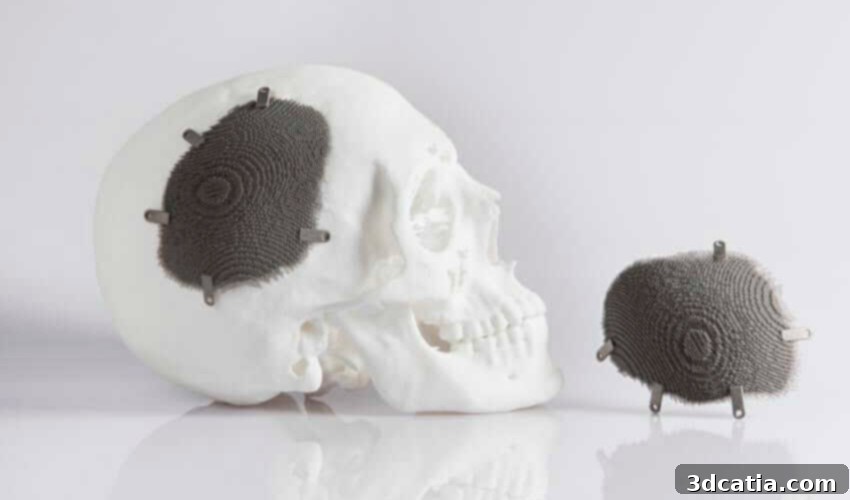
3D Printed Medical Implants: Revolutionizing Healthcare with Personalized Solutions and Exponential Market Growth
The landscape of modern healthcare is undergoing a profound transformation, largely driven by advancements in additive manufacturing, commonly known as 3D printing. A recent report published by Precedence Research sheds light on the escalating importance and financial trajectory of 3D printed medical implants. The findings are staggering: the market for these innovative devices is projected to soar past 9 billion dollars by 2030, a significant leap from the 1.5 billion dollars recorded in 2020. This represents an impressive compound annual growth rate (CAGR) of 19%, underscoring the rapid adoption and expanding applications of this technology within the medical sector.
As surgical operations become increasingly intricate and demanding, the need for precision, customization, and reduced risks has never been more critical. Additive manufacturing offers a compelling solution, empowering medical practitioners with the tools to perform complex procedures with greater accuracy and confidence. This technological shift directly addresses the challenges faced by surgeons, enabling them to enhance patient outcomes and significantly mitigate the potential for associated errors. The study particularly highlights the orthopedic market as a primary engine of this growth, predicting that 3D printed orthopedic devices alone will experience a remarkable 25% growth between 2021 and 2025, reaching an estimated revenue of 1.94 billion dollars. Furthermore, the report emphasizes the pivotal role of advanced 3D printing materials, whose continuous innovation and improved properties have been instrumental in fueling this surge in market value.
The global healthcare sector has endured unprecedented stress in recent times, with the recent health crisis exposing critical vulnerabilities, particularly within supply chains. In this challenging environment, 3D printing technologies emerged not just as a promising innovation, but as a vital necessity. While additive manufacturing already held a significant potential, the onset of COVID-19 dramatically accelerated its integration and adoption across medical facilities worldwide. The inherent flexibility and speed of 3D printing enable the rapid design and production of a diverse range of tailor-made medical devices, highly accurate anatomical models for pre-surgical planning, and patient-specific surgical guides. These capabilities allow healthcare professionals to meticulously prepare for operations, optimize surgical workflows, and substantially reduce the likelihood of complications. Crucially, patients benefit from solutions that are perfectly adapted to their unique anatomy and physiological needs, especially when it comes to implants that must integrate seamlessly with the human body. This level of personalization leads to improved functional outcomes, faster recovery times, and enhanced overall patient comfort.
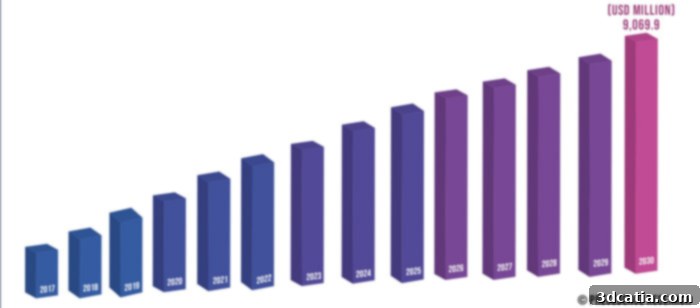
The impressive growth trajectory of 3D printed implants from 2017 to 2030, highlighting market expansion.
The Unparalleled Advantages of 3D Printed Implants for Practitioners and Patients
The market for 3D printed implants is significantly influenced by the increasing number of organ transplants, tissue grafts, and particularly joint replacement surgeries performed globally. These are typically major operations that demand extraordinary precision and meticulous preparation from surgical teams. By leveraging the capabilities of additive manufacturing, surgeons can create highly customized implants that offer a multitude of benefits over traditionally manufactured devices. These tailor-made solutions play a crucial role in minimizing the risk of post-operative infections, promoting superior osseointegration – the direct structural and functional connection between living bone and the surface of a load-bearing implant – and ultimately enhancing patient comfort and recovery. For instance, the increased use of biocompatible materials like titanium in 3D printing allows for intricate lattice structures that encourage bone growth into the implant, improving stability and longevity.
Beyond improved integration, 3D printed implants are often lighter, intricately designed to perfectly match the complex morphology of individual bones, and exhibit enhanced durability. This translates to better biomechanical compatibility, reducing stress shielding effects and improving the long-term success rates of implant procedures. The ability to produce implants with specific porosity, surface textures, and internal structures allows for unprecedented control over how the implant interacts with surrounding tissues, fostering a more natural healing environment. This level of customization is simply unattainable with conventional manufacturing methods, making 3D printing a game-changer for complex reconstructive and replacement surgeries.
Beyond orthopedics, dental and cranial implants are highlighted as two other critical application areas experiencing substantial growth. The precision afforded by 3D printing is invaluable for craniomaxillofacial operations, which often involve complex bone structures and require exact anatomical replication for both functional and aesthetic reasons. From custom dental crowns and bridges to intricate skull plates and facial prosthetics, 3D printing delivers unparalleled accuracy and fit. On the value chain side, the continuous innovation and development of advanced materials are identified as the most significant drivers of market expansion, attracting substantial investments in research and development. The study also focuses on key additive manufacturing technologies foundational to this progress, including laser powder bed fusion (such as DMLS or SLM), material jetting, and electron beam melting. These advanced techniques enable the creation of highly complex geometries, superior material properties, and the precise control necessary for medical-grade implant production.
Driving Factors and Regional Dominance in the 3D Printed Implant Market
The evolution of 3D printing materials is a cornerstone of its success in medical implants. For metallic implants, titanium alloys remain the gold standard due to their exceptional biocompatibility, high strength-to-weight ratio, and excellent corrosion resistance. 3D printing allows for the creation of porous titanium structures that mimic natural bone, encouraging osteointegration. Polymeric materials such as PEEK (Polyetheretherketone) are also gaining traction, particularly for spinal implants and cranial plates, due to their bone-like mechanical properties, radiolucency (allowing clear imaging without artifact), and biocompatibility. Ceramic materials, like bioceramics, are being explored for their osteoinductive properties, promoting new bone formation. The continuous research into new biomaterials and composites further expands the possibilities for personalized implant design and functionality.
Delving deeper into the printing technologies, laser powder bed fusion (L-PBF), which includes Direct Metal Laser Sintering (DMLS) and Selective Laser Melting (SLM), is widely used for metal implants. It involves a laser selectively melting metallic powder layer by layer to build intricate parts. Electron Beam Melting (EBM) is another crucial metal additive manufacturing process, particularly for titanium, known for its ability to produce highly dense parts with minimal residual stress. Material jetting, a technology similar to inkjet printing, deposits tiny droplets of liquid photopolymer or wax materials, which are then cured by UV light. This method offers high resolution and smooth surface finishes, ideal for anatomical models, surgical guides, and some polymeric implants. The choice of technology is often dictated by the desired material, geometric complexity, and specific mechanical properties required for the implant’s intended function.
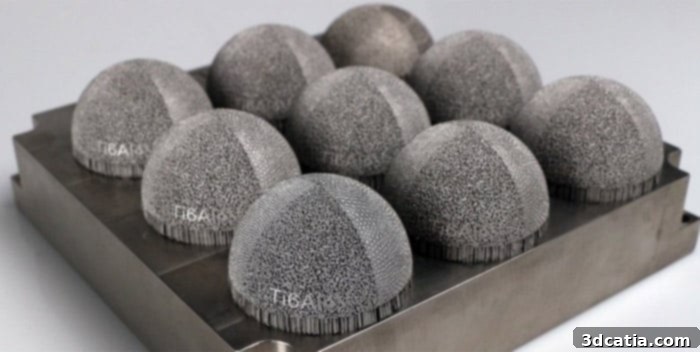
Diverse applications: Examples of 3D printed implants showcasing precision and customization (photo credits: Health Canada)
Geographically, the study specifies that North America currently holds the dominant position in the market for 3D printed implants, commanding more than 30% of the total market shares. This leadership can be attributed to several factors, including a robust healthcare infrastructure, significant investments in research and development, a high adoption rate of advanced medical technologies, and a well-established regulatory framework. However, the report also forecasts a dynamic shift, with the Asia Pacific region anticipated to emerge as the second-largest user of 3D technologies by 2022. Key countries driving this growth in the APAC region include China, India, and Japan, which are rapidly expanding their healthcare capabilities and investing heavily in technological innovation.
The surge in demand within the Asia Pacific region is largely fueled by an increasing prevalence of dental and bone disorders, an aging population, and a rising awareness regarding advanced treatment options. As these countries continue to modernize their healthcare systems, the demand for personalized and high-quality medical implants is expected to skyrocket. Despite this positive trajectory, the industry still faces a number of crucial challenges that need to be addressed for widespread adoption. One of the most significant hurdles is the rigorous certification and regulatory approval process for 3D printed implants. Ensuring the safety, efficacy, and consistent quality of these devices requires stringent testing and adherence to global medical standards, which can be time-consuming and costly. However, ongoing collaborations between regulatory bodies, manufacturers, and medical professionals are working towards streamlining these processes.
Other challenges include the high initial investment in 3D printing equipment and materials, the need for specialized training for healthcare providers, and scaling up production to meet global demand efficiently. Nevertheless, the rapid pace of technological innovation, coupled with increasing clinical evidence supporting the benefits of 3D printed implants, strongly suggests that the industry is on a promising path. The future of personalized medicine is undeniably intertwined with the evolution of 3D printing, promising a new era of highly effective, patient-specific healthcare solutions. For more detailed information on this transformative market, readers can refer to the full report HERE.
* Cover photo courtesy of Novax DMA, exemplifying the precision of medical additive manufacturing.
What are your thoughts on the profound impact of 3D printing in designing the next generation of medical implants? We’d love to hear your perspective! Let us know in a comment below or join the conversation on our Facebook, Twitter, and LinkedIn pages! Don’t miss out on the latest advancements and insights in additive manufacturing – sign up for our free weekly Newsletter here, delivering the freshest 3D printing news directly to your inbox!