
3D Printing and Solidarity: A Lifeline for Italy’s COVID-19 Crisis Amidst Supply Chain Challenges
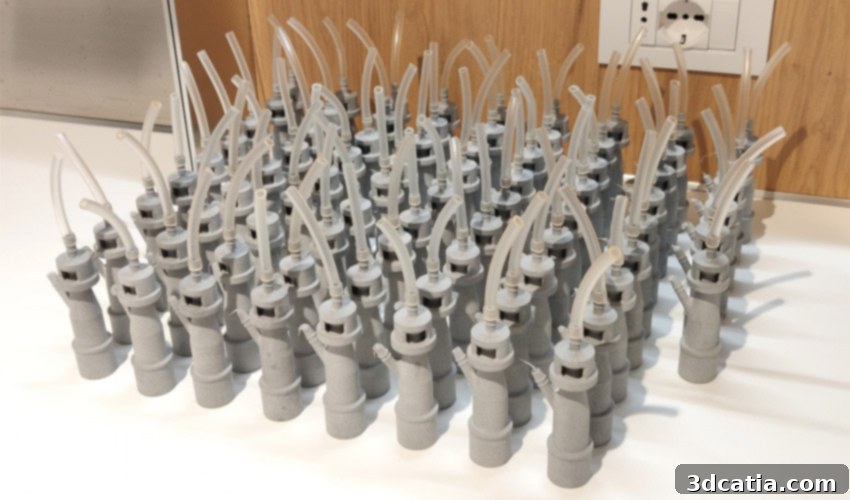
In early 2020, as the world grappled with the nascent stages of the COVID-19 pandemic, northern Italy found itself at the epicenter of a rapidly escalating health crisis. Hospitals in regions like Lombardy were overwhelmed, facing an unprecedented surge in critically ill patients requiring intensive care and respiratory support. The demand for essential medical equipment, particularly components for ventilators, quickly outstripped the capacity of traditional supply chains, which were already strained and, in many cases, completely frozen due. In these desperate times, the spirit of solidarity shone brightly, leading to an extraordinary mobilization of resources and ingenuity. A powerful call for help resonated through the additive manufacturing community, prompting a swift and remarkable response from innovative companies and individuals. This collective effort centered on leveraging the power of 3D printing to produce urgently needed valves for respiratory intensive care units, a critical intervention that would ultimately save lives.
The impact of this initiative was immediate and profound. Within a remarkably short timeframe, a hospital in one of Italy’s most affected areas successfully equipped approximately ten patients with life-saving respiratory machines fitted with these 3D printed valves. The immediate success demonstrated not only the technical feasibility but also the immense potential of additive manufacturing as a rapid deployment solution during global emergencies. Amidst a crisis that brought conventional industries to a standstill and exposed the vulnerabilities of globalized production networks, 3D printing emerged as a crucial answer. It offered a decentralized, agile, and effective method to bypass broken supply chains, providing essential tools and components where they were most desperately needed, highlighting its vital role in crisis management and resilience.
While it may be premature to declare additive manufacturing as the sole long-term panacea for combating the multifaceted challenges of a global pandemic like COVID-19, its capacity to offer immediate and impactful solutions is undeniable. Its versatility extends beyond just ventilator parts; it can provide tangible relief to affected populations in various forms. For instance, discussions emerged about the potential for small 3D printed houses to alleviate hospital congestion by providing temporary isolation or recovery facilities. More directly, the rapid design and production of specialized medical tools and components using 3D printing technologies proved invaluable in addressing critical shortages of conventional supplies. This was vividly demonstrated in Brescia, a city in Lombardy particularly ravaged by the virus. Here, the local additive manufacturing community rallied to support a struggling hospital, enabling it to operate more Intensive Care Units (ICUs) and, crucially, save more lives.
The situation in the Brescia hospital was dire. Critical shortages of ICU valves meant that life-saving respirators could not be utilized to their full capacity, leaving medical staff with agonizing choices. Their usual supplier, overwhelmed by global demand and logistical hurdles, was simply incapable of delivering the necessary components in time. This seemingly insurmountable obstacle, however, ignited a spark of innovation and community spirit. The desperate need transcended traditional manufacturing limitations, paving the way for a grassroots solution driven by technological prowess and a deep sense of human responsibility. This moment underlined a pivotal shift: when conventional systems fail, agile and localized manufacturing capabilities, such as those offered by 3D printing, can step in to fill critical voids.
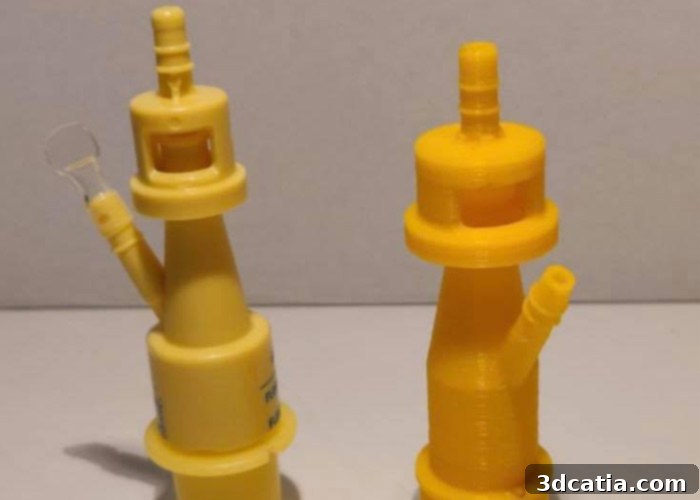
The initial prototype valves were rapidly 3D printed using an FDM machine, demonstrating agility in crisis.
The genesis of this remarkable initiative can be traced back to Massimo Temporelli, the visionary founder of The FabLab in Milan. Upon receiving an urgent call from an editor at the Giornale di Brescia newspaper, detailing the critical shortage of respirator valves at the hospital in Chiari and the tragic consequences, Temporelli immediately understood the gravity of the situation. He swiftly mobilized his extensive network, appealing to various FabLabs, 3D printing services, and manufacturers across Italy. The response was instantaneous and inspiring, demonstrating the power of a connected and altruistic community. Among those who answered the desperate plea was Isinnova, an Italian design office, whose CEO, Cristian Fracassi, articulated the profound urgency and moral imperative driving their actions through an emotional Facebook post. He recounted the harrowing phone call: “We received a phone call, we were told that at the hospital in Chiari, the valves for the respirators were missing and people were dying. The ordinary way, that of supplying standard parts, was not feasible for a simple reason of time. What were we to do? People’s lives were in danger, and we acted. That’s all, we did what we had to do.” This powerful statement underscored the ethical backbone of their decision, prioritizing human life over any bureaucratic or logistical hurdles.
The team from Isinnova acted with extraordinary speed and efficiency. To ensure the precise functionality and compatibility of the valves, the Italian company brought a small FDM (Fused Deposition Modeling) 3D printer directly to the hospital. This on-site approach allowed for rapid iteration and testing, enabling them to design and refine the correct valve model in real-time. The ability to produce and test prototypes directly within the clinical environment proved invaluable, dramatically cutting down the development cycle that would typically take weeks or months. This direct collaboration between innovators and medical professionals was a critical factor in the initiative’s success. Once a functional model was confirmed, production commenced, and within hours, around ten patients were successfully equipped with the newly printed valves, directly impacting their chances of survival. The initial deployment demonstrated the immediate utility of FDM technology for rapid prototyping and low-volume, on-demand manufacturing in an emergency.
As the demand grew and the night of March 14-15 progressed, the teams recognized the need for a more robust and scalable solution to sustain production. They quickly transitioned from the initial FDM prototypes to a more industrial-grade SLS (Selective Laser Sintering) machine. SLS technology, known for its ability to produce stronger, more precise, and higher-quality parts at a faster rate, was ideal for scaling up the production of these critical components. This strategic shift highlighted the adaptability of additive manufacturing workflows, moving from quick, rough prototypes to more sophisticated, durable parts as the situation evolved. Cristian Fracassi reflected on the urgency and impact of their work, emphasizing the collective effort: “If we acted quickly, it’s only because with 3D printers, you can quickly test a small production that would be impossible on an industrial scale. We just want one thing to remain from this story: the community, consisting of a hospital, a newspaper, a team of professionals, ran a race against time and saved lives. That is all.” His words encapsulate the spirit of innovation, collaboration, and profound humanity that defined this critical intervention.
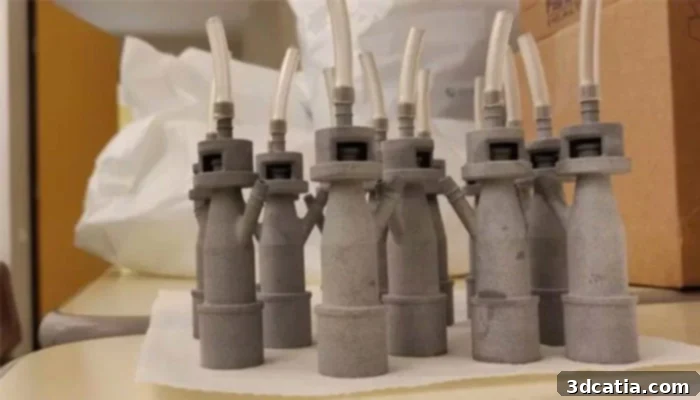
For larger scale and improved quality, the valves were subsequently 3D printed on an SLS machine.
The incredible success of this initiative naturally led to widespread interest in the digital design file (STL file) for these life-saving valves. Many hoped that by openly sharing the file, other hospitals and regions facing similar shortages could replicate the effort. Our team managed to reach out to Cristian Fracassi, the engineer behind the STL file, with the intention of retrieving and sharing the model. However, Fracassi explained the complexities and ethical considerations involved in such a decision. He stated: “I can’t share the file because at the moment only 150 parts are needed. If a hospital gives me the correct code for the valve and they have contacted their supplier who told them that they cannot deliver on time, then I will send them the file. The Prime Minister called me personally and asked me not to share anything.” This decision, while seemingly restrictive, was rooted in a deep concern for patient safety and regulatory compliance. Uncontrolled dissemination of medical device designs could lead to unregulated production with unverified materials and processes, potentially causing harm. The involvement of the Prime Minister underscored the national significance and the need for a coordinated, controlled response to prevent unintended risks, ensuring that quality and safety standards were maintained even in an emergency.
This pivotal moment in northern Italy vividly illustrates how the potent combination of human solidarity and advanced 3D printing technology became a beacon of hope, saving the lives of numerous COVID-19 patients during an unprecedented crisis. The rapid prototyping, localized production, and agile response offered by additive manufacturing proved to be a critical differentiator when traditional systems faltered. This success story is a powerful testament to the transformative potential of 3D printing beyond mere industrial applications, positioning it as an indispensable tool for humanitarian aid and disaster response in the future. It highlights the urgent need for governments, medical institutions, and manufacturing communities worldwide to foster similar collaborative frameworks and invest in decentralized manufacturing capabilities. By doing so, we can build more resilient healthcare systems and better prepare for future emergencies, ensuring that innovation and compassion continue to lead the way in times of global challenge. We sincerely hope that this inspiring initiative will catalyze the rapid implementation of many more similar solutions to address ongoing and future health crises globally.
We invite you to share your thoughts, comments, and similar initiatives you may be aware of. Please leave a comment below or engage with us on our Facebook and Twitter pages. Don’t forget to sign up for our free weekly Newsletter to receive all the latest news and updates in the dynamic world of 3D printing delivered straight to your inbox!