
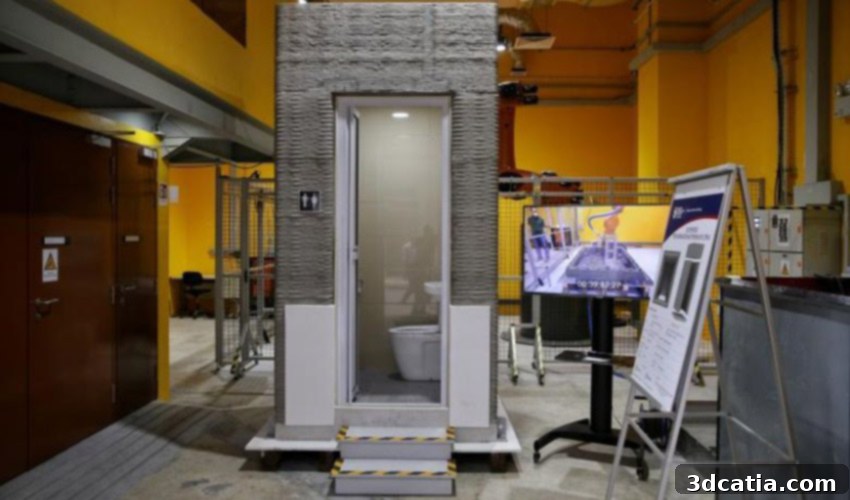
Revolutionizing Construction: NTU Singapore Pioneers Rapid 3D Printed Prefabricated Bathroom Units
In a groundbreaking stride for the construction industry, a dedicated team of professors at Nanyang Technological University (NTU) Singapore has successfully developed and demonstrated a compact, 3D printed bathroom cubicle. What makes this achievement particularly remarkable is the speed of its creation: the concrete walls of these innovative units can be 3D printed in as little as nine hours. Once the structural shell is complete, the cubicle is swiftly outfitted with essential amenities including a toilet, shower, sink, and mirror, transforming it into a fully functional, prefabricated unit. This significant innovation promises to deliver easier, more cost-effective, and remarkably faster solutions for construction projects worldwide, addressing long-standing challenges in traditional building methods and paving the way for a new era of modular construction.
The advent of 3D concrete printing has truly opened up a world of possibilities, moving beyond mere conceptual prototypes to tangible, impactful projects. This advanced additive manufacturing technique has been instrumental in the creation of diverse structures, from complete affordable homes and small, functional commercial buildings to ambitious architectural marvels like villas and even towering skyscrapers and modern business offices. The inherent flexibility of 3D printing technology offers unparalleled freedom in terms of geometric design, allowing architects and builders to realize complex shapes and intricate details that would be exceptionally difficult or expensive to achieve with conventional construction methods. Beyond aesthetic advantages, this technology dramatically reduces the labor intensity, overall project costs, and manufacturing timelines typically associated with building. Impressively, some pioneering builders have reported printing all the load-bearing walls of an entire house in a mere 24 hours! This astonishing speed provides crucial context for the Nanyang Technological University researchers’ remarkable feat: designing and structurally printing a complete bathroom cubicle in a comparable timeframe signifies a monumental leap in construction efficiency and productivity, highlighting the immense potential of 3D printing for rapid deployment.
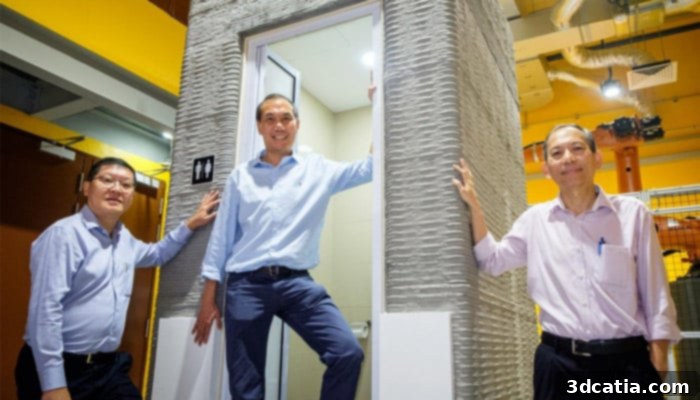
The three leading professors working on the project in front of the prefabricated cabin | Photo Credits: NTU Singapore
An Innovative and Durable 3D Printing Material for Rapid Construction
A cornerstone of this project’s success lies in the innovative material developed by the NTU Singapore team. They engineered a specialized concrete mixture that incorporates geopolymers derived from industrial ash waste. This unique composite material is precisely formulated to possess a dual functionality critical for successful 3D printing: it must be fluid enough to be smoothly extruded through the robotic nozzle, yet cure rapidly enough to support subsequent layers without sagging or deformation. This delicate balance ensures structural integrity as the layers are built up, allowing for continuous and swift fabrication. According to the dedicated researchers, this advanced geopolymer concrete offers substantial advantages over traditional construction materials. It significantly contributes to sustainability by repurposing waste materials and allows for material savings of up to 30% in both volume and weight, leading to lighter and more resource-efficient structures. Furthermore, the material’s optimized properties enable a construction process that is twice as fast as conventional cast concrete methods, drastically cutting down project timelines and enhancing overall productivity in the building sector, especially for modular units like these prefabricated bathrooms.
The NTU Singapore team proudly unveiled two prototype prefabricated bathroom units, showcasing the versatility and efficiency of their 3D printing system. The first unit, measuring a compact 1.62 x 1.5 x 2.8 meters, had its concrete walls precisely 3D printed in an astonishing nine hours. A larger variant, measuring 2 x 2.6 x 2.8 meters, required only 12 hours of printing time for its robust structure. For the additive manufacturing process, a high-precision KUKA 6-axis robotic arm was deployed, offering an impressive operational range of approximately six meters in diameter, ensuring comprehensive coverage and intricate detailing. Once the structural printing was finalized, a subsequent phase of skilled craftsmanship began, where the teams meticulously laid tiles, installed plumbing, and equipped the cabins with all essential fittings. This includes a modern sink, a practical mirror, a refreshing shower, and comfortable toilets. Remarkably, this entire equipping process, transforming a printed shell into a ready-to-use bathroom, was completed in approximately five days. These 3D printed cabins are not only significantly lighter than their conventionally built counterparts but also less expensive to produce, making them ideal candidates for efficient transportation directly to various construction sites, thereby streamlining logistics and reducing overall project expenditures for modular buildings.
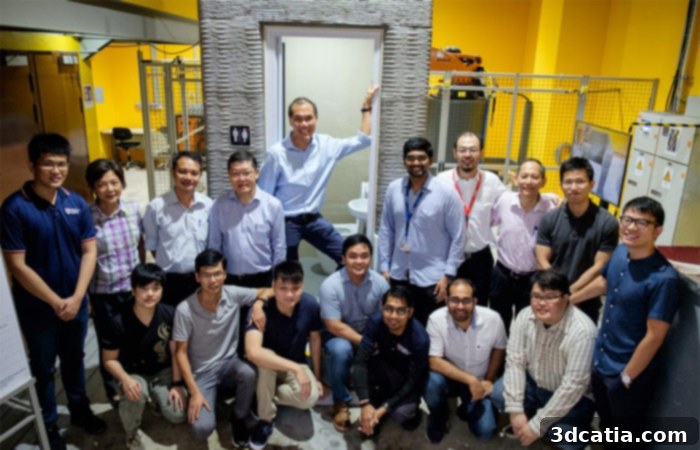
The research team behind the project | Photo Credits: NTU Singapore
Professor Tan Ming Jen, a key figure at the Singapore 3D Printing Centre at NTU University, eloquently articulated the profound implications of this innovation: “By being able to print on demand, companies can realize significant savings on their inventory costs, as the need for large-scale storage is dramatically reduced. Furthermore, labor costs can be optimized, as employees can be strategically redeployed to perform more complex, higher-level tasks that require human ingenuity and oversight, rather than repetitive manual labor. This approach not only boosts efficiency but also markedly improves workplace safety, as robots are primarily responsible for the construction of the core bathroom unit, mitigating risks associated with hazardous manual work on construction sites.” To ensure their readiness for practical application, the larger of the two 3D printed bathroom cabins underwent a series of rigorous tests. The results unequivocally demonstrated that the unit achieved the required strength, durability, and robustness, fully complying with stringent industry standards and regulations, confirming its viability for mainstream construction. For those interested in delving deeper into the technical specifics and research findings, more detailed information can be found HERE.
This pioneering work by NTU Singapore represents more than just a technological breakthrough; it signifies a paradigm shift in how we approach construction, particularly for essential components like bathroom units. The ability to rapidly produce high-quality, durable, and cost-effective prefabricated bathrooms using 3D printing holds immense potential for accelerating housing projects, supporting disaster relief efforts, and providing sustainable solutions for urban development. By combining advanced materials, robotic automation, and modular design principles, this innovation is poised to address critical challenges facing the global construction sector, from labor shortages and rising costs to environmental sustainability and project timelines. The future of building looks increasingly automated, efficient, and innovative, with 3D printed modular units playing a pivotal role in shaping more resilient and accessible infrastructure. The vision of easier, cheaper, and faster construction is now closer to reality than ever before, thanks to trailblazing research like that conducted at NTU Singapore.
What are your thoughts on this revolutionary 3D printed bathroom technology and its potential impact on the construction industry? We invite you to share your insights and opinions in a comment below, or join the conversation on our Facebook and Twitter pages! Don’t miss out on the latest advancements and news in the world of 3D printing – sign up for our free weekly Newsletter to receive all the crucial updates delivered straight to your inbox!