
Revolutionizing Manufacturing: A Deep Dive into Velo3D’s Metal 3D Printing Capabilities and Key Applications
The landscape of manufacturing is undergoing a profound transformation, with metal 3D printing, also known as metal additive manufacturing (AM), emerging as a pivotal force. While polymer 3D printing has historically dominated the market, metal AM is rapidly closing the gap, driven by its unparalleled ability to produce complex, high-performance parts with intricate geometries. This innovative technology is no longer confined to prototyping; it’s now integral to creating end-use components across a multitude of demanding sectors, including aerospace, automotive, energy, and medical. According to a comprehensive report by IDTechEx, the metal AM market is poised for explosive growth, projected to reach an impressive $18.5 billion within the next decade, propelled by an estimated annual growth rate of 18.8%. This signifies a clear shift in industrial production paradigms, moving towards more agile, efficient, and sophisticated manufacturing processes.
As industries seek greater design freedom, reduced lead times, and enhanced part performance, the capabilities of metal 3D printing are becoming indispensable. From specialized tooling to critical, flight-ready components, the applications are expanding at an unprecedented rate. But what exactly drives this surge, and what kind of groundbreaking innovations can we expect from the pioneers in this field? This article delves into the cutting edge of metal 3D printing, focusing on the transformative power of Velo3D’s Sapphire™️ family of 3D printers and exploring some of the most exciting applications that are pushing the boundaries of what’s possible in advanced manufacturing.
Velo3D: Pioneering Support-Free Metal Additive Manufacturing
Velo3D stands at the forefront of the metal 3D printing revolution, distinguished by its comprehensive end-to-end metal additive manufacturing solutions. The company has carved out a niche for itself by addressing some of the most persistent challenges in metal AM, particularly the reliance on support structures and the constraints imposed by traditional Design for Additive Manufacturing (DfAM) principles. Their innovative approach empowers engineers and designers to create complex geometries that were previously deemed unprintable, opening up entirely new avenues for product innovation and performance optimization.
Velo3D’s core technology utilizes powder bed fusion, a highly precise method where a laser selectively melts metallic powder layer by layer to build a part. What sets Velo3D apart is its intelligent software and hardware integration, which allows for the successful printing of complex internal channels, intricate lattice structures, and large, low-angle overhangs — all without the need for extensive support structures. This “support-free” capability is a game-changer. Traditionally, supports are required to prevent deformation during the printing of overhanging features, but their removal is a time-consuming, labor-intensive, and often costly post-processing step. By virtually eliminating the need for supports in many complex designs, Velo3D significantly reduces post-processing, lowers overall production costs, and accelerates manufacturing timelines.
The impact of this technology extends beyond mere cost and time savings. It fundamentally changes the design paradigm. Engineers are no longer constrained by the limitations of conventional manufacturing or even conventional metal AM. The freedom to design parts purely for function and performance, without compromise due to manufacturability concerns, unlocks unprecedented levels of innovation. This capability is particularly vital for sectors like aerospace, oil & gas, and transportation, where performance, weight reduction, and extreme operating conditions demand parts with highly optimized and often complex internal geometries.
Transforming Industries: Velo3D’s Impact Across High-Stakes Sectors
Velo3D’s end-to-end solution, encompassing advanced hardware like the Sapphire™️ family printers, intelligent Flow™️ software, and Assure™️ quality assurance, is tailor-made for producing mission-critical parts. Its applications span a diverse range of industries, each benefiting from the unique advantages of support-free metal 3D printing:
- Aerospace: In aerospace, weight reduction is paramount, and performance gains can mean the difference between success and failure. Velo3D enables the creation of lightweight, high-strength components with optimized internal cooling channels for rocket engines, turbine blades, and satellite parts. The ability to print complex geometries without supports allows for radical redesigns that enhance efficiency and propulsion, pushing the boundaries of space exploration and flight.
- Oil & Gas: The oil and gas industry demands highly durable components capable of operating in extreme conditions, often involving high pressures, corrosive environments, and elevated temperatures. Velo3D’s technology facilitates the production of specialized parts like impellers, valves, and intricate flow components with improved internal geometries that enhance efficiency, extend lifespan, and reduce maintenance requirements in critical infrastructure.
- Transportation (Automotive & Mobility): The automotive sector is constantly seeking ways to improve fuel efficiency, reduce emissions, and enhance vehicle performance. Metal AM contributes significantly by enabling the production of lightweight structural components, advanced engine parts, and specialized tooling. Velo3D’s capabilities allow for rapid iteration and production of complex components, speeding up development cycles for next-generation vehicles, from luxury sports cars to electric mobility solutions.
Unveiling Innovation: Top Metal 3D Printing Applications from Velo3D
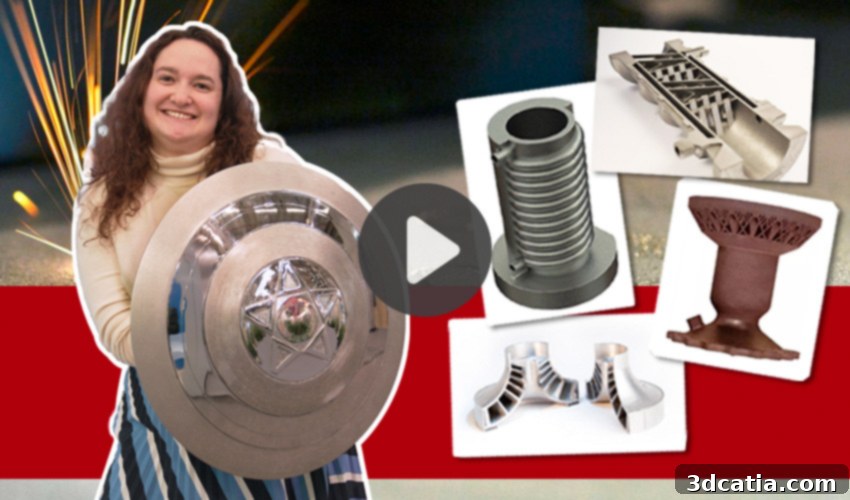
To truly appreciate the transformative potential of Velo3D’s technology, one must look at the specific parts it enables. In our latest video showcase, we explored five groundbreaking metal 3D printing applications produced on Velo3D’s Sapphire™️ machines. These examples vividly illustrate the power of support-free printing and the expanded design freedom it offers:
1. Advanced Static Mixers
Static mixers are critical components in chemical processing, designed to blend fluids without moving parts. Their efficiency relies on complex internal geometries that induce turbulence and promote thorough mixing. Traditionally, these intricate designs are challenging or impossible to manufacture. Velo3D’s technology allows for the creation of highly optimized internal channels and structures within static mixers, vastly improving mixing efficiency and process throughput. This level of geometric complexity, produced without the constraints of support removal, ensures superior performance and opens doors for innovations in chemical engineering, pharmaceuticals, and other process industries.
2. High-Performance Tooling: HPDC Insert and Sprue Bushing
High-Pressure Die Casting (HPDC) is a widely used manufacturing process for producing metal parts. Key to its efficiency and the quality of the final product are the HPDC inserts and sprue bushings, which are subjected to extreme thermal and mechanical stresses. The ability to integrate conformal cooling channels directly within these tooling components is a major breakthrough enabled by Velo3D’s AM. Conformal cooling means the cooling channels follow the contour of the mold cavity, allowing for more even and rapid heat dissipation. This significantly extends tool life, reduces cycle times, minimizes part warpage, and improves overall part quality – a massive economic benefit for manufacturers in various sectors.
3. The Iconic Captain America Shield Replica: A Design Freedom Showcase
Beyond its pop culture appeal, the 3D printed Captain America shield replica represents a monumental technical achievement. This particular part holds the distinction of being the largest dome ever 3D printed in metal without supports. Printing large, unsupported domed structures is incredibly challenging due to the stress and deformation that typically occur during the printing process. Velo3D’s ability to achieve this feat demonstrates its mastery over complex geometries and low-angle features, showcasing the extreme design freedom and geometric capabilities of its Sapphire™️ printers. It serves as a powerful testament to the technology’s potential for intricate, large-scale, and structurally demanding components in any industry.
4. Next-Generation Rocketry: Rocket Thrust Chamber Made with GRCop-42
The future of space exploration hinges on advanced propulsion systems, and rocket thrust chambers are at their core. This application features a rocket thrust chamber made with GRCop-42, an exciting new high-performance copper alloy developed by NASA. GRCop-42 is engineered for extreme temperature resistance and high thermal conductivity, making it ideal for the demanding environment within a rocket engine. Velo3D’s metal 3D printing enables the creation of highly optimized, complex internal cooling channels within the thrust chamber, which are critical for managing the intense heat generated during operation. This allows for lighter, more efficient, and more powerful engines, directly contributing to advancements in space launch capabilities and deep-space missions.
5. Optimizing Fluid Dynamics: The Zero-Degree Impeller
Impellers are rotating components found in pumps, compressors, and turbines, designed to increase the pressure and flow rate of fluids. A “zero-degree impeller” refers to a design with extremely steep or vertical blade angles, which are highly challenging to produce with conventional methods and even with most traditional AM systems due to the need for extensive support structures. Velo3D’s support-free printing capability makes the realization of such an impeller possible. This design freedom allows for significantly improved aerodynamic and hydrodynamic efficiencies, leading to higher performance, reduced energy consumption, and quieter operation in a wide range of fluid-handling systems, from industrial pumps to aerospace turbomachinery.
The Future of Metal AM: Beyond Current Limits
These remarkable applications from Velo3D underscore a fundamental shift in how complex metal parts are designed and manufactured. By providing unparalleled design freedom and drastically reducing the need for post-processing, Velo3D is not just enabling new products; it’s empowering engineers to rethink entire systems. The capabilities demonstrated, from intricate internal channels to large unsupported geometries and the use of advanced materials like GRCop-42, are pushing the boundaries of what was once considered impossible in metal manufacturing. This technology promises to unlock new levels of performance, efficiency, and sustainability across critical global industries.
As metal 3D printing continues its exponential growth, innovations like those championed by Velo3D will be crucial in expanding its adoption from niche applications to widespread industrial production. The ability to produce high-quality, complex metal parts on demand, with reduced lead times and greater design flexibility, positions metal AM as a cornerstone of future manufacturing strategies. The emphasis on quality assurance and end-to-end solutions also ensures reliability, a key factor for critical applications where failure is not an option.
What do you think of these innovative applications from Velo3D and the future of metal 3D printing? Let us know your thoughts in a comment below or connect with us on our LinkedIn, Facebook, and Twitter pages! Don’t forget to sign up for our free weekly Newsletter here to get the latest 3D printing news straight to your inbox! You can also find all our insightful videos on our YouTube channel for more in-depth content.