
Revolutionizing Heart Valve Replacement: Georgia Tech’s Bioresorbable, Shape-Memory 3D-Printed Valves
The landscape of medical innovation, particularly in cardiology, has been significantly transformed by advancements in additive manufacturing. For several years, 3D printed heart valves have been a beacon of hope, showing remarkable promise for patients suffering from cardiovascular conditions. Indeed, a comprehensive review published in 2023 by the prestigious Cureus Journal of Medical Science, titled “Trends and Challenges in the Development of 3D-Printed Heart Valves and Other Cardiac Implants: A Review of Current Advances,” highlighted the “tremendous progress” achieved in this specialized field. Researchers in this domain have made significant strides in improving several critical aspects, including the biocompatibility of materials, the ability to customize implants precisely to individual patient anatomies, and the overall functional performance of these sophisticated devices.
Despite these impressive advancements, the path to widespread clinical application has not been without its hurdles. The same review also pointed out persistent limitations that needed to be addressed. Key challenges included making these advanced heart valves more affordable and scalable for mass production, alongside the continuous need for enhanced biocompatibility to ensure long-term patient safety and integration. However, the medical community is now abuzz with news of a groundbreaking development that promises to overcome many of these obstacles. Researchers at Georgia Tech have achieved an unprecedented feat: they have successfully 3D printed heart valves that are, for the very first time, not only bioresorbable but also crafted from an innovative shape memory material. This dual breakthrough represents a significant leap forward, potentially ushering in a new era for cardiac implant technology.
Heart valve disease is a pervasive and debilitating condition, affecting over five million individuals in the United States each year. This serious ailment occurs when any of the human heart’s four critical valves—the aortic, mitral, pulmonary, or tricuspid—become diseased or damaged. These valves play an indispensable role in maintaining healthy blood circulation by precisely opening and closing to regulate blood flow both into and out of the heart. When a valve is compromised, it may not fully open (a condition known as stenosis) or close properly (regurgitation or insufficiency), leading to a range of uncomfortable and potentially life-threatening symptoms. Patients often experience shortness of breath, fatigue, chest pain, dizziness, and swelling in the ankles and feet. In severe cases, untreated heart valve disease can culminate in debilitating complications like stroke, heart failure, and even fatalities.
According to the U.S. Centers for Disease Control (CDC), treatment for heart valve disease can often begin with medication to manage symptoms and prevent further damage. However, for more severe cases where structural integrity is significantly compromised, surgical intervention involving valve repair or replacement becomes necessary. Current replacement valves typically fall into two main categories: mechanical valves and bioprosthetic (tissue) valves. Mechanical valves are highly durable but require patients to take lifelong anticoagulant medication to prevent blood clots, posing risks of bleeding. Bioprosthetic valves, often derived from animal tissue (porcine or bovine), offer a more natural feel and do not usually require lifelong anticoagulation. However, a significant drawback is their limited lifespan, typically necessitating replacement every 10 to 15 years as they calcify and degenerate. For children, the treatment options are even more complex and limited. A growing child’s heart valve replacement will inevitably be outgrown, often requiring multiple, invasive reinterventions throughout their childhood and adolescence, placing immense physical and emotional burden on young patients and their families. This new Georgia Tech innovation seeks to directly address these profound challenges.
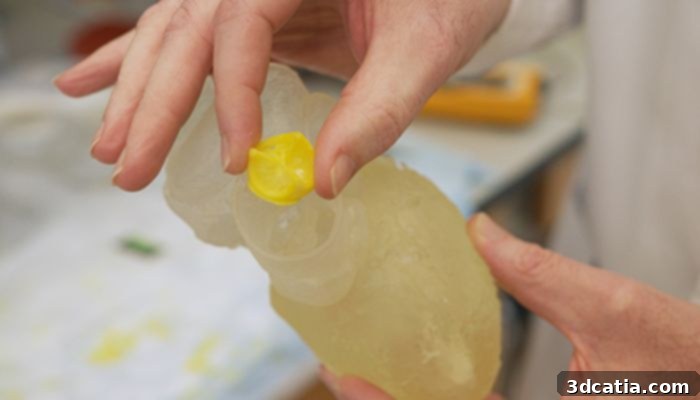
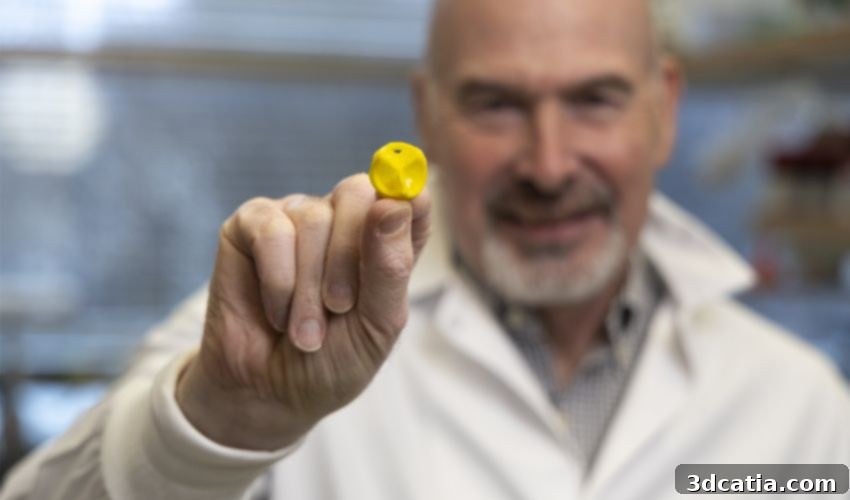
The bioresorbable heart valve (yellow) developed by Georgia Tech researchers.
The pioneering Georgia Tech project is a testament to the power of interdisciplinary collaboration, born from the synergy of two distinct yet complementary research teams. One team was expertly led by Lakshmi Prasad Dasi, an internationally recognized leader renowned for his profound contributions to understanding heart valve function and mechanics. The other pivotal team was championed by Scott Hollister, a distinguished expert in the cutting-edge fields of tissue engineering and 3D printing, specifically tailored for pediatric medical devices. This unique combination of expertise—Dasi’s deep insights into the biological and mechanical intricacies of heart valves and Hollister’s mastery of advanced biomaterial fabrication—proved to be the crucible for their extraordinary innovation.
Dasi articulated the profound distinctions of their breakthrough, stating with conviction, “This technology is very different from most existing heart valves, and we believe it represents a paradigm shift. We are moving away from using animal tissue devices that don’t last and aren’t sustainable, and into a new era where a heart valve can regenerate inside the patient.” This statement underscores a fundamental philosophical shift in medical device design. Instead of relying on static, foreign materials that often have limited lifespans and can trigger immune responses, this new approach leverages the body’s innate regenerative capabilities. The concept of a heart valve actively regenerating within the patient’s own body is not just a technological advancement; it is a transformative vision for personalized medicine, promising a future where implants are not just replaced but truly integrated and renewed. This regenerative capacity holds immense potential for long-term health outcomes, reducing the need for repeated interventions and improving quality of life for countless patients.
The vision of a heart valve regenerating within a patient holds particular significance and offers immense benefits for young patients. Dr. Hollister further elaborated on this crucial aspect, explaining, “In pediatrics, one of the biggest challenges is that kids grow, and their heart valves change size over time. Because of this, children must undergo multiple surgeries to repair their valves as they grow. With this new technology, the patient can potentially grow new valve tissue and not have to worry about multiple valve replacements in the future.” This addresses a deeply complex and emotionally taxing problem for pediatric cardiology. Children born with congenital heart defects often face a lifetime of surgical interventions, each carrying its own risks, recovery periods, and psychological toll. The ability for a heart valve to grow and adapt with the child’s developing body would be revolutionary, potentially eliminating the need for subsequent painful and costly surgeries. This innovative approach offers the promise of a single, minimally invasive procedure that allows the patient’s own body to mature and remodel the valve tissue over time, significantly improving long-term health outcomes and dramatically enhancing the quality of life for these young individuals.
Development, Material Science, and Rigorous Testing
The groundbreaking development process at Georgia Tech involved the careful selection and application of advanced biomaterials. The team meticulously chose and utilized a unique material known as poly(glycerol dodecanedioate) to 3D print these innovative heart valves. This specific polymer was selected for its exceptional properties, notably its biocompatibility, its ability to be precisely formed through additive manufacturing, and crucially, its bioresorbable nature. One of the most significant advantages of this material and the resulting valve design is the novel delivery mechanism: instead of requiring highly invasive open-heart surgery, which involves opening the chest cavity and stopping the heart, these valves can be folded into a compact form and delivered directly to the heart via a minimally invasive catheter. This percutaneous approach dramatically reduces surgical trauma, shortens recovery times, and lowers the risk of complications for patients.
Once the folded implant reaches its target location within the body, the inherent shape memory properties of poly(glycerol dodecanedioate) come into play. Upon reaching body temperature, the material undergoes a controlled transformation, gradually unfolding and expanding into its original, pre-designed functional shape. This precise unfolding ensures optimal positioning and functionality within the heart. But the innovation doesn’t stop there. Afterward, the sophisticated material acts as a scaffold and, more importantly, signals the surrounding biological environment to stimulate the body’s own natural healing and regenerative processes. This intricate biological signaling encourages the patient’s body to produce and integrate its own new, healthy tissue around and within the scaffold. Over a period of several months, the original 3D-printed device, now having served its purpose as a temporary template and stimulant, will be completely absorbed and safely metabolized by the body, leaving behind only the patient’s newly regenerated, functional heart valve tissue. This elegant solution eliminates the long-term issues associated with permanent foreign implants.
To ensure the viability, safety, and efficacy of these pioneering 3D-printed heart valves, an exhaustive and rigorous testing protocol is underway. Research scientist Sanchita Bhat and Srujana Joshi, a diligent fourth-year Ph.D. student, are at the forefront of this critical evaluation in Dasi’s advanced lab. Their comprehensive assessment involves both extensive physical tests and sophisticated computational models. To accurately analyze the valve’s performance under realistic physiological conditions, they utilize a state-of-the-art human heart simulation system. This advanced simulator is capable of precisely replicating the complex pressure and flow conditions found within a real human heart, allowing researchers to observe how the valve functions under various stress scenarios and to identify any potential hemodynamic inefficiencies. Additionally, to gauge the mechanical durability and longevity of the valves, they employ a specialized machine designed to subject the implant to millions of heart cycles in a significantly compressed timeframe. This accelerated testing mimics years of normal heartbeats, providing invaluable data on the valve’s resistance to fatigue, wear, and tear, ensuring it can withstand the relentless demands of the cardiovascular system for an extended period.
While the initial findings are incredibly promising and represent a significant stride forward, the journey for Georgia Tech’s 3D-printed heart valves to reach the operating room is still a considerable one. The path from innovative research to clinical application involves numerous stages, including extensive preclinical studies, rigorous animal trials, and multi-phase human clinical trials, all subject to stringent regulatory approvals from bodies like the FDA. Looking ahead, the researchers are particularly focused on positioning this new technology as a transformative solution, especially for pediatric patients. As highlighted earlier, children with heart valve disease currently face extremely limited options due primarily to the rarity of the disease in young populations and the prohibitively high manufacturing costs associated with custom pediatric devices. This technology aims to provide a tailored, long-lasting solution where conventional options fall short.
Dr. Dasi expressed the profound aspirations behind this project, articulating a hopeful vision for the future of cardiac care: “The hope is that we will start with the pediatric patients who can benefit from this technology when there is no other treatment available to them.” This humanitarian focus underscores the immediate need to address the most vulnerable patient populations first. He further added, “Then we hope to show, over time, that there’s no reason why all valves shouldn’t be made this way.” This ambitious long-term goal suggests that if successful in pediatric applications, this bioresorbable, shape-memory technology could eventually become the gold standard for all heart valve replacements, regardless of age. The implications for patient quality of life, reduced re-operations, and healthcare economics are immense. To delve deeper into the intricate details of this groundbreaking project and the dedicated team behind it, readers are encouraged to explore the comprehensive article published by Georgia Tech, which can be accessed HERE.
What are your thoughts on these revolutionary bioresorbable 3D-printed heart valves and their potential to transform cardiovascular medicine? We invite you to share your insights and comments below, or engage with our community on our social media platforms: LinkedIn, Facebook, and Twitter! For those interested in staying abreast of the latest innovations in medical and dental 3D printing, be sure to visit our dedicated content page HERE. Don’t miss out on vital industry updates – sign up for our free weekly Newsletter here to get the freshest 3D printing news delivered straight to your inbox! You can also find an extensive collection of our videos and exclusive interviews on our YouTube channel for further exploration.
*All Image Credits: Georgia Tech