

Unlocking Potential: The Transformative Role of Titanium and Ti6Al4V in Advanced 3D Printing
Titanium and its sophisticated alloys, particularly the renowned Ti6Al4V, hold paramount importance in the rapidly evolving landscape of 3D printing and additive manufacturing. Found abundantly in nature, titanium primarily exists as stable oxides such as rutile (TiO2) and ilmenite (FeTiO3). Extracting pure titanium from these natural forms is a complex and energy-intensive process, typically achieved through the industrial Kroll Method. This intricate procedure begins with the chlorination of titanium oxide at approximately 1000ºC in the presence of carbon oxide, yielding titanium tetrachloride (TiCl4). Subsequently, this TiCl4 is reduced with either magnesium or ground sodium in a meticulously controlled inert atmosphere, usually at temperatures ranging from 800-850ºC. The high reactivity of titanium makes its purification challenging, which is why a sample with 99.9% purity is commercially recognized as pure titanium. This inherent reactivity and the demanding extraction process contribute to titanium’s higher cost compared to more common industrial metals. Consequently, titanium is most frequently utilized in combination with other elements, forming alloys that enhance its properties and broaden its applicability.
The distinctive properties of titanium make it an exceptionally attractive material across numerous high-performance sectors. Its most celebrated characteristics include superior mechanical strength, remarkably low density, and outstanding corrosion resistance. This unique combination makes titanium and its alloys indispensable in industries such as aeronautics, aerospace, defense, and medicine, where material performance is critical. While its high cost remains a significant consideration, the unparalleled advantages it offers often outweigh this factor, especially when designing for extreme environments or demanding applications. Furthermore, the inherent capabilities of titanium alloys, particularly their high strength-to-weight ratio and ability to withstand harsh conditions, present vast potential for the manufacturing of complex parts and functional elements through modern additive manufacturing techniques. This synergistic relationship between titanium’s properties and 3D printing’s design freedom is driving innovation in countless fields.
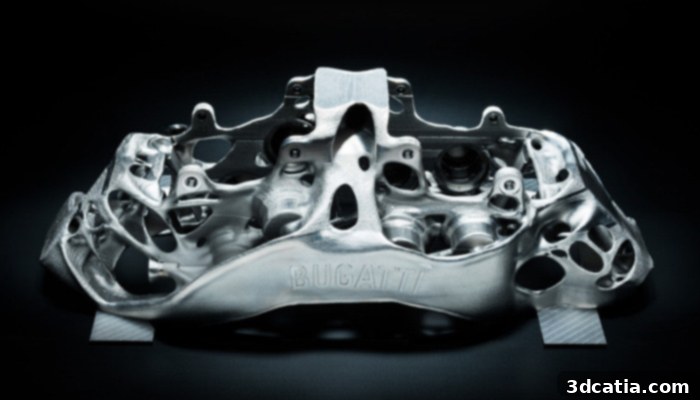
Bugatti additively manufactured a titanium brake caliper. | Credits: Bugatti
Classification and Types of Titanium Alloys: Understanding Microstructure and Performance
Titanium alloys are systematically categorized into three primary groups: α (alpha), α + β (alpha-beta), and β (beta), a classification fundamentally based on the specific crystallographic phases present within the alloy’s microstructure. To fully grasp this classification, it’s essential to understand the terms ‘microstructure’ and ‘phase’. The microstructure refers to the internal structure of a material as observed under an optical or electron microscope. It reveals critical information about the size, shape, and orientation of the individual crystals or grains that constitute the material. The microstructure is a primary determinant of a material’s macroscopic properties, influencing everything from strength and ductility to fatigue resistance. A phase, in the context of materials science, is a region within a material that possesses uniform physical and chemical properties. It distinguishes itself from other regions by variations in its microstructure, chemical composition, or both. The specific phases and microstructure developed in a titanium alloy are highly dependent on factors such as the cooling rate from its liquid state to solid and any subsequent heat treatments applied, which can be precisely controlled to tailor the material’s final characteristics.
Exploring Alpha, Beta, and Alpha-Beta Alloys
The categorization of titanium alloys into these groups is directly linked to the alloying elements combined with pure titanium. Alpha (α)-type alloys are characterized by a predominance of alpha-stabilizing elements, which include aluminum, carbon, oxygen, and nitrogen. These elements stabilize the hexagonal close-packed (HCP) alpha phase at higher temperatures. Alpha alloys are generally noted for their exceptionally low mechanical properties compared to other titanium alloy types, but they compensate with outstanding corrosion resistance, high-temperature strength, and excellent weldability. Common alloys within this group include Ti3Al2.5V and Ti5Al2.5V, often used in applications requiring good creep resistance and corrosion performance, such as chemical processing equipment and airframe components. In contrast, Beta (β)-type alloys were developed with a primary focus on enhancing the material’s mechanical properties. These alloys contain significant amounts of beta-stabilizing elements like iron, molybdenum, and vanadium, which promote the body-centered cubic (BCC) beta phase. Beta alloys offer superior strength, excellent hardenability, and improved formability, making them suitable for applications requiring high strength and ductility. Examples include Ti10.2.3, Ti555.3, and Ti17, which find use in landing gear components and fasteners due to their high strength and toughness.
Finally, the Alpha + Beta (α + β)-type alloys represent a highly versatile and widely researched category, incorporating both alpha-stabilizing and beta-stabilizing elements. This results in a mixed microstructure that masterfully balances the beneficial properties of both alpha and beta phases, offering an exceptional combination of mechanical strength, ductility, fatigue resistance, and fracture toughness. Among these, Ti6Al4V stands out as the most widely used and industrially significant alloy, dominating approximately 56% of the total titanium market. Its remarkable versatility and balanced properties make it the preferred choice for a vast array of critical applications. Analyzing market utilization by alloy type further underscores this dominance, with α alloys accounting for 26%, β alloys for a smaller 4%, and α + β alloys, largely driven by Ti6Al4V, commanding a substantial 70% share. This market distribution clearly illustrates Ti6Al4V’s unparalleled position as a cornerstone material in advanced engineering and manufacturing.
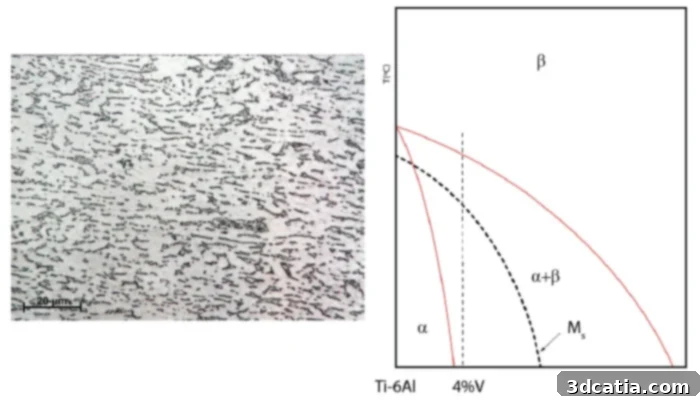
On the left an equiaxial Ti6Al4V microstructure (as-received state without heat treatment). On the right the Ti6Al4V phase diagram.
3D Printing with the Ti6Al4V Alloy: Precision Manufacturing for High-Performance Applications
Mirroring its prominence in the general metal market, the Ti6Al4V alloy is undeniably the most crucial and frequently utilized material in the realm of metal 3D printing. Its widespread adoption stems from a powerful combination of properties: exceptional high strength, critically low density, outstanding corrosion resistance, and remarkable biocompatibility. This comprehensive suite of characteristics renders Ti6Al4V an invaluable material across a diverse spectrum of demanding industries. In the automotive sector, it enables the creation of lightweight, high-performance components for racing and luxury vehicles. For aerospace applications, its strength-to-weight ratio is critical for structural parts, engine components, and satellite structures, leading to significant fuel efficiency gains. The medical and biomedical fields extensively leverage its biocompatibility for implants, prosthetics, and surgical instruments, ensuring patient safety and device longevity. Furthermore, its superb corrosion resistance makes it ideal for chemical processing equipment, while its robust mechanical properties are essential for various military and defense applications, including specialized components and protective gear.
Powder Production for Additive Manufacturing
Before Ti6Al4V can be utilized in 3D printing processes for creating intricate parts and elements, it must first be meticulously transformed into a fine, consistent powder form. The quality and characteristics of this powder are paramount, directly influencing the final properties and performance of the 3D-printed component. There are two primary techniques employed for producing high-quality Ti6Al4V metal powder: plasma atomization and gas atomization. Plasma atomization is particularly well-suited for reactive materials like Ti6Al4V, which are challenging to process. In this method, wires of the alloy are continuously fed into an atomizer hopper. These wires are then melted by a high-temperature plasma torch. As the molten metal droplets fall, they rapidly solidify into highly spherical, low-porosity particles, maintaining exceptional purity. Gas atomization, on the other hand, is a more commonly used and cost-effective technique across the metal powder industry. Here, molten Ti6Al4V is introduced into a nozzle where it is fragmented by a high-velocity stream of inert gas, typically argon (Ar) or nitrogen (N). This gas stream simultaneously cools and solidifies the molten material, forming spherical particles that are subsequently deposited and collected at the bottom of a sealed chamber.
The choice of metal powder manufacturing technique, and consequently the resulting characteristics of the Ti6Al4V powder, is profoundly important. These characteristics, including particle size distribution, sphericity, flowability, and purity, directly dictate the processability in additive manufacturing machines and, ultimately, determine the mechanical properties, surface finish, and integrity of the final 3D-printed part. Currently, three main types of commercialized Ti6Al4V powders are available: TC4, which conforms to the Chinese standard GB/T 3620.1-2017; Ti6Al4V Grade 5; and Ti6Al4V Grade 23, both adhering to the ASTM B348-13 standard. These grades differ primarily in their particle size distribution and trace element composition, which, in turn, impacts factors such as minimum printable layer thickness, achievable resolution, and material density. For 3D printing Ti6Al4V, the most commonly employed additive manufacturing techniques are Direct Metal Laser Sintering (DMLS) and Selective Laser Melting (SLM). These powder bed fusion methods are favored due to their ability to produce highly dense, complex geometries with excellent mechanical properties, making them ideal for the precise demands of titanium alloy fabrication.
The Future of Ti6Al4V in Additive Manufacturing
The symbiotic relationship between the advanced properties of titanium, particularly the Ti6Al4V alloy, and the transformative capabilities of 3D printing is continuously pushing the boundaries of engineering and design. This synergy allows for the creation of components with intricate geometries, optimized topologies for weight reduction, and integrated functionalities that were previously impossible with traditional manufacturing methods. As research and development in both material science and additive manufacturing processes continue to advance, we can anticipate even more efficient powder production, finer resolution printing, and broader applications for Ti6Al4V across even more industries. This ongoing innovation promises to make titanium-based 3D printed parts more accessible, cost-effective, and performance-driven, further solidifying Ti6Al4V’s position as a cornerstone material for the future of advanced manufacturing.
What are your thoughts on titanium, its alloys, and the future of 3D printing with Ti6Al4V? Let us know in a comment below or connect with us on our Facebook and Twitter pages! Don’t miss out on the latest advancements – sign up for our free weekly Newsletter here to get the freshest 3D printing news delivered straight to your inbox!