
Revolutionizing Particle Foam Mold Production: GROB’s Liquid Metal Printing (LMP) and Hofmann’s Expertise Drive Innovation in Aluminum 3D Printing
Additive manufacturing, commonly known as 3D printing, has rapidly transformed various sectors of industrial production. It is now extensively utilized in the creation of essential equipment, sophisticated tools, specialized molds, and durable dies. This innovative technology extends beyond mere prototyping, enabling the fabrication of robust, resilient, and highly customized end-use parts that meet stringent performance requirements.
A prime illustration of this transformative power is the groundbreaking partnership between two prominent German enterprises: GROB-WERKE GmbH and Siegfried Hofmann GmbH. This collaboration is specifically engineered to redefine the production landscape for aluminum particle foam molds through advanced 3D printing techniques. By synergizing GROB’s profound expertise in state-of-the-art additive manufacturing processes with Hofmann’s extensive, specialized knowledge in mold design and fabrication, the alliance aims to develop solutions that are not only more efficient but also fundamentally more innovative for the entire industry. This article delves into the intricate workings of GROB’s unique additive manufacturing technology and explores how Hofmann is strategically leveraging these advancements to optimize the production of superior particle foam tools and molds.
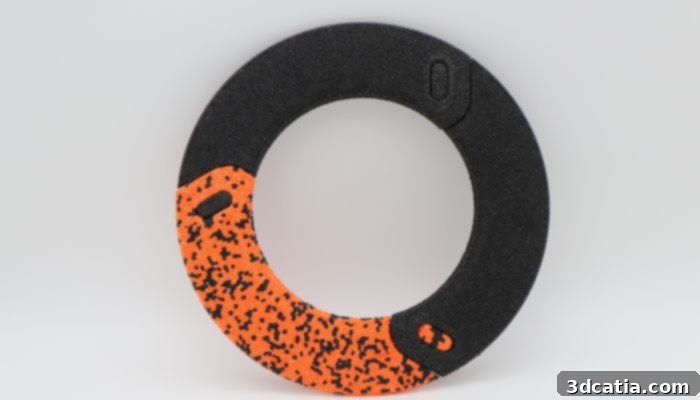
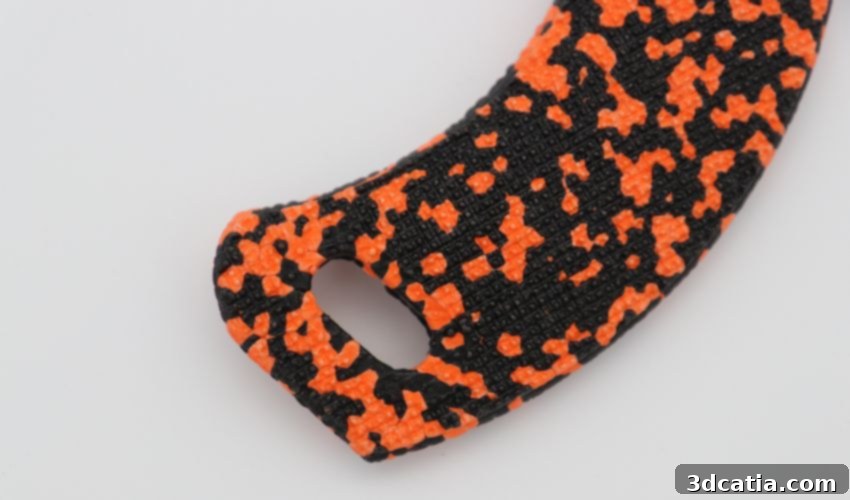
Demonstrator “Frisbee,” a particle foam component, that has the desired feel on the surface, thanks to the uniform porous structure of the GMP printed mold.
GROB’s Liquid Metal Printing (LMP) Technology: A Game-Changer for Aluminum Part Production
In 2022, GROB, a globally recognized leader in the manufacturing of high-precision industrial automation machines and integrated systems, marked a significant milestone with the introduction of its inaugural additive manufacturing machine: the GMP300. This highly innovative 3D printer is built upon a revolutionary concept known as Liquid Metal Printing (LMP) technology, often also referred to as Molten Metal Printing (MMP). GROB specifically engineered this advanced solution for the rapid, cost-effective, and high-quality production of aluminum components, addressing a critical need within various industrial sectors.
Understanding the operational mechanics of Liquid Metal Printing (LMP) technology is crucial to appreciating its advantages. Unlike many conventional metal additive manufacturing processes that rely on fine metal powders, the GMP300 utilizes readily available and economical aluminum wire as its primary feedstock. This choice of material not only simplifies handling and storage but also significantly reduces potential safety concerns associated with powdered metals. The aluminum wire is precisely melted within the system, transforming it into a molten state. Analogous to the precision of an inkjet printer, this liquid aluminum is then meticulously deposited layer by layer onto a heated build plate. The build plate measures a substantial 300 x 300 mm, providing ample space for diverse part geometries. This innovative deposition process facilitates extremely rapid production, boasting an impressive maximum printing speed of 200 cm³ per hour. This speed translates directly into faster lead times and increased throughput for complex aluminum parts.
GROB emphatically states that the parts fabricated using this advanced LMP technology exhibit exceptional characteristics. The resulting components are inherently stress-free, eliminating the need for extensive post-print stress relief treatments that are often required with other metal AM methods. Furthermore, they are immediately ready for use in their intended applications and possess outstanding mechanical properties, rivaling or even surpassing those of traditionally manufactured aluminum parts. The benefits extend to post-processing as well; LMP-produced parts require only minimal subsequent finishing, substantially reducing overall production time and labor costs. Hofmann, a key beneficiary of this technology, further corroborates these advantages, highlighting that aluminum tools produced with LMP are not merely lighter and more resistant to corrosion compared to their steel counterparts. Critically for particle foam applications, these tools also enable optimal vaporization, superior venting capabilities, and ensure a highly homogeneous filling of the mold cavity, all of which are paramount for achieving high-quality foam products.
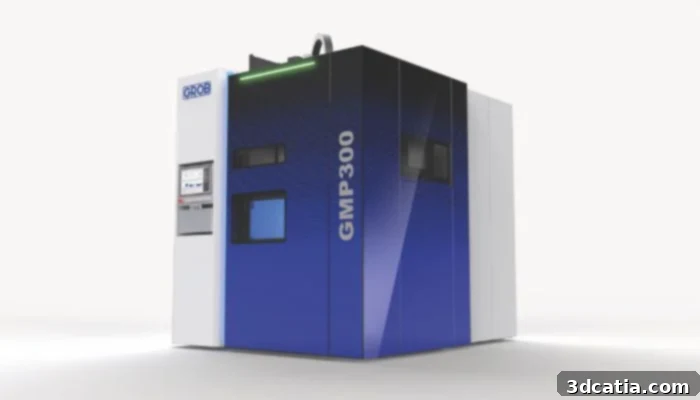
The GMP300 from GROB
Unlocking Efficiency: Additively Manufactured Particle Foam Tools vs. Traditional Methods
To achieve the remarkable performance and efficiency observed in their new generation of particle foam tools, GROB and Hofmann have meticulously engineered an integrated solution. This involves seamlessly combining GROB’s cutting-edge LMP technology with Hofmann’s specialized BE-AD.MACHINE particle foam molding machine. This strategic fusion represents a significant leap forward in manufacturing capabilities. Stefan Hofmann, the Managing Director of Siegfried Hofmann GmbH, expresses immense pride in this achievement, particularly emphasizing the unparalleled speed of production for these additively manufactured aluminum foam molds. He proudly notes, “We only needed a third of the time to produce our demonstrator tool compared to its 3D printed steel counterpart.” This staggering reduction in manufacturing time underscores the immense potential of the GROB-Hofmann collaboration.
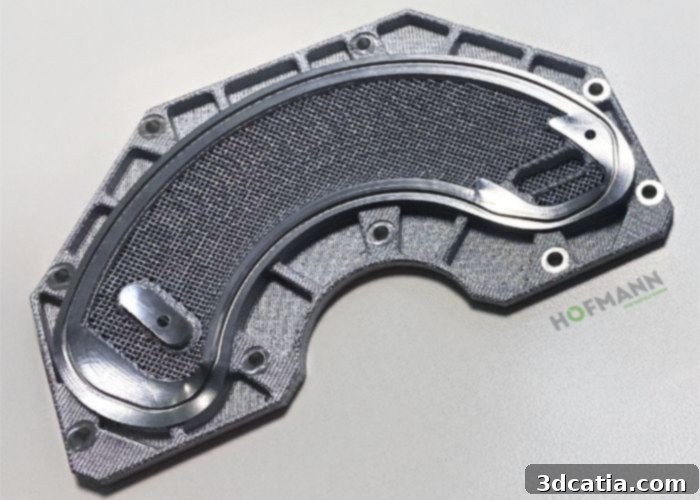
A GMP printed mold for a particle foaming machine, one of two half shells. It has an aluminum, porous structure and is “as printed,” only the sealing surface was post-processed.
The adoption of 3D printing for particle foam tools brings a multitude of compelling advantages when contrasted with conventional manufacturing techniques. Hofmann highlights several key benefits that are redefining industry standards. Firstly, the ability to achieve shorter thermal stages is critical. Aluminum, with its superior thermal conductivity compared to steel, allows for faster heating and cooling cycles within the mold. This directly translates to reduced cycle times during the foaming process, boosting overall productivity and energy efficiency. Secondly, optimized material use is a significant environmental and economic advantage. Additive manufacturing inherently reduces waste by building parts layer by layer, minimizing material scrap compared to subtractive methods. These combined efficiencies ultimately lead to substantial reductions in tool weight, manufacturing costs, and overall production time, providing a competitive edge.
A particularly transformative benefit is the vastly expanded design freedom that 3D printing affords. This capability allows for the creation of molds with incredibly complex and customized geometries, including intricate internal features such as hollow structures of virtually any shape. This level of design flexibility is practically unattainable with traditional manufacturing. For particle foam molds, this means the integration of optimized conformal cooling channels that precisely follow the mold’s contours, ensuring uniform temperature distribution and improved part quality. Furthermore, the ability to create lightweight internal lattice structures reduces material consumption without compromising structural integrity, making the molds easier to handle and contributing to energy savings during operation.
Moreover, the LMP process guarantees the creation of tools that are dense and exhibit minimal distortion. This inherent accuracy and reliability are paramount for consistent performance in demanding industrial production environments. The structural integrity ensures that the molds maintain their precise geometry over extended operational periods, leading to higher quality final products and reduced scrap rates. A critical feature for particle foam production is the high porosity achievable in the mold insert, up to 50%. This controlled porosity is vital for ensuring maximum evaporation of the raw material’s blowing agents and efficient venting of gases during the foaming process. Such optimized porosity facilitates homogeneous filling and prevents imperfections, allowing for the successful production of even very large and complex particle foam components without encountering common issues like sink marks or incomplete filling.
Stefan Hofmann further elaborates on the remarkable acceleration in the production timeline made possible by GROB’s Liquid Metal Printing process. Depending on the complexity of the project, the entire process, from the initial design phase to the first successful foaming operation, can now be completed in as little as one week. This drastically condensed lead time is a game-changer for industries requiring rapid iteration and quick market response. The solution is also presented as an ideal choice for the production of series parts, particularly those with basic surface quality requirements where the speed and cost-effectiveness of LMP shine. Beyond full-scale production, these lightweight, additively manufactured molds offer an unparalleled solution for short-term prototype testing. They enable manufacturers to quickly evaluate new materials, optimize spraying patterns, and refine evaporation processes, significantly accelerating the R&D cycle for innovative particle foam products.
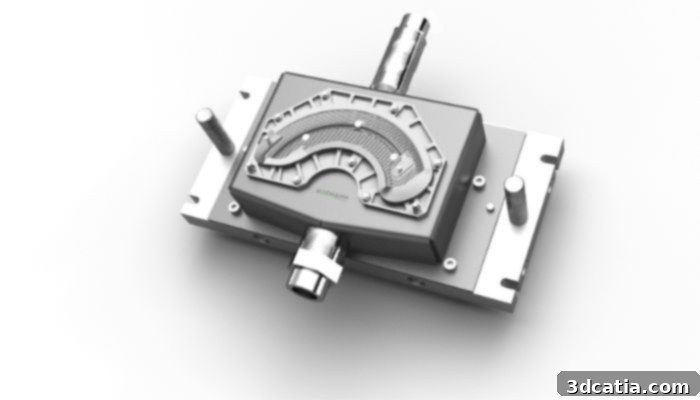
Steam chamber with GMP printed mold, also one of two sides, for installation in a particle foaming machine.
Without doubt, this strategic collaboration between GROB and Hofmann represents a monumental stride towards the widespread integration and adoption of additive manufacturing within the demanding particle foam industry. This partnership serves as a compelling case study, vividly demonstrating how additive manufacturing can deliver faster, more cost-effective, and significantly lighter solutions across various industrial sectors. It powerfully illustrates why 3D printing is progressively emerging as a formidable and increasingly viable alternative to traditional manufacturing methods, which are often characterized by slower processes, higher costs, and inherently less versatility. The innovations stemming from this alliance not only optimize current production but also pave the way for future advancements in material science and product design within the particle foam sector. To delve deeper into GROB’s cutting-edge additive manufacturing offerings and explore their comprehensive product range, we invite you to click HERE.
We value your insights and opinions! What are your thoughts on the innovative application of GROB’s LMP process for manufacturing particle foam tools? Share your perspective by leaving a comment below, or join the conversation on our official LinkedIn, Facebook, and Twitter pages! Don’t miss out on the latest advancements in 3D printing; remember to sign up for our free weekly Newsletter here to receive all the breaking news directly in your inbox! For visual content and demonstrations, you can also explore all our videos on our dedicated YouTube channel.
*All Photo Credits: GROB-WERKE GmbH