
Revolutionizing Dentistry: How 3D Printing Transforms Implant Procedures and Patient Care
The dental industry stands at the forefront of a technological revolution, largely propelled by the integration of additive manufacturing, commonly known as 3D printing. This innovative technology is rapidly transforming various aspects of dental care, offering unprecedented precision, customization, and efficiency. Its applications within the sector are vast and ever-expanding, encompassing the development of highly accurate dental models, custom prostheses, durable implants, and perfectly fitted crowns. The widespread adoption and increased accessibility of dental 3D printing are not merely improving clinical practices; they are significantly driving market growth. Recent analyses underscore this trajectory: a comprehensive study published by Markets and Markets projects that the dental 3D printing market will soar to an impressive $7.9 billion by 2027, demonstrating a robust annual growth rate of 20.2%. This promising outlook is increasingly evident in the growing number of dental clinics and specialized centers globally that are actively embracing 3D printing solutions within their daily operations. A prime example of this transformative shift is the West Lake branch of the renowned Dental Doctor clinic, situated in Suzhou, China, which has strategically partnered with the advanced manufacturing expertise of RAYSHAPE. This collaboration aims to rigorously optimize their production processes and deliver exceptionally precise and personalized dental solutions to their patients.
While dental implants are widely recognized as a safe, highly efficient, and remarkably precise method for replacing missing teeth, offering strong mechanical properties without compromising adjacent natural teeth, the journey to their successful integration has historically been fraught with challenges. The primary obstacles, as highlighted by clinics like Dental Doctor, have revolved around the substantial costs associated with their manufacture and the considerably long lead times required for production and final delivery to the patient. For individuals requiring only one or two implants, the process can be relatively straightforward. However, when faced with extensive oral reconstructions—such as replacing an entire arch or even half of a patient’s dentition—the complexity escalates dramatically. Such major procedures demand significantly more time, not only for the implantation itself but also for the subsequent recovery period, leading to extended patient discomfort and elevated treatment expenses. Traditional manufacturing methods often involve multiple patient visits, labor-intensive manual processes, and potential delays, all contributing to the overall burden on both patients and dental professionals. This creates a critical need for solutions that can streamline the workflow, reduce costs, and accelerate the entire implant journey without sacrificing quality or precision.
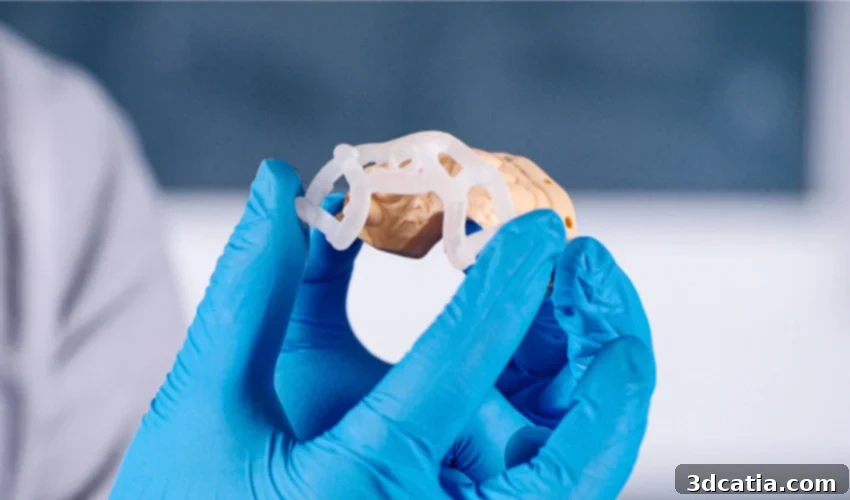
Dental 3D printing is projected to reach an impressive $7.9 billion valuation by 2027, driven by technological advancements and widespread adoption (photo credits: RAYSHAPE).
Integrating Advanced Resin 3D Printing for Enhanced Dental Procedures
Recognizing these pervasive challenges in implant dentistry, the Doctor West Lake Dental Clinic embarked on a thorough evaluation of various technological possibilities. Their objective was unambiguous: to dramatically shorten both surgery times and the fabrication period for dental models, while simultaneously minimizing surgical trauma for patients. Among the diverse additive manufacturing methods available today, resin 3D printing stands out as a preeminent technique within the dental industry, closely followed by metal fabrication for specific applications. The clinic found its ideal solution in the cutting-edge Shape 1 Dental 3D printer, developed by RAYSHAPE. This innovative machine proved instrumental in enabling the clinic to precisely create custom surgical guides, a critical component for modern implantology.
The Shape 1 Dental 3D printer leverages advanced DLP (Digital Light Processing) technology. DLP is a highly regarded additive manufacturing process that uses a digital micromirror device (DMD) to project an entire layer of an image at once, rapidly curing liquid resin with UV light. This method offers distinct advantages over other techniques like Stereolithography (SLA), primarily in terms of speed and consistency across the build platform, making it exceptionally efficient for batch production of dental components. The Shape 1 boasts a generous print volume of 144 × 81 × 200 mm (equivalent to 5.76 × 3.2 × 7.87 inches), making it suitable for a wide array of dental applications, from single surgical guides to multiple models and other prosthetic components. Its combination of high printing speed, impressive throughput, and a competitive price point positions it as an exemplary solution for seamless integration into bustling dental clinics and sophisticated laboratories. Furthermore, the printer is complemented by RAYSHAPE’s proprietary ShapeWare 3D printing software, specifically optimized with a dental version to streamline the design and preparation processes for various applications. Dr. LV Haoxin, a leading practitioner at Dental Doctor clinic, attests to the efficacy of this integration, stating, “The quality of the 3D printed parts from RAYSHAPE is exceptionally good, and the accuracy consistently meets our highest expectations. This reliability is paramount in achieving superior patient outcomes and ensuring the longevity of our dental restorations.“
Optimizing the Digital Workflow: Precision and Customization with DLP Technology
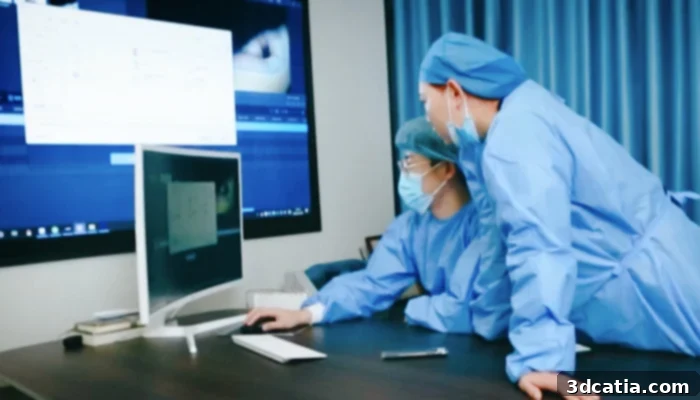
Through the strategic adoption of a fully digital dental implant system powered by RAYSHAPE’s cutting-edge DLP technology, the West Lake clinic has achieved remarkable optimization across the entire process of developing surgical guides and crafting dental implants meticulously tailored to each individual patient’s unique anatomical requirements. This advanced digital workflow represents a significant leap forward from conventional methods, which often rely on analog impressions and manual model fabrication, prone to inaccuracies and delays. The digital process begins with precise intraoral scans and CBCT (Cone Beam Computed Tomography) imaging, generating a comprehensive 3D representation of the patient’s oral anatomy. This detailed data is then imported into specialized dental planning software, where clinicians can virtually plan the entire implant procedure.
Dr. LV Haoxin elaborates on the profound impact of this digital integration: “The design of these 3D printed guides is incredibly effective in substantially reducing surgery time and significantly decreasing postoperative reactions and discomfort for our patients. When a patient presents with missing teeth requiring restoration, we now possess the capability to utilize this sophisticated technology to meticulously design the virtual ideal implant placement even before the actual surgery commences. Within the software, we can make informed choices and precise judgments regarding crucial parameters such as the implant’s axial direction, its optimal depth, the most suitable site distribution within the jawbone, and even its specific diameter, length, and ultimately, the strength and precise shape of the implant itself. This unparalleled level of planning allows us to simulate various scenarios and select the most favorable outcome for each patient, ensuring predictable results. Finally, the precisely fabricated surgical guide, born from this meticulous digital planning, is then employed during the surgery to construct the perfect junction between the final restoration and the implant, ensuring that the designed outcome is achieved with pinpoint accuracy in the patient’s mouth. This iterative and precise process ensures predictability and minimizes intraoperative surprises, leading to superior clinical outcomes.” The ability to visualize and plan every detail in a virtual environment before making any physical intervention not only enhances safety and reduces risks but also allows for greater aesthetic and functional predictability, ultimately leading to higher patient satisfaction and faster recovery times.
Unlocking the Multifaceted Benefits of Additive Manufacturing in Dentistry
The strategic integration of RAYSHAPE’s state-of-the-art DLP additive manufacturing systems has empowered the Dental Doctor clinic to fully harness a broad spectrum of benefits offered by this transformative technology across its entire operational framework. On an operative level, the clinic can now virtually simulate the exact placement of each implant, determining its optimal position, precise depth, and ideal orientation with unwavering confidence, all guided by the accuracy of a custom 3D printed surgical guide. This eliminates much of the guesswork associated with traditional freehand implant placement and significantly enhances safety and predictability for complex cases, especially in areas with vital anatomical structures.
According to Dr. LV Haoxin, one of the most compelling advantages is how additive manufacturing facilitates a minimally invasive digital implantation procedure, completed in a considerably shorter timeframe. This means patients can undergo surgery in a manner that is significantly more comfortable, relaxed, and virtually painless, transforming what was once a daunting experience into a more manageable one. The reduced invasiveness often translates to less swelling, minimal bleeding, and a quicker post-operative recovery, directly improving the patient’s overall journey. More broadly, the adoption of AM brings about significant time savings throughout the entire treatment process. This is particularly evident in the creation of surgical guides, which can be produced rapidly, often within hours, even when they are highly complex or require multiple iterations for optimal fit. The ability to quickly iterate and produce precise components drastically reduces lead times compared to traditional laboratory fabrication methods that can take days or weeks. Furthermore, the inherent increase in the quality and consistency of 3D printed parts is a crucial aspect, guaranteeing reliable, precise results with an exceptionally low margin for error. This consistent accuracy is vital for long-term implant success, optimal occlusal function, and overall patient well-being.
Beyond clinical improvements, a paramount advantage lies in comprehensive cost optimization. This is achieved through several synergistic factors. Firstly, increased efficiency and faster turnaround times allow clinics to serve a greater number of patients, thereby boosting customer acquisition and expanding their market reach. As treatment times are reduced and workflows become more streamlined, dental professionals can dedicate more focused attention to patient care and interaction, fostering stronger relationships and enhancing the overall patient experience. This increased patient volume, in turn, leads to a lower amortized cost per patient for consumables and specialized equipment, making advanced dental care more accessible and economically viable for both the clinic and the patients. Additionally, the digital workflow inherent in 3D printing often reduces material waste compared to subtractive manufacturing techniques, further contributing to cost savings. The precision of 3D printing also minimizes the need for costly chairside adjustments or remakes, saving valuable time and resources. This economic advantage positions clinics that adopt 3D printing as highly competitive and forward-thinking providers in the rapidly evolving dental market, attracting more patients seeking modern, efficient, and precise treatments.
With these significant advancements, Dental Doctor has firmly established itself as one of the pioneering dental clinics in China to fully embrace and successfully implement technological, intelligent, and digital projects on a grand scale. Their unwavering commitment to innovation is further exemplified by the continuous improvement of their chosen technology: the original Shape 1 Dental 3D printer has since been upgraded to the more advanced Shape 1+ Dental version. This enhanced model boasts new and sophisticated features that enable even better development and precision in dental models and surgical guides, pushing the boundaries of what is possible in digital dentistry. RAYSHAPE’s comprehensive 3D printing solution has not only streamlined the clinic’s operations but has also provided patients with a distinctly modern, intelligent, and highly effective treatment experience, with performance consistently exceeding initial expectations. This success story serves as a powerful testament to the transformative potential of additive manufacturing in shaping the future of dental healthcare, setting a new benchmark for patient care and operational efficiency. If you are interested in exploring the full range of the manufacturer’s innovative technology and solutions, we encourage you to visit their official website HERE for more detailed information.
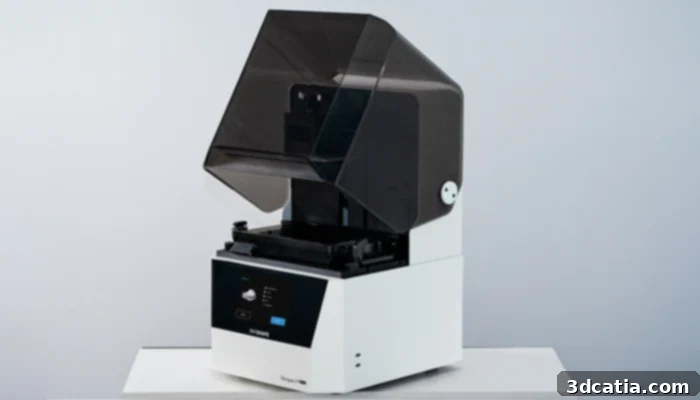
The advanced Shape 1+ Dental 3D printer, a cornerstone of modern digital dentistry, has been enhanced with numerous new features for superior performance and versatility (photo credits: RAYSHAPE).
What are your thoughts on the revolutionary use of resin 3D printing in modern dentistry? We invite you to share your insights and opinions in a comment below or join the conversation on our LinkedIn, Facebook, and Twitter pages! For those eager to stay abreast of the very latest developments and breakthroughs in the dynamic world of 3D printing, don’t forget to sign up for our free weekly Newsletter here, delivering essential news directly to your inbox. You can also explore all our engaging video content and expert interviews on our dedicated YouTube channel.