

Lamborghini Drives Innovation: Accelerating Luxury Automotive Manufacturing with Carbon 3D Printing
From its foundational roots building robust tractors, the iconic Italian marque Lamborghini quickly pivoted to become a global symbol of luxury, performance, and breathtaking design in the world of sports cars. Today, this relentless pursuit of innovation extends into the realm of advanced manufacturing. Lamborghini is strategically embracing additive manufacturing, specifically partnering with Carbon for its cutting-edge Digital Light Synthesis (DLS) 3D printing technology. This collaboration marks a significant step towards revolutionizing how high-performance components are produced for its esteemed vehicle lineup, beginning with the Urus, the brand’s pioneering Super SUV, which first rolled off the production line in March 2018. This groundbreaking initiative includes the production of vital parts, such as a precision 3D printed fuel tank cap, demonstrating a clear commitment to integrating next-generation manufacturing processes into their workflow.
Transforming Production: Lamborghini’s Strategic Bet on Carbon 3D Printing
The partnership between Carbon and Lamborghini represents a pivotal moment in automotive manufacturing. Carbon, renowned for previously producing 3D printed components for Ford models, is now leveraging its expertise and advanced DLS technology to empower Lamborghini in accelerating the production of end-use parts for some of its most coveted sports cars and SUVs. By integrating Digital Light Synthesis (DLS) technology into its manufacturing processes, the Italian automotive giant aims to achieve a new paradigm in part development. The core objectives are clear: to manufacture components that are significantly lighter yet demonstrably stronger than traditionally produced alternatives. This strategic shift is designed to yield multifaceted benefits, including elevated vehicle performance, enhanced design flexibility, and ultimately, a reduction in production costs over time. As of this collaboration’s inception, Lamborghini has successfully integrated a sophisticated 3D printed fuel tank cap and a critical air duct fastening element, both meticulously fabricated using Carbon’s high-performance EPX 82 resin, into its production vehicles. These components underscore the immediate and tangible advantages of additive manufacturing for complex, functional parts.
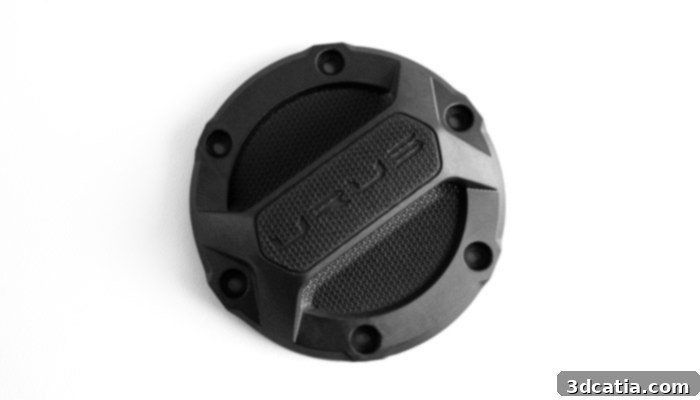
The innovative 3D printed fuel tank cap for the Lamborghini Urus, showcasing precision and advanced manufacturing.
The Power of Digital Light Synthesis (DLS) and EPX 82 Resin
At the heart of this transformative partnership lies Carbon’s revolutionary Digital Light Synthesis (DLS) technology. Unlike traditional layer-by-layer 3D printing methods, DLS uses a proprietary process that rapidly projects a sequence of UV images through an oxygen-permeable window into a reservoir of liquid resin. This creates a “dead zone” above the window where polymerization is inhibited, allowing for continuous liquid interface production. This method enables the simultaneous curing of multiple layers, resulting in parts with isotropic mechanical properties—meaning they are equally strong in all directions—and exceptionally smooth surfaces, minimizing the need for extensive post-processing. This speed and precision are crucial for automotive applications where performance and aesthetics are paramount.
The choice of Carbon’s EPX 82 resin further exemplifies Lamborghini’s commitment to high performance. EPX 82 is an epoxy-based engineering material known for its exceptional strength-to-weight ratio, high heat deflection temperature, and long-term durability. These properties make it an ideal candidate for automotive components exposed to demanding operating conditions, such as those found in an engine bay or structural applications. Its ability to withstand high temperatures and resist chemicals ensures the longevity and reliability expected from a Lamborghini part, directly contributing to the vehicle’s overall performance and safety. By leveraging EPX 82, Lamborghini can confidently produce complex geometries that would be challenging or impossible to create with traditional manufacturing techniques, unlocking new possibilities for design optimization and functional integration.
Designing for the Future: Insights from Lamborghini’s Procurement
Stefan Gramse, the purchasing manager at Automobil Lamborghini SpA, sheds light on the strategic rationale behind this innovative collaboration. He articulates, “Through our extensive procurement research, we found that many of our vehicle components were ideal candidates for digital manufacturing. By partnering with Carbon, we are designing on the means of production, which allows us to produce more durable products smarter, faster, and more efficiently, while also substantially accelerating our time to market.” This statement highlights a profound shift in thinking within Lamborghini. “Designing on the means of production” implies an integrated approach where the design process itself is optimized for additive manufacturing’s capabilities, rather than retrofitting traditional designs to new technologies. This forward-thinking strategy allows engineers to reimagine part geometries, consolidate multiple components into single, more efficient structures, and implement intricate lattice designs that maximize strength while minimizing weight. The result is a more agile development cycle, where design iterations can be rapidly prototyped and refined, significantly cutting down the time from concept to final production, a critical advantage in the highly competitive luxury automotive market.
Expanding Horizons: Future Applications of Additive Manufacturing at Lamborghini
Beyond the initial components like the fuel tank cap and air duct fastening element, Lamborghini is actively exploring a broad spectrum of other parts that could benefit from 3D printing. The ongoing investigation includes a diverse range of applications such as interior components, mirror assembly parts, and various accessories. The potential for additive manufacturing in these areas is immense. For interior parts, 3D printing offers unparalleled opportunities for customization, allowing for bespoke designs and textures that enhance the luxury experience. Customers could potentially personalize elements like dashboard trims, vent covers, or even unique stylistic accents, making each vehicle truly distinct. For mirror assembly parts, the technology allows for complex internal structures that could improve aerodynamics, reduce weight, or integrate new sensor technologies more seamlessly. Accessories, often produced in smaller batches, are ideal candidates for on-demand 3D printing, enabling rapid prototyping and flexible manufacturing without the need for expensive tooling.
This extensive exploration positions Lamborghini firmly among the growing list of elite manufacturers who have seamlessly integrated additive manufacturing into their production lines. This trend signals a broader acceptance of 3D printing as a viable and superior method for producing not just prototypes, but actual end-use parts. Dr. Joseph DeSimone, CEO and co-founder of Carbon, eloquently summarizes this paradigm shift: “The automotive industry is very promising for the use of digital manufacturing for large-scale production, and our partnership with Lamborghini is a perfect example of the kind of innovation you can achieve when you combine design, manufacturability and engineering.” This statement underscores the synergy between advanced design capabilities, the inherent flexibility of digital manufacturing, and rigorous engineering principles. This triumvirate creates an environment ripe for innovation, pushing the boundaries of what is possible in vehicle design and production.
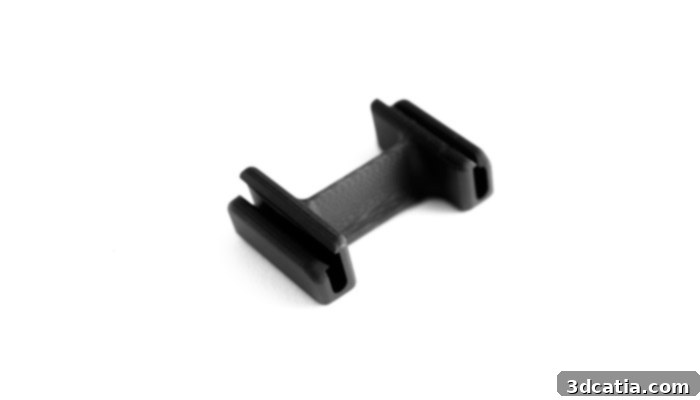
The intricately designed 3D printed fixing element, demonstrating complex geometry capabilities.
The Broader Impact: Additive Manufacturing in the Luxury Automotive Sector
The adoption of Carbon 3D printing by Lamborghini is more than just a technological upgrade; it represents a strategic embrace of a manufacturing philosophy that offers profound advantages for the luxury automotive sector. Firstly, it enables unprecedented levels of customization and personalization. In a market where exclusivity is highly valued, the ability to create unique, bespoke components on demand provides a significant competitive edge. Imagine a customer choosing not only the color and trim of their Lamborghini but also having specific internal components or accessories tailored to their exact aesthetic and functional preferences, all made possible by additive manufacturing.
Secondly, the performance gains are undeniable. By producing lighter yet stronger parts, Lamborghini can reduce the overall weight of its vehicles, leading to improved acceleration, better handling, and enhanced fuel efficiency (even for high-performance vehicles). This commitment to optimizing every gram aligns perfectly with the brand’s ethos of pushing the limits of automotive engineering. Furthermore, the geometric freedom offered by DLS allows engineers to design parts with complex internal lattice structures that provide superior structural integrity and dissipate energy more effectively, contributing to both performance and safety.
Finally, the long-term benefits extend to supply chain resilience and sustainability. Additive manufacturing facilitates on-demand production, reducing the need for large inventories and complex global supply chains. Parts can be produced closer to the point of need, minimizing transportation costs and carbon footprint. Moreover, the inherent nature of 3D printing, which adds material only where needed, significantly reduces material waste compared to subtractive manufacturing processes. This makes it a more environmentally conscious choice, aligning with growing global demands for sustainable production practices. Lamborghini’s investment in Carbon 3D printing is not just about producing parts; it’s about building a more agile, high-performing, and sustainable future for luxury automotive manufacturing.
For those interested in delving deeper into the technological advancements and advantages offered by Carbon, comprehensive information can be found on its official website HERE.
What are your thoughts on Lamborghini’s significant investment and strategic move into additive manufacturing? We invite you to share your perspectives in a comment below or join the conversation on our Facebook and Twitter pages! Don’t miss out on the latest advancements and news in the dynamic world of 3D printing – be sure to sign up for our free weekly Newsletter, delivered directly to your inbox!