
Exploring the Cutting Edge: Top 5 3D Printing Innovations Driving the Future of Manufacturing
The world of additive manufacturing, commonly known as 3D printing, is experiencing a period of unprecedented growth and innovation. This revolutionary technology continues to reshape how products are designed, developed, and produced across a multitude of industries. From pioneering new medical solutions and streamlining complex automotive parts to creating entirely new supply chains, 3D printing is at the forefront of the next industrial revolution. Staying abreast of these rapid advancements can be challenging, but it’s crucial for anyone involved in or interested in the future of manufacturing.
This week, we’ve curated a selection of the top five videos that brilliantly showcase how additive manufacturing is not just changing production, but redefining what’s possible. Our handpicked collection delves into groundbreaking collaborations, significant technological advancements, crucial industry discussions, and initiatives fostering future talent. These videos offer a glimpse into the diverse applications and profound impact 3D printing is having, infiltrating sectors from life-saving medical devices to high-performance automotive components. We invite you to explore these innovations and witness the transformative power of 3D printing firsthand. For even more insightful content, be sure to visit our YouTube channel, where a wealth of 3D printing videos awaits. We trust you’ll find these updates engaging and inspiring!
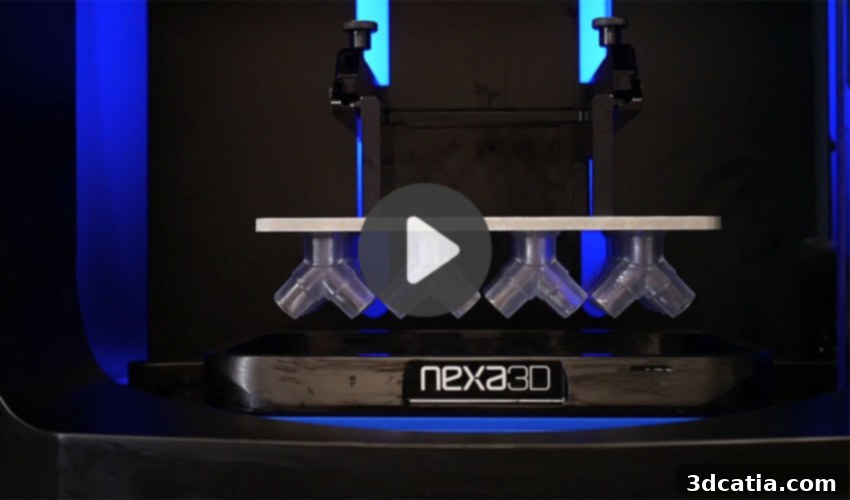
Top 1: Nexa3D & Henkel Forge Ahead with Biocompatible Materials
The unprecedented challenges of recent global health crises underscored the urgent need for rapid, innovative solutions in medical device manufacturing. It was during this critical period that a highly fruitful partnership between Nexa3D, a prominent maker of ultrafast stereolithography (SLA) production 3D printers, and Henkel, a leading global supplier of high-impact functional additive materials, truly blossomed. Their collaborative efforts swiftly led to the development of a revolutionary new material: xMED412.
This advanced polypropylene-like material is specifically engineered for manufacturing a wide range of biocompatible, medical, and wearable devices. Nexa3D’s expertise in high-speed resin 3D printing technology, particularly their proprietary Lubricant Sublayer Photo-curing (LSPc) process, complements Henkel’s deep knowledge in polymer chemistry and material science. The result is a material that not only possesses properties akin to polypropylene – known for its excellent chemical resistance, durability, and flexibility – but is also certified for biocompatibility. This makes xMED412 ideal for applications requiring direct patient contact, such as surgical guides, diagnostic tools, prosthetics, and customized wearable medical sensors. This innovative material allows for the rapid production of patient-specific devices, accelerating healthcare solutions and significantly impacting clinical outcomes by offering unparalleled customization and speed to market.
Top 2: AMT’s Automated De-powdering System Revolutionizes Post-Processing
One of the long-standing bottlenecks in scaling additive manufacturing, particularly for powder bed fusion technologies like Selective Laser Sintering (SLS), has been the post-processing phase. Traditionally, removing excess powder from 3D printed parts is a labor-intensive, often messy, and time-consuming manual task. Additive Manufacturing Technologies Ltd. (AMT), a company dedicated to industrializing additive manufacturing through automation, has tackled this challenge head-on with their innovative PostProDP Pro system.
The PostProDP Pro is an industrial de-powdering solution designed to significantly reduce manual intervention in the additive manufacturing workflow. By automating up to 90% of the cleaning process, this system not only slashes labor costs but also dramatically improves efficiency and consistency. What once took hours of meticulous hand-cleaning can now be achieved in approximately 10 minutes, delivering clean, ready-to-use products. The system is software-enabled and ergonomically designed, making it user-friendly while optimizing for industrial environments. For companies looking to scale up their additive manufacturing facilities from prototyping to high-volume production lines, the PostProDP Pro represents a critical step towards achieving true industrialization, ensuring repeatable quality and accelerating throughput. This automation is vital for making AM a more competitive and sustainable manufacturing method.
Top 3: European Patent Office & EU IP Office Host Pivotal 3D Printing Conference
As additive manufacturing continues its rapid expansion and integration into global industries, the legal and intellectual property (IP) implications become increasingly complex and critical. Recognizing this, the European Patent Office (EPO) joined forces with the European Union Intellectual Property Office (EUIPO) to host their inaugural digital 3D printing conference. This four-day virtual event convened a diverse assembly of legal experts, visionary inventors, savvy investors, and leading academics to meticulously discuss additive manufacturing technology within the intricate framework of intellectual property rights.
Key figures such as António Campinos, President of the EPO, and Christian Archambeau, Executive Director of the EUIPO, spearheaded discussions on the profound potential implications of additive manufacturing for the economy, society, and the established intellectual property system. Topics ranged from patentability of new materials and processes to challenges in enforcing design rights and combating counterfeiting in a digital-first manufacturing paradigm. A particularly highlight was the esteemed presence of Chuck Hull, widely recognized as the inventor of stereolithography – the foundational and first commercially viable 3D printing technology. Mr. Hull shared invaluable insights into the future trajectory of his groundbreaking invention and the broader AM landscape, offering a unique perspective from the very genesis of the industry. This conference served as a vital platform for dialogue, fostering a deeper understanding of how to protect and leverage innovation in the era of 3D printing.
Top 4: Titan Robotics and Braskem Introduce New Industrial Polypropylene Pellets
Material innovation is a cornerstone of advancing additive manufacturing capabilities, unlocking new applications and improving performance. Polypropylene (PP) is one of the most widely used plastics globally, prized for its excellent chemical resistance, durability, flexibility, and cost-effectiveness. However, its widespread adoption in industrial 3D printing has been challenging due to issues like warping and adhesion during the printing process. Addressing this significant market need, Titan Robotics, a leading manufacturer and service provider of industrial large-format 3D printers, partnered with Braskem, a major Brazilian petrochemical company, to launch a groundbreaking new 3D printable polypropylene (PP) resin.
This innovative pellet-based polymer is specifically optimized for printing large-format production parts, a niche where Titan Robotics excels with its robust Atlas 3D printer series. Unlike typical filament-based materials, pellet extrusion offers several advantages, including significantly lower material costs, higher throughput, and the ability to print much larger, stronger parts. This particular offering marks the first commercially available grade of *unfilled* polypropylene designed explicitly for industrial pellet extrusion systems like Titan’s Atlas. The absence of fillers ensures that the material properties are consistent and predictable, making it ideal for demanding industrial applications such as automotive components, jigs and fixtures, functional prototypes, and end-use parts where PP’s inherent characteristics are highly valued. This collaboration represents a major leap forward in making high-performance, cost-effective industrial-grade polymers accessible to the additive manufacturing sector.
Top 5: “Mobility Goes Additive” Fosters Next-Gen Talent in 3D Printing
The rapid evolution of additive manufacturing necessitates a continuous influx of skilled and innovative talent. Recognizing this critical need, the “Mobility goes Additive” initiative stands out as an international competition specifically designed for students, covering all facets of additive manufacturing and digitization. This competition is a collaborative effort spearheaded by the esteemed Association of German Engineers (VDI e.V.) in partnership with the international network Mobility goes Additive e.V. It serves as a vital platform to engage, educate, and inspire the next generation of engineers, designers, and innovators to tackle real-world challenges using AM technologies.
The competition encourages students to explore diverse aspects of 3D printing, from material science and process optimization to design for additive manufacturing and the integration of digital workflows. Participants are challenged to develop creative and practical solutions relevant to the mobility sector, encompassing automotive, aerospace, rail, and other transportation industries. Organizers have expressed immense satisfaction with the participation rate, the palpable motivation demonstrated by the students, and the exceptional quality of the results presented. The enthusiasm and success of this event strongly indicate that “Mobility goes Additive” will almost certainly continue in the coming years, solidifying its role as a crucial pipeline for future talent and innovation in the additive manufacturing landscape. Such initiatives are indispensable for bridging the gap between academic learning and industrial application, ensuring a robust future for 3D printing across all industries.
This week’s roundup vividly demonstrates the dynamic and progressive nature of the 3D printing industry. From advanced biocompatible materials and automated post-processing solutions to critical intellectual property discussions and initiatives nurturing future talent, additive manufacturing is clearly on an unstoppable trajectory of innovation. These five videos offer just a snapshot of the incredible advancements and strategic collaborations that are driving the industry forward, impacting global economies and daily lives. We hope you found these insights compelling and informative.
What were your thoughts on these groundbreaking developments? We encourage you to share your comments and perspectives below, or join the conversation on our Facebook and Twitter pages! To ensure you never miss out on the latest news, breakthrough technologies, and significant events in the ever-evolving 3D printing industry, don’t forget to sign up for our free weekly Newsletter. Get all the essential updates delivered straight to your inbox and stay ahead of the curve!