
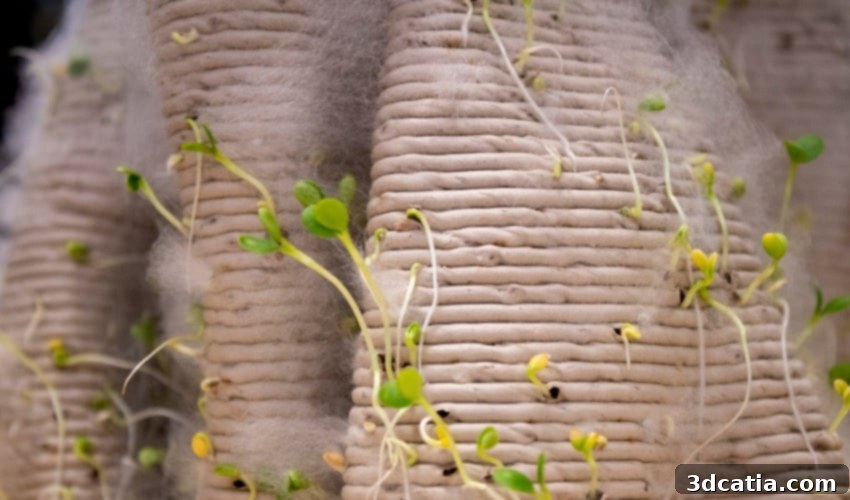
Urban Reef: Pioneering Sustainable Cities Through 3D Printed Natural Architecture
Additive manufacturing, commonly known as 3D printing, is rapidly gaining traction across diverse sectors, not merely for its role in digitizing production processes but also for its profound potential to foster more sustainable practices. This innovative technology enables the transformation of various natural materials, either recycled or sourced directly from nature, into previously unimaginable applications. Imagine structures crafted from clay, soil, food waste, or even coffee grounds – 3D printing makes this a reality, paving the way for a manufacturing paradigm that prioritizes ecological responsibility.
A brilliant exemplar of this transformative approach is the Dutch startup, Urban Reef. This pioneering company seamlessly integrates cutting-edge technologies like 3D printing with natural materials to envision and design urban environments that are not only greener but also more inclusive and welcoming. Urban Reef has developed unique structures, aptly named “Reefs,” which they believe will revolutionize cities, offering tangible solutions to pressing global challenges such as climate change and pollution. To delve deeper into their groundbreaking work and vision, we had the opportunity to speak with one of Urban Reef’s co-founders, Max Latour.
Max Latour: A Visionary in Computational Design and Sustainable Architecture
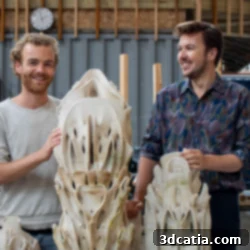
Max Latour (left) and Pierre Oskam (right), co-founders of Urban Reef.
“I am Max Latour, one of the co-founders of Urban Reef, and my professional journey has been shaped by my background as a computational designer with roots in architecture,” Max begins, introducing himself. “My initial academic exploration began at the faculty of architecture at TU Eindhoven, where I first encountered the intriguing possibilities of 3D printing. These early interactions, though brief, sparked a nascent interest in how technology could intersect with architectural design. Following my bachelor’s degree, I transitioned to TU Delft for my master’s studies, specifically drawn to its strong emphasis on advanced architectural design principles. It was during this period that my fascination with computational design truly began to flourish.”
Max’s early design inclinations were centered around the creation of intricate organic shapes. However, this initial interest quickly evolved into a deeper engagement with natural morphogenetic processes – the ways in which natural forms develop and change. He became captivated by the potential of translating these biological growth principles into sophisticated design tools. This intellectual pursuit culminated in his master’s graduation from the esteemed Robotic Building Lab. This specialized studio within the faculty of architecture at TU Delft is renowned for its pioneering work in leveraging computational design tools alongside large-scale, 1:1 prototyping using advanced robotic manufacturing processes, including various forms of additive manufacturing.
After successfully completing his master’s degree, Max continued his association with the Robotic Building Lab, transitioning into a research role. Concurrently, he embarked on independent explorations into broader applications of computational design tools and natural morphogenetic processes, frequently examining their synergy with 3D printing. It was this confluence of his deep expertise in robotic manufacturing and computational design, combined with the insightful work of Pierre Oskam on rewilding urban spaces and his profound philosophical perspectives on the topic, that elegantly converged and ultimately gave rise to Urban Reef as it exists today. This unique blend of technological prowess and ecological philosophy laid the foundation for a company dedicated to transforming urban landscapes.
The Genesis and Mission of Urban Reef: Rewilding Urban Environments
Urban Reef’s journey commenced as a modest yet ambitious experiment, spearheaded by Max Latour and Pierre Oskam. Their paths crossed during a collaborative project at TU Delft, where their shared interests in sustainable design and urban revitalization became evident. Pierre Oskam, also an alumnus of the faculty of Architecture at TU Delft, pursued his doctoral research in Strategic Design at the University of Aveiro and the University of Porto in Portugal. His PhD dissertation delved into the complex concept of “rewilding” abandoned urban spaces, critically examining the evolving relationship between humanity and the natural world, alongside the profound philosophical underpinnings of this paradigm shift. Towards the culmination of his PhD, Pierre sought to materialize one of his core ideas and reached out to the Robotic Building Lab at TU Delft, precisely when Max was engaged in his research there.
The collaborative project at TU Delft served as a fertile ground for extensive discussions regarding the transformative potential of merging their respective interests. They envisioned a future where urban environments could be rewilded through sophisticated design, leveraging abstract principles derived from natural processes. Inspired by these discussions, Max and Pierre decided to initiate an independent, small-scale experiment. This involved the 3D printing of a series of prototypes, meticulously designed according to their innovative ecological principles. Crucially, they experimented with various unconventional materials, including coffee grounds, mycelium (the root structure of fungi), and even living seeds, directly integrating them into the 3D printing process. These initial experiments proved remarkably successful, validating the immense potential of their interdisciplinary approach. This early triumph provided the impetus and confidence needed to dedicate themselves full-time to the venture, propelling Urban Reef into its next crucial phase of development and laying the groundwork for its impactful mission: to create vibrant, self-sustaining ecosystems within the urban fabric, fostering biodiversity and resilience.
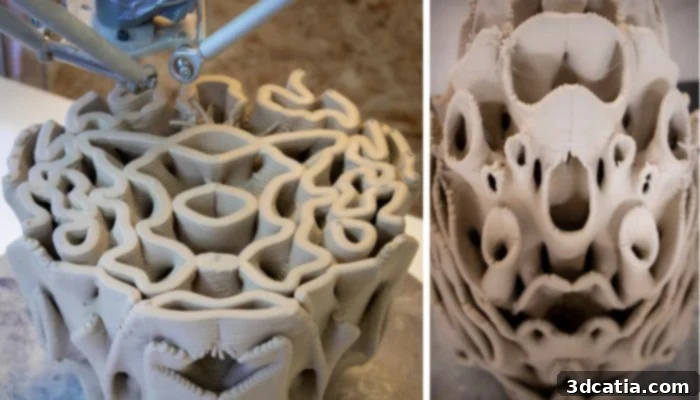
An example of organic structures designed and created using advanced 3D printing techniques.
Unveiling the “Reefs” Concept: Engineering Urban Ecosystems
The core of Urban Reef’s innovation lies in its “Reefs” concept – structures specifically engineered to significantly enhance ecological potential by fostering an extensive diversity of conditions. These intricate structures derive their functionality from geometric complexity, which gives rise to a myriad of interconnected spaces. This architectural intricacy, in turn, cultivates diverse microclimates within and around the Reefs. Factors such as variations in size, shape, and orientation relative to environmental elements like sunlight, wind patterns, and rainfall, all contribute to creating these nuanced microclimates. The ultimate outcome is the creation of potential habitats suitable for a wide array of organisms, from microorganisms and insects to plants and even small animals. The overarching aim of these Reefs is to establish conditions within the urban environment where ecosystems can autonomously thrive, requiring minimal human interference, active management, or reliance on complex artificial systems.
One particularly compelling application of this concept is Urban Reef’s Rain Reef. These structures are meticulously designed for seamless integration with existing urban infrastructure, specifically connecting to downspouts to efficiently collect and buffer rainwater. The material composition of the Rain Reef is intentionally porous, allowing rainwater to be passively absorbed and distributed across its surface. This continuous, natural moistening creates an ideal environment for pioneering ecological growth, enabling algae, mosses, and other hydrophilic vegetation to grow directly on the structure. This ingenious process not only provides critical habitats for urban biodiversity and effectively manages stormwater runoff but also actively contributes to humidifying and cooling the surrounding air through the natural processes of evaporation and transpiration. This makes the Rain Reef a powerful tool in combating the pervasive urban heat island effect, offering a tangible benefit to city dwellers and the environment alike.
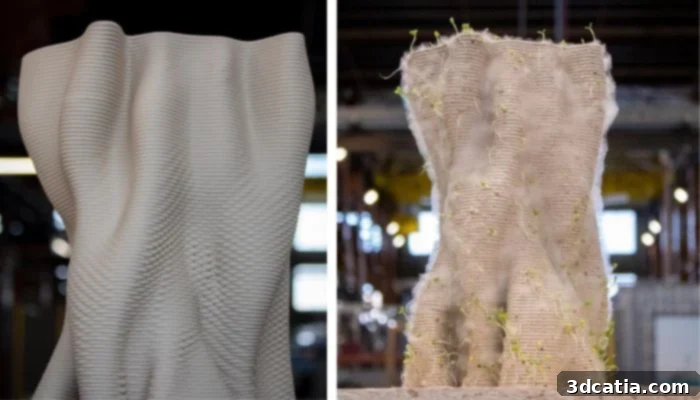
Urban Reefs are designed to ‘come to life’ as they absorb moisture and become thriving environments for fungi, moss, and other natural growth.
Sustainable Materials: Urban Reef’s Bifurcated Approach to 3D Printing
In their dedicated pursuit of integrating profoundly sustainable practices into contemporary urban architecture, Urban Reef has strategically adopted a bifurcated approach to both material research and application development. This dual-track methodology is crucial; it enables the company to deploy viable and applicable solutions in the immediate term, addressing current urban challenges, while simultaneously continuing to explore, innovate, and advance novel bio-based materials for future, even more sustainable implementation. This ensures both immediate impact and long-term ecological progress.
For their currently deployed structures, Urban Reef has judiciously selected ceramics as the primary construction material. This choice is rooted in several practical and environmental considerations: ceramics exhibit relative sustainability, making them a more eco-conscious option compared to many conventional building materials, and they demonstrate excellent compatibility with the existing built environment. Furthermore, ceramics are widely used in construction and possess a suite of essential properties that are perfectly suited for Urban Reef’s applications. These include superior workability during the design and fabrication phases, excellent printability for precise 3D manufacturing, robust structural capacity to ensure durability and stability, and inherent porosity, which is vital for the ecological functions of the Reefs. However, Max acknowledges one significant hurdle yet to be fully overcome: the necessity of the firing process for ceramics, which remains quite energy-intensive. It is precisely at this juncture that Urban Reef’s material research becomes critically pivotal, focusing on mitigating this environmental impact.
In the short term, Urban Reef is intensely focused on maximizing the utilization of local resources. This strategic emphasis is driven by the overarching goal of significantly reducing carbon footprints associated with material transport and sourcing. A prime illustration of this commitment is their collaborative project with Blauwe Bagger, an initiative where they are actively researching and developing the use of local dredge. Blauwe Bagger possesses the innovative capability to extract high-quality clay from dredge – material typically found at the bottom of rivers, lakes, or harbors – transforming this abundantly available, often overlooked, resource into a valuable and sustainable construction material. By integrating such localized and recycled materials, Urban Reef aims to drastically diminish the environmental impact traditionally linked to the sourcing and transportation of building components, thereby enhancing the overall circularity and sustainability of their production processes.
Looking towards the long term, Urban Reef harbors an ambitious vision: to entirely substitute traditional clay with advanced bio-based materials, ideally those that undergo an organic hardening process, eliminating the need for energy-intensive firing. To push the boundaries in this domain, they frequently collaborate with highly specialized partners who possess specific expertise in these innovative materials. For instance, Urban Reef is currently partnering with Junai.earth to experiment with 3D printing using materials derived from olive pits, oyster shells, and alginate. Additionally, in collaboration with Lindey Cafsia, they have successfully explored the potential of printing with cow dung – a testament to their commitment to unconventional and highly sustainable resources. The ultimate objective is to seamlessly integrate these cutting-edge bio-based materials into their mainstream production, once they have been thoroughly developed and are deemed fully ready for large-scale implementation, marking a significant leap towards truly regenerative urban architecture.
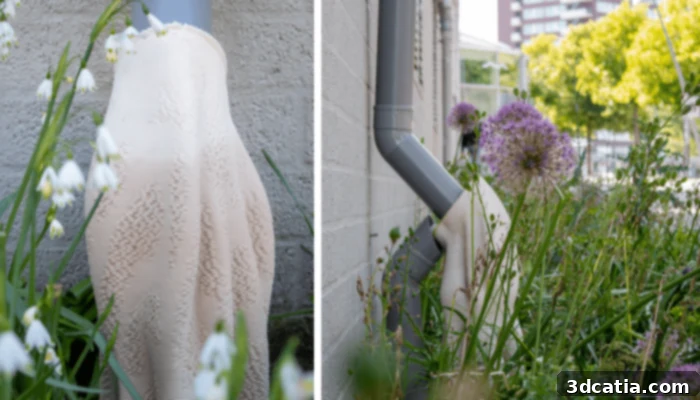
Urban Reef structures are designed to blend seamlessly and organically into their natural and urban surroundings.
Redefining Urban Architecture: The Future Role of Additive Manufacturing
From Urban Reef’s unique vantage point, the future of urban architecture is one where buildings transcend their conventional static roles, evolving into dynamic, living components intricately woven into the very ecosystems they inhabit. Their vision extends far beyond merely integrating superficial green spaces into cityscapes; it is about fundamentally redefining the core essence of what an urban environment can genuinely be. Urban Reef foresees a future where urban structures and buildings exist in profound harmony with nature, actively contributing to and enhancing biodiversity, fostering robust sustainability, and building intrinsic environmental resilience. This holistic approach envisions a symbiotic relationship between the built and natural worlds, where each supports and enriches the other.
In this forward-looking future, 3D printing, or additive manufacturing, is poised to play an absolutely pivotal role, serving as a powerful catalyst for this transformative vision. The immense potential that 3D printing brings to the field of architecture lies in its unparalleled ability to materialize extraordinarily complex geometries and intricate designs. These are forms and structures that were previously either impossible to achieve with traditional construction methods or economically unfeasible due to prohibitive costs and labor. This groundbreaking capability opens up entirely new avenues for architectural innovation, particularly when synergistically combined with advanced computational design strategies. The precision and flexibility of 3D printing, guided by intelligent algorithms, unlock unprecedented creative and functional possibilities in urban design.
These sophisticated computational design strategies empower architectural design to emerge from more organic, bottom-up processes rather than conventional top-down approaches. This paradigm shift can result in designs that are far more intricately related and responsive to specific physical or environmental conditions. Imagine structures optimized not just for aesthetics but also for their interaction with solar radiation, the flow of structural forces, efficient rainwater distribution, or even their ecological potential through the creation of diverse microclimate habitats. Such architecture would be inherently natural, not only from a material perspective but also in its morphogenetic development and its environmental integration, influencing its aesthetic appeal. Furthermore, this approach would lead to the eventual redundancy of many active systems – such as extensive HVAC or irrigation – which are currently considered essential for maintaining desired comfort levels within buildings. This current necessity often stems from a fundamental lack of environmental embeddedness in conventional architectural design, a deficiency that Urban Reef seeks to overcome through intelligent, nature-integrated solutions.
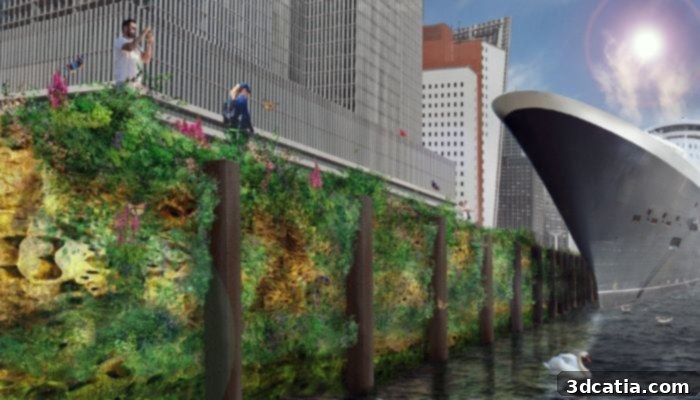
A conceptual rendering illustrating a potential application of Urban Reef’s structures within a vibrant urban setting.
Urban Reef’s Path Forward: Piloting the Future
Currently, Urban Reef possesses the advanced capability to produce innovative stand-alone sculptural structures. This strategic focus has been instrumental, affording the team the invaluable freedom to iteratively experiment with a wide array of design strategies and meticulously evaluate their ecological and functional impacts in controlled environments. This phase of development has been crucial for refining their technology and design philosophy.
As they advance, Urban Reef is actively establishing pilot projects in close collaboration with key market partners. These include leading construction companies, visionary architects, and forward-thinking municipalities. These pilot initiatives are designed to develop and test diverse applications of their “Reefs” in real-world urban contexts, ranging from integrated building components to public art installations that double as ecological habitats. Each project is subjected to rigorous evaluation, considering multiple critical perspectives: its ecological benefits, its functional efficacy, and its alignment with existing market demand. The invaluable insights garnered from these comprehensive evaluations are then used to strategically guide Urban Reef’s future development trajectory, continually moving towards the grander vision of creating cities that not only tolerate but actively stimulate spontaneous, thriving ecologies.
A Call to Action: Reimagining Our Cities
We extend our sincere gratitude for your expressed interest in the mission and values that Urban Reef passionately upholds. As we collectively stand at the threshold of what promises to be a profound revolution in architectural design and urban planning, it is imperative to recognize that 3D printing is far more than merely a novel tool for reproducing conventional designs with new techniques. Instead, it serves as an extraordinary catalyst, unlocking unprecedented possibilities in both design innovation and advanced manufacturing processes, enabling us to transcend existing limitations and envision truly transformative solutions.
Urban Reef extends a heartfelt invitation to everyone – designers, architects, urban planners, environmentalists, and engaged citizens alike – to join us in actively exploring these boundless opportunities. Together, we can not only reinvent our urban environments, making them more resilient and sustainable, but also fundamentally reimagine them as integral, dynamic natural landscapes. We encourage you to learn more about Urban Reef and our pioneering initiatives by visiting our official website HERE.
What are your thoughts on Urban Reef’s innovative approach to urban sustainability? We invite you to share your perspectives in a comment below or connect with us on our LinkedIn, Facebook, and Twitter pages! Don’t miss out on the latest advancements in 3D printing; sign up for our free weekly newsletter here, delivering the most current news straight to your inbox! Additionally, you can explore all our engaging video content on our YouTube channel.
*All Photo Credits: Urban Reef