
Microalgae Ink: Pioneering Sustainable Biocompatible 3D Printing for Medical and Life Science Innovations
Microalgae, a vast and diverse group of microscopic photosynthetic organisms, play a critical role in global ecosystems, contributing an estimated 50% of the world’s oxygen. Beyond their ecological significance, these single-celled powerhouses have long been recognized as a renewable raw material with a multitude of existing applications, ranging from sustainable food production and biofuels to cosmetics and wastewater treatment. Now, an exciting and transformative new field of application is emerging for microalgae, positioning them at the forefront of medical innovation thanks to their integration with advanced 3D printing technologies. This convergence promises to unlock unprecedented possibilities for creating biocompatible structures in healthcare.
The groundbreaking development comes from an international research team, spearheaded by Prof. Dr. Eva Blasco from the Institute for Molecular Systems Engineering and Advanced Materials (IMSEAM) at Heidelberg University. This team has successfully engineered and developed the first-ever microalgae-based ink specifically designed for laser 3D printing, enabling the fabrication of intricate, biocompatible microstructures with unparalleled precision. Prof. Dr. Blasco highlights a critical challenge in the field of microstructure production, particularly for techniques like two-photon polymerization: the predominant reliance on petrochemical-based polymers. These conventional materials carry a heavy environmental burden, contributing significantly to the depletion of finite fossil fuels, the exacerbation of greenhouse gas emissions, and often necessitate the use of potentially toxic components in their formulation. In stark contrast, the newly formulated microalgae ink stands as a revolutionary, environmentally conscious alternative, heralding a new era of sustainable materials for advanced manufacturing.
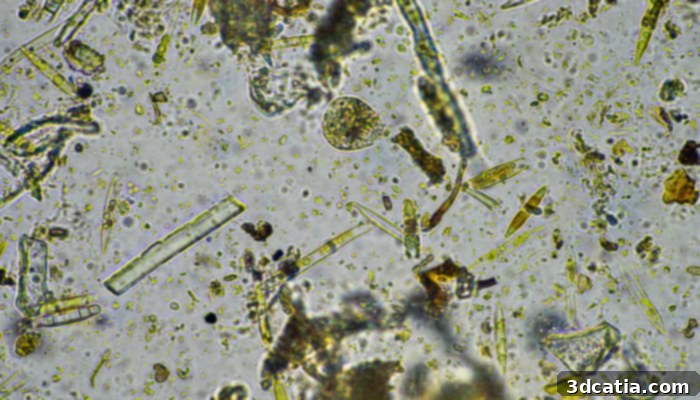
Diatoms and aquatic microorganisms are being harnessed for sustainable 3D printing.
To craft this innovative microalgae ink, researchers meticulously selected two specific types of algae renowned for their exceptional richness in fats, primarily in the form of triglycerides. These particular species—the diatom *Odontella aurita* and the green algae *Tetraselmis striata*—were chosen due to their inherent qualities as superior “biofactories” for the efficient and sustainable production of essential raw materials. The process begins with the careful extraction of these valuable triglycerides from the chosen algae. Following extraction, these triglycerides undergo a crucial functionalization step where they are chemically modified with acrylates. This acrylate functionalization is vital as it imbues the material with the necessary properties to enable rapid and controlled curing when exposed to light, a fundamental requirement for precision laser 3D printing.
A unique and particularly innovative aspect of this microalgae ink lies in its curing mechanism. Instead of relying on external photoinitiators, which are often synthetic and can be potentially toxic, the photoactive green dyes naturally present within the algae biomass itself are leveraged. When these natural pigments are exposed to specific wavelengths of light during the 3D printing process, they trigger a precise chemical reaction that rapidly hardens and solidifies the microalgae ink into the desired complex 3D structure. Clara Vazquez-Martel, a PhD student within Eva Blasco’s distinguished research group at IMSEAM, emphasizes the profound significance of this approach: “In this way we avoid using potentially toxic additives like the photoinitiators used in conventional inks.” This intrinsic bio-curing mechanism not only enhances the biocompatibility of the final printed structures but also aligns perfectly with the overarching goal of developing truly sustainable and eco-friendly biomaterials, setting a new benchmark for additive manufacturing.
A paramount consideration for any material intended for medical or biological applications is its biocompatibility. To rigorously assess this critical property of the novel microalgae ink, the research team conducted a series of comprehensive experiments involving living cell structures. The researchers fabricated intricate 3D micro-scaffolds using the microalgae ink, carefully designed to mimic natural tissue environments. Upon these scaffolds, mammalian cells were cultivated for a period of 24 hours. The results were nothing short of impressive: an astounding survival rate of 100% was observed among the cultivated cells. This remarkable outcome unequivocally demonstrates the excellent biocompatibility of the microalgae ink, confirming its suitability for direct contact with living biological systems without inducing toxicity or adverse reactions.
Prof. Blasco enthusiastically highlights the far-reaching implications of these findings: “Our results open up new possibilities not only for more sustainable 3D printing with light, but also for life science applications – from 3D cell cultures to biocompatible implants.” This success marks a pivotal moment, paving the way for a paradigm shift in how biomaterials are developed and utilized. The ability to create complex, highly precise, and cell-friendly microstructures from a sustainable, non-toxic source is a game-changer for regenerative medicine, drug discovery, and personalized healthcare. This breakthrough suggests that algae-based bioprinting can support cellular proliferation and function, which is essential for creating functional tissues and organs.
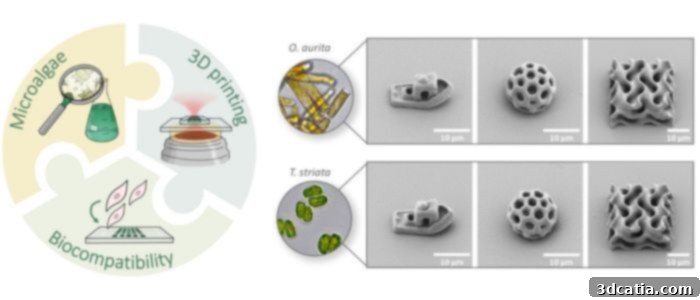
With microalgae ink, complex 3D microstructures can be produced with remarkable quality and precision using 3D printing, enabling new possibilities in various high-tech fields (photo credits: © Clara Vazquez-Martel)
The potential future applications of microalgae ink are vast and transformative, particularly within the medical sector. Its exceptional properties make it an ideal candidate for producing extremely precise micro- and nanostructures, which are crucial for advanced medical devices, diagnostics, and targeted drug delivery systems. Imagine custom-printed scaffolds that perfectly mimic native tissue architecture, accelerating tissue repair and regeneration, or personalized implants designed to integrate seamlessly with the human body. Furthermore, its versatility extends beyond structural components; it could form the basis for next-generation implants and sophisticated scaffolds specifically tailored for 3D cell cultures, enabling more accurate disease modeling and drug screening platforms. The high resolution achievable with this innovative ink also unlocks significant potential across diverse high-tech fields, including optics, photonics, microfluidics, and various other biomedicine applications where intricate detail and functional integration are paramount. Crucially, given its confirmed biocompatibility, microalgae ink is uniquely suited for printing products that will directly interface with living tissue, minimizing the risk of rejection or adverse immune responses.
Beyond its direct utility in advanced manufacturing, the adoption of microalgae-based materials offers substantial environmental benefits. Unlike synthetic polymers derived from petrochemicals, algae are a rapidly renewable resource, capable of growing back quickly and abundantly. Their cultivation actively contributes to environmental protection by sequestering atmospheric carbon dioxide during photosynthesis, thus helping to mitigate climate change. This closed-loop approach to material sourcing represents a significant step towards a more sustainable and circular economy. Prof. Blasco, whose research group operates at the dynamic intersection of macromolecular chemistry, materials science, and 3D nanofabrication, rightly points out: “Despite their advantages, microalgae have hardly been considered as raw materials for light-based 3D printing.” This highlights a previously overlooked opportunity that her team has now successfully capitalized on, showcasing the immense untapped potential of these remarkable microorganisms as a cornerstone for future sustainable technologies.
The development of microalgae ink signifies a major leap forward, not just in materials science but in the broader quest for truly sustainable and functional biomaterials. While challenges such as scaling up production, optimizing cost-effectiveness, and navigating regulatory pathways for medical devices remain, the fundamental breakthrough achieved by Prof. Blasco’s team lays a robust foundation. This innovation underscores the importance of interdisciplinary collaboration in addressing complex scientific and societal challenges. The research work itself was a product of such collaborative synergy, carried out within the prestigious “3D Matter Made to Order” Cluster of Excellence, a joint initiative between Heidelberg University and the Karlsruhe Institute of Technology (KIT). Additional researchers from KIT and the Universidad de Las Palmas de Gran Canaria also played integral roles in bringing this pioneering vision to fruition. For those interested in delving deeper into the specifics of this groundbreaking research, further information can be accessed HERE.
What are your thoughts on the revolutionary potential of using microalgae ink for cutting-edge 3D printing applications, especially in medicine? We invite you to share your perspectives and engage with our community by leaving a comment below. You can also connect with us and join the conversation on our LinkedIn, Facebook, and Twitter pages! Don’t forget to sign up for our free weekly newsletter here for the latest 3D printing news straight to your inbox and stay ahead of the curve! For more visual content and in-depth discussions, you can also find all our videos on our dedicated YouTube channel.