
VENOX Systems Unveils Revolutionary V-REX 5-Axis 3D Printer for High-Strength Continuous Fiber Composites
From its base in Lingenau, western Austria, the innovative start-up VENOX Systems is pioneering the future of additive manufacturing with its groundbreaking 5-axis 3D printer. This sophisticated machine is engineered to process an extensive array of thermoplastics, including those reinforced with continuous fibers. A standout feature of the VENOX system is its unique head-changing mechanism, which grants access to a suite of tools, enabling diverse manufacturing options within a single build process. In developing this advanced machine, VENOX Systems directly addresses the critical challenge of achieving superior part strength in additive manufacturing, a long-standing limitation for many applications.
The V-REX printer is specifically designed to deposit continuous fibers—such as carbon, glass, and aramid—precisely along a part’s load path. This strategic fiber alignment fundamentally alters the mechanical properties of 3D printed components, offering an exceptionally high strength-to-weight ratio. This advancement holds immense promise for a multitude of industries, including aerospace, automotive, and sports equipment, where lightweight yet robust parts are paramount. We had the distinct pleasure of speaking with Nicolai Wampl, co-founder of this ambitious Austrian company, to delve deeper into the specifics of this revolutionary printing process, its underlying technology, and its vast potential applications in the industrial landscape.
3DN: Could you introduce yourself and elaborate on your connection to the world of additive manufacturing?
My name is Nicolai Wampl, and I am a proud co-founder of VENOX Systems. My journey into additive manufacturing began through a pivotal encounter with my fellow co-founders here at VENOX. They had already made significant strides in developing a sophisticated 3D printing system, one that possessed the remarkable capability to print not only with various thermoplastic materials but also to integrate continuous fibers, which is a game-changer for material properties. Initially, we faced the typical challenges associated with bringing a novel technology to fruition – from refining the hardware and software to perfecting the material extrusion process. However, through perseverance and a shared vision, we successfully navigated these early hurdles. Our next critical step was to secure the necessary financial backing to scale our innovative technology to an industrial level, making it viable for widespread commercial adoption. Obtaining crucial funding under a prestigious Austrian support program proved to be a decisive turning point for our company, allowing us to accelerate development and solidify our position in the advanced manufacturing sector.
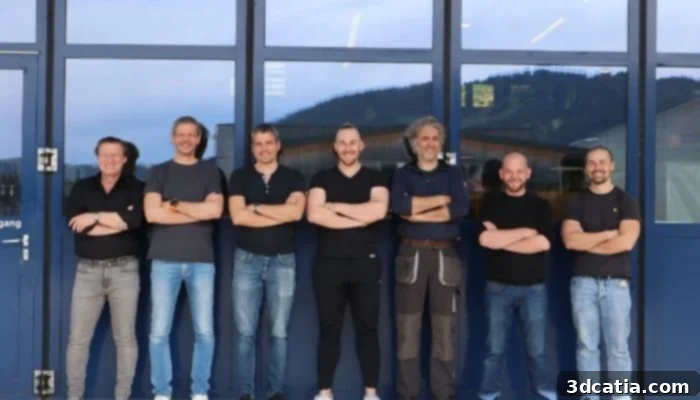
The VENOX Systems team
3DN: How did the foundational idea for VENOX Systems first come about?
A few years ago, as the field of industrial 3D printing began its transition into the mainstream, garnering increasing attention across various sectors, we undertook a comprehensive analysis. Our goal was to identify the primary obstacles that were preventing 3D printing from truly competing with established, traditional manufacturing methods on a broader scale. We rigorously evaluated the landscape and pinpointed three significant limitations inherent in much of the existing FDM/FFF technology: namely, the strength and durability of the printed parts, the relatively slow manufacturing speed, and often, the subpar surface quality of the finished products. Among these critical issues, the challenge of enhancing part strength emerged as the most pressing and impactful for industrial applications. It was this fundamental problem – the need for stronger, more reliable 3D printed components – that VENOX Systems resolutely set out to solve, forming the core mission of our company and guiding our technological development.
3DN: Can you provide more details about your innovative machine, the V-REX?
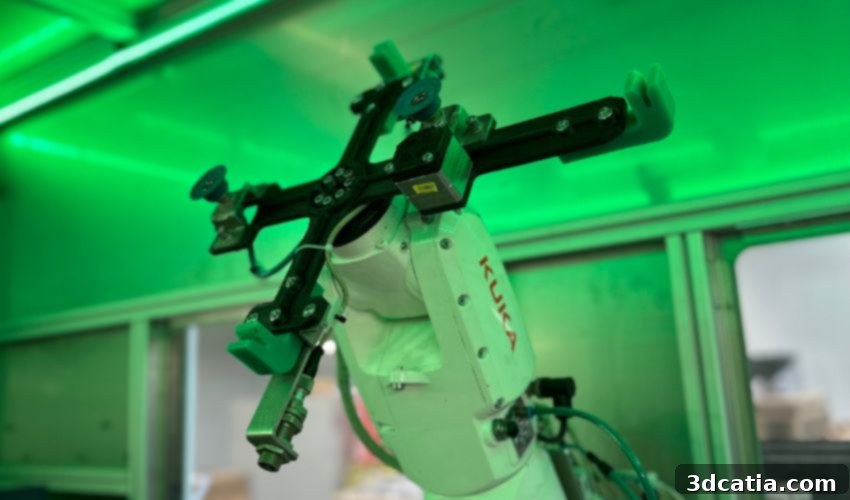
Our new machine, aptly named the V-REX, which stands for VENOX-Revolutionary Extrusion System, is not just an incremental improvement but a leap forward in additive manufacturing. It boasts a suite of unique features that set it apart from conventional 3D printers. Leveraging our extensive background and deep expertise in mechanical engineering, our vision from the outset was to create something far more advanced than a typical extrusion printer with just one novel addition. We drew profound inspiration from the versatility and multi-tool capabilities found in traditional manufacturing processes, and this led us to integrate a sophisticated head-changing system. This innovative system empowers the V-REX to utilize up to six different tools dynamically within a single, continuous manufacturing process, offering unprecedented flexibility and complexity in part production. Imagine a single machine capable of performing multiple functions without manual intervention, streamlining the entire workflow and expanding design possibilities.

The V-REX 3D printer
These interchangeable tools include various FDM printheads, optimized for different materials and extrusion rates, alongside our truly exclusive CFFP (Collision-Free Fiber Placement) process. The CFFP system is a cornerstone of the V-REX’s capability, enabling the precise and efficient printing of continuous fibers such as carbon, which are crucial for high-performance applications. While other machines exist that can print continuous fiber-reinforced thermoplastics, our innovative 5-axis gantry system provides a distinct and critical advantage. It’s important to understand that carbon fibers and other composite materials inherently possess anisotropic properties. This means their strength, stiffness, and other mechanical characteristics are highly dependent on the direction in which the fibers are oriented within the material. Traditional 3-axis printers are limited to reinforcing parts primarily at a planar level, typically in the X-Y plane, which often results in significantly reduced strength along the Z-axis – a common Achilles’ heel for FDM parts. Our advanced 5-axis machine overcomes this inherent limitation by allowing us to manipulate the print head and the build platform simultaneously across multiple axes. This enables the precise alignment of continuous fibers along the exact load path a part will experience in its intended application. The result is the creation of highly optimized, lightweight components that exhibit exceptional strength and durability, precisely where it is needed most. This capability opens up new avenues for designing parts that were previously impossible to manufacture with conventional additive techniques, fundamentally improving structural integrity and performance across demanding industries.
3DN: What range of materials is compatible with the VENOX Systems machine?
The VENOX Systems machine is engineered for broad material compatibility, reflecting its versatility in advanced manufacturing. It can seamlessly print with the vast majority of thermoplastics, accommodating those with melting temperatures up to 500°C. This wide thermal range allows for the processing of standard engineering plastics as well as high-performance polymers, enabling a diverse range of applications. Beyond thermoplastics, our system is uniquely capable of working with various composite materials, significantly enhancing the mechanical properties of printed parts. This includes continuous fibers such as high-strength carbon fiber, lightweight fiberglass, and robust aramid fibers, each bringing specific advantages in terms of stiffness, tensile strength, and impact resistance. The ability to integrate these fibers allows manufacturers to produce components with tailored properties for demanding environments. In an exciting development, we are also actively pushing the boundaries by exploring the incorporation of electrical features directly into 3D printed parts. This involves printing with specialized wires instead of traditional fibers, which could revolutionize the creation of smart components with integrated circuitry. While this capability is still under meticulous development and refinement, we have already achieved significant milestones, successfully producing initial demonstration parts that showcase the immense potential for embedding functionality directly within the material structure. This innovation could pave the way for entirely new categories of electronic and mechatronic 3D printed devices.
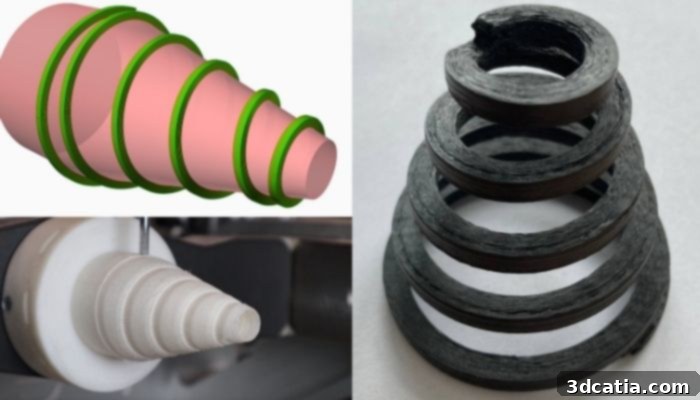
The machine is compatible with a wide range of thermoplastics
3DN: How does your machine effectively address the key challenges currently faced by 3D printing users in various industries?
Our V-REX machine is meticulously designed to tackle several prominent challenges that users of 3D printing technology frequently encounter. Firstly, it offers unparalleled openness, providing both material and software flexibility. This means users are not locked into proprietary ecosystems; they have the freedom to choose from a vast range of materials and integrate with their preferred software workflows. This openness is crucial for maximizing the technology’s potential, allowing for greater innovation, customization, and cost-effectiveness. By empowering users with choice, we enable them to push the boundaries of design and application without artificial constraints. Secondly, the V-REX is specifically engineered not just for prototyping, but for the robust and reliable mass production of end-use parts. This represents a significant shift from many conventional 3D printers that are often relegated to producing conceptual models or functional prototypes. Our system delivers higher quality and enhanced functionality in final parts, making additive manufacturing a viable and often superior alternative for direct manufacturing. This capability is vital for industries requiring components that meet stringent performance criteria and can withstand operational stresses. Furthermore, the V-REX addresses the critical need for improved mechanical properties, particularly strength and durability, through its unique continuous fiber placement and 5-axis capabilities. By strategically reinforcing parts along their load paths, we significantly enhance their structural integrity, making them suitable for high-stress applications previously unattainable with additive manufacturing. This superior strength, combined with the machine’s ability to handle advanced thermoplastics and composites, empowers users to create lightweight, high-performance parts that meet the rigorous demands of sectors like aerospace, automotive, and medical devices.
3DN: Do you have any final words or insights you’d like to share with our readers?
Indeed, as we introduce this transformative additive manufacturing technology to the wider industry, we are offering more than just the V-REX machine itself. We recognize that not every company has the immediate infrastructure or expertise to integrate a new manufacturing system. Therefore, VENOX Systems is also proud to offer advanced 3D printing as a service. This means that if you have a specific project or application where the weight-to-resistance ratio is an absolutely critical factor – whether for aerospace components, high-performance sporting goods, or lightweight industrial tooling – we are poised to be your ideal solution. Our expert team can leverage the V-REX’s capabilities to produce your custom, high-strength, lightweight parts, providing access to cutting-edge technology without the initial capital investment. We encourage anyone interested in exploring the potential of continuous fiber reinforcement and 5-axis additive manufacturing to reach out and discover how our technology can revolutionize their product design and manufacturing processes. Don’t hesitate to visit our official website HERE to learn more about our services, the V-REX machine, and the future of high-performance 3D printing. We are confident that our solutions can unlock new levels of performance and efficiency for your most challenging projects.
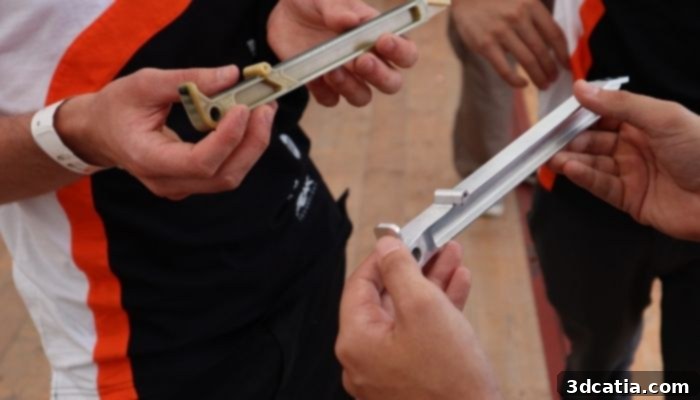
VENOX Systems also offers a 3D printing service
What are your thoughts on the groundbreaking 3D printer developed by VENOX Systems and its potential to reshape industrial manufacturing? We’d love to hear your perspective! Share your comments below or engage with us on our social media platforms: connect with us on LinkedIn, follow our updates on Facebook, and join the conversation on Twitter! To stay at the forefront of the latest advancements in the world of 3D printing, remember to sign up for our free weekly newsletter here – delivering the most pertinent news and insights straight to your inbox. You can also explore all our captivating videos and in-depth content on our dedicated YouTube channel.
*All Photo Credits: VENOX Systems