
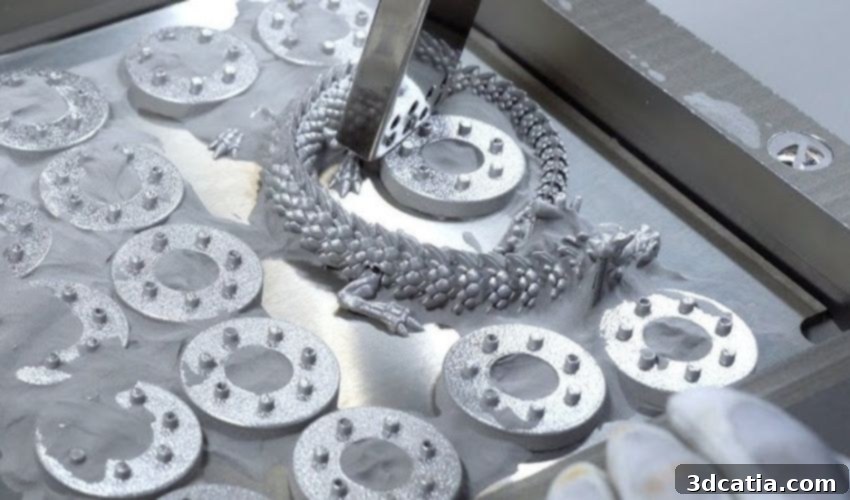
Resilience and Reinvention: Shapeways and Voxeljet Chart a Path Towards a Brighter Future for Additive Manufacturing
The year 2024 has presented its fair share of challenges for the additive manufacturing industry, marking a period of significant economic headwinds and structural adjustments. While the sector continued to witness remarkable technological innovations and groundbreaking applications, the broader economic climate exerted considerable pressure on many companies. We’ve seen prominent players like KIMYA face closures and experienced widespread layoffs across various organizations, signaling a difficult operating environment. Even at major industry gatherings such as Formnext, an air of caution, or even stagnation, seemed to pervade discussions, reflecting a market grappling with maturation and consolidation. However, recent developments, particularly from pioneers like Shapeways and industrial powerhouses like voxeljet, suggest that the additive manufacturing market is far from predictable and still holds significant capacity for surprising comebacks and strategic shifts. These stories offer a much-needed glimmer of hope, hinting at renewed vigor and strategic redirection for the industry moving into 2025.
The journey for Shapeways, a company long recognized as a trailblazer in digital manufacturing, has been particularly tumultuous. News earlier this year that the company was officially ceasing operations was, for many in the industry, not entirely unforeseen given the volatile market, yet it was met with widespread sadness. Shapeways had, for years, championed the democratization of 3D printing, providing an accessible platform for designers, engineers, and hobbyists to transform digital models into physical objects. Its innovative marketplace connected creators with manufacturing capabilities, fostering a vibrant ecosystem of innovation and custom product development. The prospect of losing such a foundational entity was a blow to the community it had cultivated. However, the narrative has taken an unexpected, and immensely positive, turn. A recent press release has dramatically announced Shapeways’ intention to re-enter the global market, albeit under a “new” management team. The quotation marks are deliberate, as this “new” leadership marks a significant return to the company’s roots, consisting of two of its original co-founders who had departed in 2012 and 2014, alongside key personnel who remained with the company in its crucial Eindhoven operations.
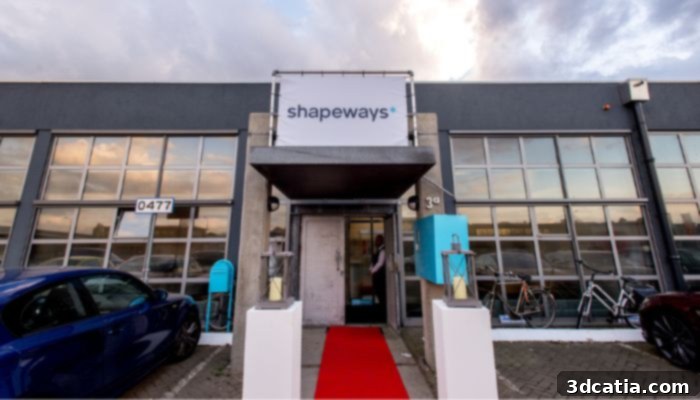
The Eindhoven factory at its opening (photo credits: Silas Pelsmaeker/Shapeways)
The re-emergence of Shapeways is spearheaded by Marleen Vogelaar, who co-founded the company in 2007 and left in 2014, and Robert Schouwenburg, the other co-founder who departed in 2012. These visionary leaders will be joining forces with Jules Witte, Tiago São José, and Job van de Laar, who maintained the company’s vital operations in Eindhoven. This strategic re-alignment underscores a fundamental understanding of what led to the previous downturn. The press releases explicitly state that the company’s bankruptcy in July was largely a consequence of significant structural and business model changes implemented under previous leadership. These changes, often driven by rapid scaling or diversification efforts, may have inadvertently diluted the company’s core focus or financial stability. Recognizing this, the management of the profitable Eindhoven factory made the crucial decision to partner with the original founders, aiming to reset the company’s trajectory and steer it back towards its foundational principles and sustainable growth. This move is a testament to the enduring vision of the founders and the operational resilience embedded within the Eindhoven facility.
Marleen Vogelaar, now stepping into the role of CEO for the revitalized Shapeways, articulated the renewed mission with clear conviction. She explained, “When I helped to launch Shapeways in 2008 it was at the forefront of democratizing access to digital manufacturing. The new management team believes there is a ‘next chapter’ to be written in the Shapeways story, one that includes learning from the past and building a pragmatic, financially sustainable and operationally stable company that continues to provide exceptional service to our users.” This statement is incredibly insightful, highlighting a shift from potentially aggressive growth strategies to a more grounded approach focused on long-term viability and customer satisfaction. It signals a maturity in the digital manufacturing sector, where sustainability, both financial and operational, is paramount. The emphasis on “learning from the past” suggests a critical evaluation of previous missteps, ensuring that the company’s future trajectory is built on solid, realistic foundations. This pragmatic vision is precisely what the additive manufacturing industry needs as it navigates economic uncertainties and strives for mainstream industrial adoption.
The restructured Shapeways plans to continue its operations primarily from Eindhoven, The Netherlands, leveraging its well-established infrastructure and expertise as a digital manufacturing engine for a global customer base. The company’s commitment to offering a diverse array of 3D printing technologies, materials, and comprehensive post-processing options remains steadfast, ensuring that users can access a wide spectrum of additive manufacturing solutions with standard and custom quality control options. This focus on its core strength as a manufacturing service provider is a smart move, concentrating resources where its operational excellence is proven. However, the bankruptcy did incur certain unavoidable losses. Notably, the popular Shapeways marketplace and individual shops will not be able to be restarted due to critical data loss incurred during the bankruptcy proceedings. This is a regrettable but understandable consequence, impacting the community aspect that was central to its original model. Furthermore, while the new management team successfully acquired all intellectual property previously owned by the defunct entity, user-generated intellectual property (User IP) could not be sold, as it legally belongs to the individual users. This distinction is crucial for maintaining trust and protecting creators’ rights within the digital manufacturing ecosystem, signaling Shapeways’ renewed commitment to ethical practices and user-centric operations.
voxeljet Signs Agreement With Anzu, Securing Its Future
In a similar vein to Shapeways, voxeljet, a key player in industrial 3D printing, has also navigated a challenging period throughout the year. The company, known for its pioneering binder jetting technology, particularly for sand casting and complex metal applications, faced considerable financial pressures. These challenges culminated in its withdrawal from the NASDAQ Stock Exchange and SEC in March, a strategic move aimed at significant cost reduction and streamlining operations in response to market demands and financial pressures. Such a withdrawal often signals a period of intense restructuring and a search for more stable financial footing. However, much like Shapeways, hope has emerged for this promising, albeit struggling, spin-off from the Technical University Munich (TUM). In a pivotal development, US technology investor Anzu Partners has formalized an agreement to acquire voxeljet for an approximate value of €20,033,000. This acquisition includes a comprehensive financial structure: the purchase price, subject to customary adjustments and closing conditions, will be primarily facilitated through Anzu’s assumption of voxeljet’s existing liabilities, complemented by a cash payment of approximately €1.7 million. This strategic investment not only provides immediate financial relief but also injects crucial capital and strategic partnership into a company with immense technological potential.
Rudolf Franz, CEO of voxeljet AG, expressed profound optimism regarding the acquisition, emphasizing the intrinsic value of the company’s assets and talent. “For more than 25 years our incredibly talented teams have created some of the most powerful industrial 3D-printers,” said Franz. He further elaborated on the synergy anticipated from this partnership: “The combination of voxeljet’s world-class talent and extraordinary franchises with Anzu’s technology network, access to talent, ambitious vision and shared commitment to investing in the next generation of breakthroughs will help ensure our continued success in an increasingly competitive industry.” Franz’s statement highlights voxeljet’s long-standing legacy in developing robust, high-performance industrial 3D printing solutions. Their expertise spans from creating some of the largest sand 3D printers in the world to developing precise binder jetting systems capable of producing intricate components. Anzu Partners’ involvement brings not only financial stability but also a broader technology network and a strategic vision that can propel voxeljet to new heights, enabling it to better compete and innovate within the rapidly evolving additive manufacturing landscape. This partnership signifies a recognition of voxeljet’s core strengths and its potential to lead in industrial-scale additive manufacturing.
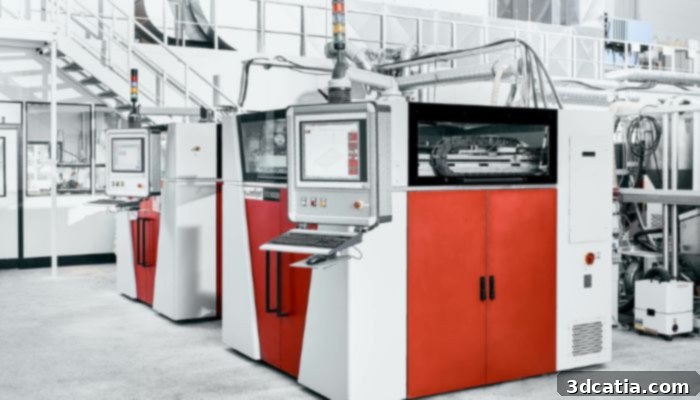
voxeljet’s solutions were a major draw for Anzu (photo credits: voxeljet)
Anzu Partners has clearly articulated its strategy and commitment following the acquisition, emphasizing its strong dedication to voxeljet’s existing customer base, supplier network, and invaluable employees. This continuity is vital for maintaining operational stability and market confidence. Anzu’s attraction to voxeljet stems from the latter’s immense potential to accelerate industrial-scale 3D printing, leveraging its advanced technology suite. This includes everything from the world’s largest 3D printers, capable of producing massive sand molds and cores for metal casting, to systems that enable the creation of incredibly fine details and complex geometries in various materials. Such capabilities position voxeljet uniquely in markets requiring high precision, speed, and scalability in additive manufacturing. The newly acquired company will be strategically managed, with Whitney Haring-Smith, a managing partner at Anzu, taking on the role of chair of the Board of Directors. Rudolf Franz, the current CEO, will continue to lead the post-transaction business, ensuring a seamless transition and leveraging his deep industry knowledge. This collaborative leadership structure aims to provide voxeljet with a robust partner to support its further growth, facilitate necessary financing for future developments, and expand its market reach in the competitive industrial 3D printing sector.
It is important to note that as part of the acquisition agreement, voxeljet has been granted a standard “go-shop” period, which is set to expire on January 12, 2025. This provision allows voxeljet to actively solicit and consider alternative acquisition proposals from third parties, ensuring that the company explores all potential avenues to maximize shareholder value. The press release further clarifies that in the event a superior proposal emerges during this period, voxeljet retains the right to terminate the current purchase agreement with Anzu. This mechanism is a common practice in M&A transactions, designed to protect the interests of the selling company and its shareholders by ensuring the best possible outcome. While the “go-shop” period introduces a slight element of uncertainty, the initial agreement with Anzu Partners provides a strong foundation for voxeljet’s future. Regardless of whether an alternative offer materializes, the news regarding both Shapeways’ determined comeback and voxeljet’s strategic acquisition by Anzu Partners is unequivocally positive. These developments signal a crucial turning point, moving these companies away from financial difficulties and towards renewed stability and growth. This could very well be a harbinger of a “sunnier” and more stable 2025 for the broader additive manufacturing market, reflecting a period of strategic consolidation, resilient innovation, and renewed investor confidence as the industry matures.
The recent turnarounds at Shapeways and voxeljet are more than just isolated corporate news; they represent significant markers for the broader additive manufacturing industry. These events highlight the sector’s intrinsic resilience and its capacity for strategic evolution in the face of economic pressures. As Shapeways returns to its core mission of being a reliable digital manufacturing engine and voxeljet gains robust backing for its industrial 3D printing innovations, the market is poised for a more focused and financially sustainable future. These stories exemplify a shift from speculative growth to pragmatic development, emphasizing operational efficiency, customer value, and long-term viability. What are your thoughts on these critical developments for Shapeways and voxeljet? How do you foresee these strategic moves influencing the wider additive manufacturing landscape in the coming year? We invite you to share your insights and opinions in a comment below or join the conversation on ourLinkedIn,Facebook, andTwitter pages! To stay informed about all the latest breakthroughs and news in 3D printing, don’t forget to sign up for our free weeklyNewsletter here, delivered straight to your inbox. You can also explore our extensive library of videos and expert analyses on our dedicatedYouTube channel. Your engagement helps us foster a dynamic and informed community within the additive manufacturing world.