
Thangs by Physna: Revolutionizing 3D Model Search, Design, and Collaboration with AI
In a groundbreaking move set to redefine the landscape of digital design and manufacturing, Physna, a recognized leader in geometric deep-learning technology, has officially unveiled Thangs. Heralded as the world’s inaugural geometric search engine for 3D models, Thangs has swiftly emerged as a cornerstone online community for 3D model creators, just days following its highly anticipated launch. Physna’s ambitious vision for Thangs extends beyond mere search; the company aims to “democratize” the complex realm of 3D models by establishing a global, easily accessible index of physical objects. To achieve this monumental goal, Physna has seamlessly integrated its cutting-edge, proprietary artificial intelligence (AI) algorithms into Thangs, offering a platform that is entirely free to join and poised to profoundly revolutionize the entire 3D printing and design workflow. But what precisely makes Thangs so exceptional, and how is it poised to transform how we interact with three-dimensional data?
Physna’s Pioneering Technology: The Brain Behind Thangs
Founded in 2015 by the visionary duo Paul Powers and Glenn Warner, Physna has meticulously developed and refined a suite of proprietary algorithms coupled with advanced geometric deep-learning technology. This sophisticated system is capable of codifying intricate 3D models into incredibly detailed and structured data. The resulting digitized model empowers Physna to discern and highlight precise differences and subtle similarities between various models, a feat that remains challenging even for human experts. This capability extends even to incomplete models or those stored in disparate file formats, effectively breaking down traditional data silos. The depth of analysis goes further, enabling users to visually inspect every single component within complex assemblies, and even identify parts nested within other parts – an unprecedented level of insight into mechanical and structural compositions.
Physna’s AI technology offers much more than just advanced search; it provides a comprehensive suite of analytical tools vital for modern product development and manufacturing. It can rapidly generate accurate production predictions, offering invaluable foresight into manufacturing processes. Furthermore, it estimates costs with remarkable precision, recommends optimal materials based on design specifications, and even identifies the most suitable suppliers. Critically, the software can predict part performance by analyzing vast datasets of past designs and identifying the impact of design changes. This predictive capability allows engineers and designers to uncover potential design flaws and structural weaknesses long before any physical models are produced, thereby saving significant time, resources, and mitigating costly errors. The immense power and potential of this underlying technology have attracted top talent, further bolstering Physna’s leadership position. This past summer, industry heavyweights such as Dennis DeMeyere, a former technical director at Google Cloud, and Jason Warner, the esteemed CTO of GitHub, joined the company. With such experienced and influential individuals on board, Physna is strategically planning to integrate major functionality features, drawing inspiration from these two tech giants, Google and GitHub, directly into its nascent Thangs platform. This strategic infusion of expertise and functionality culminated in the official release of Thangs, the 3D model community platform, on August 18th.
Revolutionizing 3D Model Search: Beyond Keywords
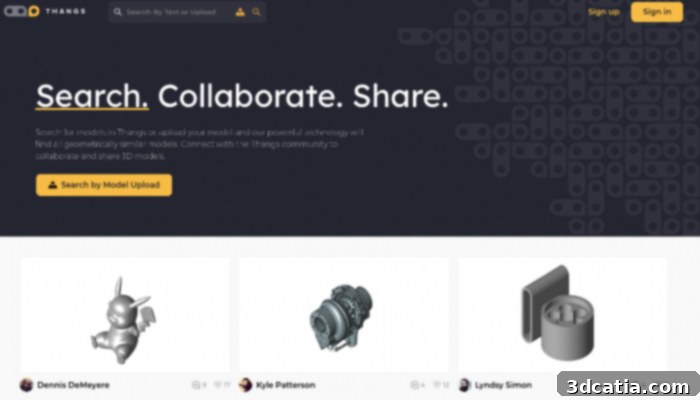
Prior to Thangs, the world of 3D models lacked a definitive “Google” – a universally accessible and intelligently indexed search engine. This absence made the process of locating specific 3D files incredibly tedious, often relying on imprecise keyword searches or manual browsing through disparate databases. Similarly, there was no true “GitHub” for 3D models, meaning that version control for collaborative projects was exceptionally complex, and team collaboration remained largely unintuitive and fragmented. Thangs directly addresses and comprehensively solves these pressing challenges.
Just as Google revolutionized the indexing and searching of 2D data like text and images, Thangs is achieving the same transformative impact for physical objects and intricate 3D models. The platform empowers users to discover parts not merely by descriptive tags, but based on their inherent geometric properties and their potential functional relationships to other components. Powered by Physna’s unparalleled geometric deep-learning engine, Thangs possesses the remarkable ability to “read” and comprehend the “physical DNA” of objects in ways that were previously unimaginable. By deeply understanding the intrinsic physical structure of 3D models across an extensive variety of file types, Thangs unveils profound, in-depth information about 3D designs, including their complex assemblies and even parts that are embedded within other parts. This capability transcends simple visual recognition, delving into the very essence of an object’s form and function, providing unprecedented insights to designers, engineers, and hobbyists alike.
A New Era of Collaboration and Community for 3D Creators
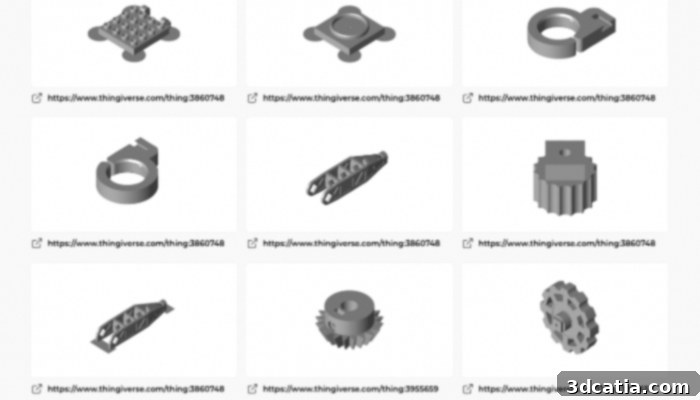
While Thangs, at first glance, might bear some resemblance to existing 3D model repositories like Thingiverse or other online databases, its capabilities far surpass these traditional platforms. Indeed, it allows users to efficiently search every publicly available 3D model database, aggregating resources into a single, powerful interface. However, Thangs distinguishes itself by offering a unique and invaluable feature: it provides a graphical, collaborative history of every single model, offering complete transparency into its evolution. Crucially, it can accurately identify if a particular model is, in fact, an integral part of a larger assembly or another model altogether. Upon its initial launch, the platform already boasted an impressive catalog of more than one million indexed 3D models, with an exponential growth trajectory anticipated in the very near future as more creators join and contribute.
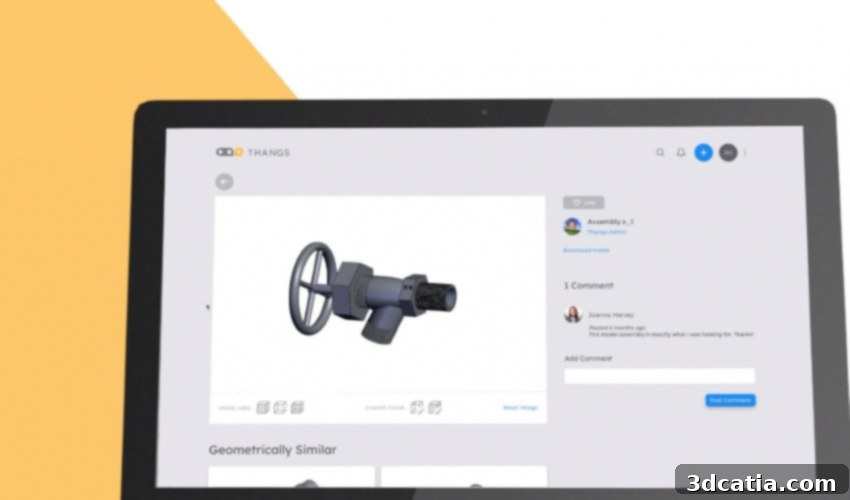
Going beyond mere search and indexing, Thangs introduces a suite of robust collaboration tools meticulously designed to streamline teamwork among 3D designers. These tools make it easier than ever for both professional engineers and amateur hobbyists to join forces, share ideas, and collaboratively work on complex models. Features like shared folders automate the often-cumbersome process of version control, bringing unparalleled clarity and organization to even the most intricate collaborative projects. Emulating the intuitive features of popular social media platforms, Thangs users can actively engage with designs by commenting on 3D models, “liking” their favorite creations to save them to their personalized profiles, and receiving real-time notifications when other users interact with their own uploaded designs. This fosters a vibrant, interactive community where feedback and engagement are central to the design process.
Unlocking Deeper Insights: Predictive Analytics and Design Optimization
The geometric deep-learning capabilities embedded within Thangs, powered by Physna’s core technology, extend far beyond simple identification and indexing. For professionals in industries such as aerospace, automotive, and manufacturing, these advanced analytics offer a significant competitive advantage. The ability to quickly predict production outcomes, estimate precise costs, recommend suitable materials based on engineering requirements, and even identify optimal suppliers for specific components translates directly into enhanced efficiency and reduced operational expenses. By leveraging past design data and continuously learning from new inputs, Thangs can forecast how design changes will impact part performance, allowing for proactive adjustments before any physical prototypes are even considered. This foresight is critical for uncovering potential design flaws, structural weaknesses, or manufacturing challenges at the earliest stages of development, thereby preventing costly rework, material waste, and production delays. This level of comprehensive analysis ensures that designs are not only aesthetically pleasing but also functionally robust and economically viable.
The Vision from the Top: Paul Powers on Democratizing 3D Data
Paul Powers, the visionary CEO of Physna, articulates the core philosophy behind Thangs: “Thangs is Physna’s first open product, but it uses some of the same powerful technology at the core of our enterprise offerings. Our enterprise product is widely recognized as the technological leader in 3D search and analysis, and we’re democratizing some of its capabilities through Thangs. This product is built to be powerful enough for a leading aerospace CAD engineer, yet simple enough for literally anyone to use. Reality is three-dimensional, and it’s time for the digital age to be as well. Thangs gives everyone not only access to 3D data, but utility from it as well using some of the most cutting-edge technology available today.” This statement underscores Thangs’ dual mission: to provide sophisticated tools for highly technical professionals while simultaneously making the power of advanced 3D data accessible and useful for a broader audience, from students and hobbyists to small businesses and educators. It represents a significant step towards a more inclusive and technologically empowered digital future.
The launch of Thangs marks a pivotal moment in the evolution of 3D technology. By providing a truly intelligent, geometric search engine coupled with robust collaboration features, Physna has addressed critical gaps in the existing ecosystem. The platform promises to accelerate innovation, foster unprecedented collaboration, and make the intricate world of 3D design and manufacturing more accessible and efficient for everyone involved. Its ability to understand the “physical DNA” of objects through AI is not just a technological marvel but a practical tool that will empower creators to bring their ideas to life with greater precision, speed, and shared insight than ever before.
Discover the Thangs platform and explore its capabilities HERE.
Join the Future of 3D Modeling
The advent of Thangs truly represents a paradigm shift in how we discover, manage, and collaborate on 3D models. Do you envision Thangs soon becoming the universally recognized “Google for 3D models,” an indispensable tool for every designer and engineer? Are you eager to join this burgeoning community and contribute to its growth? We invite you to share your thoughts and opinions in the comments section below or engage with us on our Facebook and Twitter pages! Don’t miss out on the latest advancements and insights in the world of additive manufacturing. Sign up for our free weekly Newsletter to receive all the essential news in 3D printing delivered straight to your inbox!