
Sony Xperia XZ1: Revolutionizing Mobile 3D Scanning for Everyone
Imagine holding a powerful 3D scanner right in your pocket. This is no longer a futuristic dream, but a tangible reality thanks to the innovative vision of Japanese manufacturer Sony. With their groundbreaking smartphones, the Xperia XZ1 and the Xperia XZ1 Compact, Sony has introduced a feature set to transform how we interact with the physical world. These new devices come equipped with the unprecedented ability to perform 3D digitization, effectively making advanced scanning technology readily accessible to a global audience. This integration marks a significant leap forward, democratizing a technology once confined to professional studios and high-end equipment.
Xperia XZ1 (right) and the XZ1 Compact (left), showcasing integrated 3D scanning capabilities.
Before Sony’s bold move, the landscape of mobile 3D scanning was fundamentally different. Most initiatives that attempted to combine smartphones with 3D scanning capabilities treated the scanner as a separate, additional device. Users would typically connect an external peripheral to their phone – much like the Eora 3D scanner or the iSense for iPhones 6 and 6+ – to capture and visualize 3D models. While these solutions offered a degree of portability, they added bulk, required extra equipment, and often came with a higher price point, presenting barriers to widespread adoption. Sony, therefore, stands out as the pioneering smartphone manufacturer to seamlessly merge both technologies into a single, cohesive unit. This integrated approach simplifies the user experience dramatically and removes many of the obstacles that previously hindered mass market penetration of 3D digitization tools. Furthermore, Sony’s position as a leader in this field is bolstered by its long-standing reputation for producing exceptionally high-quality camera technology. Japan, as a nation, produces nearly half of the world’s image sensors for smartphones, with Sony being a dominant force in this sector. This expertise in imaging hardware is undoubtedly a cornerstone of their success in developing an effective on-device 3D scanning solution.
Introducing the Xperia XZ1 and Its Revolutionary 3D Creator App
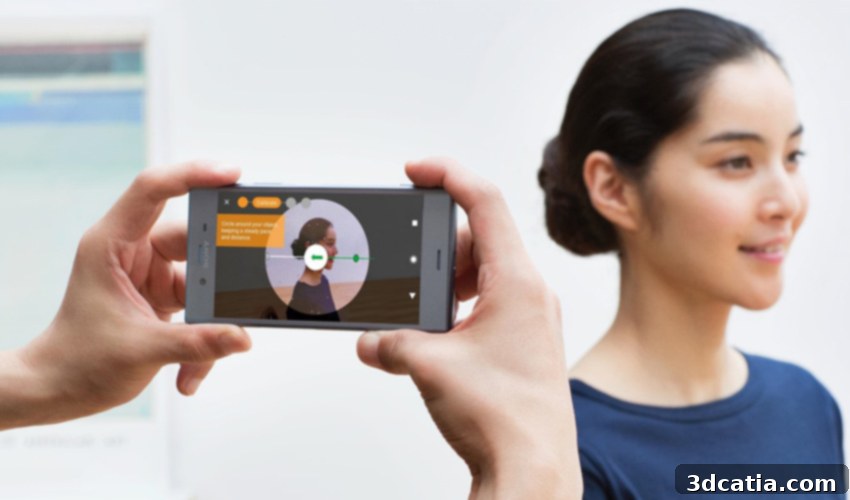
The world got its first glimpse of the Xperia XZ1 and XZ1 Compact, along with their groundbreaking 3D scanning feature, at the prestigious IFA event in Berlin. These devices were not just another iteration of smartphones; they represented a paradigm shift in what a mobile phone could achieve. At the heart of this innovation lies the intuitive and user-friendly 3D Creator application. Designed to be accessible to everyone, the app guides users through the scanning process with clear, step-by-step instructions. The beauty of this system is its simplicity: to create a detailed 3D image of virtually any object, users simply point their phone’s lens at it, much like they would when taking a photograph or video. The phone’s advanced camera system, coupled with Sony’s proprietary algorithms, then works its magic to capture depth and spatial information.
A glance at the user interface of the innovative 3D Creator application.
One of the most significant advantages of Sony’s integrated approach is the complete absence of a requirement for external cloud services to process the captured data. Unlike many other mobile scanning solutions, which often rely on powerful cloud-based computation for stitching and rendering 3D models, the Xperia XZ1 performs all necessary processing directly on the device. This on-phone processing capability offers several critical benefits: enhanced privacy, as sensitive data never leaves the user’s device; increased speed, as there’s no lag associated with uploading and downloading large files; and greater reliability, as an internet connection is not always necessary for scanning. This commitment to on-device functionality underscores Sony’s dedication to providing a truly seamless and independent mobile 3D scanning experience.
Versatile Scanning Modes and Seamless Sharing
The 3D Creator application is remarkably versatile, offering four distinct scanning modes tailored to different types of objects and user needs. These include specialized modes for scanning the head, capturing the intricate details of a human face or bust; a figure mode, ideal for full-body scans or larger statues; a dedicated food scanning mode, perfect for creating digital models of culinary creations; and a highly flexible free scanning mode, which allows users to capture a wide array of other objects without specific constraints. This variety ensures that users can achieve optimal results regardless of what they wish to digitize in 3D. The speed of the scanning process is another highlight, with detailed 3D scans taking as little as 60 seconds to complete, from initiation to a fully rendered 3D model. This rapid turnaround time makes the technology practical for everyday use, encouraging experimentation and creative exploration.
Once a 3D scan has been successfully completed, the possibilities for its use are extensive. The Xperia XZ1 facilitates easy sharing of these 3D files. Users can instantly share their digital creations via popular messaging applications like WhatsApp, allowing for quick peer-to-peer sharing. For those looking to showcase their models to a wider audience or engage with a community of 3D enthusiasts, direct sharing to platforms like Sketchfab is integrated, providing a vibrant ecosystem for viewing and discovering 3D content. Beyond digital sharing, the captured 3D files can also be seamlessly sent to a physical 3D printer for direct fabrication or uploaded to an online printing service. This direct link between mobile scanning and physical output significantly lowers the barrier to entry for 3D printing, empowering users to move from concept to tangible object with unprecedented ease. From creating custom figurines of loved ones to designing unique prototypes, the potential applications are immense and extend across various domains.
The Democratization of 3D Digitization and Future Implications
Sony’s initiative with the Xperia XZ1 series poses a pivotal question: will this embedded technology be the catalyst that truly democratizes 3D digitization? The answer appears to be a resounding yes. By integrating sophisticated 3D scanning capabilities into a device as ubiquitous as the smartphone, Sony is effectively putting powerful design and capture tools into the hands of millions. This move could spark a revolution across numerous industries and everyday applications. Consider the impact on augmented reality (AR) and virtual reality (VR) development, where readily available 3D models of real-world objects can enrich immersive experiences. Game developers could quickly scan physical objects for use as in-game assets, or users could scan their own faces for personalized avatars. In e-commerce, customers could create 3D models of themselves to virtually try on clothing or scan their living spaces to preview furniture arrangements, leading to more informed purchasing decisions and reduced returns. Educational institutions could leverage this technology to allow students to capture and study historical artifacts or biological specimens in 3D, fostering a new level of interactive learning.
Moreover, the ability to effortlessly capture and share 3D models opens up new avenues for creativity and personal expression. Hobbyists can easily digitize collectibles, artists can create digital archives of their sculptures, and families can capture precious moments in a rich, multi-dimensional format. This shift moves 3D technology from being a niche, specialized field to a mainstream utility, similar to how digital photography became universal with smartphone cameras. The ease of use, combined with the power of on-device processing and seamless integration with sharing and printing services, makes the Sony Xperia XZ1 a game-changer. It lowers the entry barrier significantly for individuals and small businesses alike, allowing them to explore the potential of 3D scanning and 3D printing without substantial initial investment in specialized hardware.
Looking Ahead: The Evolution of Mobile 3D Scanning
The introduction of integrated 3D scanning in smartphones by Sony is likely just the beginning. We can anticipate other manufacturers to follow suit, leading to rapid advancements in mobile 3D capture technology. Future iterations might feature improved depth sensors, faster processing, and even more refined algorithms for higher fidelity and accuracy. The implications for the future of mobile phones are profound; they are evolving from mere communication devices into versatile, multi-functional tools capable of interacting with and recreating the physical world in digital form. This innovation paves the way for a more interactive and personalized digital experience, blurring the lines between the physical and virtual realms. We’re excited to watch this evolution unfold and witness how this newfound accessibility transforms industries and empowers creativity across the globe.
To learn more about these innovative new phones and their 3D scanning capabilities, we invite you to check out the video below:
What do you think this could mean for phones in the future? We’d love to hear your thoughts! Let us know in a comment below or join the conversation on our Facebook and Twitter page! Don’t forget to sign up for our free weekly Newsletter, with all the latest news in 3D printing delivered straight to your inbox!