
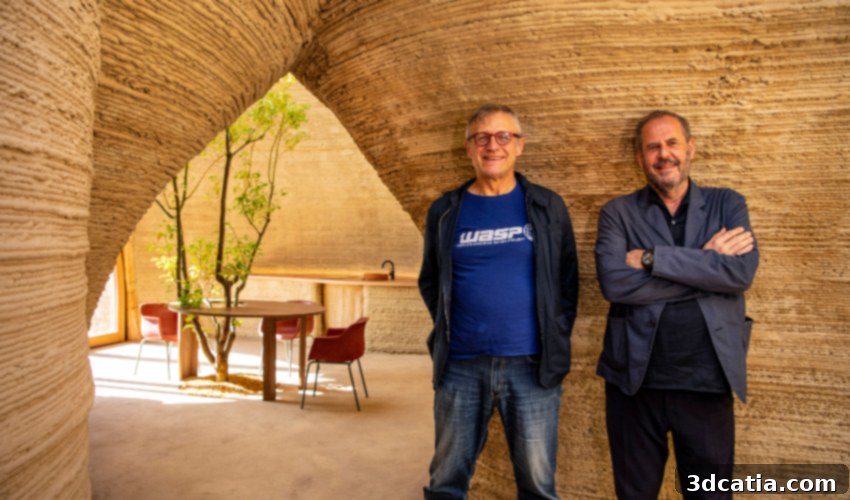
TECLA: Pioneering Sustainable 3D Printed Earth Homes for a Resilient Future
In a significant stride towards addressing both the global housing crisis and the escalating climate emergency, WASP and Mario Cucinella Architects have proudly announced the official completion of their groundbreaking eco-sustainable housing project, TECLA. Standing majestically in Massa Lombarda, near Ravenna in Italy, the first TECLA home represents a tangible blueprint for the future of construction. This innovative dwelling is entirely 3D printed using local raw earth, a revolutionary approach that drastically reduces environmental impact while offering a scalable solution for housing needs worldwide. We have been keenly following the development of this project, recognizing its profound originality and transformative potential within the sustainable construction sector. Now, after two years of dedicated work and pioneering innovation, the vision has materialized into reality, demonstrating that beautiful, resilient, and environmentally conscious homes can be built with efficiency and elegance.
The TECLA project holds immense personal significance for its visionary creators, Massimo Moretti, the founder of WASP, and renowned architect Mario Cucinella. Their collaboration was driven by a shared commitment to tackle two of the most pressing challenges of our time. Firstly, the project directly confronts the climate emergency by offering a radically low-carbon housing alternative. Traditional construction methods are notoriously resource-intensive and contribute significantly to greenhouse gas emissions. TECLA, by utilizing readily available raw earth and advanced additive manufacturing techniques, presents a viable path towards minimizing environmental footprint and fostering a more sustainable circular economy in construction. Secondly, TECLA aims to provide a scalable solution for the pervasive global housing emergency, a crisis anticipated to worsen due to increasing natural disasters and large-scale migrations exacerbated by climate change.
Mario Cucinella articulates the profound philosophy behind the project: “We like to think that TECLA is the beginning of a new story. It would be truly extraordinary to shape the future by transforming this ancient material with the technologies we have available today. The aesthetics of this house are the result of a technical and material effort; it was not an aesthetic approach only. It is an honest form, a sincere form.” This powerful statement underscores TECLA’s holistic approach, where form is intrinsically linked to function, material, and ethical considerations. The house is not merely an architectural marvel; it is a declaration of intent, a testament to the power of combining ancestral wisdom with cutting-edge technology to create living spaces that are both beautiful and responsible. The ability to leverage an abundant, natural resource like raw earth, transformed by advanced 3D printing techniques, heralds a new era of construction where sustainability is not a luxury but an inherent characteristic of design and execution.

TECLA’s ‘zenith lights’ (Photo: Iago Corazza)
A Fusion of Ancient Wisdom and Modern Innovation
The successful realization of TECLA stands as a testament to the synergistic partnership between Mario Cucinella Architects, celebrated for their sustainable architectural vision, and WASP, pioneers in advanced 3D printing for construction. This collaboration ingeniously marries age-old building principles with contemporary technological prowess. On one hand, the design team drew inspiration from profound historical and literary concepts. They delved into past notions of architecture and urban planning, finding resonance in twentieth-century metaphors, particularly Italo Calvino’s Invisible Cities, which evokes a sense of perpetual construction and the evolving relationship between humanity and its built environment. This connection highlights a philosophical approach to construction, viewing it not just as erecting structures, but as shaping ongoing narratives and communities.
TECLA’s unique aesthetic also harks back to the timeless beauty and practicality of ancient homes. Its distinctive curved structure and atypical, organic shape echo traditional earth-built dwellings found across various cultures, renowned for their inherent thermal properties and structural integrity. The use of earth as a primary building material, often shaped into natural, flowing forms, has a proven track record of creating comfortable and resilient habitats in diverse climates for millennia. This deep historical connection is further exemplified by TECLA’s ingenious skylights, aptly named ‘zenith lights’. These design elements refer to the highest point in the celestial sphere, a concept imagined and observed by ancient civilizations centuries ago. The zenith lights are not merely decorative; they serve a crucial function, providing abundant natural light and enhancing passive ventilation, contributing to the dwelling’s overall energy efficiency and occupant comfort. This thoughtful integration of passive design principles, rooted in historical architectural wisdom, ensures that TECLA is not only visually striking but also supremely functional and ecologically sound.
The WASP Crane: Revolutionizing Additive Construction
Complementing these timeless architectural inspirations, the TECLA project heavily relies on cutting-edge modern technologies, embodying the wider global movement towards customization, Industry 4.0, and the Internet of Things (IoT). At the heart of this technological marvel is WASP’s state-of-the-art 3D printer, the Crane WASP. This revolutionary system stands out as the world’s first truly modular and multilevel construction 3D printer. Its innovative design allows for two or more printing units to operate simultaneously and synchronously, significantly accelerating the construction process and enabling the creation of complex, large-scale structures with unprecedented efficiency. This synchronized operation not only speeds up the build time but also enhances precision and reduces labor requirements on site, making it a highly cost-effective and efficient solution for rapid housing deployment.
The Crane WASP’s ability to work with local raw earth is a game-changer for sustainable construction. By utilizing materials found directly on site – in this case, the soil from the local area – TECLA dramatically reduces transportation costs and the substantial carbon emissions typically associated with the production and delivery of traditional building materials like concrete and steel. This approach fosters a truly circular economy within construction, where resources are locally sourced, reused, and waste is minimized to almost zero. Furthermore, the inherent properties of raw earth provide excellent thermal mass, allowing the material to absorb and release heat slowly. This natural regulation of indoor temperatures significantly reduces the need for extensive artificial heating or cooling systems, contributing immensely to the home’s energy efficiency and long-term sustainability throughout its lifespan.
A key characteristic of TECLA’s advanced design is its profound adaptability. Each structure is meticulously designed and fabricated, both in composition and shape, to respond directly to its specific location’s climatic conditions and geographical latitude. This parametric design approach ensures that every TECLA home is optimized for its unique environment, maximizing natural light, promoting efficient cross-ventilation, and enhancing thermal performance. This customization also improves resilience against local weather patterns, be it extreme heat, cold, or wind. This level of customization, powered by advanced digital design and additive manufacturing, ensures that future TECLA homes will not be generic, one-size-fits-all solutions, but rather perfectly integrated dwellings that harmonize with their natural surroundings, providing optimal comfort and minimal environmental impact. This bespoke approach represents a paradigm shift from mass production to mass customization in the construction industry, promising more efficient, sustainable, and tailored building solutions for a diverse range of global needs.
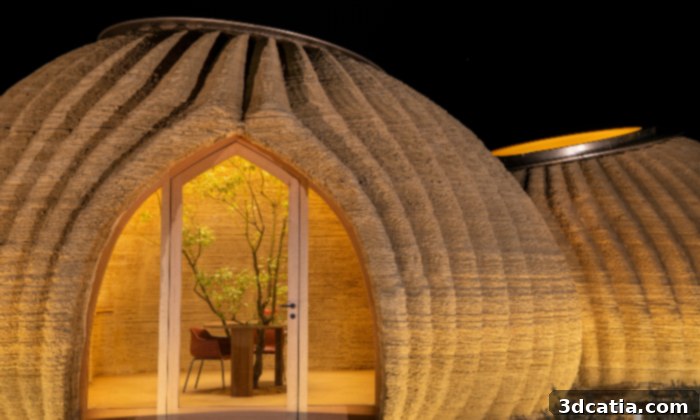
Photo: Iago Corazza
Impact and Future Prospects: From Earth to the Moon
With the successful completion of the first TECLA house, the ambitions of its creators stretch far beyond terrestrial applications. Massimo Moretti, the pioneering Founder of WASP, articulates an interplanetary vision for this initiative, stating: “TECLA shows that a beautiful, healthy, and sustainable home can be built by a machine, giving the essential information to the local raw material. TECLA is the finger that points to the Moon. The Moon is the home, as a birthright, for everybody on the planet. From TECLA on, that’s getting possible.” This powerful statement encapsulates the audacious goal of the project: to make dignified, resilient, and accessible housing a reality for everyone, everywhere, including potentially off-world environments.
The concept of TECLA as a “birthright” home resonates deeply with the urgent need for affordable, rapidly deployable housing solutions in regions affected by poverty, conflict, or natural disasters. The ability to construct robust and sustainable dwellings using locally available resources, coupled with the unparalleled speed and automation of 3D printing, positions TECLA as a potent tool for humanitarian efforts and long-term community development. Imagine communities rebuilt rapidly after a catastrophe, or sustainable villages established in remote areas with limited access to conventional building supplies, all utilizing the very earth beneath their feet. This approach not only provides shelter but also empowers local populations, reduces reliance on external supply chains, and fosters greater self-sufficiency and local economic development. The simplicity of the materials combined with the sophistication of the technology offers a robust pathway to addressing housing shortages on a global scale.
Furthermore, Moretti’s vision extends to the stars. The principles demonstrated by TECLA — primarily the utilization of in-situ resources (like raw earth) for construction, automated building processes, and the creation of resilient structures adapted to extreme environments — are directly applicable to building habitats on the Moon or Mars. Future lunar and Martian missions face immense challenges in transporting sufficient building materials from Earth due to prohibitive costs and logistical complexities. Technologies like the Crane WASP, capable of processing extraterrestrial regolith (soil) into structural components, could enable future space colonists to construct shelters, laboratories, and other necessary infrastructure directly using local Martian or lunar materials. This capability would drastically reduce mission costs, enhance crew safety, and significantly increase the self-sustainability and longevity of off-world settlements. TECLA is thus not just a house; it is a foundational step towards expanding humanity’s presence both on Earth and beyond, proving that advanced manufacturing can unlock unprecedented possibilities for shelter and survival, pushing the boundaries of what is conceivable in construction. More information on this groundbreaking project can be found HERE.
Sustainable Living: The Promise of 3D Printed Earth Homes
TECLA represents more than just a technological achievement; it is a paradigm shift in how we conceive and construct our living spaces. By integrating principles of the circular economy, such as minimal waste generation, localized material sourcing, and energy efficiency, it offers a compelling and thoroughly researched alternative to conventional construction. The environmental benefits are manifold: a significantly reduced carbon footprint compared to concrete-intensive buildings, lower energy consumption during construction and operation, and a minimized impact on natural ecosystems due to the non-toxic and biodegradable nature of raw earth. This holistic approach ensures that TECLA homes are not just sustainable in their creation but also in their entire lifecycle, from material sourcing to eventual deconstruction, which can return materials safely to the earth.
Beyond its ecological credentials, TECLA also champions social responsibility. The potential to rapidly deploy dignified, durable, and comfortable housing in areas of need positions it as a powerful tool for promoting social equity. It can provide safe havens for displaced populations, affordable housing for growing communities, and resilient structures capable of withstanding the increasing threats of climate change-induced weather events, thereby enhancing community stability and security. This blend of environmental stewardship and social impact underscores the project’s profound significance, moving beyond mere innovation to practical, scalable solutions for real-world problems affecting millions globally. TECLA embodies a vision where advanced technology serves humanity and the planet, offering hope for a more sustainable and equitable future.
We invite you to consider the profound implications of this project: Would you live in a TECLA home? Share your thoughts and engage with our community by leaving a comment below or connecting with us on ourFacebook,Twitter, andLinkedIn pages! To stay updated with the very latest in 3D printing news and sustainable innovations, sign up for our free weeklyNewsletter here, delivered straight to your inbox.
*Cover Photo: Massimo Moretti and Mario Cucinella Tecla 3D printed house WASP + MCA