
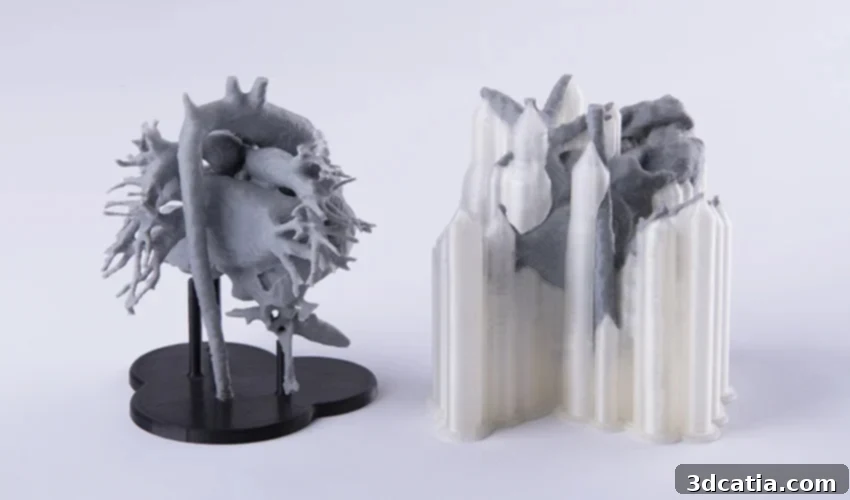
PVA in 3D Printing: The Ultimate Guide to Water-Soluble Support Material
Polyvinyl Alcohol, commonly known as PVA, stands out as a revolutionary material in the realm of 3D printing, primarily recognized for its unique ability to dissolve in water. This characteristic makes it an indispensable component, particularly when utilizing FDM dual extruder 3D printers. The integration of PVA as a support material offers designers and engineers unprecedented freedom, enabling the creation of intricate parts with complex geometries and challenging overhangs without compromising the final print quality. The more elaborate a design, featuring delicate details or extensive cantilevered sections, the greater the necessity for robust support structures during manufacturing. This comprehensive guide aims to illuminate the fundamental properties of PVA, explore its pivotal role in additive manufacturing, and provide practical insights to achieve optimal results in every 3D printing endeavor.
Production and Key Characteristics of PVA Filament
From a technical perspective, PVA belongs to the synthetic polymer family, distinguished by its advantageous biodegradability. Its creation involves a two-step process: initially, vinyl acetate is polymerized, and subsequently, this polymer undergoes hydrolysis to yield polyvinyl alcohol, which is then processed into filament form suitable for 3D printing. This material typically presents a transparent to off-white or cream-colored appearance and boasts remarkable resistance to oils and greases, making it robust in various environments. Beyond these attributes, PVA exhibits excellent adhesive properties, comparable to other common thermoplastics like PLA, CPE, or Nylon. It also offers high tensile strength combined with commendable flexibility. Importantly, PVA is odorless and non-toxic, affirming its safety for human interaction, animal environments, and the broader ecosystem, reinforcing its position as an eco-friendly choice in additive manufacturing.
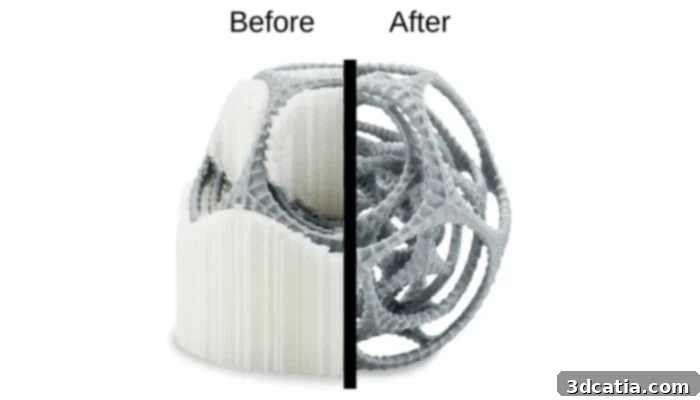
PVA is a soluble material used as printing support (photo credits: Ultimaker)
Delving deeper into its mechanical properties, PVA demonstrates a tensile elongation of approximately 360% and a tensile strength of 22MPa. A fascinating aspect of PVA’s behavior is its interaction with humidity; water acts as a plasticizer, significantly increasing the material’s flexibility and elasticity. While inherently brittle and fragile in dry conditions, PVA becomes progressively more elastic as it absorbs moisture from the air or comes into contact with water, eventually dissolving completely. This unique characteristic is central to its utility as a support material. Despite its generally odorless nature, a subtle scent may be detectable during the printing process. For successful additive manufacturing, it’s crucial to be aware of PVA’s melting point of 230°C and, more critically, its degeneration temperature of 200°C. Exceeding this degeneration temperature can lead to carbonization, manifesting as unsightly black spots on the printed object and potentially damaging the printer’s nozzle.
Mastering PVA for FDM 3D Printing: Advantages, Challenges, and Best Practices
Advantages of PVA as a Support Material
The paramount advantage of PVA, as highlighted earlier, is its remarkable water solubility. This property simplifies post-processing significantly, as supports can be removed merely by submerging the print in water, eliminating the need for complex, often hazardous, chemical solvents. This not only streamlines the workflow but also contributes to a safer and more environmentally friendly printing process. Furthermore, PVA supports can be designed to provide extensive contact with the printed object, ensuring superior surface finish on supported areas—a feat difficult to achieve with break-away supports. Its use with dual extruder systems grants unparalleled design freedom, allowing for complex internal geometries and delicate structures that would otherwise be impossible to print.
Common Challenges and Disadvantages
While PVA offers significant benefits, it’s important to acknowledge its inherent challenges, many of which are common to other soluble materials. One of its most notable drawbacks is its high sensitivity to moisture. PVA is highly hygroscopic, meaning it readily absorbs atmospheric moisture. This can severely degrade its print quality, leading to issues such as stringing, bubbling, poor layer adhesion, and even nozzle clogging. To mitigate this, stringent storage conditions are imperative; PVA filament must be kept in airtight containers with desiccant or ideally, in a dedicated filament dry box to maintain its optimal properties. Another frequent issue is nozzle clogging, which tends to occur if the nozzle remains hot while PVA is not actively extruding. The prolonged heat can cause the PVA to degrade and carbonize within the hotend, forming blockages. Additionally, many users perceive PVA as a relatively expensive filament, especially considering it is ultimately dissolved and discarded. However, its value lies in enabling prints that would otherwise be unachievable, justifying the cost for specialized applications.
Optimal Printing Parameters and Storage
To achieve successful prints with PVA, specific printer settings are crucial. The printing bed should be preheated to a temperature between 45 – 60°C to ensure good adhesion. The extruder temperature for PVA typically ranges between 180 – 200°C. It is critically important to maintain temperatures below its degeneration point of 200°C to prevent carbonization. As mentioned, proper storage is non-negotiable. PVA filament should always be stored in a cool, dry place, protected from direct light and dust. An optimum storage temperature is between 15-25°C. If the material has already absorbed moisture, it’s essential to dry it thoroughly before use. This typically involves placing it in a filament dryer or a convection oven at 50-80°C for approximately 8–12 hours. For dual extrusion setups, it is also recommended to pair PVA with primary printing materials that have similar melting temperatures, such as PLA or PA (Nylon), to avoid issues arising from large temperature differentials between the two extruders.
Advanced Slicer Settings and Troubleshooting
Effective management of extruders is key when working with PVA. Implementing a cooling fan for the PVA hotend when it’s idle is vital to prevent oozing and the dreaded clogging caused by heat degradation. Slicer settings such as retraction distance and speed should be optimized to minimize stringing. Furthermore, setting the top support clearance distance to 0 layers is highly recommended. Since PVA supports are designed to dissolve completely, direct adhesion to the final part during the fabrication process is not a concern and actually promotes a much smoother, higher-quality surface finish on the underside of the main object. The best results, characterized by smooth, blemish-free objects, are consistently achieved when using fresh, properly stored, and thoroughly dry PVA. If PVA has absorbed too much moisture, tell-tale signs during printing include distinct hissing noises from the nozzle as water boils, and defects on the final object such as curling, excessive stringing, visible holes, bubbles, and under-extrusion. Addressing these signs promptly by drying the filament will salvage print quality.
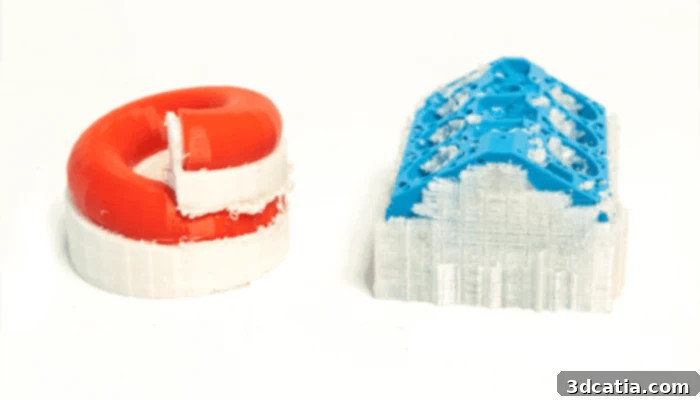
In post-processing, the PVA support structures simply dissolve in water (photo credits: MatterHackers)
Post-Processing: Effortless Support Removal
In stark contrast to the meticulous storage requirements for PVA, its post-processing is remarkably straightforward. Once the 3D print is complete, simply place the entire object into a water bath. The PVA support structures will begin to dissolve, typically taking between 1 to 2 hours for complete removal, depending on the volume and density of the supports. Using lukewarm water (around bath temperature) can help accelerate the dissolution process, and gentle agitation can further speed things up. The dissolved PVA solution is biodegradable and can safely be disposed of down the drain, making the entire post-processing workflow incredibly clean and convenient. This ease of removal is a significant factor in PVA’s popularity, as it eliminates manual support removal which can often damage delicate parts or leave behind unsightly marks.
Diverse Applications of PVA in Additive Manufacturing
As a water-soluble material, PVA is ideally suited as a complementary material for manufacturing parts with highly complex geometries, including those featuring intricate internal cavities, challenging overhangs, conceptual models, and specialized molds. The ability to print with soluble supports allows for enhanced design freedom, enabling the creation of components that would be impossible or exceedingly difficult to produce with traditional break-away supports. PVA-supported 3D prints consistently exhibit superior surface quality on the underside of features, as the supports precisely conform to the part’s shape without leaving witness marks. This also provides the flexibility to orient the part in any direction during printing to optimize its mechanical properties, knowing that supports can be effectively removed regardless of their intricacy or location.
Beyond purely functional prototyping, PVA’s versatility extends to various sectors. By allowing the 3D printing of virtually all types of parts, regardless of design complexity, PVA has found a notable niche in the art world for crafting elaborate decorative models and artistic pieces with intricate details. However, its utility is far from limited to aesthetics. Even the most advanced industries leveraging FDM technology for creating functional tooling, jigs, fixtures, or high-fidelity prototypes are increasingly integrating soluble materials like PVA to fabricate supports, recognizing the significant improvements in design freedom, print success rates, and final product quality it provides. Its application spans across engineering, product design, medical modeling, and architectural visualization, where precision and clean finishes are paramount.
Market Overview: PVA Filament Manufacturers and Pricing
PVA filament is readily available in the market in standard diameters of 1.75 mm and 2.85 mm, catering to a wide range of FDM 3D printers. When purchasing, it is crucial to verify that the chosen filament diameter corresponds precisely to your printer’s hotend specifications to ensure compatibility and prevent feeding issues. Typically, spools containing 500 grams of PVA material are priced anywhere between $30 and $130, though prices often average upwards of $50. The cost can fluctuate significantly based on the manufacturer, brand reputation, and specific filament properties. Numerous reputable companies offer high-quality PVA filaments, including industry leaders such as Ultimaker, eSun, Formfutura, XYZprinting, BCN3D, PrimaCreator, MatterHackers, Polymaker, Makerbot, and many others, providing a diverse selection for consumers.
Maximizing Value: Smart Printing Strategies with PVA
Given that PVA is generally more expensive than primary printing materials like PLA, adopting smart printing strategies can help optimize material usage and reduce costs. Many modern slicer software, such as Slic3r Prusa Edition, offer an ingenious option to print only the crucial interface layers directly beneath the main object using PVA, while the bulk of the support structure can be printed with a more affordable material like PLA. This “PVA interface layer” technique leverages PVA where it matters most—for creating a perfectly smooth surface where the support meets the part—while minimizing the quantity of the more costly soluble filament consumed. This hybrid support strategy effectively balances cost-efficiency with superior print quality, allowing users to harness the benefits of PVA without a prohibitive impact on their budget. For those interested in exploring a broader range of 3D printing filaments and their applications, comprehensive guides are available to help you choose the best material for your specific needs, which you can consult HERE.
Conclusion: The Future of Soluble Supports
PVA’s unique water-soluble property has firmly established it as a cornerstone material in FDM 3D printing, particularly for applications requiring complex geometries and high-quality surface finishes. Despite its sensitivity to moisture and higher cost compared to standard filaments, its advantages in enabling intricate designs, simplifying post-processing, and contributing to environmentally friendly practices are undeniable. As 3D printing technology continues to evolve, advancements in PVA formulations and smarter slicing strategies will likely further enhance its accessibility and performance, solidifying its role as an indispensable support material for innovators across various industries. Mastering PVA ensures that the creative potential of dual extrusion 3D printing can be fully realized, bringing increasingly complex and functional designs to life with unparalleled ease and precision.
What are your thoughts on the characteristics and utility of PVA in 3D printing? Share your experiences and insights in a comment below or join the conversation on our Linkedin, Facebook, and Twitter pages! Don’t forget to sign up for our free weekly Newsletter here to receive the latest 3D printing news directly in your inbox! You can also find all our engaging videos on our YouTube channel.
*Cover Photo Credits: Zortrax