
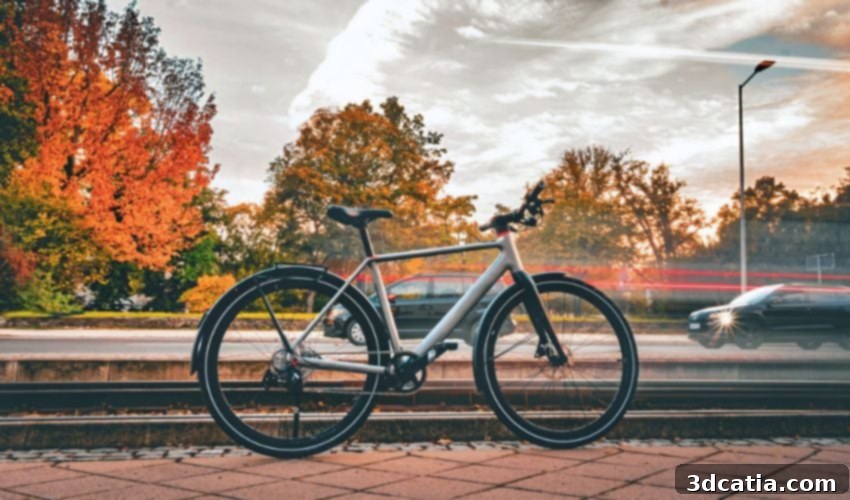
Möve Avian: Redefining E-Bike Engineering with 3D Printing and Ultra-Lightweight Titanium
The landscape of personal transportation is undergoing a significant transformation, with electric bicycles, or e-bikes, emerging as a leading force in sustainable and efficient mobility. As consumer demand for lighter, more powerful, and aesthetically integrated designs grows, manufacturers are increasingly turning to advanced technologies to meet these evolving expectations. Among these innovations, additive manufacturing, commonly known as 3D printing, stands out as a game-changer, enabling unprecedented design freedom and material efficiency.
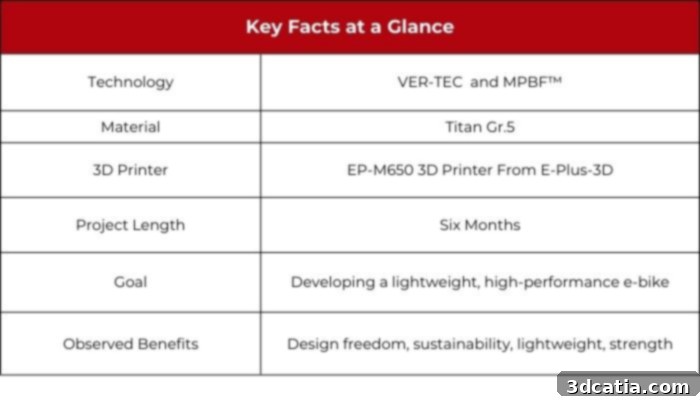
In this exciting era of innovation, Möve Mobility GmbH has made a significant impact with its groundbreaking Möve Avian e-bike. This remarkable bicycle is a testament to what can be achieved when cutting-edge 3D printing technology is synergistically combined with patented manufacturing processes. Möve Mobility has particularly garnered attention for seamlessly integrating metal 3D printing with its proprietary VER-TEC technology, setting a new benchmark in e-bike production and design.
The Möve Avian is not just another e-bike; it holds the distinction of being the world’s first ultra-lightweight titanium touring e-bike featuring a fully integrated battery. This engineering marvel was brought to life through a sophisticated blend of advanced 3D printing techniques and Möve’s in-house manufacturing expertise. Key structural components, including vital sections of the frame, the bottom bracket, and specialized titanium sleeves, were precisely fabricated using 3D printing. These intricate 3D-printed parts were then ingeniously connected to high-quality hydroformed titanium tubes, forming a robust yet incredibly light frame. This ambitious project is the culmination of a strategic partnership between Möve Mobility GmbH, a company with over a century of manufacturing heritage, and E-Plus-3D, a renowned specialist in the field of metal 3D printing, showcasing a powerful synergy of design innovation and manufacturing prowess.
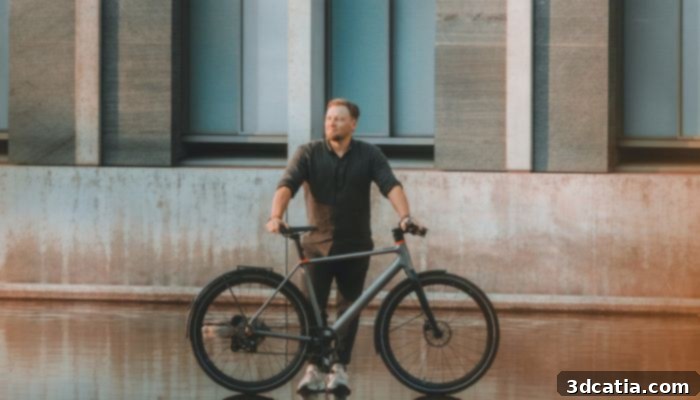
Möve GmbH, a company with over 100 years of history, has developed the Möve Avian, an e-bike that impresses with its ultra-lightweight design and manufacturing processes (photo credits Möve Mobility GmbH)
Breakthrough Engineering: The Power of VER-TEC Technology and 3D Printing
The core innovation behind the Möve Avian’s exceptional performance and lightweight design lies in Möve’s patented VER-TEC technology. This sophisticated joining technique represents a significant departure from conventional frame manufacturing methods, specifically designed to overcome the limitations often associated with welding titanium, such as material distortion and compromised structural integrity. VER-TEC technology intelligently combines custom-designed, 3D-printed titanium sleeves with precision-engineered hydroformed titanium tubes to forge an exceptionally durable and rigid frame structure.
A prime example of this technology in action is found in the bottom bracket area – a critical junction for power transfer and frame stability. Here, the structure is meticulously divided into lightweight sleeve segments, each weighing approximately 133 grams. These segments are produced using advanced 3D printing, allowing for complex internal geometries and optimized material distribution that would be impossible with traditional machining. Once printed, these specialized sleeves are precisely connected to high-quality hydroformed titanium tubes, creating a seamless and robust connection. This innovative method ensures unparalleled precision in production, which not only guarantees the functional superiority of the titanium frame but also makes it highly suitable for efficient series production, thereby expanding the possibilities for advanced e-bike manufacturing.
Beyond its structural advantages, the VER-TEC finished frame offers significant practical benefits. Constructed from titanium size 5, renowned for its exceptional strength-to-weight ratio and superior corrosion resistance, the frame is inherently rustproof. This characteristic makes the Möve Avian an ideal choice for outdoor use across various challenging weather conditions and guarantees remarkable longevity, minimizing maintenance requirements over its lifespan. The innovative joining technique employed by VER-TEC also efficiently replaces conventional welding processes, contributing to optimized production costs while simultaneously enhancing the overall stability and integrity of the frame. The result is an e-bike that is not only robust and highly durable but also remarkably lightweight. The complete frame alone weighs an astonishing 1.186 grams, contributing to a total bike weight of just 11.8 kilograms. This exceptionally low weight for an e-bike truly sets the Möve Avian apart from its competitors on the market, offering riders an unparalleled experience in terms of agility, responsiveness, and ease of handling.
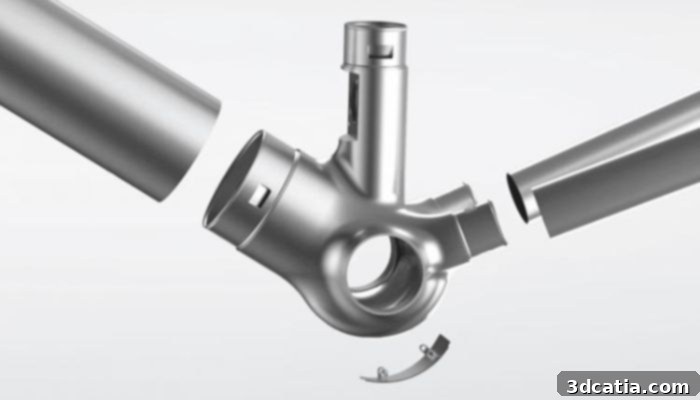
The patented VER-TEC technology with 3D-printed titanium sleeves (photo credits: Möve Mobility GmbH)
Precision Manufacturing: The Role of Metal Powder Bed Fusion (MPBF)
The manufacturing of the intricate 3D-printed titanium sleeves and other frame components for the Möve Avian relies on Metal Powder Bed Fusion (MPBF) technology, specifically leveraging the advanced MPBF™ systems provided by E-Plus-3D. MPBF is an additive manufacturing process where a laser selectively melts and fuses metallic powder particles layer by layer, based on a digital 3D model. This method is celebrated for its ability to create complex geometries with high precision and excellent material properties, making it perfectly suited for high-performance applications like e-bike frames.
One of the most significant advantages of 3D printing, particularly MPBF, is its unparalleled design freedom. This capability was crucial for Möve Mobility, as it allowed for the complete integration of the e-bike’s battery directly within the frame structure. Such integration not only contributes to a cleaner aesthetic but also optimizes weight distribution and protects the battery from external elements, enhancing both performance and durability. Tobias Spröte, Managing Director of Möve Mobility GmbH, articulated the strategic choice, stating, “We chose MPBF™ because, at the state of the art, we could only achieve our production cost targets with the help of this process.” This highlights the economic viability and efficiency that advanced additive manufacturing brings to complex product development. Furthermore, the use of large-format 3D printing facilitated an incredibly efficient production process, dramatically reducing the project duration to an impressive six months from concept to reality – a timeline virtually impossible with traditional manufacturing methods.
Despite its numerous benefits, the use of titanium in 3D printing does present unique challenges. Titanium, known for its reactive nature and high melting point, often necessitates the use of robust support structures during the printing process. These structures are vital for dissipating heat, preventing distortion, and maintaining the structural integrity of the part as it’s built layer by layer. However, the need for supports typically leads to increased material waste and requires intensive, time-consuming post-processing for their removal and surface finishing. E-Plus-3D, with its deep expertise in metal additive manufacturing, successfully navigated these hurdles by meticulously fine-tuning the printing parameters. This optimization minimized the need for extensive support material and significantly reduced material waste, demonstrating a mastery of the MPBF process.
Another technical challenge Möve Mobility GmbH adeptly addressed was the surface treatment of the titanium frame. Achieving a uniform matte finish that met both functional and aesthetic design objectives required a precise approach. Möve Mobility employed a specialized blasting technique, which not only delivered the desired visual appeal but also contributed to improving the durability of the frame. This treatment process was carefully controlled to ensure it enhanced the surface properties without compromising the inherent strength or structural integrity of the titanium material, showcasing a harmonious balance between form and function.
Sustainable Innovation and Future Impact
The synergy between VER-TEC technology and Metal Powder Bed Fusion in the creation of the Möve Avian e-bike offers a multitude of compelling advantages. Foremost among these is the extraordinary light weight, a direct outcome of the innovative production technology and the judicious use of titanium. This lightweight construction translates into a more agile, responsive, and energy-efficient e-bike, enhancing the rider’s experience and potentially extending battery range.
Beyond performance, a critical aspect that cannot be overlooked is sustainability. The choice of titanium as the primary material for the Avian frame is a testament to Möve Mobility’s commitment to environmental responsibility. Titanium is an exceptionally durable and long-lasting material, which inherently reduces the need for frequent replacements. Crucially, it is 100% recyclable, meaning that at the end of its long service life, the material can be repurposed without degradation, thereby significantly minimizing its environmental footprint. Furthermore, 3D printing processes, by their nature, can reduce material waste compared to traditional subtractive manufacturing methods, contributing to a more sustainable production cycle.
The Möve Avian e-bike not only represents a pinnacle of contemporary e-bike design and engineering but also serves as a powerful illustration of the transformative potential of additive manufacturing. It sets a new benchmark for what is achievable in lightweight, high-performance mobility solutions and underscores the value of interdisciplinary collaboration between seasoned manufacturers and advanced technology specialists. This pioneering approach paves the way for future innovations, hinting at a future where customized, highly efficient, and environmentally conscious personal vehicles become the standard. It showcases how precision engineering, advanced materials, and smart manufacturing can collectively push the boundaries of design and redefine user experience in the realm of electric mobility.
What are your thoughts on the Möve Avian and Möve Mobility GmbH’s innovative approach? We invite you to share your insights and comments below, or engage with us on ourLinkedIn, Facebook, and Twitter pages! Don’t forget to sign up for our free weekly Newsletter here to get the latest 3D printing news delivered straight to your inbox! You can also find all our compelling videos on our YouTube channel.
*Cover Photo Credits: Möve Mobility