
Revolutionizing Micro-3D Printing: Magnetically Actuated Microstructures for Advanced Applications
In a significant leap forward for advanced manufacturing, researchers from the esteemed University of Grenoble have pioneered a groundbreaking method for 3D printing microstructures that possess the remarkable ability to deform and operate under the influence of an external magnetic field. This innovation harnesses the immense potential of two-photon polymerization (2PP) 3D printing technology, developed in collaboration with the renowned French company, Microlight 3D. The scientific team successfully fabricated intricate magnetic microtweezers, demonstrating unprecedented control over their movement – allowing for precise translation, rotation, and opening simply through a magnetic field.
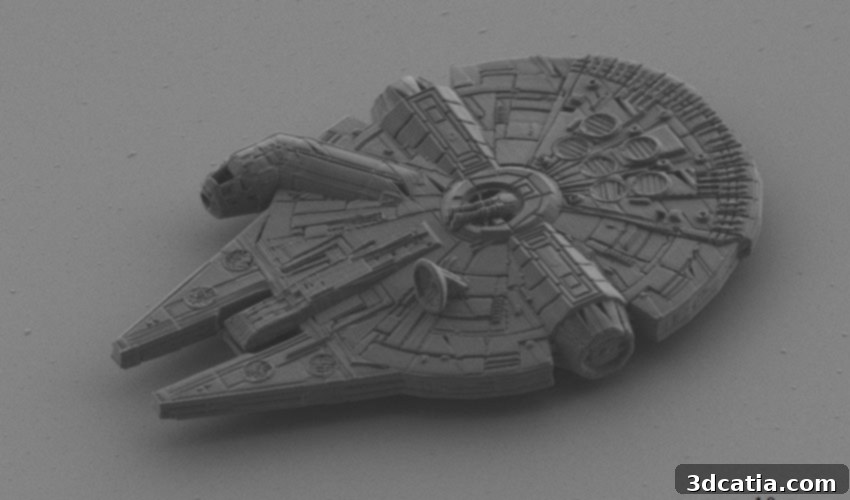
This breakthrough is poised to redefine various fields, offering transformative potential for enhancing existing microactuators and paving the way for novel applications such as magnetically-poled hydrogels for highly targeted drug delivery systems. The dedication of the Grenoble-based team to pushing the boundaries of microscale 3D printing was vividly illustrated by their creation of a nanoscale replica of the iconic Millennium Falcon from the Star Wars franchise, a testament to the technology’s ultra-high resolution capabilities. This miniature marvel, measuring an astonishing 100 µm in length, highlights the precision achievable with their novel 2PP technique, opening new horizons for complex micro-device fabrication.
The Power of Two-Photon Polymerization (2PP): Precision at the Micro-Nanoscale
Two-photon polymerization (2PP) stands as a cornerstone technology in the realm of micro- and nanoscale 3D printing. Its ability to achieve resolutions far beyond conventional methods has garnered considerable attention from scientists and innovative companies worldwide. Microlight 3D’s advanced additive manufacturing systems exemplify the effective application of 2PP, meticulously fabricating structures from specialized photoactivatable materials. The core principle involves a highly precise optical phenomenon: when two photons, emitted by a pulsed-laser, converge at their focal point, they can be simultaneously absorbed by a photo-activated monomer. This absorption occurs within an incredibly minute volume, commonly referred to as a ‘voxel’.
Upon this simultaneous absorption, a localized chemical reaction is initiated, causing the liquid monomer within that specific voxel to undergo a phase transition and solidify into a polymer. The extraordinary control over the laser’s focal point, coupled with a carefully selected combination of optical elements and monomer materials, allows for the creation of voxels with diameters as small as 0.1 µm. This unparalleled precision is precisely why 2PP is uniquely suited for ultra-high resolution 3D printing, enabling the creation of features previously thought impossible. The depth of this technological expertise is a direct result of over 15 years of fundamental research conducted at the prestigious University of Grenoble Alpes (UGA), underscoring a strong legacy of scientific inquiry and innovation.
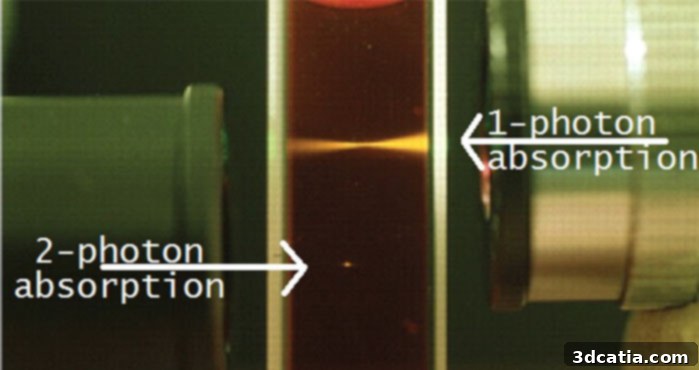
Image via Microlight 3D
A Glimpse into the Research: Magnetically Actuated Microstructures
The ambition behind this research is eloquently captured in the abstract of their seminal paper: “Only achievable with two photons’ polymerization, 3D printing at the micrometer scale is essential for the fabrication of complex objects such as photonic components, deformable microstructures, or microscaffolds for biological cells. Integrating magnetic materials inside those structures has made their remote actuation with an external magnetic field possible. However, the nature of the magnetic material, its volume, and precise position in the structure are keys for the efficiency, dexterity, and compatibility with optical or biological functions. Herein, an original approach consisting in the bonding of discrete and fully magnetic microbeads to unaffected 3D microprinted structures is presented.” This passage highlights the critical importance of 2PP in creating the foundational micro-objects and the intricate challenge of embedding magnetic elements.
The team’s work demonstrates a sophisticated understanding of how to engineer materials at an unprecedented scale. By creating complex micro-tweezers capable of translation, rotation, and opening through a simple magnetic field, they have proven the viability of wirelessly controlled micro-devices. Such dexterity, achieved without any physical connections, has profound implications for environments where physical interaction is difficult or impossible, such as inside the human body or within delicate microfluidic systems. The ability to precisely position and manipulate these structures remotely is a game-changer, promising new paradigms in various scientific and engineering disciplines.
Overcoming Challenges: Integrating Magnetic Functionality at the Microscale
The integration of magnetic properties into micro-3D printed structures presents a significant hurdle. Traditional methods often involve mixing magnetic nanoparticles directly into the photopolymer resin, which can compromise the resin’s properties, reduce printing resolution, or lead to non-uniform magnetic responses. The critical insight from the Grenoble team, as underscored in their research abstract, is that the “nature of the magnetic material, its volume, and precise position in the structure are keys for the efficiency, dexterity, and compatibility with optical or biological functions.” This means that simply adding magnetic material isn’t enough; the placement must be strategic and precise to achieve desired functionalities without impeding the microstructure’s inherent design or other potential functions, such as optical guiding or biocompatibility.
Their approach meticulously addresses these challenges by ensuring that the magnetic components are integrated in a manner that preserves the integrity and functionality of the 3D microprinted structures. This precision is vital for applications requiring intricate control and interaction at the cellular or sub-cellular level, where even minor variations in material properties or structural integrity can have significant consequences. The development of a method that allows for highly localized and controlled integration of magnetism, rather than a diffused approach, is what truly sets this research apart and unlocks a new era for remotely actuated micro-devices.
The Innovative Direct Laser Bonding Method
To achieve their magnetically actuated microstructures, the Grenoble team devised an original and highly effective strategy: the Direct Laser Bonding method. This technique elegantly bypasses the limitations of homogeneous magnetic material integration. Instead, they begin by distributing polycrystalline microbeads randomly within a UV-curable polymer substrate. The genius of the method lies in the precise application of the 2PP laser. During the printing process, the 3D printer’s laser is meticulously directed from the intended object’s structure to these randomly distributed microbeads, selectively curing the photoresist material that lies along this path and essentially “bonding” the magnetic microbead to the desired location within the microstructure.
This targeted bonding mechanism allows for the creation of discrete, fully magnetic microbeads precisely positioned within the otherwise non-magnetic polymer structure. Unlike methods that diffuse magnetic particles throughout the material, Direct Laser Bonding enables highly localized magnetic regions. This localized magnetism is critical for achieving fine-grained control and complex actuation patterns, ensuring that the magnetic field interacts only where intended, thus maximizing efficiency and dexterity. This innovative approach not only maintains the high resolution and structural integrity of the 2PP printed components but also introduces a new dimension of functionality, setting the stage for a new generation of sophisticated microactuators and advanced applications in fields like soft robotics.
Transformative Applications Across Industries
The implications of this research extend across numerous high-tech sectors, promising to revolutionize how we interact with the micro-world. The development of remotely controllable, deformable microstructures offers unprecedented opportunities for advancements in various applications:
- Microactuators and Soft Robotics: Current microactuators often rely on complex mechanical systems or electrical wires, limiting their miniaturization and use in delicate or fluidic environments. Magnetically actuated microstructures, however, provide wireless, precise, and flexible control. This is particularly crucial for soft robotics, where compliant, adaptable micro-devices are needed for tasks like manipulating individual cells, navigating intricate microfluidic channels, or performing minimally invasive surgeries. Imagine microscopic grippers that can sort cells or deliver therapeutic agents with unparalleled gentleness and precision.
- Targeted Drug Delivery and Biomedical Devices: One of the most promising avenues is in biomedicine, especially for drug delivery applications. By integrating magnetic microbeads into biocompatible hydrogels, researchers can create “magnetically-poled hydrogels” that can be precisely guided to specific diseased tissues or cells within the body using external magnetic fields. This targeted approach could drastically reduce systemic side effects of potent drugs, enhance treatment efficacy, and allow for controlled release mechanisms. Beyond drug delivery, these microstructures could form the basis of advanced biosensors, miniature surgical tools, or active components within “lab-on-a-chip” devices for rapid diagnostics.
- Micro-Optics and Photonics: The ability to deform structures at the microscale opens up possibilities for reconfigurable micro-optical components. Lenses, mirrors, or waveguides that can change their shape and optical properties on demand could lead to highly adaptable optical systems for imaging, sensing, and communication, all operating at previously unattainable scales.
- Environmental Sensing and Microfluidics: Remote magnetic control allows for deployment in harsh or inaccessible environments. Micro-robots capable of navigating polluted waterways to detect contaminants, or micro-valves within advanced microfluidic platforms that can precisely control fluid flow, are just a few examples.
The versatility and precision offered by magnetically actuated 2PP-printed microstructures represent a significant leap towards a future where intelligent, autonomous micro-devices can perform complex functions across a multitude of fields, ultimately enhancing human health, industrial processes, and scientific exploration.
The Synergy of Academia and Industry: University of Grenoble & Microlight 3D
This groundbreaking research exemplifies the critical importance of strong collaboration between academic institutions and industrial partners. The University of Grenoble Alpes (UGA) provides the deep fundamental research, scientific rigor, and innovative thinking necessary to push the boundaries of what’s possible. Their fifteen-year legacy of research in 2PP technology laid the essential groundwork for this recent breakthrough. On the other hand, Microlight 3D, a French company specializing in advanced 2PP systems, brings the industrial expertise, engineering capabilities, and commercial drive required to transform scientific discovery into practical, implementable technology.
This symbiotic relationship ensures that cutting-edge scientific innovations are not confined to laboratories but are developed with an eye towards real-world applications and eventual commercialization. Microlight 3D’s advanced additive manufacturing systems, leveraging the core 2PP principles, provide the robust and precise platforms necessary for researchers to execute such complex fabrication processes. This collaboration accelerates the pace of innovation, bridging the gap between theoretical knowledge and practical solutions, and ultimately brings these transformative technologies closer to widespread adoption in various industries.
Future Outlook and Unlocking New Possibilities
The development of magnetically deformable microstructures marks an exciting chapter in the evolution of micro-3D printing. Looking ahead, this technology promises continued advancements in miniaturization, multi-functional material integration, and autonomous control. We can anticipate the creation of even more complex micro-robots capable of intricate tasks, potentially guided by artificial intelligence, performing diagnostics, or executing localized repairs at microscopic scales.
However, like any nascent technology, challenges remain. Further research will focus on expanding the range of compatible magnetic materials, optimizing the fabrication process for scalability and cost-effectiveness, and integrating these micro-devices into more complex macro-systems. The potential to combine magnetic actuation with other stimuli-responsive materials (e.g., light, temperature, pH) could lead to even more sophisticated and adaptive micro-machines. The ongoing exploration in this field holds the promise of unlocking a plethora of new applications, from personalized medicine to next-generation electronics, truly pushing the boundaries of what micromanufacturing can achieve.
Further Reading and Research
For those keenly interested in delving deeper into the technical specifics and methodologies of this pioneering work, the full details of the publication, entitled ‘Fabrication and Magnetic Actuation of 3D‐Microprinted Multifunctional Hybrid Microstructures’, are available in the esteemed Advanced Materials Technologies journal, where it was originally published. This publication provides comprehensive insights into the experimental setup, results, and broader implications of the research. Additionally, readers can find more extensive information regarding the current state of microscale 3D printing and its diverse applications by following the provided link, offering a broader context for this exciting field.