
Prusa Leads Global 3D Printing Effort, Producing Thousands of Medical Face Shields for Healthcare Frontlines
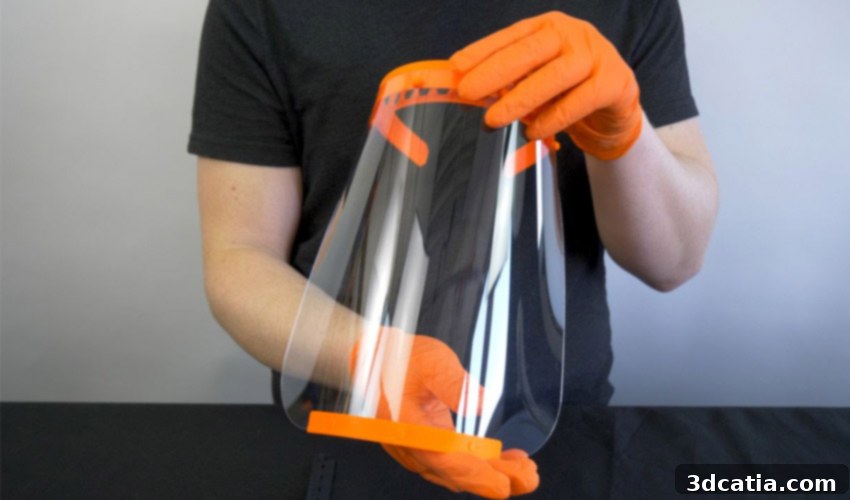
In a powerful display of community support and technological agility, Prusa, the renowned open-source 3D printer manufacturer, swiftly mobilized its extensive capabilities to address a critical shortage of personal protective equipment (PPE) during an unprecedented global health crisis. The company initiated a large-scale project to 3D print hundreds, and quickly thousands, of essential medical face shields for frontline healthcare professionals. This rapid response firmly positions Prusa among the many innovative players in the additive manufacturing industry who have launched various impactful initiatives to combat the spread of COVID-19. The specific design championed by Prusa is a robust 3D printed face shield, meticulously crafted to be worn over a conventional surgical mask. Its primary function is to offer a crucial additional layer of protection, safeguarding the wearer’s eyes and significantly blocking the trajectory of airborne microbes and germs, thereby reducing the risk of viral transmission. Demonstrating remarkable speed and efficiency, Prusa’s dedicated teams developed dozens of prototypes within an astonishing three-day timeframe. As announced by Prusa, the inaugural batches of these vital units were immediately dispatched to hospitals for rigorous field testing and validation, ensuring they met the stringent demands of medical environments before mass deployment.
The design of this protective face shield might already be familiar to many, reflecting the collaborative spirit of the open-source community. Prusa ingeniously leveraged an existing, publicly available file sourced from GrabCAD, a popular platform for sharing CAD models. Their expert engineers then meticulously adapted and optimized this initial design, making it significantly easier and more efficient for widespread 3D printing. This iterative process ensured that the final product was not only effective but also scalable for rapid production. Indeed, similar efforts were notably undertaken by Budmen Industries, where a visionary founding couple utilized their own 3D printers to produce hundreds of these essential shields from their home workshop. However, amidst the flurry of grassroots 3D printing efforts, Josef Prusa, the visionary founder of Prusa, felt compelled to deliver a profoundly important message to his vast community of makers and enthusiasts. He stated, “I don’t intend to hamper the vibe we have now – not by a long shot, but printing respirators might not be the best idea at this time. Let me explain.” This crucial cautionary advice underscored the inherent complexities and potential dangers associated with attempting to 3D print medical respirators without proper certification and rigorous testing. Josef Prusa highlighted that, to his knowledge, none of the readily available 3D printable respirator designs had undergone the necessary verification processes to guarantee they provided the required level of protection. To address this gap, Prusa’s teams diligently gathered as many existing designs as possible, collaborating closely with medical experts to identify and validate truly effective solutions. The core focus points for effective respiratory protection, as emphasized by Prusa, include a perfect seal around the face, the efficacy of the filter material itself, the secure attachment of the filter to the mask, and the overall stability of the mask on the wearer’s face—each element demanding absolute precision. He further elaborated on the challenges posed by common 3D printing materials: “Most of us print rigid materials that are hard to make compliant for seals. Even if we can get a good seal, will it remain functional e.g. even when the wearer talks?” This highlights the critical difference between a simple physical barrier and a certified medical device designed for respiratory protection, where factors like flexibility, fit, and sustained sealing under dynamic conditions are paramount.
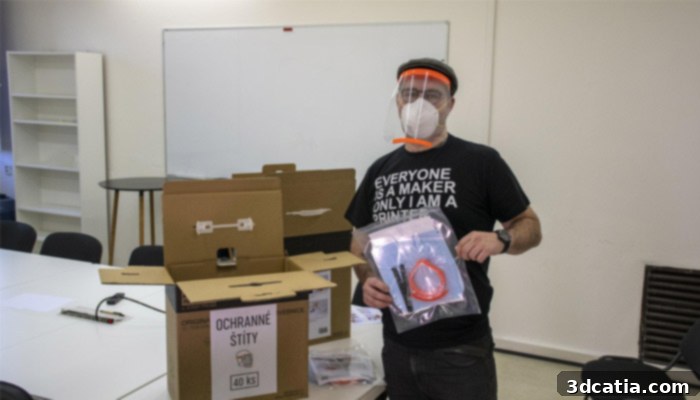
Josef Prusa wearing the 3D printed face shield
3D Printed Face Shields: A Safer and More Accessible PPE Solution
Given the intricate safety considerations surrounding 3D printed respirators, Prusa’s teams made a strategic and pragmatic decision to focus their efforts on creating a full-face shield solution. This design is intended to be worn as an external protective layer, placed strategically over existing certified surgical masks, thereby circumventing many of the inherent safety and regulatory hurdles associated with directly 3D printing a respiratory mask. The implications of a 3D printed mask that directly covers the mouth and nose raise significant concerns, particularly regarding the long-term resistance and biocompatibility of the plastic material. As a wearer breathes, the confined space within such a mask inevitably becomes a warm and humid environment—an ideal breeding ground for bacteria and other pathogens. For healthcare professionals, who are constantly exposed to infectious agents, taking such a risk is simply not an option. Consequently, a well-designed face shield presents itself as a far less restrictive and demonstrably safer alternative at first glance. It provides a robust physical barrier against splashes, sprays, and respiratory droplets, protecting the eyes, nose, and mouth area, without compromising the integrity of a medical-grade respirator worn underneath. This approach allows the additive manufacturing community to contribute effectively and responsibly to the PPE supply chain, focusing on solutions that can be rapidly deployed and provide clear, immediate protective benefits without introducing new health risks.
The operational scale of Prusa’s initiative is truly impressive. The company proudly reports that its vast 3D printer farm is capable of producing approximately 800 parts per day. What is even more remarkable is that this high output is achieved while utilizing only about one-fifth of its total production capacity specifically for this face shield project. This significant reserve capacity means that the daily production volume could be easily and substantially increased should the demand escalate further. Josef Prusa has transparently communicated that the design of the safety mask is not static; it is currently undergoing continuous verification and refinement, indicating that the design could evolve and improve even within days or hours based on feedback from field tests and ongoing research. To ensure that individuals and smaller groups contributing to this effort can produce the safest possible devices for both medical staff and patients, Prusa has also provided invaluable and detailed printing tips on its website. These critical guidelines include, but are not limited to: ensuring the printing environment is well-ventilated, meticulously wearing gloves and a surgical mask during the printing and handling process, avoiding leaving the printed part on the heated 3D printing plate for excessive durations, and other essential hygienic practices. Furthermore, a crucial caution emphasized by Prusa relates to the longevity of the virus on surfaces and the limitations of sterilization for 3D printed plastics: “the virus can live on the plastic for 48-90 hours and plastics cannot be easily sterilized after use. So they are one-use only, at least until we find a way to reliably sterilize the printed parts!” This stark reminder underscores the disposable nature of these printed shields and the need for stringent protocols to prevent cross-contamination, highlighting the ongoing scientific challenges in finding reliable sterilization methods for diverse 3D printed geometries and materials.
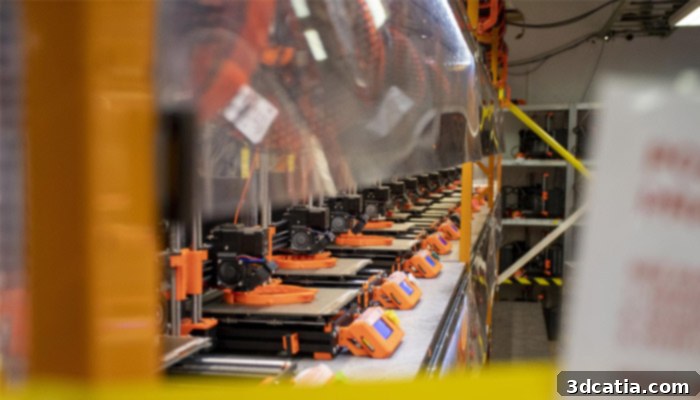
Prusa’s 3D Printer Farm prints hundreds of parts a day
Optimizing Production: Material Selection and Simple Assembly for Wide Adoption
The efficiency of production for these life-saving devices is remarkable, with each complete face shield taking approximately two hours to print across its various components. For optimal performance and ease of printing, Prusa specifically recommends the use of PETG filament. PETG is an excellent choice for this application due to its combination of durability, flexibility, chemical resistance (which is crucial for potential cleaning and exposure to various substances), and its relative ease of printing compared to some other engineering plastics. Another significant advantage of Prusa’s refined design is that it does not require printing supports, simplifying the printing process, reducing material waste, and speeding up post-processing. Beyond the 3D printed components, the assembly of the face shield requires only a few additional, readily available items: a standard rubber band to secure both ends of the mask comfortably around the wearer’s head, and a clear plastic sheet of sufficient thickness for the front visor. Prusa specifies that any transparent, laser-cut plastic material will suffice, recommending a minimum thickness of 0.5 mm to ensure adequate rigidity and protection. This minimalist approach to supplementary materials ensures that the barrier to entry for individuals and smaller workshops wanting to contribute is kept as low as possible. Once all the necessary parts, both 3D printed and off-the-shelf, have been gathered, the assembly process is straightforward and can be easily followed by consulting the comprehensive instructional video provided below, making it accessible even to those with limited prior experience.
In a testament to its commitment to public health, Prusa reportedly donated its initial shipment of 10,000 units directly to the Czech Ministry of Health, providing immediate relief to the country’s medical facilities. Beyond this substantial corporate contribution, Prusa has championed an open-source, decentralized approach, actively inviting individuals and small businesses globally to participate in this vital effort. They encourage anyone with a 3D printer to produce these medical face shields for their local communities and healthcare providers who are in urgent need. This widespread participation is contingent on one critical condition: strict adherence to all the detailed instructions and safety guidelines meticulously outlined on the Prusa website. By making all design files, printing parameters, and assembly instructions freely available, Prusa empowers a global network of makers, transforming individual enthusiasts into a distributed manufacturing force capable of rapidly augmenting the supply of essential PPE. Everything required to contribute to this crucial cause is conveniently accessible on the official Prusa blog, found HERE. This initiative beautifully exemplifies the power of open-source collaboration and additive manufacturing’s unique ability to respond with unprecedented speed and adaptability during times of crisis, bridging critical supply chain gaps and providing tangible support to those on the front lines.
The rapid and widespread adoption of 3D printing for medical supplies during the pandemic has underscored its invaluable potential as a resilient and agile manufacturing technology. While traditional supply chains struggled under immense pressure, additive manufacturing demonstrated its capacity for localized, on-demand production, effectively filling crucial gaps in the provision of personal protective equipment. Initiatives like Prusa’s face shield project serve as powerful case studies, illustrating how open-source collaboration, combined with readily available desktop 3D printers, can quickly pivot to address urgent societal needs, transforming ordinary citizens into vital contributors to global health efforts. This collective response highlights a new paradigm in manufacturing, one that emphasizes decentralization, community engagement, and rapid innovation.
What are your thoughts on these innovative 3D printed medical shields and the broader role of additive manufacturing in crisis response? We invite you to share your perspectives in a comment below or engage with our community on our Facebook and Twitter pages! Don’t forget to sign up for our free weekly Newsletter, ensuring you stay informed with all the latest news, innovations, and developments in the dynamic world of 3D printing, delivered directly to your inbox!