
Unlocking Innovation: The Transformative Benefits and Advantages of 3D Printing
3D printing, also known as additive manufacturing, has rapidly transcended its niche origins to become a cornerstone of the 4th Industrial Revolution. Its ability to create three-dimensional objects layer by layer from digital designs has sparked a wave of innovation, leading to its widespread adoption across diverse sectors such as aeronautics, medical, automotive, and jewelry design. From rapid prototyping to customized end-use parts, the advantages of 3D printing are vast and continuously expanding. This technological shift is not merely an incremental improvement; it represents a fundamental rethinking of how products are designed, manufactured, and distributed.
Companies worldwide are increasingly evaluating how to integrate this powerful technology into their manufacturing processes. The pertinent questions for many businesses are: To what extent should 3D printing be incorporated? And what tangible benefits can a company expect from its adoption? To provide a clear understanding of its potential, this comprehensive guide will delve into the primary advantages of 3D printing, exploring why it has become an indispensable tool for modern industry and what makes it a game-changer for businesses seeking efficiency, innovation, and adaptability.
1. Reduced Costs for Small-Batch Production and Customization
One of the most compelling arguments for adopting 3D printing, particularly for businesses dealing with specialized products or varied demands, revolves around its economic benefits. Unlike traditional subtractive manufacturing methods, which often involve cutting away material from a larger block (generating significant waste), 3D printing is an additive process. It builds objects by adding material only where it’s needed, thus inherently minimizing material waste. This efficiency translates directly into lower material costs, especially when working with expensive or specialized engineering-grade materials.
Furthermore, 3D printing significantly simplifies the overall supply chain. It often reduces the need for complex tooling, molds, or fixtures that are costly and time-consuming to produce for traditional manufacturing. This simplification directly contributes to a lower total production cost. For small series, custom parts, or unique prototypes, the upfront investment in tooling for conventional methods can be prohibitive. Additive manufacturing bypasses this obstacle, making it economically viable to produce even a single part or a limited run of highly customized products. This is especially beneficial for companies focusing on niche markets, personalized goods, or specialized industrial components.
A unique characteristic of 3D printing is its relatively constant production cost per part, regardless of the quantity (within reasonable operational limits). While traditional manufacturing benefits from significant economies of scale, where per-unit costs decrease drastically with larger production volumes, 3D printing maintains a more stable cost structure. This seemingly counter-intuitive point is precisely what makes it advantageous for low-volume production. For companies that do not exceed a certain production threshold, additive manufacturing becomes the preferred choice, enabling profitable production of custom parts or small series that would otherwise be uneconomical. This empowers startups and small and medium-sized enterprises (SMEs) to enter new markets with less financial risk, allowing them to test product viability and iterate quickly without massive initial investment in mass production infrastructure.
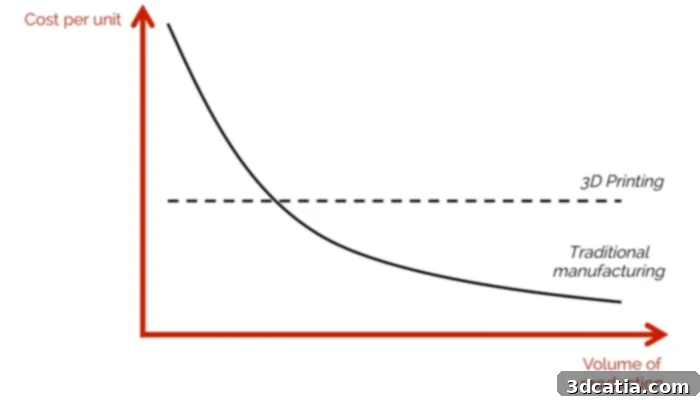
The graph above vividly illustrates the cost curve difference between 3D printing and traditional manufacturing. It highlights how 3D printing enables profitability for unique parts or small batches, a critical advantage for businesses seeking flexibility and reduced market entry barriers.
2. Accelerated Manufacturing and Product Development Cycles
While the actual 3D printing of a complex part might take several hours, considering the entire product lifecycle from concept to market, 3D printing dramatically accelerates the process. In many instances, it shortens development timelines from several months to just a few weeks. This rapid turnaround is particularly evident in the prototyping phase, where iterative design is crucial.
By integrating 3D printing capabilities in-house, companies can swiftly design, produce, and test prototypes without relying on external suppliers. The conventional process of outsourcing prototyping often involves waiting days or even weeks for each new iteration of a design. With an in-house 3D printer, designers can make adjustments and have a new physical prototype ready within hours or a day. This immediate feedback loop fosters greater agility throughout the design phase, allowing for more experimentation, faster validation of concepts, and ultimately, a significantly quicker time-to-market for the final product. This profound acceleration led to the coining of the term “Rapid Manufacturing,” which was one of the earliest descriptors for 3D printing in the 1990s, underscoring its historical significance in speeding up industrial processes.
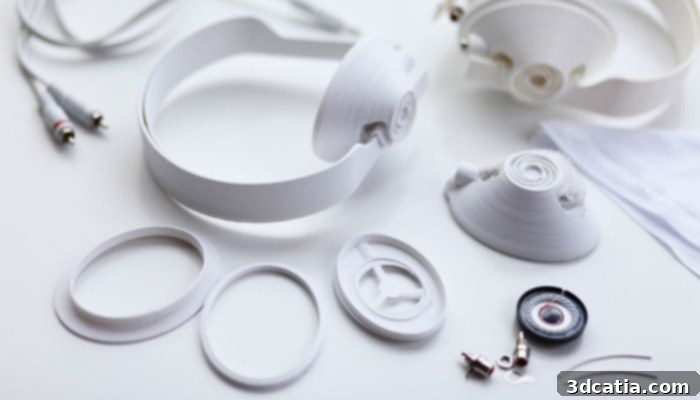
3D printing offers greater agility during the prototyping phase, enabling rapid iteration and faster product development.
“Additive manufacturing makes it possible to test innovations very quickly and at a lower cost. We are no longer in a project management type “Waterfall”, that is to say where everything is planned in advance, with inevitably his lot of unforeseen that come to question everything, but in an iterative approach much more agile” – Théophile Guettier, Additive Manufacturing specialist at Bosch.
Beyond individual part production, other specificities of 3D printing contribute to its speed. For instance, the ability to simultaneously print multiple, vastly different objects on the same build plate is a significant time-saver. Imagine a single print job producing an architectural model, an anatomical scan for a patient, and a complex mechanical part for a machine – all at once. This multi-tasking capability optimizes machine utilization and streamlines diverse production needs. Moreover, the capacity to create functional and highly complex models in a single, continuous step eliminates numerous chronophagous assembly stages that are typically required in conventional manufacturing. This simplification of the assembly process is not just about saving time; it also reduces potential points of failure, improving product reliability and consistency.
3. Unprecedented Design Freedom and Geometric Complexity
One of the most revolutionary innovations brought forth by 3D printing technologies is the unparalleled ability to produce parts of extraordinary geometric complexity. Shapes, internal structures, and intricate designs that were previously considered impossible or prohibitively expensive to manufacture with traditional methods are now readily achievable with almost any 3D printer. This includes intricate lattice structures, organic forms inspired by nature, and highly detailed internal channels that can optimize fluid flow or heat exchange.
This removes the traditional constraint where designers had to adapt their vision to the limitations of manufacturing tools. Instead, 3D printing liberates designers and 3D modelers to imagine and create virtually any drawing that comes to mind—be it entangled pieces, un-assembled forms, or complex meshes. This technological leap has also paved the way for new paradigms in 3D design methodology, pushing the boundaries of what’s possible in product aesthetics and functionality.
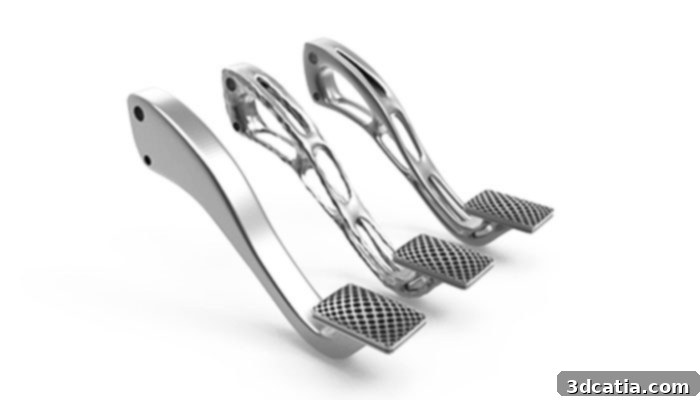
An example of a topologically optimized design, showcasing significant weight reduction while maintaining structural integrity.
Among these innovative design techniques is topological optimization software. This advanced tool allows engineers to optimize the design of a part based on specific mechanical constraints, loads, and boundary conditions. The primary goal is to strip away excess material from areas that contribute minimally to structural integrity, thereby reducing the part’s weight while maintaining or even improving its performance. This criterion is paramount for applications where weight is a critical factor, such as in the aerospace sector (e.g., lighter aircraft components lead to fuel efficiency) or motor racing (e.g., lighter vehicle parts enhance speed and performance). This approach not only conserves material but also unlocks entirely new geometric forms that are incredibly efficient.
Other revolutionary concepts further amplify this design freedom. Generative design, for example, often relies on bio-mimicry, where algorithms generate design solutions inspired by natural evolutionary processes and forms. This can lead to highly optimized, organic-looking structures. Similarly, the creation of latticed structures within parts provides immense strength-to-weight ratios. These intricate internal meshes can reinforce components while significantly reducing their overall mass, a feat practically impossible with conventional machining. Pioneers like Airbus, with its bionic aircraft concept, XtreeE, known for constructing nature-inspired concrete pavilions, and the American studio Nervous System in jewelry, exemplify how 3D printing fuels a design revolution. Each unique, personalized jewel from Nervous System, for instance, is originally designed on a computer and resembles intricate coral formations, demonstrating the ultimate blend of artistic vision and technological capability.
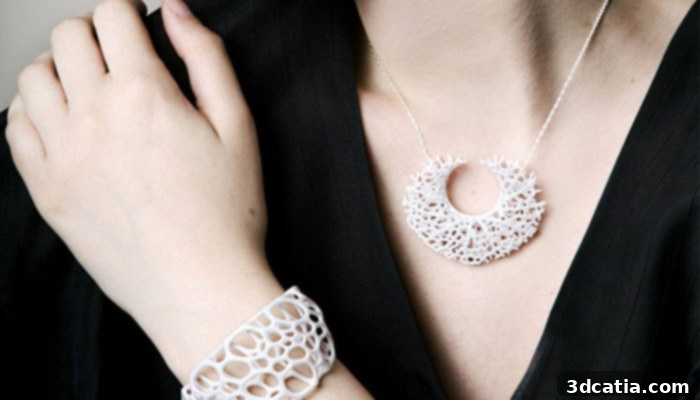
The unique jewels from the American studio Nervous System, showcasing intricate designs inspired by nature and made possible through 3D printing.
4. The Rise of On-Demand Production and Mass Customization
A final, but equally remarkable, advantage of 3D printing is its role in driving the digitisation of industrial catalogs and the emergence of truly on-demand production. In the not-so-distant future, many physical products could be reduced to simple digital files, signaling a profound shift away from traditional inventory management and warehousing. This trend is already being substantiated by research, such as a study from the Finnish MTB research center, which estimated that at least 5% of all spare parts could already be digitized and produced via 3D printing, eliminating the need for physical stock.
Major global corporations like Boeing, SEB, Volvo, and Volkswagen are actively pursuing initiatives to provide customers with access to digital versions of their spare parts. This strategy allows them to reduce inventory carrying costs, mitigate risks associated with obsolete parts, and provide more efficient service. Beyond industrial applications, initiatives like Boulanger’s Happy3D platform in France empower individual consumers to directly download and 3D print replacement components for their household appliances. This not only offers a powerful solution in the fight against planned obsolescence but also extends the lifespan of products and promotes sustainability by reducing waste.
More broadly, 3D printing, propelled by advancements in digital technology and the internet, is formalizing the concept of on-demand production. Every order for a 3D printed part can operate in a lean, single-flow process, dramatically changing the supply chain dynamics across numerous industries. This paradigm shift opens the door to the mass customization of an extensive range of consumer goods. Whether it’s personalized toys, bespoke footwear, custom-fit lingerie, or ergonomically designed headphones, the possibilities are virtually limitless. Dozens of innovative startups have recognized this immense potential, launching businesses with lower overheads and greater agility than their traditional counterparts. Much like the digital revolutions that transformed the music and cinema industries, established giants in manufacturing must adapt quickly to these changes or risk ceding market share to the burgeoning forces of 3D printing innovation.

Boulanger’s French platform, Happy3D, exemplifies on-demand production by offering customers digital files to 3D print their own spare parts, empowering consumers and extending product life cycles.
To delve deeper into the transformative impact of additive manufacturing, we highly recommend exploring the work of Thierry Rayna, a distinguished professor at École Polytechnique in France. For several years, Professor Rayna has keenly focused on the profound implications of 3D printing on traditional business models. In one of his insightful papers, titled “Will the industrial revolution of 3D printing take place?” (which notably inspired this very article), he synthesizes the three core reasons that should compel any company to consider adopting this technology:
- When there is urgency: For rapid prototyping, quick repairs, or urgent production of critical components where speed is paramount.
- When the volume of production is low: Ideal for custom orders, small-batch manufacturing, or personalized products where traditional economies of scale don’t apply.
- When the shape of the object is such that it cannot be manufactured using other technologies: For intricate geometries, internal structures, or optimized designs that only additive manufacturing can achieve.
Professor Rayna further concludes by advising businesses to actively study the potential synergies between 3D printing and other cutting-edge technologies. Integrating additive manufacturing with advancements such as connected objects (IoT), bio-mimicry, and Big Data analytics promises to significantly expand the spectrum of applications, unlock new efficiencies, and drive unprecedented levels of innovation across all industries.
Do you have additional insights or experiences regarding the remarkable advantages of 3D printing that you’d like to share? We invite you to contribute your thoughts in the comments section below or engage with us on our Facebook and Twitter pages! And for all the latest news, trends, and breakthroughs in the world of 3D printing, don’t forget to sign up for our free weekly Newsletter, delivered straight to your inbox.