
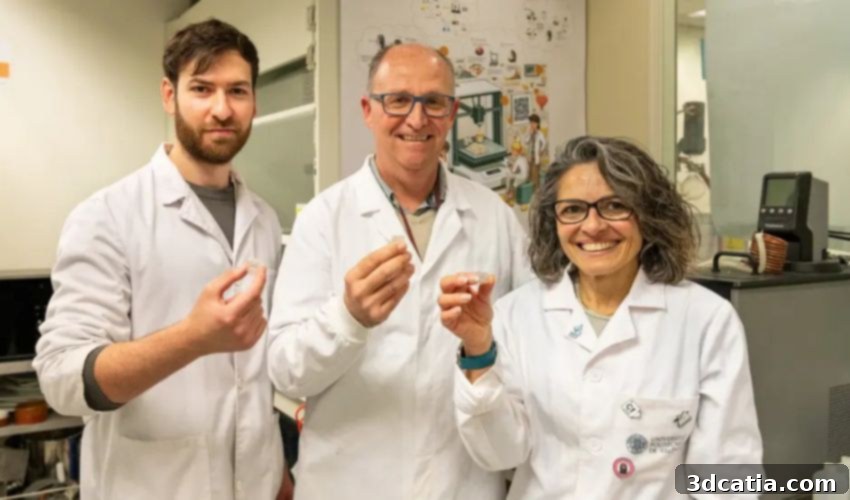
Revolutionizing Health: 3D Printed Gummies Offer Personalized Nutrition Solutions
Imagine a future where your daily nutritional supplements are perfectly tailored to your unique biological needs. Picture a delicious gummy, precisely formulated with the exact amount of iron, vitamin D, zinc, or any other vital micronutrient your body specifically requires. This groundbreaking vision is now closer to reality thanks to an innovative collaboration. A dedicated team of researchers from the Universitat Politècnica de València (UPV) in Spain, in partnership with the University of Foggia in Italy and Jiangnan University in China, has successfully developed a sophisticated 3D printing system capable of producing gummies enriched with customized micronutrients. Their pioneering study, meticulously detailed in the esteemed scientific journal Journal of Food Engineering, marks a significant leap forward, unlocking unprecedented possibilities for the field of personalized nutrition and proactive health management.
The global challenge of malnutrition, particularly due to a lack of essential micronutrients, presents a profound public health crisis, impacting an alarming one-third of the world’s population, according to data from the World Health Organization (WHO). This pervasive issue, often termed “hidden hunger,” arises from various factors, including nutrient-deficient diets, underlying absorption problems, or restricted access to a diverse range of nutritious foods. Micronutrient deficiencies, such as those involving iron (leading to anemia), zinc (impacting immune function), and B vitamins (critical for energy metabolism and neurological health), can have severe, long-term consequences, affecting physical and cognitive development, immune response, and overall quality of life across all age groups, especially vulnerable populations like children, pregnant women, and the elderly. In light of this widespread problem, the capacity to precisely manufacture personalized foods, meticulously formulated to address each individual’s specific nutritional requirements, emerges as a remarkably promising and impactful solution.
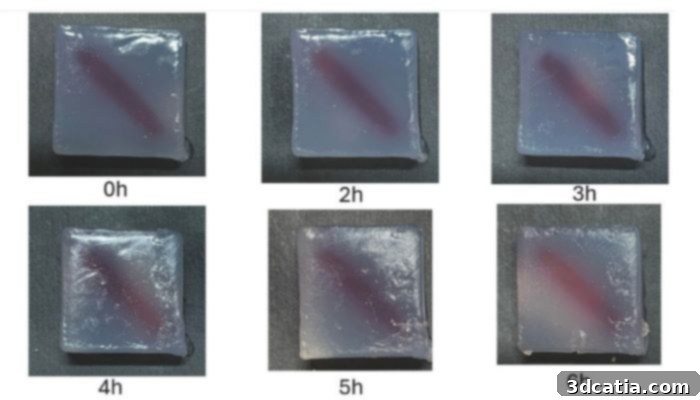
Photographs of the 3D gummies showing their storage for 6 hours at room temperature (Credits: Adrián Matas-Gil et al.).
The Dawn of Personalized Nutrition: The Role of 3D Printing in Gummy Production
The fundamental objective behind these innovative gummies is to significantly enhance individual health outcomes. These unique edibles are meticulously crafted from a specialized starch gel, primarily composed of Ultratex, which is derived from tapioca, combined with agar. This specific combination was chosen for its excellent rheological properties, providing the ideal texture and structural integrity for the printing process. The true ingenuity lies in the gummies’ adaptable internal structures, which can be precisely engineered to house and deliver the necessary nutrients with unparalleled accuracy. The cornerstone of this entire development hinges on the extraordinary precision offered by advanced 3D printing technology, also known as additive manufacturing.
Utilizing bespoke software, users gain complete control to define both the intricate external shape and, more critically, the exact amount and type of nutrients they wish to incorporate into each individual gummy. This level of customization moves beyond generic supplements, allowing for precise formulation based on individual health profiles, dietary restrictions, or medical recommendations. The system seamlessly translates this detailed information into a sophisticated digital design, which is then brought to life by an extrusion-based 3D printer. A nozzle, remarkably fine at just 0.4 mm in diameter, deposits the gel material layer by layer, ensuring an incredibly high fidelity between the initial digital model and the final physical product. This precision minimizes material waste and guarantees that each gummy delivers its intended nutritional payload. For the initial testing and validation phases of this research, the scientists employed the reliable Foodbot chocolate 3D printer, demonstrating the adaptability of existing food-grade additive manufacturing equipment for this novel application.
Beyond mere production, the research team conducted rigorous testing, yielding highly encouraging results. They confirmed that the 3D printed gummies successfully retain their nutritional quality over time, a crucial factor for efficacy. Furthermore, their texture was consistently found to be adequate – offering a pleasant and easy-to-chew experience, which is essential for consumer acceptance and adherence to nutritional regimens. A significant finding was their stability, remaining intact and viable for several hours at room temperature. This robust stability is a game-changer, as it could substantially facilitate their broader distribution, potentially through innovative channels like smart vending machines in workplaces, schools, or healthcare facilities, as thoughtfully suggested by the pioneering scientists. Xavier Martínez Monzó, a lead researcher at the University Institute of Food Engineering-FoodUPV, shared his optimism regarding the project’s progress: “The results we have obtained so far are very positive. We are still working to improve some aspects, such as enhancing long-term nutrient stability and refining structural integrity, but this work represents a significant new advance in the application of 3D printing within the food industry, with a clear focus on improving the health and well-being of consumers worldwide.”
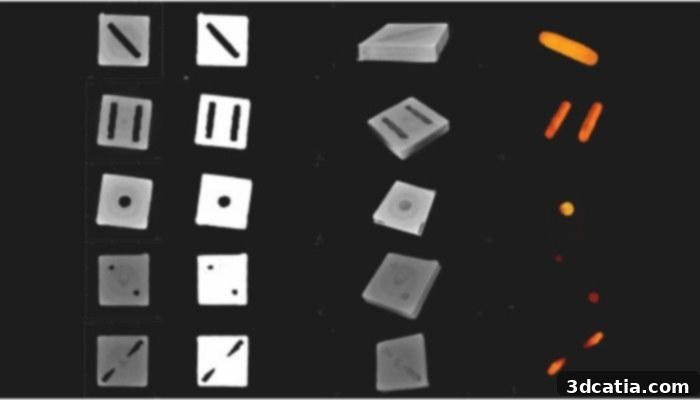
X-ray images of the 3D gummies show the fidelity of the print and its microstructural features (Credits: Adrián Matas-Gil et al.).
Advancing the Science: Precision Dosing and Material Innovation
One of the most compelling aspects that distinguishes the scientists’ innovative proposal is its inherent capability for precise, micro-level dosing during the preparation of the gummies. This is a crucial differentiator from conventional methods. Unlike many other approaches that rely on mixing ingredients in fixed, often broad, proportions, this revolutionary method empowers exact dosing of even minute amounts of critical micronutrients. This meticulous control offers numerous benefits: it significantly avoids the costly waste of valuable ingredients, ensuring greater efficiency in production, and more importantly, it guarantees that each consumer receives a supplement perfectly aligned with their specific dietary needs without over- or under-dosing. Furthermore, the selection of specific gel formulations, such as the starch-agar blend, is instrumental to the process. These gels are engineered to ensure excellent flowability during printing, allowing for intricate and consistent designs, coupled with rapid solidification once printed. This characteristic is absolutely essential for maintaining the high quality, structural integrity, and consistency of the printed gummies, preventing deformation and ensuring the encapsulated nutrients remain securely within their designated structures.
Future Outlook and Unlocking Full Potential
While the developed system is already robustly functional and demonstrates significant promise, the research team is not resting on its laurels. They are diligently continuing to refine various critical aspects to optimize the technology further. Key areas of ongoing development include enhancing the solidity of the internal cavities within the gummies, which is vital for preventing potential nutrient leakage or degradation over time. Concurrently, they are focused on improving the long-term stability of the incorporated nutrients, ensuring they remain bioavailable and effective throughout the product’s shelf life. Furthermore, new tests are continuously being analyzed to improve the overall resolution of the printing process, allowing for even finer details and more complex internal structures. The team is also actively working to adapt the material formulations to cater to a broader spectrum of dietary needs and preferences. This includes developing vegan-friendly options, sugar-free alternatives, and formulations that address specific allergies or sensitivities, thereby expanding the accessibility and applicability of these personalized nutritional gummies to an even wider global population. The transformative potential of this technology for public health is immense, promising a future where nutrition is truly individualized and optimized for everyone.
The journey from laboratory innovation to widespread consumer availability involves overcoming several challenges, including scaling up production efficiently, managing the initial costs associated with advanced 3D printing technology, navigating complex regulatory approvals for novel food products, and ensuring broad consumer acceptance and understanding. However, the foundational research presented here lays a solid groundwork, pointing towards a future where customized nutrition is not just a concept, but an accessible reality for individuals seeking to proactively manage their health with unprecedented precision and personalization. This blend of cutting-edge technology and nutritional science is poised to redefine how we approach dietary supplementation, moving away from a ‘one-size-fits-all’ model to truly bespoke health solutions.
What are your thoughts on the revolutionary potential of these 3D printed gummies for personalized health? We invite you to share your insights and comments below, or engage with us on our vibrant LinkedIn and Facebook pages. Additionally, don’t miss out on the latest advancements in additive manufacturing—sign up for our free weekly Newsletter to receive the most current 3D printing news directly in your inbox. You can also explore all our insightful videos on our dedicated YouTube channel. Are you interested in more groundbreaking news from the medical and dental 3D printing sector? Visit our specialized page HERE to stay informed.
*Cover Photo Credit: Universitat Politècnica de València