
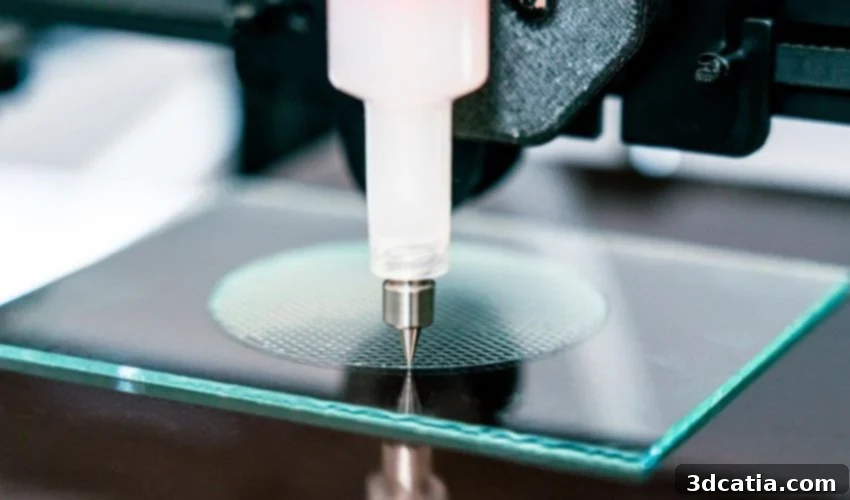
Revolutionizing Bioprinting: ViscoTec’s Puredyne Printheads Powered by Carbon DLS Additive Manufacturing
The medical sector is a dynamic landscape of continuous innovation, and among the most groundbreaking advancements emerging today is bioprinting. This revolutionary technology harnesses the power of 3D printing to precisely combine living cells, intricate growth factors, and specialized biomaterials, creating complex biomedical parts. The immense potential of bioprinting is truly exhilarating, promising to transform healthcare by enabling medical professionals to 3D print biocompatible organs, reconstruct bones, and engineer tissues with unprecedented accuracy and speed. Such capabilities could fundamentally redefine personalized medicine, regenerative therapies, and drug development. However, as an evolving and highly specialized field, bioprinting faces unique challenges, particularly concerning the precision, material compatibility, and geometric complexity required for its applications. Meeting these stringent demands necessitates innovative solutions and advanced manufacturing techniques.
Fortunately, pioneering companies are rising to meet these challenges. One such key player, ViscoTec Pumpen- und Dosiertechnik GmbH (ViscoTec), a renowned manufacturer of high-precision dosing solutions, recognized the need for a superior printhead design. To overcome the inherent difficulties in manufacturing such a sophisticated component, ViscoTec strategically partnered with rapid product manufacturing GmbH (rpm), a leading production partner for cutting-edge additive manufacturing. This collaboration, leveraging the advanced capabilities of Carbon’s Digital Light Synthesis™ (DLS™) process, was instrumental in developing state-of-the-art printheads specifically engineered for the rigorous demands of bioprinting. This innovative approach promised to deliver the precision, material compatibility, and design freedom essential for the next generation of bioprinting applications.
ViscoTec specializes in manufacturing dosing solutions based on progressive cavity technology, a principle known for its accuracy and consistency in dispensing a wide range of materials. Their flagship Puredyne printhead solution epitomizes this expertise, featuring patented single-use cartridges designed for ultra-precise dispensing in extrusion-based bioprinting. These cutting-edge printheads are poised to unlock a multitude of critical applications, including the creation of detailed organ models for research, groundbreaking cancer research, advanced tissue engineering, bespoke personalized medicine solutions, custom scaffolds for cell growth, efficient drug development and testing platforms, innovative food production techniques, sophisticated organs-on-a-chip systems for toxicology, and even advanced cosmetics development. The versatility of the Puredyne printheads is remarkable; they are engineered to process a diverse array of liquids and pastes, ranging from low to high viscosity. This includes delicate hydrogels and cell-laden materials, conductive inks vital for bioelectronics, and robust ceramic pastes, among many others. However, the inherently delicate and precise nature of bioprinting posed significant manufacturing hurdles for the printhead itself, rendering traditional production methods almost impossible to implement effectively. The intricacies of internal channels, the need for sterile, biocompatible surfaces, and the demand for extreme geometric accuracy pointed toward a clear solution: additive manufacturing.
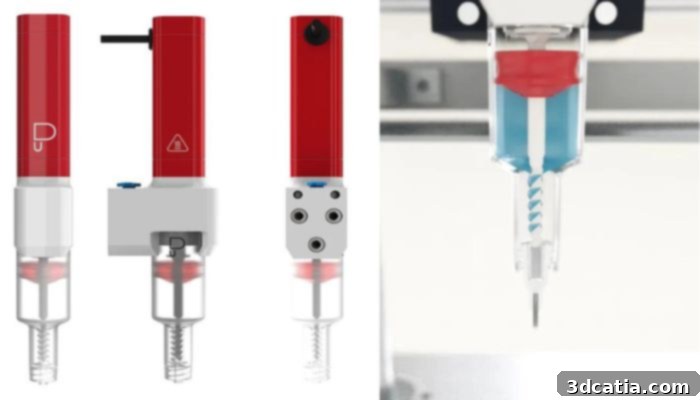
The Puredyne printhead incorporated milled materials (left) and complex internal channels (not displayed) that require high accuracy 3D printing (photo credits: Puredyne)
Embracing Additive Manufacturing for Next-Generation Bioprinting Printheads
From the outset of designing the Puredyne printhead part, ViscoTec understood the rigorous specifications it needed to meet. These requirements were not merely desirable; they were absolutely critical for a component operating in highly sensitive biomedical environments. Paramount among these was the necessity for the part to be fabricated from a medically approved material, ensuring complete biocompatibility and safety for applications involving living cells and biological tissues. Furthermore, the material needed to exhibit exceptional chemical resistance to a broad spectrum of detergents and disinfectants, crucial for maintaining sterility and preventing cross-contamination in medical settings. Beyond material properties, the manufacturing solution itself had to offer unparalleled design freedom, allowing for the creation of intricate internal geometries. It also demanded incredibly tight tolerances to ensure precise functionality, ease of cleaning to prevent biofilm formation, and a superior surface quality that minimizes cell adhesion outside designated areas and prevents material clogging. While additive manufacturing emerged as a clear frontrunner due to its inherent advantages in achieving high design freedom and enabling cost-effective production for low-volume, specialized parts, not just any 3D printing technology could deliver the perfect product to meet these exacting standards.
Initial explorations with alternative additive manufacturing methods underscored the unique challenges. For instance, when ViscoTec attempted to produce the part using Selective Laser Sintering (SLS) with PA12 material, they quickly discovered that the resulting surface quality fell short of the necessary medical-grade standards. The inherent porosity and rough surface finish of SLS parts, while acceptable for many industrial applications, proved problematic for bioprinting where smooth, easily sterilizable surfaces are paramount. Moreover, conventional post-production finishing techniques proved insufficient to address this issue, particularly for the printhead’s complex internal channels and intricate undercuts, which remained inaccessible for effective treatment. This limitation effectively ruled out both SLS and traditional milling processes, as neither could achieve the required internal precision and surface integrity. However, by engaging with Carbon production partner rpm, ViscoTec discovered that the Carbon DLS process offered a comprehensive solution. Not only did DLS fully satisfy all their stringent design and manufacturing requirements, but it also provided access to a groundbreaking material perfectly suited for the application, overcoming the limitations encountered with other technologies.
The Carbon DLS process, a form of photopolymerization, is renowned for its ability to rapidly produce highly accurate parts with exceptional surface quality and minimal post-processing requirements. Unlike other methods, DLS utilizes a continuous liquid interface production (CLIP) technology, which allows for the smooth, layerless creation of objects, resulting in isotropic mechanical properties and incredibly fine features. This continuous process also significantly enhances print speed and reduces the likelihood of imperfections. The critical high surface quality needed for the Puredyne printhead was further assured by the selection of Carbon MPU 100, a medical-grade material specifically formulated for demanding applications. This innovative material not only met all the technical requirements, including superior biocompatibility (crucial for direct contact with living cells), optimal hardness for durability, high shape fidelity for precise operation, and excellent resistance to a wide range of solvents used in laboratory settings, but it also boasted critical medical approvals. MPU 100 has passed rigorous tests, including ISO 10993 and USP Class VI, affirming its suitability for medical devices and applications involving prolonged contact with biological systems. Furthermore, parts produced from MPU 100 exhibit excellent aesthetic properties, being non-yellowing and maintaining their high surface quality over time, essential for long-term clinical and research use.
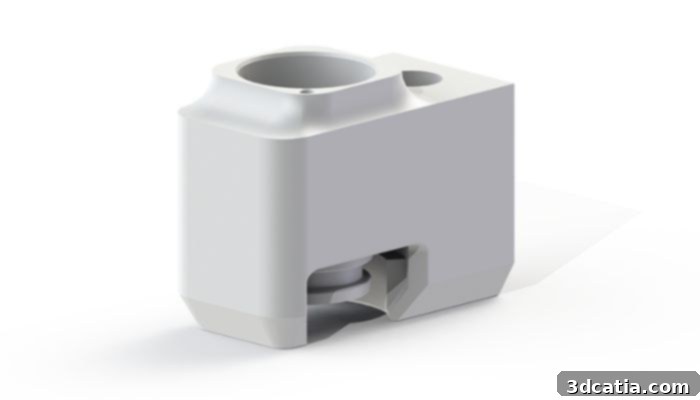
The printhead part which was made by rpm using the Carbon DLS process and MPU 100 (photo credits: Carbon)
The transformative capability of Carbon DLS was particularly evident in its ability to fabricate the exceptionally complex inner channels of the Puredyne printhead. These intricate channels are not merely design features; they are critical functional components that facilitate a precisely controlled air supply, which in turn drives a plunger mechanism. This sophisticated system ensures a constant and consistent flow of material to the pump, preventing air bubbles and ensuring uninterrupted, precise dispensing – a paramount requirement in bioprinting where material integrity and deposition accuracy are non-negotiable. The creation of these deeply embedded internal channels, combined with the necessity for a minimal installation space, proved to be an insurmountable hurdle for traditional manufacturing techniques such as injection molding or conventional milling. These methods are inherently limited by line-of-sight and tooling constraints, making the production of such complex, enclosed geometries virtually impossible or prohibitively expensive. In contrast, DLS not only enabled the seamless printing of these highly complex geometries but also allowed for the maintenance of incredibly tight tolerances throughout the entire structure. These combined factors – unparalleled design freedom, material suitability, and precision manufacturing – converged to allow ViscoTec to engineer a printhead that perfectly met, and even exceeded, their specific and highly demanding requirements for advanced bioprinting applications.
Tangible Results: How DLS Elevated the Puredyne Printhead’s Performance
The adoption of additive manufacturing, particularly Carbon’s DLS technology, yielded profound benefits for ViscoTec in the development and production of their innovative Puredyne printheads. Beyond meticulously meeting all the stringent design and material requirements, the Carbon DLS process delivered a host of additional advantages, most notably in areas crucial for product commercialization and performance: time to market, cost efficiency, and significant lightweighting. By leveraging the geometric freedom offered by AM, ViscoTec was able to drastically reduce the overall dimensions of the printhead, optimizing its footprint and integration into bioprinting systems. The collaborative efforts with rpm further enhanced this optimization, allowing ViscoTec to strategically remove excess material without compromising the printhead’s structural integrity or critical dispensing quality. The outcome was a remarkable reduction in weight by 55%, decreasing from an initial 275 grams to a mere 125 grams. Concurrently, the physical size saw a substantial decrease, with the height shrinking from 22 cm to 16.5 cm, representing an impressive 25% reduction. These reductions in weight and size are not just numerical improvements; they translate into more compact, agile, and potentially portable bioprinting systems, offering greater flexibility for researchers and clinicians.
One of the most impactful benefits derived from the collaboration with rpm and the implementation of the Carbon DLS process was the dramatic acceleration of the product development cycle. ViscoTec successfully slashed the time to market from a projected one year down to an astonishing four months. This rapid turnaround is invaluable in a fast-paced field like bioprinting, where innovation cycles are short, and getting cutting-edge tools into researchers’ hands quickly can provide a significant competitive edge. Furthermore, DLS technology is uniquely suited for creating on-demand parts without any sacrifice in quality. This capability is a game-changer for specialized applications such as bioprinting, where production volumes are often low, and customization is frequently required. The ability to produce parts precisely when needed, rather than relying on large, expensive batch runs typical of traditional manufacturing, ensures that production remains highly cost-effective. Moreover, DLS facilitates unparalleled personalization, allowing each Puredyne printhead to be tailored to the specific needs of individual customers or specialized research projects, opening new avenues for bespoke bioprinting solutions.
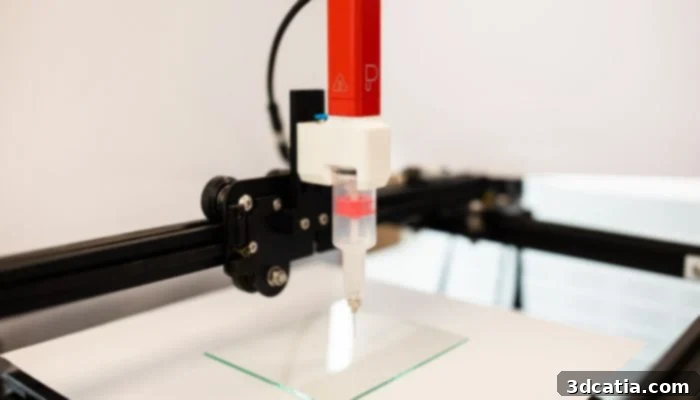
Photo Credits: Puredyne
The synergistic efforts of Carbon and rpm culminated in what ViscoTec proudly considers a radically superior product, fundamentally reshaping the possibilities within bioprinting. According to all collaborating companies, this innovative solution effectively addressed and resolved several common and persistent issues plaguing bioprinting processes. These include mitigating process fluctuations that often lead to inconsistent results, significantly enhancing bioprinting precision for more reliable and accurate cellular deposition, and crucially, eliminating the notorious problem of clogged dispensing needles, which can halt experiments and waste precious biological materials. The Puredyne printhead’s impact has been widely recognized, earning the prestigious Red Dot Design Award 2022 for industry design, a testament to its exceptional form, function, and innovation. With this accolade, the Puredyne printhead is now successfully entering the North American market, poised to empower researchers and developers across the continent. To delve deeper into the transformative capabilities and design intricacies of the Puredyne Printhead, further information is available HERE.
What are your thoughts on the groundbreaking Puredyne printheads and their profound impact on advancing bioprinting technology? We invite you to share your insights in a comment below or join the conversation on ourLinkedIn,Facebook, andTwitter pages! Don’t miss out on the latest advancements in 3D printing; remember to sign up for our free weeklyNewsletter here, delivering the most current news directly to your inbox! You can also explore our extensive library of videos on ourYouTube channel.
*Cover Photo Credits: Puredyne