

Origin One: Revolutionizing Industrial 3D Printing with Open Photopolymerization for High-Volume Production
The additive manufacturing sector has eagerly anticipated the widespread availability of the Origin One platform, a groundbreaking industrial 3D printer designed to tackle the limitations of traditional manufacturing. First announced by the US startup Origin, this innovative machine introduces an open additive platform built upon proprietary Programmable Photopolymerization (P3) technology. Since its initial unveiling, Origin has experienced an exponential surge in demand from customers globally, underscoring the market’s readiness for such a sophisticated and flexible solution. In the past six months alone, the company has successfully more than doubled its installed printer base, reaching prominent Global Fortune 500 customers across diverse regions including the United States, Ireland, Germany, and Denmark. This rapid adoption spans critical industries such as footwear, automotive, contract manufacturing, and government sectors, demonstrating the Origin One’s versatility and capacity to meet complex industrial requirements.
Reflecting on this significant achievement, Chris Prucha, co-founder and CEO of Origin, expressed immense satisfaction: “Shipping our first production printer, Origin One, is a huge milestone for the company. The tremendous customer growth and demand we’ve seen for the printer, as well as the positive reception from our open material network, is extremely gratifying and proof that we’ve created a platform that our customers need.” Prucha’s statement highlights not only the successful transition from development to market deployment but also the validation of Origin’s core strategy: providing an open, adaptable platform that truly addresses manufacturing challenges and drives innovation in industrial 3D printing.
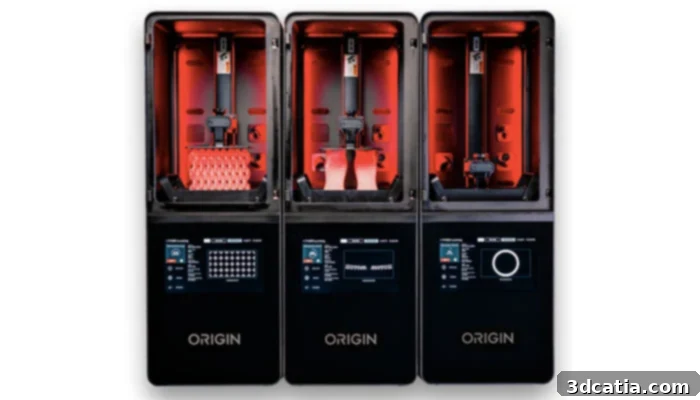
The Origin One production platform, powered by P3 technology | Image via Origin
Addressing Industry Challenges with an Open Additive Manufacturing Platform
Established in 2015, Origin was founded on a clear vision to overcome a pervasive challenge within the additive manufacturing landscape: the prevalence of closed ecosystems. Historically, many 3D printer manufacturers developed machines that were only compatible with their proprietary materials, severely limiting innovation, increasing operational costs, and restricting end-user choice. Recognizing this bottleneck, Origin engineered the Origin One as an open platform, fostering an ecosystem where users can leverage a wide array of custom and third-party materials. This pioneering approach has allowed Origin to cultivate an extensive network of material partners, significantly broadening the range of available materials for its platform. Such flexibility empowers customers to select the optimal material for specific applications, rather than being confined by a single vendor’s offerings. Consequently, the Origin One delivers unparalleled adaptability in terms of the types of parts that can be produced, alongside impressive gains in printing speed and more efficient post-processing workflows, crucial for high-volume production scenarios.
The Power of Programmable Photopolymerization (P3) Technology
At the heart of the Origin One’s industrial capabilities lies its advanced Programmable Photopolymerization (P3) technology. P3 is a sophisticated form of resin-based 3D printing that utilizes light to cure liquid photopolymer resins layer by layer, transforming them into solid objects. What distinguishes P3 from other resin-based methods like DLP (Digital Light Processing) or SLA (Stereolithography) is its enhanced control over the polymerization process. Origin’s P3 technology incorporates advanced software and hardware elements that precisely manage light intensity, temperature, and other critical parameters during the printing process. This granular control allows for the production of parts with exceptional mechanical properties, superior surface finish, and tight dimensional accuracy – qualities that are absolutely essential for high-performance, end-use components in demanding industrial environments.
The industrial robustness of the Origin One is further affirmed by industry experts. Dan Straka, General Manager of InterPro, a prominent manufacturing service provider, elaborates on the platform’s impact: “We’re excited to offer Origin’s P3 technology to our wide range of customers in the automotive, aerospace and medical industries. Origin One will enable us to produce end-use parts with excellent surface quality and dimensional accuracy. Plus, the parts will be made of production-grade materials from the Origin Open Material Network.” Straka’s endorsement highlights the printer’s capacity to deliver not just prototypes, but truly functional, production-ready components, a critical differentiator in the competitive additive manufacturing market for industrial-grade parts.
Enhanced Specifications for Unrivaled Performance and Efficiency
Since its initial launch, the Origin One platform has undergone continuous refinements, solidifying its position as a leading solution for industrial additive manufacturing. This advanced resin 3D printer is equipped with a high-resolution 4K lithography engine, paired with a native resolution of 50µm. This combination delivers one of the highest resolutions available on the market, ensuring intricate details and smooth surfaces for even the most complex geometries. Such precision is paramount for applications ranging from high-fidelity medical devices to intricate automotive components and highly detailed consumer goods.
Optimized Build Volume and Compact Design
The Origin One boasts an optimized build volume of 192mm x 108mm x 350mm, providing ample space for printing multiple smaller parts in a single batch or larger, intricate components. This generous volume, combined with the printer’s impressive speed, contributes significantly to increased throughput and production efficiency. Despite its robust industrial capabilities, the machine maintains a remarkably compact footprint of 400mm x 450mm x 1100mm. This thoughtful design allows manufacturers to maximize production capacity per square foot of factory floor space, making it an ideal choice for facilities where space is at a premium. Furthermore, its minimal power requirements translate into lower operational costs and greater energy efficiency, aligning with modern industrial demands for sustainable and cost-effective manufacturing solutions.
The Strategic Advantage of an Open Material Network
The strategic decision to build an open material network fundamentally differentiates the Origin One from many competitors in the industrial 3D printing space. This approach offers several distinct advantages:
- Material Versatility: Access to a vast range of photopolymer resins, including engineering-grade, high-temperature, flexible, and biocompatible materials, allows manufacturers to innovate and meet specific performance requirements for diverse applications.
- Cost-Effectiveness: The ability to source materials from multiple vendors fosters competition, potentially leading to more competitive pricing and reduced reliance on a single supplier, thus lowering overall production costs.
- Accelerated Innovation: By collaborating with leading material developers, Origin and its users can rapidly integrate new and improved resins as they become available, keeping pace with evolving industry needs and material science advancements.
- Application Customization: Manufacturers can fine-tune material properties to achieve desired characteristics such as strength, stiffness, heat resistance, or flexibility, ensuring optimal part performance for highly specialized or challenging applications.
Impact on Industries and Future Outlook
The Origin One’s unique combination of P3 technology, an open material platform, and industrial-grade specifications positions it as a transformative force across various manufacturing sectors. In the **automotive industry**, it enables rapid prototyping of functional components, production of jigs and fixtures, and even direct manufacturing of specialized end-use parts, accelerating vehicle development cycles. For **aerospace applications**, where precision, lightweight materials, and high performance are paramount, the Origin One can produce complex geometries with stringent material properties, contributing to lighter and more efficient aircraft. The **medical sector** benefits from its ability to create custom surgical guides, anatomical models, and potentially biocompatible medical devices with exceptional accuracy and surface finish, enhancing patient care. The footwear industry, as another key adopter, leverages the platform for rapid development and production of highly customized soles and components, catering to personalized fashion and athletic performance needs.
Looking ahead, the continued evolution of the Origin One platform and its expanding open material network promises to further democratize high-performance additive manufacturing. By removing barriers associated with proprietary materials and offering a robust, flexible solution, Origin is not only meeting current industrial demands but also paving the way for future innovations in digital manufacturing. The company’s rapid customer growth and strategic partnerships indicate a strong trajectory towards becoming a pivotal player in the next generation of industrial production, driving efficiency and innovation across global supply chains.
What are your thoughts on the Origin One and its potential to reshape industrial production through its open approach and advanced P3 technology? We invite you to share your insights in a comment below or join the discussion on our Facebook and Twitter pages! Don’t miss out on the latest advancements in 3D printing; sign up for our free weekly Newsletter, delivered straight to your inbox with all the breaking news and essential updates from the world of additive manufacturing.