
Top 5 3D Printing Videos: Unveiling This Week’s Innovations & Essential Technologies
Welcome to our latest deep dive into the dynamic world of additive manufacturing! Each week, we scour the industry to bring you the most compelling and insightful 3D printing content, and this week is no exception. Our curated selection of the top 5 3D printing videos covers a broad spectrum of applications and technologies, ensuring there’s something fascinating for everyone, regardless of your specialization. From mastering intricate design techniques with industry leaders like Markforged to exploring revolutionary material applications such as carbon fiber in helicopter manufacturing, these videos highlight the cutting edge of what’s possible. We’ll also delve into comprehensive engineering platforms, the critical role of laser solutions in medical additive manufacturing, and inspiring student projects pushing the boundaries of material science. Prepare to be informed, inspired, and amazed by the rapid advancements shaping the future of 3D printing. We hope you enjoy this week’s collection!
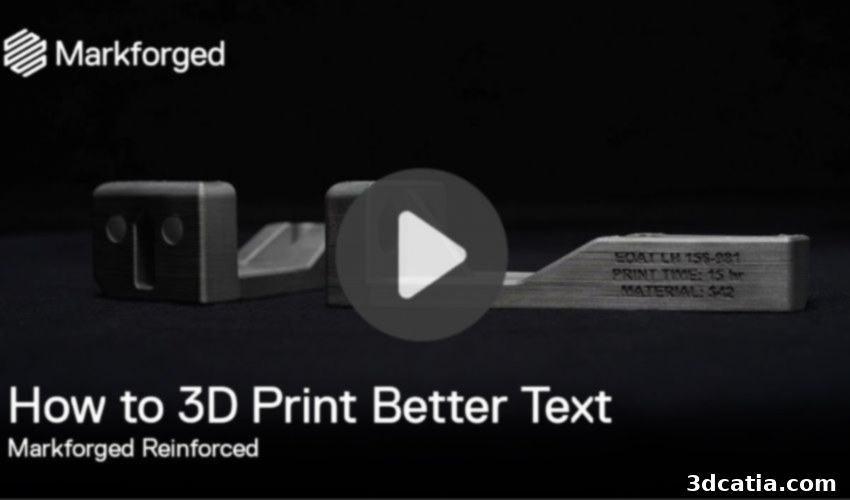
Top 1: Markforged and the Design Process to Add Text to A Part
In the realm of 3D printing, personalization and identification are often crucial. Whether it’s for branding, adding a serial number, indicating part functionality, or simply personalizing an item with a name, integrating text onto a 3D printed component requires precision and careful design. This week’s first featured video comes from Markforged, a recognized giant in the additive manufacturing industry, offering invaluable insights into the best practices for incorporating text into your printed parts. The tutorial provides a detailed walkthrough of the technical design considerations involved, specifically focusing on the mesh file process. It meticulously demonstrates how to strategically choose the optimal placement for your text, highlighting a key recommendation: placing text on the side of a part rather than the top or roof. This advice is often based on considerations for printability, structural integrity, and visual clarity. Beyond placement, the video also covers essential aspects like selecting the appropriate thickness, size, and font for the writing, ensuring legibility and aesthetic appeal while maintaining the part’s structural integrity. Understanding these design nuances can significantly enhance the functionality and professional finish of your 3D printed objects, making this video an indispensable resource for designers and engineers aiming for perfection in their additive manufacturing projects.
Top 2: Dassault Systèmes’ 3DEXPERIENCE Platform: A Comprehensive Run-Through
You might recall hearing about our team’s attendance at Dassault Systèmes’ 3DEXPERIENCE World event just a few weeks ago, where the power of collaborative design and engineering was a central theme. Now, we’re excited to delve deeper into the technical capabilities of the firm’s advanced software suite. This second video offers a compelling demonstration of the 3DEXPERIENCE platform in action, showcasing its versatility and robust features. The video follows an engineering team as they leverage the platform to develop a complex Unmanned Aerial Vehicle (UAV). Viewers are guided through the entire product development lifecycle, from the initial conceptual design stage, where ideas take shape and initial models are created, to advanced simulation processes that test performance under various conditions. The journey continues through rigorous analysis stages, crucial for identifying potential flaws and optimizing designs, culminating in the detailed design phase where every component is meticulously refined for manufacturing. This comprehensive run-through illustrates how the 3DEXPERIENCE platform facilitates seamless integration across different engineering disciplines, enabling teams to collaborate effectively, accelerate innovation, and bring sophisticated products to market with greater efficiency and precision. It’s a powerful testament to how integrated software solutions are revolutionizing modern product development.
Top 3: The Indispensable Role of Laser Solutions in Medical Additive Manufacturing
Medical additive manufacturing stands as one of the most transformative and exciting applications of 3D printing technologies today. Its potential spans an incredible range, from creating highly personalized medical devices and patient-specific surgical planning models to the groundbreaking frontier of bioprinted organs. Recognizing the immense impact of this field, our third video takes a closer look at the contributions of Trumpf, a renowned German 3D printing manufacturer specializing in advanced laser printing solutions. The video features host Susanne Schöne, who engages in an insightful discussion with expert guests, exploring the vast possibilities unlocked by these sophisticated laser technologies. They delve into how precision laser sintering and melting are enabling the creation of intricate, biocompatible structures essential for medical applications, offering unparalleled accuracy and material versatility. The conversation extends to the future trends shaping this critical industry, highlighting the anticipated increase in automation for higher throughput and consistency. Furthermore, the discussion addresses the crucial challenge of ensuring the global accessibility of medical additive manufacturing technologies, emphasizing the need for solutions that are not only cost-effective but also rigorously safe and compliant with stringent medical standards. This video is a must-watch for anyone interested in how advanced manufacturing is revolutionizing healthcare and patient outcomes.
Top 4: Student Rocket Project Tests Advanced Manufacturing Capabilities
Innovation often springs from academic environments, where passionate students push the boundaries of current technology. Our fourth video brings us to Braunschweig, Germany, where a dynamic group of students has formed ERIG – a student interest group dedicated to the study and development of rockets and robots. We hear directly from Lennart Fox, the team lead of CREATE, a specialized subsection within the ERIG organization. CREATE, which stands for Carbon Reinforced Additive Manufacturing Technology Experiment, is a testament to the cutting-edge research being conducted. This team is actively participating in the prestigious Rexus-Bexus rocket experimentation program, a collaborative initiative allowing students to conduct scientific and technological experiments on sounding rockets and stratospheric balloons. In the video, the ERIG team proudly showcases their meticulously crafted models developed for this competition. They elaborate on their innovative use of 3D printing with carbon-reinforced plastics. Their specific research focuses on investigating the influence of gravity on the impregnation process during the production of these advanced composite materials. This project not only demonstrates the students’ profound understanding of complex aerospace engineering principles but also highlights the immense potential of additive manufacturing in creating lightweight, high-strength components crucial for space applications. It’s an inspiring example of how student-led initiatives are contributing valuable insights to material science and rocketry, fostering the next generation of engineers and innovators.
Top 5: How Carbon Fiber Revolutionizes Optimum Helicopter Design
Our final video takes us into the high-flying world of aerospace, specifically focusing on the transformative impact of advanced materials on helicopter manufacturing. We hear from Hill Helicopters, a pioneering UK-based manufacturer of private helicopters, which has recently made significant strides by integrating carbon fiber into their production processes. This strategic shift is driven by a clear objective: to produce highly efficient, cost-effective private helicopters capable of carrying a high payload. The team at Hill Helicopters enthusiastically champions the use of carbon fiber, underscoring its numerous benefits that make it an ideal material for aerospace applications. These advantages include its remarkably low density, exceptional strength-to-weight ratio, and impressive stiffness. By leveraging these properties, Hill Helicopters is able to engineer and produce intricately streamlined body pieces with simpler tooling and fewer parts, drastically reducing manufacturing complexity and assembly time. The result is an overall product boasting a superior high-quality structure that perfectly aligns with the demanding performance requirements of modern private aviation. The integration of carbon fiber not only contributes to a lighter airframe, leading to improved fuel efficiency and increased range, but also enhances safety and durability. This video offers a fascinating glimpse into how material innovation is driving efficiency, performance, and cost-effectiveness in the cutting-edge field of helicopter design and manufacturing.
What are your thoughts on this week’s selection of top 3D printing videos? From Markforged’s essential tips on adding text to printed objects to the revolutionary application of carbon fiber in aerospace, these videos truly showcase the breadth and depth of innovation within the additive manufacturing landscape. We’d love to hear your insights and perspectives! Please share your feedback in a comment below or engage with us on our vibrant social media platforms, including our LinkedIn, Facebook, and Twitter pages. To ensure you never miss out on the latest advancements and news in the 3D printing world, don’t forget to sign up for our free weekly Newsletter here, delivering the most relevant updates directly to your inbox. You can also discover and explore all our captivating video content anytime on our dedicated YouTube channel. Stay connected and stay informed with 3Dnatives!