
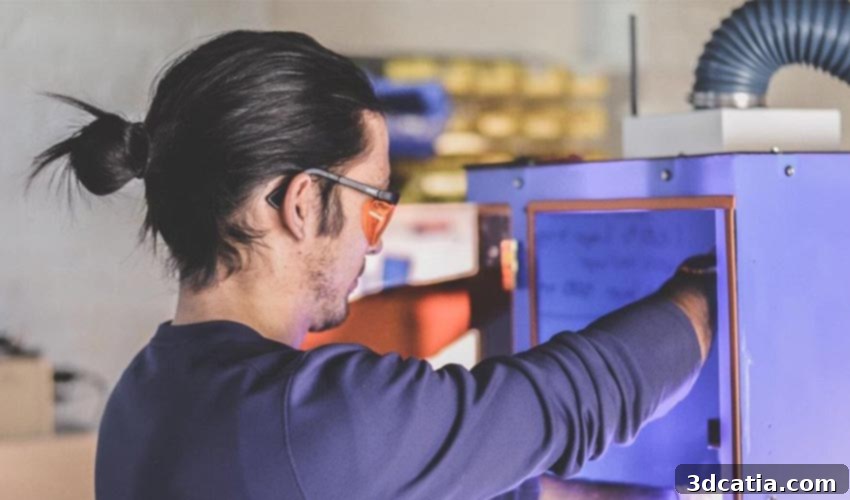
Revolutionizing Composite 3D Printing: Fortify’s Fluxprint and CKM System for Advanced Materials
In the rapidly evolving landscape of additive manufacturing, the demand for high-performance materials continues to surge. At the forefront of this innovation is Fortify, a dynamic startup based in Boston, dedicated to advancing the capabilities of composite 3D printing. Born from cutting-edge research conducted at Northeastern University, Fortify’s founders embarked on a mission to engineer materials with exquisitely optimized microstructures, addressing critical limitations in the existing additive manufacturing paradigm. Their pioneering approach centers on a proprietary technology they term Fluxprint – a magnetic 3D printing process designed to precisely control material composition at a microscopic level. Building on this foundation, the Boston-based company recently unveiled its innovative Continuous Kinetic Mixing (CKM) system, a significant advancement poised to ensure the uniform suspension of fibers and other functional additives throughout the printing process, thereby unlocking unprecedented material consistency and performance.
The additive manufacturing industry’s insatiable appetite for advanced materials that can meet increasingly rigorous specifications is a key driver for innovations like Fortify’s. Composites, in particular, offer a compelling solution for a myriad of industrial applications due to their exceptional ability to augment part strength and stiffness without incurring a significant weight penalty. This inherent advantage makes them indispensable across sectors such as aerospace, automotive, defense, and medical devices. A comprehensive study released by IDTechEx underscores this growing importance, projecting the composite 3D printing market to achieve a staggering valuation of $1.73 billion within the next decade. Such impressive growth highlights a fundamental shift towards more robust, functional, and durable 3D printed components.
It was precisely this profound and escalating need for high-performance materials that spurred Fortify to develop its foundational Fluxprint technology. Recognizing the limitations of conventional additive manufacturing processes in handling complex composite materials, the startup envisioned a method that could overcome these challenges. Their solution, which they brand as Digital Composite Printing (DCP), leverages the unique capabilities of Fluxprint. At its core, DCP is a sophisticated process that meticulously aligns functional additives – such as reinforcing particles and fibers – within each layer as it is being printed. This precise alignment is achieved through the ingenious application of a controlled magnetic field, ensuring that the additives are oriented optimally to impart superior mechanical, thermal, and electrical properties to the final part. This level of control over microstructure is what sets Fortify apart, enabling the creation of truly advanced materials for demanding applications.
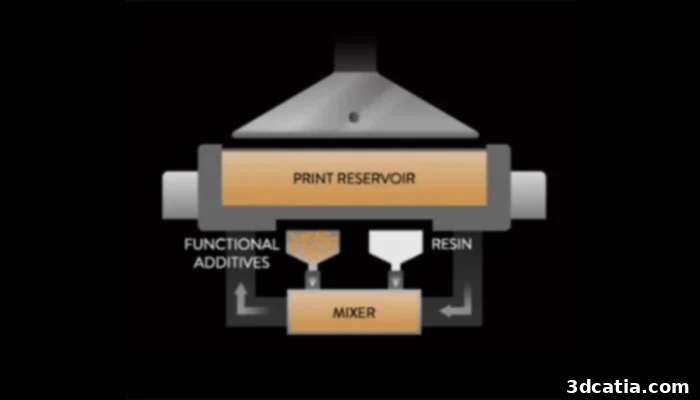
The Continuous Kinetic Mixing system: functional additives must be uniformly distributed to achieve consistent material properties | Image via Fortify
While carbon fiber composites often dominate discussions in the 3D printing industry, Fortify has strategically focused its efforts on reinforcing 3D printed photopolymers with a diverse array of functional additives. This specialized focus necessitates an unwavering commitment to ensuring that these additives remain uniformly distributed within the resin throughout the entire production cycle. Without such meticulous control, the desired material properties could be compromised, leading to inconsistent part performance. Fortify’s approach ensures that the inherent benefits of these additives are fully realized. According to the company, this leads to a substantial enhancement in a wide range of mechanical performances, including but not limited to increased strength, stiffness, toughness, and wear resistance. Furthermore, parts exhibit improved heat deflection temperature, crucial for applications exposed to elevated temperatures, as well as superior thermal and electrical properties, opening doors to advanced functional components. The significance of these advancements was eloquently captured by Josh Martin, CEO and Co-Founder of Fortify, who commented, “We’re excited to incorporate this material handling module with our Fluxprint process to solve the application challenges of our customers. It will play a critical role in manufacturing functional parts.” This statement underscores Fortify’s dedication to not just creating innovative technology, but to translating that innovation into tangible solutions for real-world industrial demands.
In terms of practical applications, Fortify has identified and targeted a particularly demanding niche: the production of injection mold tools. This strategic focus highlights the company’s commitment to solving complex manufacturing problems with additive solutions. The 3D printed tools developed by Fortify directly contend with traditional aluminum molds, offering a compelling alternative for quick-turn, short-run, and medium-run injection molding applications. This is a critical area where speed and cost-effectiveness can significantly impact production cycles. As Josh Martin elaborated in an insightful interview with 3Dnatives, “This is a demanding application because the parts must withstand high pressures (often greater than 1500 psi) and high temperatures (50 to 240°C) while maintaining defined tolerances.” The ability of Fortify’s tools to meet these stringent requirements – enduring extreme pressures and temperatures while holding tight dimensional accuracies – is a testament to the robustness of their composite materials. For specialized processes like metal injection molding, Fortify engineers utilize ceramic fibers, which are intimately blended directly with the resin. These ceramic-reinforced resins yield tools capable of withstanding the even more intense temperatures and pressures inherent in metal molding processes, as further elucidated by Josh Martin. This capability dramatically shortens lead times and reduces costs associated with traditional tooling methods, offering manufacturers unparalleled agility and efficiency.
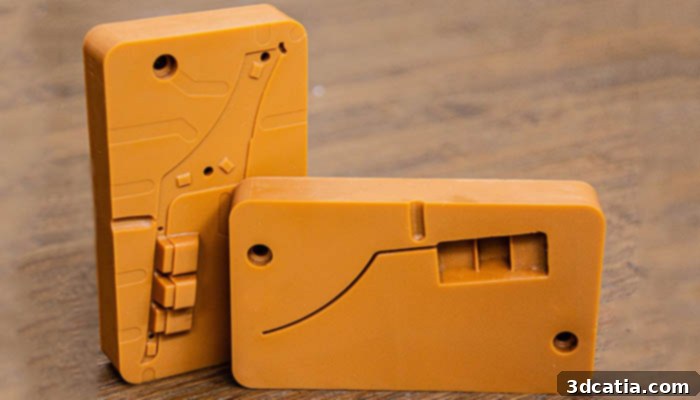
A 3D printed tool by Fortify which is used to mold an automotive part | Credits: Fortify
The consistent improvement of material properties stands as one of the most pivotal factors propelling the widespread adoption and continuous maturation of additive manufacturing technologies. Innovations like Fortify’s Digital Composite Manufacturing (DCM) platform are exemplary showcases of how AM is evolving beyond rapid prototyping to become a viable solution for end-use parts. Fortify proudly asserts that its DCM platform represents the industry’s pioneering and sole 3D printer that seamlessly integrates both onboard mixing capabilities, facilitated by its CKM system, and advanced magnetic alignment technology, powered by Fluxprint. This unique combination is not merely a technical achievement; it is a game-changer that unlocks entirely new functionalities within printed photopolymers. By precisely controlling the distribution and orientation of reinforcing additives, Fortify enables the creation of parts with previously unattainable performance characteristics. This holistic approach ensures that every printed layer contributes optimally to the final material properties, setting a new benchmark for performance in the additive manufacturing sector. For those eager to delve deeper into Fortify’s groundbreaking technologies and their potential applications, comprehensive information is readily available HERE.
The integrated nature of Fortify’s CKM and Fluxprint technologies addresses a fundamental challenge in composite additive manufacturing: ensuring homogenous and precisely oriented material distribution. Traditional methods often struggle with sedimentation or uneven dispersion of heavy fillers and fibers, leading to inconsistent part quality and compromised performance. CKM mitigates this by actively and continuously mixing the resin, keeping the functional additives in a stable suspension. This uniform feedstock then feeds into the Fluxprint process, where the magnetic field takes over, individually aligning each particle or fiber within the photopolymer as it solidifies layer by layer. This dual control mechanism provides an unparalleled level of precision, guaranteeing that the macroscopic properties of the final printed object accurately reflect the engineered microscopic structure. This synergy is what allows Fortify to produce composite parts that not only withstand demanding conditions but also exhibit predictable and repeatable performance, a critical requirement for industrial adoption.
The long-term implications of Fortify’s innovations extend far beyond injection molding. By enabling the creation of stronger, lighter, and more functional components with custom-tailored properties, Fortify is paving the way for advancements in various high-stakes industries. Imagine aerospace components that are both lighter and more resistant to fatigue, or medical devices with enhanced biocompatibility and mechanical strength. The ability to precisely tune material properties at the microstructure level opens up vast possibilities for engineers and designers to create parts that were previously impossible to manufacture using traditional methods. As additive manufacturing continues its trajectory towards becoming a mainstream production method, platforms like Fortify’s DCM will be instrumental in bridging the gap between material science and practical application, accelerating the development of truly next-generation products across the globe. This represents a significant leap forward in making additive manufacturing a truly transformative force in material engineering and product development.
What are your thoughts on Fortify’s innovative 3D printing system and its potential to reshape the composite additive manufacturing landscape? We invite you to share your insights and opinions in a comment below, or join the conversation on our Facebook and Twitter pages. Stay abreast of all the latest advancements and breaking news in the world of 3D printing by signing up for our free weekly Newsletter, delivered directly to your inbox!