
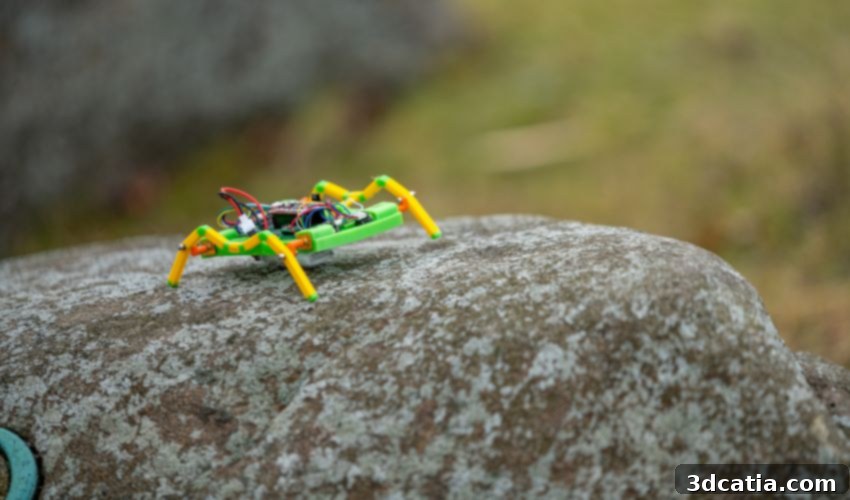
Revolutionizing Robotics: Dr. Markus Nemitz on 3D Printing Soft Swarms for Critical Humanitarian Missions
A few years ago, we brought you news of an extraordinary initiative to develop 3D printed robots specifically designed for search-and-rescue operations. The visionary behind this project, Dr. Markus Nemitz, has continued to push the boundaries of innovation. Since then, Dr. Nemitz has persistently leveraged additive manufacturing techniques in his groundbreaking work on swarm robotics. His ambitious goal is to utilize these advanced soft robots for a wide array of critical applications, ranging from explosive ordnance disposal (EOD) to complex amphibious operations. We recently had the opportunity to sit down with Dr. Nemitz to delve deeper into his fascinating research and explore the future of robotics.
Pioneering Swarm Robotics: An Introduction to Dr. Nemitz’s Vision

Markus Nemitz, PhD
Dr. Markus Nemitz currently serves as an Assistant Professor of Mechanical Engineering at Tufts University, where his research focuses on the intricate design, advanced fabrication, and precise control of swarm robots. His expertise extends to the crucial deployment of these robotic systems at critical points of impact. Dr. Nemitz’s interdisciplinary research seamlessly integrates the knowledge he gained in swarm robotics during his PhD studies with his extensive postdoctoral work in soft robotics at Harvard University. This unique combination of disciplines allows his group to tackle some of the most challenging problems in modern robotics.
His research group is dedicated to accelerating the entire robot development cycle, from rapid design to efficient fabrication and swift deployment. A significant emphasis is placed on multi-material systems and fluidic circuits, which find applications across diverse fields, including underwater exploration vehicles and advanced legged robots. A core aspect of their methodology involves developing comprehensive libraries of modular robot components and pioneering novel fabrication processes. These innovations are designed to enable “single-click” manufacturing, drastically simplifying and speeding up the production of complex robotic systems. Furthermore, Dr. Nemitz’s team integrates machine learning algorithms to create a closed-loop system for 3D printing. This revolutionary approach transforms what has traditionally been an open-loop process—where layers are printed without real-time inspection or correction—into an adaptive system featuring continuous monitoring and instantaneous adjustments, thereby enhancing precision and reliability.
The Allure of Swarm Robotics: Collective Intelligence for Global Challenges
Dr. Nemitz’s initial fascination with swarm robotics stemmed from the elegant simplicity of individual agents collaborating to achieve complex, coordinated behaviors. Nature itself offers an endless source of inspiration, showcasing remarkable instances of collective intelligence in phenomena like bustling ant colonies, synchronized bird flocks, and intricate fish schools. He recognized in these natural systems a powerful blueprint for developing scalable and resilient robotic networks, capable of addressing challenges far beyond the scope of individual, monolithic machines. This biological approach, if realized at scale, holds immense potential for numerous critical applications where individual robots would be impractical or insufficient.
The potential applications are vast and impactful. Imagine large-area search operations for missing aircraft, such as the mysterious MH370, requiring widespread, coordinated coverage. Envision locating survivors beneath vast amounts of rubble after devastating events like the 2023 earthquake in Turkey, where speed and distributed sensing are paramount. Consider distributed sensing for critical environmental monitoring, such as tracking glacier dynamics, where current measurements are sparse, particularly at depth. Swarm robotics also offers a promising solution for large-scale explosive ordnance disposal (EOD), an ongoing humanitarian crisis that disproportionately affects children. Moreover, the deployment of swarms of robots on distant planets like Mars could revolutionize planetary exploration, allowing for unprecedented data collection and coverage. In each of these scenarios, the ability to deploy a significant number of robots is absolutely essential. However, this is only feasible if the robots are both inexpensive and highly robust. Achieving this critical balance of cost-effectiveness and resilience has been a longstanding hurdle in robotics, one that Dr. Nemitz and his team are now beginning to overcome, especially for legged robotic systems.
Embracing 3D Printing: Unlocking Design Freedom and Rapid Iteration
The decision to integrate 3D printing into his research was driven by its unparalleled capabilities for rapid iteration and the seamless integration of both soft and rigid components within a single manufacturing step. These capabilities are simply unmatched by traditional methods like molding or machining, particularly when considering the complexity, speed, and inherent flexibility required for advanced robotic systems. While Dr. Nemitz had previously utilized techniques such as soft lithography and laser cutting, he found that they lacked the essential scalability and design freedom necessary for fabricating the sophisticated multi-material robots his vision required.
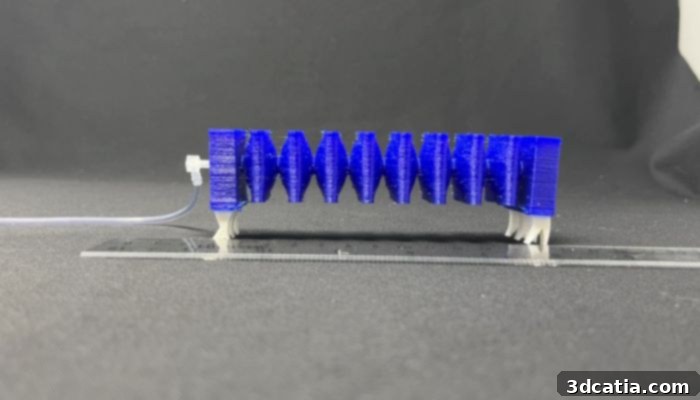
A 3D printed linear actuator made by Dr. Nemitz and his team
The potential of fused filament fabrication (FFF), a common form of 3D printing, for robot development is truly immense. With just a few spools of filament, each possessing varying material properties, his team can autonomously produce a diverse range of complex systems, from sophisticated underwater robots to agile legged robots. This process is inherently repeatable, highly automated, and minimizes human involvement, which significantly reduces the potential for error and dramatically improves scalability. More importantly, FFF facilitates direct integration with cutting-edge design discovery processes, such as evolutionary algorithms. In such systems, machines can autonomously develop and optimize novel robot designs based on predefined user objectives, accelerating the innovation cycle like never before.
Dr. Nemitz’s long-term vision extends to a future where warehouses are filled with networked 3D printers, capable of printing, rigorously testing, and efficiently recycling prototypes. These advanced systems would be guided by algorithms that continuously evolve robot designs within closed-loop feedback systems, constantly refining performance and efficiency. Furthermore, his team is actively exploring thermoplastic recycling in conjunction with fused granulate fabrication (FGF). This innovative approach further enhances sustainability and substantially reduces material costs, making the entire manufacturing process more environmentally friendly and economically viable.
Advanced 3D Printing Technologies and Materials for Soft Robotics
As previously highlighted, Dr. Nemitz’s laboratory primarily utilizes multi-material fused deposition modeling (FDM) and fused granulate fabrication (FGF) printers, often equipped with tool changers, to print elastomeric thermoplastics. These advanced processes provide an unparalleled level of precise control over critical mechanical properties, such as Shore hardness and overall flexibility, which are crucial for creating highly functional soft robots. Beyond mechanical properties, these technologies enable the 3D printing of conductive materials directly into robot structures, facilitating the creation of integrated circuit traces and sophisticated sensors. A particularly vital capability is the ability to embed components mid-print, allowing for the creation of fully integrated designs without the need for complex post-assembly. Crucially, these additive manufacturing methods are exceptionally cost-effective, a fundamental requirement when developing low-cost, scalable robotic systems that can be deployed in large numbers.
Fused Granulate Fabrication (FGF) stands out as a particularly powerful technology in their research. It allows for the 3D printing of elastomeric materials that achieve a softness comparable to traditional silicones, while simultaneously leveraging the superior manufacturability and recyclability inherent in thermoplastics. This innovative approach enables them to bypass expensive and time-consuming post-processing steps often associated with silicone molding, thereby maintaining a streamlined, “single-click” fabrication workflow. Both FDM and FGF uniquely offer this advanced level of automation and scalability at an unmatched price point, making them indispensable tools for Dr. Nemitz’s pioneering work in soft robotics.
Soft Robotics: The Key to Resilient and Integrated Systems
Soft robots represent a profound departure from the paradigm of traditional, rigid robots. While conventional robotic systems are meticulously constructed from inflexible materials, soft robots are ingeniously crafted from elastomeric materials designed to deform significantly and absorb impact. This inherent compliance makes them far more resilient to physical forces and harsh environments, allowing them to withstand collisions and navigate irregular terrains with greater ease. Drawing inspiration from nature, where most biological systems—including humans—are elegant hybrids of soft and rigid structures (our stiff bones provide foundational support, while soft tissues like skin and fat absorb shocks and protect vital organs), this biological model makes soft, hybrid robots an exceptionally compelling area of scientific inquiry and development.
Dr. Nemitz firmly believes that all robots of the future will embody hybrid designs to varying degrees, seamlessly combining soft with hard materials to optimize performance and resilience. Most importantly for his team’s work, soft robots are intrinsically material systems; their function emerges directly from the complex interplay between their material properties and their design. This characteristic makes them ideally suited for additive manufacturing, which allows for the fabrication of complete, highly integrated robots in a single, continuous process, eliminating the need for complex and time-consuming assembly. Once one truly grasps that intelligent robotic systems can be fabricated through multi-material FFF, the immense potential contained within just a few spools of filament becomes clear. In this future, the design itself defines the robot’s intelligence, and the specific use case ultimately shapes the machine’s form and function.

A 3D printed fluidic transistor that has been turned on
From Lab Prototypes to Field-Ready Missions: Current Progress and Future Deployments
Dr. Nemitz’s team is making significant strides, advancing their robotic systems from lab-scale prototypes to robust, field-ready platforms. In a recent pivotal study, they successfully demonstrated a proof-of-concept legged robot that is predominantly 3D printed and masterfully combines both stiff and soft materials. This innovative hybrid design harnesses the distinct advantages of both traditional and soft robotics. While soft robots are typically resilient to impact but often slow, and conventional legged robots are frequently faster but more fragile, both have traditionally been time-consuming to fabricate. By ingeniously merging these approaches, the team creates robots that are not only highly resilient but also capable of fast locomotion over challenging and varied terrain, with the added benefit of being manufacturable at scale through their optimized process.
Beyond locomotion, the team is actively exploring the integration of fluidic sensors, actuators, and controllers into these complex systems. The profound advantage here is that these components can be entirely 3D printed, with their specific function—whether sensing environmental data, performing computation, or enacting physical actuation—determined solely by their design. By seamlessly integrating intricate fluidic channels directly into 3D-printed structures, they can construct all three essential elements: precise sensors, sophisticated logic gates complete with memory elements, and powerful actuators. These integrated logic and memory components give rise to both combinational and sequential logic, ultimately forming state machines that provide robust, embedded low-level control capabilities directly within the robot’s structure.
Over the past five years, Dr. Nemitz has maintained a sharp focus on a particularly critical application: explosive ordnance disposal (EOD). Landmines remain a pervasive and enduring legacy of conflict, tragically responsible for killing and maiming between 1,000 and 2,000 people every single month, with the vast majority being innocent civilians and, disproportionately, children. Today, an estimated 110 million landmines are still active across approximately 70 countries and territories globally. These insidious weapons can lie dormant for decades, silently waiting for an unsuspecting victim. In a significant collaborative effort with a military contractor, Dr. Nemitz’s team successfully tested a proprietary sensor technology on an inert minefield in Oklahoma, demonstrating the capability to detect landmines buried as deep as one meter.
In another compelling project, they demonstrated the remarkable resilience of their 3D printed robots by deploying them from high altitudes; these robots not only survived free fall but successfully navigated to and located a dummy mine. Their expertise also extended to the entertainment industry, as they developed a demining robot for the feature film “Rule Breakers,” which is currently in cinemas. This wheeled robot was designed and fabricated in an astonishingly short timeframe of just one week, then shipped to Budapest, and operated on set under the direction of Bill Guttentag. The film tells the inspiring and poignant story of a group of Afghan women who, against immense challenges at home, competed in FIRST Robotics competitions, highlighting the universal spirit of innovation and perseverance.
Dr. Nemitz remains deeply committed to advancing explosive ordnance disposal through the continuous development of scalable, low-cost robotic systems. He emphasizes that far too many civilians—especially children—continue to suffer and die because of the indiscriminate nature of landmines. To ultimately end their use and impact, he asserts, “we must defeat the economy of war by making robotic demining cheaper, faster, and more accessible than deploying landmines themselves.” This powerful statement underscores the humanitarian imperative driving much of his research.
The research group recently received a substantial grant of $1,711,191 from the Office of Naval Research (ONR) to further advance the development of “crab-inspired” robots over the next four years. These biomimetic robots are specifically slated for use in challenging aerial deployment scenarios and complex amphibious operations. Similar to their other innovative projects, the team will be leveraging multi-material FFF to design robust soft-legged robots while simultaneously exploring advanced reinforcement learning techniques for developing highly robust and environment-adaptive control systems. This significant grant represents a monumental step forward and is a testament to the extensive groundwork laid by Dr. Nemitz and his dedicated research group.
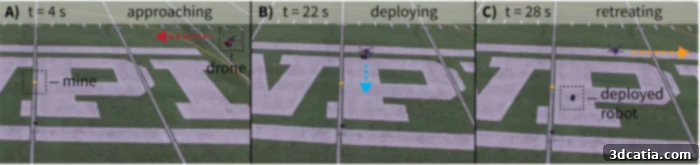
A test of 3D printed demining drone
Scalable Manufacturing and Global Deployment: A Vision for the Future
Dr. Nemitz envisions a future where these versatile robots are not only 3D printed but, equally importantly, can be rapidly adapted and customized for diverse situations, from critical environmental monitoring to urgent search and rescue operations. Combining these two powerful capabilities allows his team to develop and deploy large numbers of robots, each quickly tailored to address the specific nuances of the challenge at hand. This dynamic approach enables the deployment of highly specialized robot swarms, meticulously designed for mission-specific tasks, offering unparalleled flexibility and effectiveness in crisis scenarios.
Consider the dramatic Tham Luang cave rescue in Thailand as a compelling illustration. When the young soccer team became trapped deep within the sprawling cave system, the world watched with bated breath. The pioneering work being conducted by Dr. Nemitz and his team aims to make “crowd-solving” possible in such complex and time-sensitive scenarios. Imagine a scenario where, starting from their ever-expanding library of modular components, a global community of designers and engineers could collaboratively develop robot solutions specifically tailored to the unique and unpredictable conditions of any disaster. With highly parallelized print farms, the most promising designs could be rapidly fabricated and tested in real time, dramatically shortening development cycles. Once an optimal solution is identified and validated, the robots could be produced almost immediately. This model envisions every country potentially having its own localized manufacturing facility, or, when necessary, a mobile manufacturing unit could be rapidly deployed to the precise point of need. The beauty of this digital workflow is that transferring a digital design file takes mere seconds, meaning that a sophisticated robot designed in Boston could begin fabrication in Thailand within minutes, transcending geographical barriers in times of crisis.
This concept extends even further, pushing the boundaries of interplanetary exploration. When humans eventually venture to Mars, they will inevitably face unexpected and unforeseen challenges. These challenges could be relayed back to Earth, where specialized teams could collaboratively develop and optimize robotic solutions. The refined designs would then be transmitted back to the Martian outpost to be 3D printed on-site, whether as a single, specialized robot or an entire adaptive swarm. In essence, the power encapsulated within a single spool of filament is immense; it holds the potential to become any robot required to solve a specific problem, with the entire global community serving as its collaborative designer, fostering unprecedented levels of innovation and responsiveness.
Overcoming Challenges: Innovation in Swarm Engineering
During his PhD studies, Dr. Nemitz was deeply motivated by the ambitious desire to control vast numbers of robots in real-world environments. He quickly observed that while much of swarm robotics research remained confined to simulations, the nascent subfield of swarm engineering was actively grappling with the formidable practical challenges of actually building and deploying physical robots. In his expert view, the single greatest challenge in swarm engineering lies in significantly pushing the capabilities of individual robots without simultaneously increasing their prohibitive cost. This delicate balance is crucial for achieving truly scalable and deployable swarm systems.
Traditionally, any increase in robot capability is accompanied by a higher manufacturing cost, often reaching a point of diminishing returns where substantial expense yields only marginal improvements in performance. In swarm engineering, the core objective is to maximize intelligence and functionality for a given cost, striving to find that optimal balance where a robot is as capable as possible within strict resource constraints. Dr. Nemitz found soft robotics to be a particularly fascinating and effective research area for addressing this specific challenge. A meticulously designed, 3D-printed soft robot can achieve significantly enhanced functionality without a corresponding increase in its cost. Its inherent capability is elegantly embedded within its design and intrinsic material properties, rather than being dependent on expensive, complex components or intricate assembly processes. Embedded machine learning represents another highly promising avenue that his team is actively exploring.
During his PhD, Dr. Nemitz published a groundbreaking study that demonstrated time-series classification on a highly constrained microcontroller. This innovative approach allowed the microcontroller to accurately interpret environmental signals, even with limited computational resources. This proof of concept unequivocally showed that, with proper training and optimization, sensors can be made multifunctional, capable of extracting a wealth of additional information from simpler and more cost-effective hardware, enhancing the overall efficiency of the robotic system.
One significant technical hurdle encountered during development has been the challenge of 3D printing airtight structures, particularly essential for robots operating with pressurized air or fluids. Dr. Nemitz’s team ingeniously addressed this through the development of a novel closed-loop printing process. This advanced system utilizes laser scanning and integrated cameras to meticulously monitor the printing process in real time, allowing for instantaneous detection and correction of errors. This adaptive approach is particularly novel and impactful for soft materials, where their team has made important early contributions to ensure high-fidelity fabrication. Closed-loop, multi-material printing will be absolutely critical to ensuring consistent, high-fidelity fabrication in diverse locations around the world, maintaining uniform quality without relying on the constant presence of expert operators. Dr. Nemitz firmly believes that “the time when 3D printing experts were necessary to produce high-quality parts is coming slowly (or quickly) to an end; non-experts are going to manufacture complex systems at expert quality.” To further tackle the persistent challenge of airtightness in 3D-printed systems, they also developed custom print nozzles capable of extruding concentric tubes, representing yet another creative and practical solution to a long-standing problem in additive manufacturing.
Ultimately, Dr. Nemitz concludes that creativity is the indispensable key to progress in the dynamic field of swarm engineering. The breakthrough of printing legged robots from multiple soft materials was one such creative leap that has significantly advanced his team closer to their ultimate overarching goal: the rapid design, fabrication, and agile deployment of sophisticated robotic systems at critical points of impact, specifically to address pressing humanitarian crises around the globe.
What are your thoughts on Dr. Nemitz’s pioneering research into 3D printing and swarm robotics? We invite you to share your insights in a comment below or join the conversation on our LinkedIn, Facebook, and Twitter pages! Don’t forget to sign up for our free weekly Newsletter here to receive the latest 3D printing news directly in your inbox. You can also discover all our engaging videos on our YouTube channel.
*All Photo Credits: Dr. Markus Nemitz