
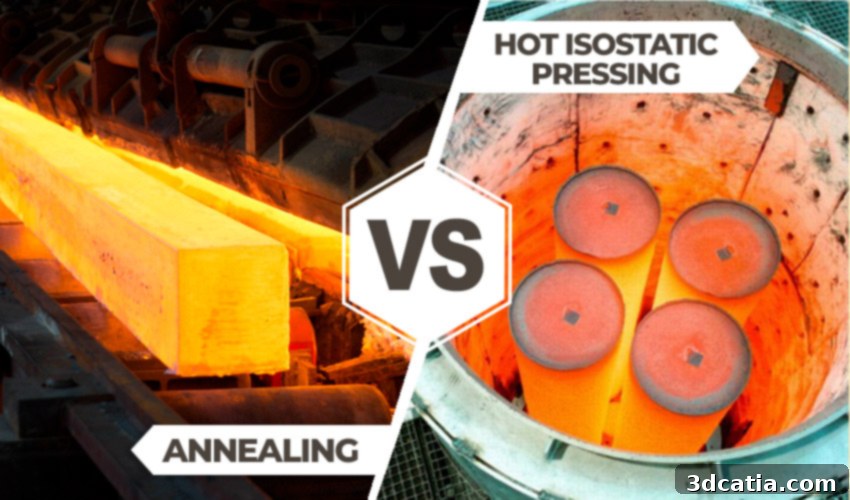
Optimizing Additive Manufacturing: The Essential Guide to Heat Treatment with Annealing and Hot Isostatic Pressing (HIP)
As additive manufacturing (AM) continues its rapid industrialization, the role of post-processing has become increasingly indispensable. This crucial stage allows manufacturers to significantly enhance the performance of 3D printed parts, making them stronger, denser, and imparting specific properties vital for demanding end-use applications across various industries. Among the array of post-processing techniques, heat treatment stands out as one of the most critical, particularly for powder bed 3D printing processes, and especially when working with metals.
The question then arises: which heat treatment method is best suited for a particular part and application? Understanding the mechanics and outcomes of different heat treatment processes is key to unlocking the full potential of additive manufacturing. In this comprehensive guide, we delve into two of the most widely used and impactful heat treatment processes: annealing and hot isostatic pressing (HIP).
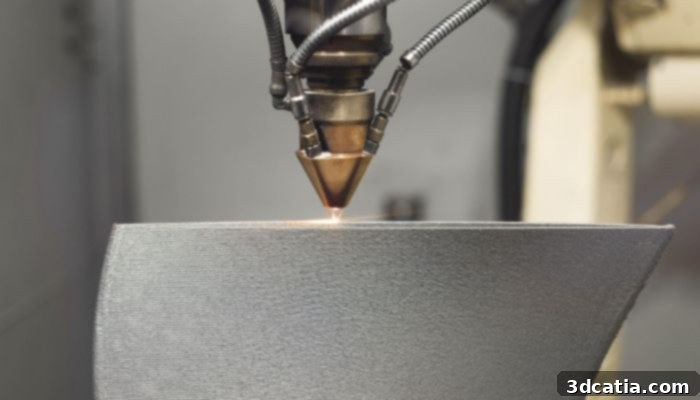
A metal part being additively manufactured (Image credit: Industrial Metal Service)
Both annealing and HIP are highly compatible with a broad spectrum of metal additive manufacturing processes, including Laser Powder Bed Fusion (LPBF), Electron Beam Melting (EBM), binder jetting, Directed Energy Deposition (DED), and even advanced techniques like nanoparticle jetting. Beyond metals, these treatments can also be applied to ceramics and certain polymers, though their efficacy and application scope may vary. The core benefits of both methods include enhancing material strength, improving workability, and refining crucial material properties. While both aim to optimize component performance, their operational principles and specific resulting advantages differ significantly.
Understanding the Mechanics: How HIP and Annealing Work
To fully grasp the distinctions and commonalities between HIP and annealing, let’s explore each procedure in detail.
The Annealing Process
Annealing is a heat treatment process renowned for its ability to modify the physical, and sometimes chemical, properties of a material. It involves heating a material—which can be metal, glass, ceramic, or polymer—to a specific temperature, holding it there for a period, and then allowing it to cool very slowly. The primary objective of annealing is to relieve internal stresses, increase ductility, and reduce hardness, thereby making the material more manageable for subsequent processing or enhancing its performance in an application. This process facilitates atomic rearrangement within the material’s microstructure, leading to a more stable and less strained state.
Stages of Annealing
Annealing typically takes place within a specialized annealing furnace, which can range in sophistication and temperature capability, generally operating between 300°C and 1000°C for higher-end models. Precise temperature control is paramount throughout the process. Annealing consists of three main stages, each dictated by specific temperature parameters that are critically dependent on the type of material being treated:
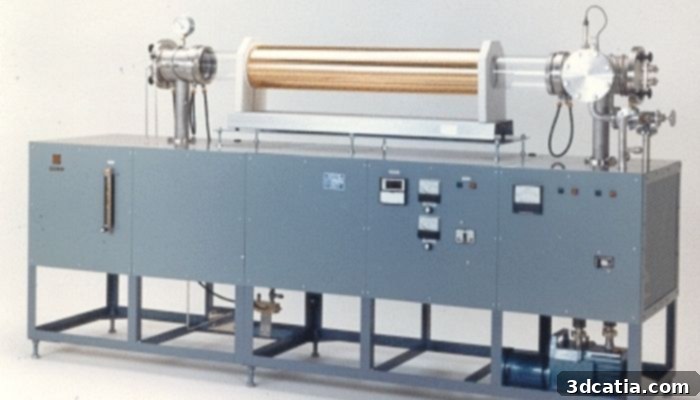
An annealing furnace (photo credits: Thermcraft)
1. Recovery Stage: In the initial recovery stage, the material’s temperature is elevated to a point where atoms gain sufficient thermal energy to begin moving. This movement facilitates the redistribution and eventual eradication of dislocations—irregularities or defects within the material’s crystal lattice. For metals, this significantly reduces internal stress, making the material more deformable and thus more ductile. A similar effect, though often less pronounced, can occur in ceramics. The overarching goal of this stage is to relieve any residual stresses accumulated during previous manufacturing steps, such as 3D printing or cold working.
2. Recrystallization Stage: As heating continues, the material reaches the recrystallization stage. This temperature is sufficiently high to initiate the formation of new, strain-free grains, but remains below the material’s melting point. These new grains grow and replace the older, strained grains and the areas previously occupied by dislocations. This fundamental change in microstructure dramatically improves the material’s mechanical properties by reducing internal energy and enhancing its ability to deform without fracturing.
3. Grain Growth Stage: Once recrystallization is complete, the object begins its slow cooling phase, entering the grain growth stage. During this controlled cooling, the newly formed grains continue to develop and grow larger. The final size and distribution of these grains are not random; they are meticulously controlled by the cooling rate and the atmospheric conditions within the furnace. By precisely managing these parameters, engineers can tailor the material’s final physical properties to meet specific application requirements.
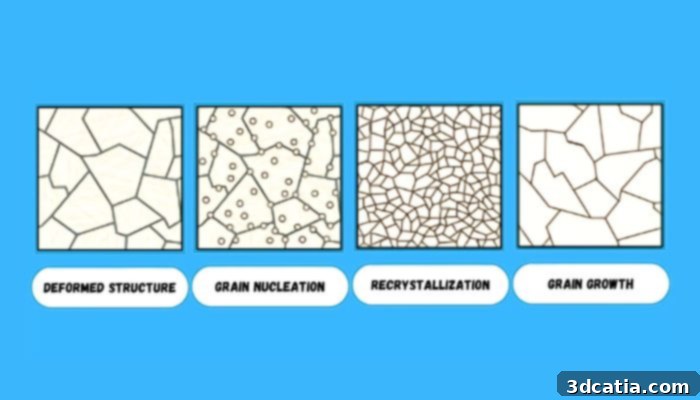
A graphic representation of what happens to molecules during annealing (photo credits: MechDaily)
Depending on the material and desired outcome, the entire annealing process can range from a few hours to a full day. It’s also important to note that various types of annealing exist, each with a specific purpose. Common types include full annealing (for maximum ductility), isothermal annealing, spheroidizing annealing (for improved machinability), diffusion annealing (for chemical homogeneity), and stress relieving. Additively manufactured parts, provided they are made from suitable materials, can benefit significantly from these processes. The choice of annealing type is primarily determined by the material composition and the intended application.
Hot Isostatic Pressing (HIP) Process
In contrast to annealing, Hot Isostatic Pressing (HIP) is a post-processing technique that subjects a part to a combination of extremely high temperatures and high isostatic gas pressures. The primary goal of HIP is to eliminate internal porosity in metallurgical materials and increase the density of many ceramics, often turning them into fully dense components. The term “isostatic” in HIP is crucial: it signifies that the gas pressure is applied equally in all directions, ensuring a uniform force around the object, which is essential for consistent densification without distorting the part’s shape.
The Mechanism of HIP
The HIP process involves loading parts into a robust high-pressure containment vessel, where they are exposed to temperatures that can reach up to 2,000°C and pressures as high as 45,000 psi (approximately 310 MPa)—a pressure comparable to that found at the bottom of the Mariana Trench. Under these extreme conditions, the material undergoes plastic deformation and creep, causing internal voids and pores to collapse and disappear. This contraction occurs while the part generally maintains its initial macroscopic shape. The combined effect of heat and pressure facilitates atomic diffusion and metallurgical bonding, leading to a denser, more homogeneous microstructure.
Argon, an inert gas, is the most commonly used pressurizing medium in HIP systems. Its inert nature is vital as it prevents any undesirable chemical reactions with the material during the high-temperature, high-pressure cycle. Specialized gas pumping systems are often employed to achieve and maintain the necessary pressure levels. These precisely applied gases are sustained for a specific duration, tailored to the material type and desired properties of the final product. HIP cycles can last anywhere from eight to twelve hours, or even several days for larger or more complex parts. The result is a part with significantly improved mechanical properties, reduced internal defects, and a uniform microstructure.
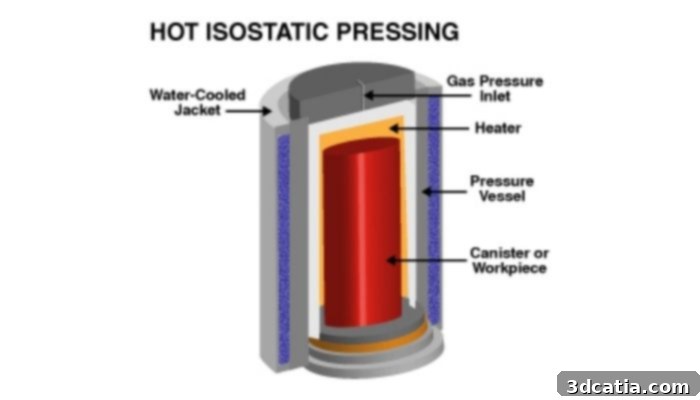
Photo Credits: Metal Powder Industries Federation
In the context of 3D printing, leaders like Hiperbaric highlight HIP’s effectiveness when combined with processes such as Laser Powder Bed Fusion (LPBF) and Electron Beam Melting (EBM) to produce superior, defect-free parts. Binder jetting, Directed Energy Deposition (DED), metal material extrusion, and metal material jetting (including nanoparticle jetting) are also highly compatible with HIP, leveraging its ability to densify components and enhance their performance.
Material Compatibility: Annealing vs. HIP for Additive Manufacturing
Both Hot Isostatic Pressing (HIP) and annealing exhibit significant overlap in their material compatibility, especially when it comes to metals. These post-processing methods can be applied to a wide array of metallic materials, with few restrictions, making them invaluable for metal 3D printing.
Metals
For annealing, the process is effective with both amorphous and crystalline materials. This includes a broad spectrum of metals such as refractory metals, various alloys, and different grades of steel. Stainless steel is a particularly common material that benefits from annealing, alongside bronze, aluminum, copper, and brass. Annealing helps to relieve internal stresses induced during the 3D printing process, refine grain structures, and improve the overall ductility and machinability of these metals.
HIP, on the other hand, is compatible with virtually all metals. This means it integrates seamlessly with most metal 3D printing processes and their corresponding materials. Its high-pressure, high-temperature environment is particularly effective for challenging materials like nickel superalloys and titanium alloys, which are known for their strength but can be difficult to process or prone to porosity. HIP ensures that these advanced materials achieve their maximum density and mechanical integrity, critical for high-performance applications.
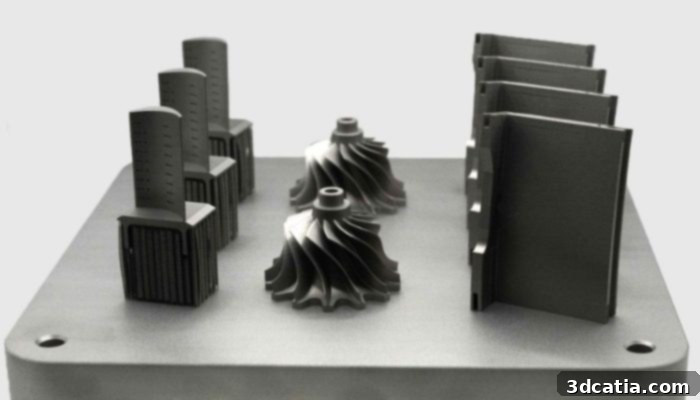
Example of 3D printed nickel superalloy (photo credits: Alloyed Aubert & Duval)
Ceramics
Beyond metals, ceramic parts can also be post-processed using either HIP or annealing. As long as the specific properties and thermal requirements of the ceramic material are respected, both methods can effectively enhance the material’s structural integrity. For ceramics, HIP is particularly valued for achieving full densification, eliminating internal voids, and significantly improving mechanical strength and reliability. Annealing can also be used for stress relief and microstructure optimization in certain ceramic types.
Polymers
A notable distinction appears when considering polymer materials. Annealing is widely compatible with most polymers used in additive manufacturing. Since annealing primarily involves temperature changes rather than pressure, many 3D printed polymer parts can be annealed to improve their strength, reduce warpage, and enhance other mechanical properties. For instance, annealing is frequently cited as an effective method to boost the strength of ABS parts. Even common FDM materials like PLA and PETG parts are increasingly being annealed by hobbyists and professionals alike to improve their performance.
Polymer HIP, however, is a less developed and far less common area, especially in additive manufacturing. The high temperatures and pressures typically employed in traditional HIP are often incompatible with the melting points and structural integrity of most polymers. Nonetheless, some researchers are exploring modified processes, such as warm isostatic pressing (WIP), which utilizes lower temperatures and pressures. WIP has shown promise for post-processing certain materials like nylon or high-performance polymers (HPP). However, given the specialized equipment and high costs associated with HIP, it remains an outlier for polymers, primarily suited for niche industrial applications and high-value materials where other methods are insufficient.
Benefits and Drawbacks of HIP and Annealing
While annealing and Hot Isostatic Pressing (HIP) operate through distinct mechanisms, they share several fundamental advantages in optimizing additively manufactured parts. Both processes are instrumental in improving the material’s ductility, enhancing mechanical performance, and eliminating internal imperfections, whether they are microscopic pores (HIP) or crystallographic dislocations and residual stresses (annealing). Essentially, these heat treatments are crucial for refining microstructural homogeneity and elevating overall material properties. They also contribute to process consolidation, as many metal 3D printed components inherently require heat treatment to mitigate residual thermal stresses introduced during the manufacturing phase.
Key Benefits
Annealing: By facilitating the migration of molecules within the microstructure, annealing effectively relieves internal strain that may have been introduced during initial material formation or the 3D printing process. This crucial benefit helps prevent cracking and significantly improves the machinability of the material. Moreover, the rectification of dislocations within the metal’s crystal lattice leads to improved electrical conductivity and enhanced magnetic properties. The precise control over heating and slow cooling in annealing allows engineers to selectively manipulate grain structures, thereby customizing the physical properties of the material for specific performance requirements.
Hot Isostatic Pressing (HIP): HIP excels at increasing a material’s density, making it a powerful tool for achieving near-theoretical density in additively manufactured parts. The process forms strong metallurgical bonds between material particles through diffusion bonding, effectively closing internal pores and voids. These improvements are paramount for applications demanding exceptional strength, reliability, and fatigue resistance. HIP can also repair latent defects within a material. For instance, a metal component with internal micro-cracks or voids can be subjected to HIP, causing the compressed material to effectively fill these imperfections. Crucially, both HIP and annealing contribute to minimizing material waste by enhancing the longevity and performance of existing components, thereby reducing the need for costly replacements or excessive material usage.
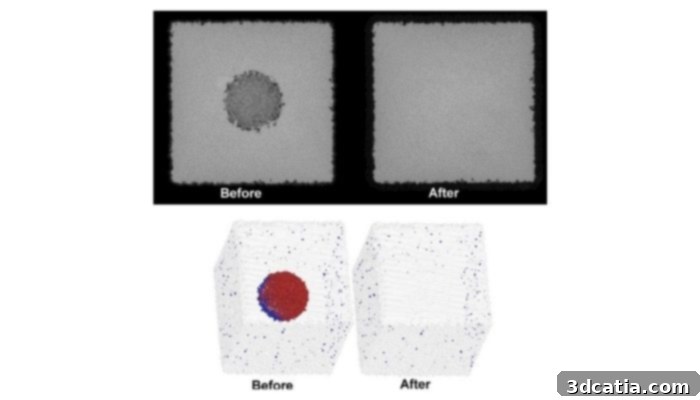
A before-and-after depiction of a material subject to HIP (photo credits: Hot isostatic pressing in metal additive manufacturing X-ray tomography reveals details of pore closure, Science Direct, A. du Plessis a b, E. Macdonald)
Potential Drawbacks
A significant disadvantage common to both HIP and annealing is the considerable time required to complete the process. Both methods can extend beyond 24 hours, and particularly for HIP, cycles can span several days, depending on part size, material, and desired properties. Furthermore, both technologies represent an added expense in the overall manufacturing workflow. They necessitate substantial upfront investments in specialized equipment and require skilled operators to manage complex parameters. Operationally, they consume significant amounts of energy for heating, and annealing may also incur additional energy costs for forced cooling cycles. The total time and cost are highly variable, contingent upon the material, the scale of production, and specific application requirements.
Finally, both processes have the potential to affect the final dimensions of a component. While not necessarily a disadvantage if accounted for, it is a critical consideration during design and manufacturing. Annealing can induce dimensional changes due to microstructural modifications and stress relief, leading to slight contractions or expansions. Similarly, HIP, by compressing the material to eliminate pores, will cause a volumetric reduction. The extent of these dimensional changes is influenced by factors such as the material’s properties, the initial part density, and the precise process parameters employed.
When to Reconsider
It’s important to discern when annealing or HIP might not be the optimal solution. If your parts do not demand enhanced mechanical properties, or if cost and lead time are extremely restrictive, these post-processing steps might be superfluous. Specifically, HIP may not be suitable for parts featuring intricate internal cavities or delicate channels that could collapse or deform under extreme pressure. Moreover, if an additively manufactured part is already produced with exceptionally high density (e.g., a high-quality laser powder bed fusion component), the additional densification offered by HIP might be unnecessary, making it an avoidable expense.
Applications for HIP and Annealing in Additive Manufacturing
In terms of application, both Hot Isostatic Pressing (HIP) and annealing primarily serve as crucial post-processing steps to significantly improve material properties in 3D printed parts. This broad utility implies that both methods are technically applicable in virtually any sector where material performance and reliability are paramount. However, a key distinction lies in accessibility: HIP is generally a high-cost, industrial-level process, whereas annealing can be performed more readily, making it accessible to a wider audience, including smaller workshops and specialized labs.
Specific Industry Applications
Hot Isostatic Pressing (HIP): HIP has a long-standing history, with its first commercial application in the aerospace industry for producing jet engine turbine blades, long before the advent of additive manufacturing. Today, when combined with 3D printing, HIP offers immense benefits across various high-stakes sectors:
- Medical: In the medical sector, the combination of HIP and LPBF is invaluable for creating high-performance orthopedic implants such as hip and knee prostheses from biocompatible titanium alloys. HIP ensures pore-free structures, crucial for long-term implant success and patient safety.
- Aerospace: For aerospace applications, HIP is critical for components like turbine blades made from nickel superalloys (with LPBF) and fuel injectors fabricated from cobalt-chrome (CoCR). It eliminates internal defects, leading to improved fatigue life and structural integrity, essential for safety-critical parts.
- Automotive: In the automotive sector, HIP instills greater confidence in 3D printed components by eliminating porosity and internal cracks, which are common in as-printed parts. This leads to improved mechanical properties and enhanced reliability for high-performance engine parts and structural components.
- General Industrial: Anywhere guarantees against pores and internal cracks—often inherent in 3D printed parts—are vital, and improved fatigue properties from eliminated stress concentrations are desired, HIP proves indispensable.
Annealing: Annealing finds similar critical applications, as it effectively improves ductility, eliminates residual stress, reduces hardness, and enhances magnetic properties while decreasing brittleness. Therefore, industries that value these specific material characteristics are ideal fits:
- Aerospace: Annealing is commonly used for aircraft components, ensuring stress relief and material stability, especially in parts subjected to significant thermal cycling or mechanical loads.
- Automotive: Similar to aerospace, it can be used for body panels and other components in car manufacturing, where malleability and formability are important for subsequent processing.
- Medical: In medicine, annealing is crucial for medical devices like orthopedic implants. It aids in forming alloys and metals that are not only biocompatible but also possess the required strength and durability after 3D printing.
- Electronics and Semiconductors: Given annealing’s ability to improve electrical conductivity and magnetic properties, it is highly valuable in the electronics industry for manufacturing semiconductors, sensors, and solar cells, where precise control over electrical characteristics is essential.
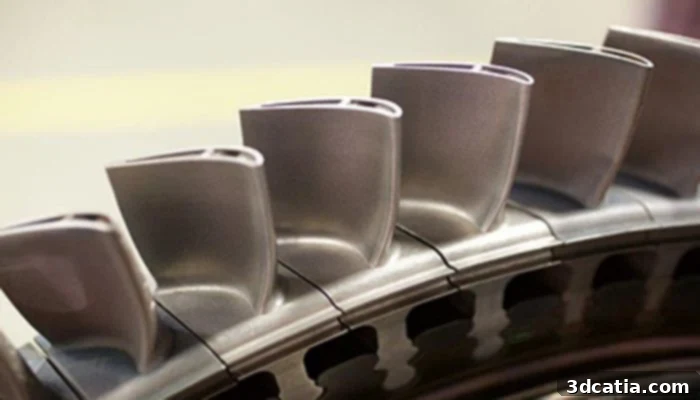
3D printed turbine blades (photo credits: Siemens)
Manufacturers and Cost Considerations for Heat Treatment
The choice of equipment and the associated costs for annealing and Hot Isostatic Pressing (HIP) vary significantly, influenced by the required precision, scale of operation, and whether the treatment is performed in-house or outsourced.
Annealing Equipment & Manufacturers
For annealing, particularly for small-scale or DIY projects, a dedicated annealing furnace isn’t always strictly necessary. Standard laboratory furnaces, provided they can reach and maintain the required temperatures, can be suitable, especially for polymer parts where extreme precision might not be the primary concern. However, for industrial applications demanding high precision, consistent results, and specific atmospheric controls, a specialized annealing furnace is essential. Notable manufacturers of industrial annealing furnaces include Precons, Gasbarre Products, Inc., and CM Furnaces, Inc. These companies offer a range of furnaces designed for various materials and processes, from batch furnaces to continuous lines.
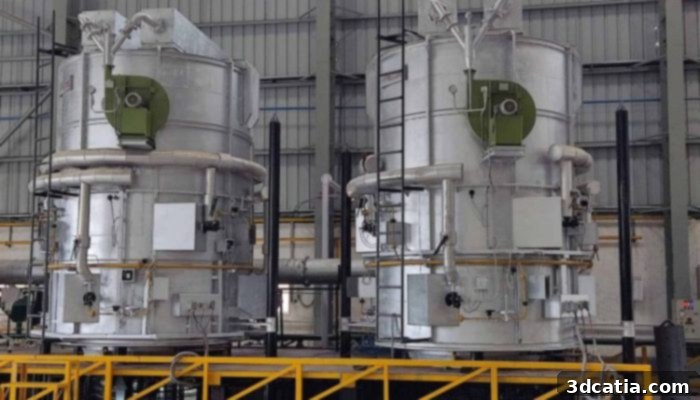
Bell annealing furnaces (photo credits: Precons)
HIP Equipment & Manufacturers
Unlike annealing, HIP demands highly specialized and robust machinery capable of handling extreme temperatures and pressures safely. Companies typically have two options: utilize an external HIP service provider or invest in purchasing a machine for in-house operations. Prominent manufacturers in the HIP industry include Bodycote, Kobe Steel, Aalberts, Quintus Technologies, and ESPI. These companies design and build advanced HIP systems tailored for various industrial applications, offering solutions that range from compact units to massive production machines.
Cost Implications
The cost associated with both annealing and HIP is influenced by several critical factors: the type of material being treated, the scale of production, the specific requirements of the application (e.g., tight tolerances, specific microstructures), and the strategic decision of outsourcing the service versus acquiring and operating equipment in-house.
For annealing, entry-level laboratory furnaces can start from approximately $500, making them accessible for smaller projects. Industrial annealing furnaces, however, represent a much larger investment, with prices ranging from $3,000 to well over $100,000, depending on size, features, and automation. Hot Isostatic Pressing machines follow a similar, but generally higher, price trajectory. Smaller HIP units might be available from around $7,000, but large-scale, high-capacity industrial HIP systems can easily cost hundreds of thousands of dollars, or even millions, reflecting their complexity, specialized engineering, and operational capabilities.
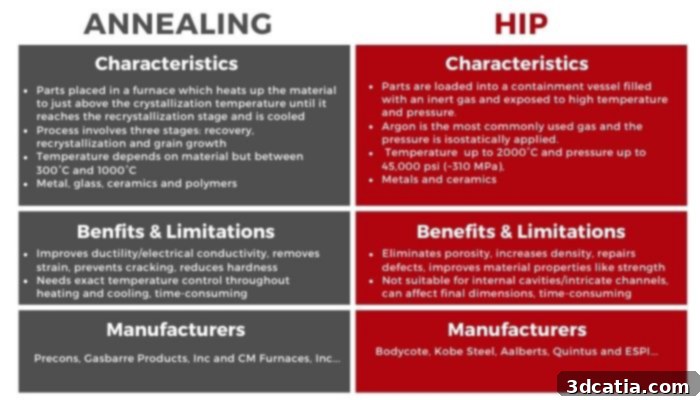
Credits: 3Dnatives
Whether you lean towards the stress-relieving properties of annealing or the densifying power of hot isostatic pressing, both heat treatment methods are crucial for enhancing the performance and reliability of additive manufactured parts. The optimal choice ultimately depends on a careful evaluation of material, application demands, and economic considerations.
Do you prefer hot isostatic pressing or annealing for your 3D printed parts? Let us know in a comment below or on our LinkedIn, Facebook, and Twitter pages! Don’t forget to sign up for our free weekly Newsletter here, bringing the latest 3D printing news straight to your inbox! You can also find all our videos on our YouTube channel.
*Cover Photo: Annealing (image credit: Aria) and HIP (image credit: ThermalProcessing.Com)