
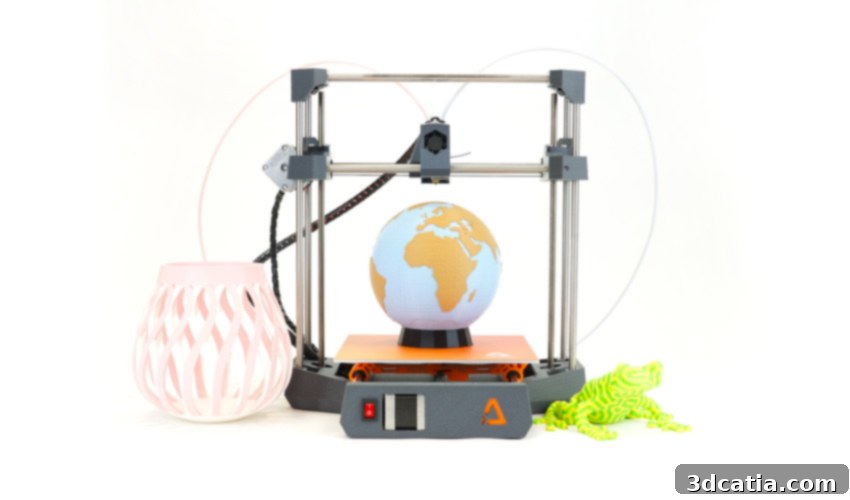
Dagoma Disco Ultimate Review: An Affordable and Feature-Rich DIY 3D Printer for Every Enthusiast
Dagoma, a prominent name among French manufacturers, has carved out a significant niche in the additive manufacturing landscape from its base in Roubaix. The company is widely celebrated for its commitment to making 3D printing accessible, largely spearheaded by its incredibly popular DiscoEasy 200 DIY 3D printer. This particular model, renowned for its ease of assembly and impressive performance at a price point under 300€ ($333), quickly became a favorite for hobbyists and educational institutions alike, demonstrating Dagoma’s capability to deliver quality within a budget.
Building on this foundation of success, and four years after its initial market entry, Dagoma has continued to innovate and expand its product line. Following the introduction of additional models such as the robust Explorer 350 and the sleek Magis (previously known as Neva), the French 3D printer manufacturer recently unveiled its latest offering: the Dagoma Disco Ultimate. This new 3D printer kit is not merely a successor but an enhanced version of the beloved DiscoEasy 200, designed to push the boundaries of what an affordable FDM 3D printer can achieve. Retailing at an attractive price of 399€ ($442), with a two-color version available for 499€ ($554), the Disco Ultimate aims to deliver an even more refined and versatile 3D printing experience without compromising on Dagoma’s core philosophy of affordability and user-friendliness. This strategic pricing, especially for a dual-color capable machine, positions the Disco Ultimate as a highly competitive option in the entry-level to mid-range desktop 3D printer market.
Eager to explore the capabilities and enhancements of this exciting new Dagoma model, the 3Dnatives’ Lab was delighted to receive the Disco Ultimate in its advanced two-color configuration for a comprehensive review. Our objective was to thoroughly investigate the significant improvements incorporated into this “Ultimate” version. We sought answers to critical questions: What specific upgrades differentiate the Disco Ultimate from its predecessor? What level of performance and print quality can users genuinely expect from a 3D printer priced below 500€? Who is the ideal user for this machine – is it best suited for beginners, educators, or more experienced makers? And, perhaps most importantly, does the Dagoma Disco Ultimate represent a worthwhile investment in today’s competitive 3D printing market? Below, we present our complete and detailed review, aiming to provide insightful answers to these questions and guide potential buyers through their decision-making process.
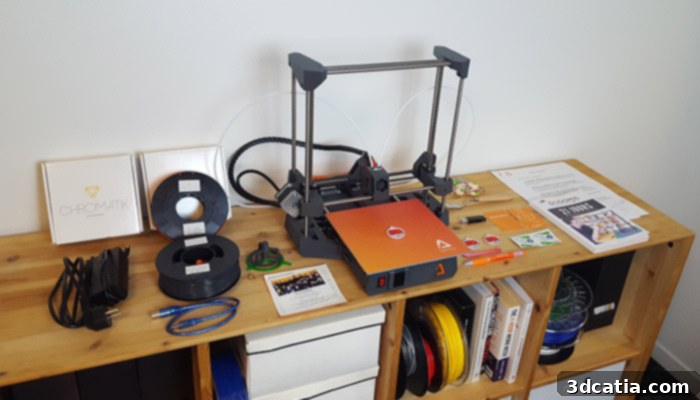
The Disco Ultimate 3D printer and its various accessories, ready for assembly or immediate use
1. Unboxing and Assembly Experience of the Dagoma Disco Ultimate
The Dagoma Disco Ultimate continues the brand’s tradition by being delivered in a convenient kit form. This approach not only helps keep the price affordable but also offers users a valuable opportunity to understand the mechanics of their 3D printer from the ground up. The assembly process is meticulously detailed in an intuitive online guide, readily accessible on the Dagoma website. This comprehensive resource ensures that users, even those new to 3D printing, can follow each step with confidence. Typically, assembling the entire 3D printer takes approximately 2 to 3 hours, a manageable timeframe that yields a rewarding sense of accomplishment. For the purpose of this in-depth review, we received an already assembled version of the Disco Ultimate, allowing us to dive directly into its operational capabilities.
Upon carefully unpacking the machine, we discovered a thoughtful array of accessories included with the Disco Ultimate Pack, demonstrating Dagoma’s attention to a complete user experience. Essential components like the power supply and a USB cable are present for connectivity. A 2GB mini SD card is provided, offering sufficient storage for initial print files, alongside a practical 2.5mm hexagonal screwdriver for maintenance and adjustments. The inclusion of a spatula is a welcome addition, proving invaluable for safely removing finished prints from the build platform. For precise bed leveling, a business card target is included, streamlining the calibration process. Interestingly, Dagoma has also included Lutti candies, a fun and unique partnership touch that adds a personalized feel to the unboxing. A significant upgrade for the Disco Ultimate is its build tray, which comes equipped with a pre-applied Buildgrip surface. This specialized material is engineered to significantly improve the adhesion of the first layer, a critical factor for successful 3D prints, thereby reducing common printing failures and ensuring greater reliability.
In addition to the standard pack, Dagoma further enhanced our test experience by providing supplementary items. These included a convenient USB key for reading SD cards, two full reels of Dagoma PLA filament (in vibrant Chromatik Orange and subtle Chromatik Gris), allowing us to immediately test the printer’s capabilities with quality materials. Furthermore, two 3D-printed reel holders were supplied, showcasing the potential of the printer itself. Beyond the hardware, the Ultimate Disco Pack truly stands out with its educational resources. It contains a comprehensive 150-page “21-day Training” guide, designed to systematically walk users through advanced 3D printing concepts and projects. This guide is a fantastic initiative, transforming the acquisition of a 3D printer into a structured learning journey. Complementing this, a 6-month premium subscription to the SelfCAD software is also included, providing powerful 3D modeling and slicing tools that empower users to create their own designs from scratch.
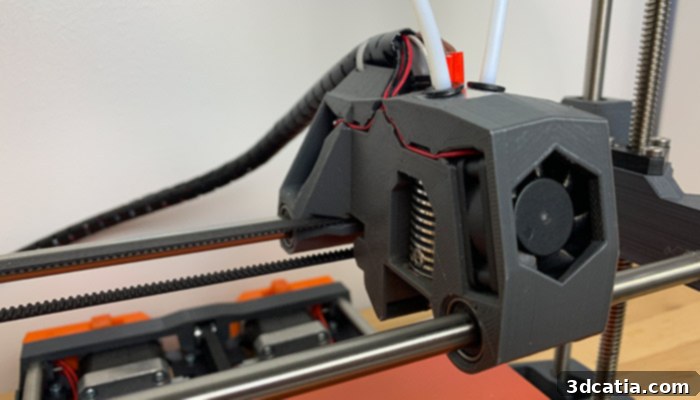
The printing head of the printer, showcasing its 3D printed structural components
Visually, the Disco Ultimate maintains a strong resemblance to its highly successful predecessor, the DiscoEasy 200, retaining its distinctive open architecture and incorporating several 3D printed components. This design philosophy not only contributes to its affordability but also fosters a sense of transparency and repairability, allowing users to easily understand and maintain their machine. However, the Disco Ultimate introduces a host of crucial new features and upgrades that significantly enhance its performance and versatility. Key among these is the two-color add-on, a standout capability for an entry-level machine. The standard Extruder+ represents a significant leap forward, offering automatic filament insertion and ejection, which greatly simplifies the loading and unloading process. Further improving user convenience is the presence of a dedicated side button, enabling users to pause prints or efficiently load/unload filaments with a simple press. The integration of end-of-filament detection is a highly practical addition, preventing failed prints due to material depletion and allowing for timely filament changes. Moreover, the Disco Ultimate boasts flexible filament compatibility, expanding the range of materials users can experiment with. The inclusion of the Expert Pack as standard further boosts precision and reliability through several key hardware improvements: machined trapezoidal rods ensure smoother and more accurate motion, a newly designed print head model optimizes extrusion, and anti-backslash/anti-play nuts minimize mechanical slack, all contributing to superior print quality. Finally, the Disco Ultimate incorporates a new electronic board, the DAGOMA F5, which promises a significantly quieter operation, making the printing experience more pleasant in various environments.
It’s worth noting that several of these advanced features, such as the Extruder+, the Expert Pack, and the two-color option, are also available for purchase separately on the Dagoma website as add-ons. This modular approach allows existing Dagoma users to upgrade their current machines or new users to customize their Disco Ultimate to their specific needs and budget. The Extruder+ is priced at 19.90€, the Expert Pack at 89.90€, and the two-color option at 169.90€. The only significant add-on not included in the version we tested, but highly recommended, is the control screen, which can be purchased for €49.00. This accessory provides direct, on-device control over various printing parameters, significantly enhancing the user’s ability to manage print jobs without needing a connected computer.
A particularly commendable innovation from Dagoma is the inclusion of its “21-day training” guide. This comprehensive resource is available in both paper and electronic formats, catering to different user preferences. The guide systematically covers fundamental aspects of 3D printing, from creating G-code and essential printer maintenance to foundational 3D modeling techniques. Crucially, it then guides users through more advanced topics, empowering them to pursue complex 3D printing projects with confidence. This thoughtful initiative by the manufacturer is highly beneficial, as it genuinely enables users to maximize the potential of their 3D printer, fostering learning and creative exploration beyond just basic operation. It transforms the purchase into an educational journey, aligning perfectly with the DIY spirit of the machine.
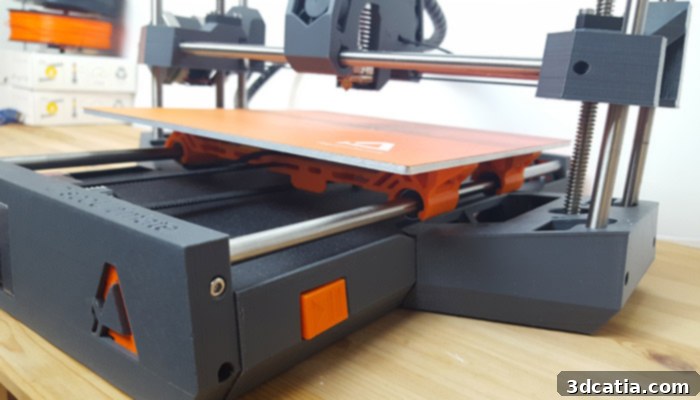
The conveniently located play/pause button on the side of the 3D printer, offering quick control for pausing print jobs and managing filament
2. Effortless Installation and Connectivity
Once the Dagoma Disco Ultimate 3D printer is fully assembled (or unboxed in our pre-assembled test case), the initial setup process is remarkably straightforward, designed to get users printing quickly. The first step involves simply plugging in the power supply and activating the machine using the easily accessible on/off button located on the front panel. Loading filaments is an incredibly streamlined experience, thanks to the integrated Extruder+. This intelligent system simplifies what can often be a fiddly process on other machines. Users merely need to push the filament into the extruder offset at the rear of the machine (a bowden-type setup), and the 3D printer automatically grips and drives the filament through the system. There’s no need for manual pushing or intricate threading. Furthermore, the printer intelligently manages the heating process; once the correct temperature is reached, the filament is automatically extruded, confirming that it’s properly loaded and ready for printing. This automation significantly reduces the learning curve and potential frustrations for new users.
The subsequent crucial step is calibrating the print bed, an operation made semi-automatic and user-friendly through the Dagom’app. This dedicated software, available for download from the Software section of the Dagoma website, guides users through the calibration process. By utilizing a simple target, such as a business card, the Dagom’app enables precise bed leveling in under 3 minutes, ensuring optimal first-layer adhesion—a cornerstone of successful 3D printing. Beyond initial setup, the Dagom’app serves as a vital tool for maintaining the printer, allowing users to easily update the firmware during future releases. To initiate these operations, the Disco Ultimate must be connected to a computer via the provided USB cable. It connects directly to the electronic board, ensuring a stable data transfer. However, one minor drawback we observed was the relatively short length of the USB cable, which can limit placement options for the printer. Additionally, we did feel the absence of a built-in WiFi connection, a feature increasingly common in modern 3D printers that offers greater flexibility and convenience for sending print jobs. While understandable for an affordable machine, this is a trade-off that users should be aware of, potentially requiring closer proximity to a computer during operation.
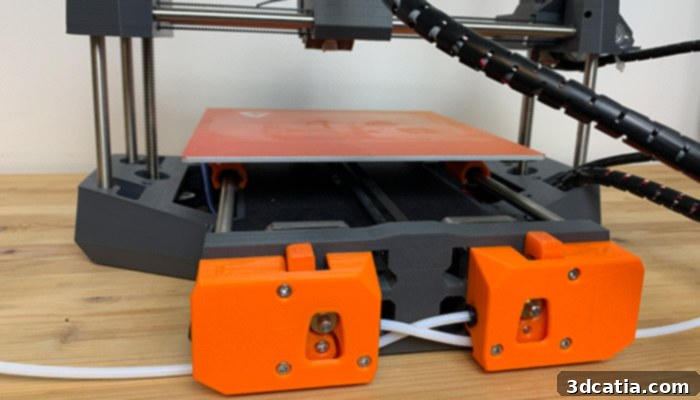
The two bowden-type extruders located at the rear of the machine, facilitating the dual-color printing mode
Regarding the impressive dual-color mode capability of this desktop 3D printer, Dagoma has implemented a clever and cost-effective solution. Instead of relying on two separate extruders and print heads – a configuration that significantly increases complexity and cost – the Disco Ultimate manages two filaments through a single extruder integrated within the print head. This ingenious system incorporates a sophisticated filament loading/unloading and purging mechanism. When switching between colors, the printer automatically retracts the current filament, purges any residual material to prevent color mixing, and then loads the new filament. This ensures distinct color separation in the final print. This innovative approach is a testament to Dagoma’s engineering prowess, allowing the Disco Ultimate to offer advanced dual-color functionality at a price point that remains highly accessible and affordable, making it a compelling option for those looking to add an extra dimension to their 3D prints without breaking the bank.
3. Exploring the CuraByDagoma Software
For the critical slicing part of the 3D printing workflow, Dagoma has opted for a pragmatic and user-centric approach rather than attempting to reinvent the wheel. They provide a specially customized version of Ultimaker’s globally renowned Cura slicer, tailored specifically for optimal performance with the Disco Ultimate. Appropriately named CuraByDagoma, this software retains the fundamental strengths and intuitive interface of the original Cura, allowing users to effortlessly position, scale, and rotate their 3D models within the virtual build plate. More importantly, it serves as the central hub for defining all essential 3D printing parameters, translating digital designs into printable instructions for the machine. This bespoke version ensures that beginners have a pre-configured and optimized experience right out of the box, minimizing the complexities often associated with setting up a new 3D printer.
While aiming to keep the 3D software incredibly simple and accessible, CuraByDagoma does feature a somewhat limited number of advanced options. This design choice primarily benefits novice users, preventing them from being overwhelmed by a multitude of settings. In practice, users can select the layer thickness (with predefined options of 100, 150, or 200 microns, directly impacting print resolution and speed), adjust the infill density (0% for hollow, 17% or 33% for structural integrity), and specify the type of PLA filament being used. While the software allows for changing the extrusion temperature to accommodate different filament brands or specific needs, it notably restricts direct control over printing speed – a deliberate simplification for consistency. Other key functionalities include the option to generate printing supports for complex geometries, setting the necessary purge volume for multi-filament prints to prevent color bleed, and adding pauses during printing, which is particularly useful for manual filament changes or embedding objects. While this streamlined approach is excellent for beginners, more experienced users might quickly find these limited options restrictive for fine-tuning specific print behaviors or experimenting with exotic materials. However, Dagoma has proactively addressed this by confirming that the Disco Ultimate is fully compatible with other industry-standard slicers such as the powerful Simplify3D or the full version of Cura from Ultimaker, offering advanced users the flexibility to utilize their preferred software for more granular control over print settings and unlock the machine’s full potential. This compatibility ensures that the printer grows with the user’s expertise.
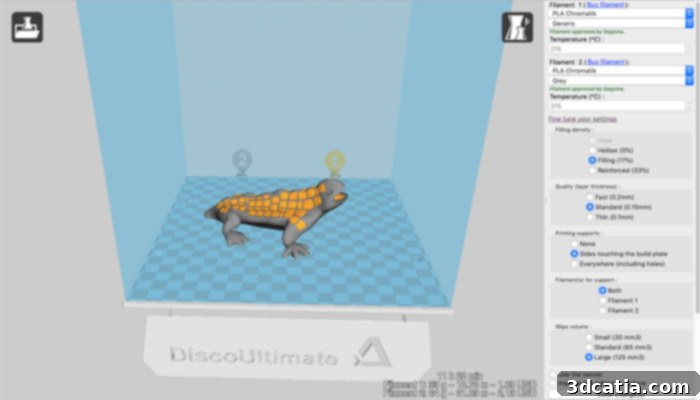
A snapshot of the user-friendly CuraByDagoma software interface, optimized for the Disco Ultimate
4. Initial Impressions and Printing Performance
Integrating a reliable dual extrusion system into an affordable desktop 3D printer has historically been a formidable engineering challenge, one that many manufacturers have struggled to implement successfully. Often, the resulting machines either command a prohibitively high selling price or deliver inconsistent print quality, undermining the very appeal of multi-color or multi-material printing. Given these common pitfalls, we approached the Dagoma Disco Ultimate with a healthy degree of skepticism before commencing our tests. However, we were genuinely and pleasantly surprised by the overall experience of their innovative extrusion method. The system proved remarkably simple to operate, and critically, the resulting dual-color 3D printed parts were largely satisfactory. What makes this even more impressive is Dagoma’s choice to achieve dual extrusion using a single printing head, coupled with a clever filament management system. This design choice is instrumental in keeping the two-color version of the Disco Ultimate at an incredibly competitive price point, with only a 100€ premium over the single-color model. This affordability, combined with decent performance, positions the Disco Ultimate as a truly compelling option for users eager to explore multi-color printing without a significant financial outlay.
During our testing, the few dual-extrusion difficulties we encountered were generally minor and easily resolvable, typical of basic 3D printing challenges. These included issues such as an improperly loaded filament, which was quickly rectified, or occasional problems with adhesion to the build plate, which were effectively solved by applying a standard adhesive like a glue stick. From the perspective of the quality of the two-color prints, we did observe some slight inconsistencies. Specifically, minor burrs and colors that weren’t as sharply defined as those typically achieved in single-extrusion prints were noticeable. Despite the intelligent filament purging system designed to prevent color mixing, there was still a subtle degree of blending or bleeding at color transitions in certain complex geometries. While these imperfections are worth noting, they are minor in the context of the printer’s price point and the inherent complexities of single-nozzle multi-color printing. For casual users and hobbyists, the results are more than acceptable, offering a vibrant and functional dual-color experience.
More generally, beyond the specifics of dual-color printing, the overall printing process with the Dagoma Disco Ultimate unfolded quite smoothly and reliably, with no major operational issues disrupting our workflow. The machine proved to be a consistent performer for single-color prints as well. One aspect that initially stood out, and can be quite disorienting for users accustomed to more feature-rich machines, is the absence of a dedicated control screen. As reviewers who frequently test machines equipped with screens by default, we certainly felt its omission. This is precisely why we strongly recommend considering the optional Screen add-on, which costs only 49€. This affordable upgrade fundamentally transforms the user experience by enabling direct control over various crucial parameters without needing a tethered computer. With the control screen, users can intuitively modify extrusion temperature, adjust printing speed on the fly, fine-tune fan speed for optimal cooling, select from multiple 3D models stored on the SD card, and even modify the nozzle offset for precise bed leveling. These capabilities offer a level of flexibility and convenience that significantly enhances the printing workflow, making the machine much more versatile and user-friendly, especially for those who prefer an untethered printing experience.
- The iconic 3DBenchy by CreativeTools, demonstrating fine detail and overhang capabilities.
- Markerbot’s Torture Test, pushing the limits of the printer’s dimensional accuracy and bridging.
- The intricate Forbidden Watchtower by kijai, showcasing fine feature reproduction and stability.
- Vladac’s Turbine, printed with a mid-print filament change, highlighting manual intervention capability.
- A standard Dice by Gcreate, demonstrating clean faces and sharp edges.
- The challenging Twisted Bottle and Screw Cup by David Mussaffi, testing thread accuracy and complex geometries.
- The Dual Drodi by BCN3D, a perfect benchmark for assessing dual-color print quality and registration.
In conclusion, the Dagoma Disco Ultimate stands out as a highly commendable entry in the affordable 3D printer market. It successfully builds upon the legacy of the DiscoEasy 200 by introducing meaningful enhancements like dual-color capability, improved user experience through Extruder+, and enhanced reliability with the Expert Pack, all while maintaining an accessible price point. While the customized CuraByDagoma software offers a straightforward experience for beginners, advanced users will appreciate the compatibility with other powerful slicers. The machine’s performance, particularly in dual-color printing, is impressive for its category, even with minor imperfections that are easily overlooked given its value. The optional control screen is a recommended upgrade that significantly elevates the overall printing experience.
The Dagoma Disco Ultimate is ideally suited for beginners taking their first steps into the world of 3D printing, educators seeking an affordable and engaging tool for classrooms, and hobbyists looking for a reliable and versatile machine to expand their creative projects, especially those interested in exploring dual-color printing without a premium price tag. Its DIY nature, coupled with comprehensive training materials, makes it not just a tool, but a gateway to learning and innovation in additive manufacturing. We believe the Dagoma Disco Ultimate offers excellent value for its price, representing a smart investment for anyone seeking a feature-rich, user-friendly, and highly capable desktop 3D printer.
Below you can find our rating! What do you think of the Dagoma Disco Ultimate 3D printer? Let us know in a comment below or on our Facebook and Twitter pages!
Check out more 3D printer tests!
Compare hundreds of 3D printers!