
Revolutionizing Maxillofacial Surgery: 3D Systems’ VSP Hybrid Guides Enhance Precision with Advanced 3D Printing
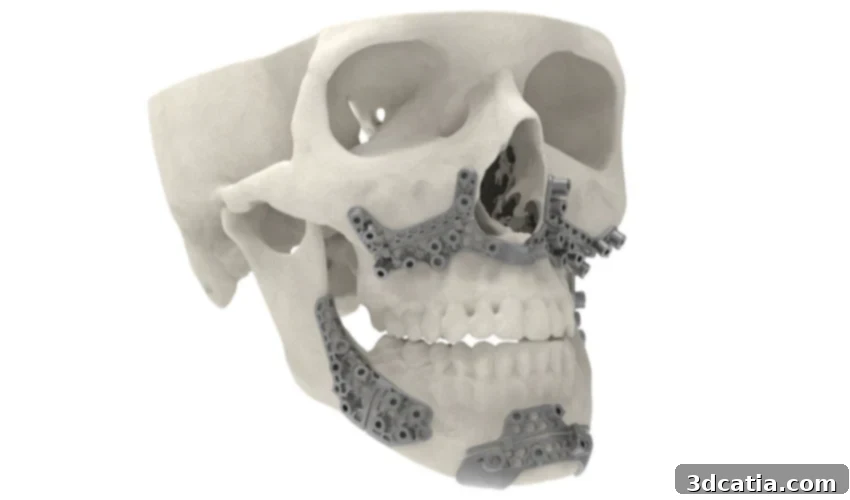
In a significant leap forward for medical technology, 3D Systems has unveiled a pivotal enhancement to its renowned VSP surgical planning portfolio: the innovative VSP Hybrid Guides. These guides are meticulously engineered to deliver a breakthrough patient-specific, occlusal-based solution tailored for the intricate demands of maxillofacial surgeries. By synergistically combining the inherent strengths of nylon and titanium, this advanced enhancement promises to elevate the accuracy of surgical treatments, ensuring superior outcomes for patients. Furthermore, their thoughtfully designed slimmer profile provides surgeons with crucial advantages, including easier placement in areas characterized by limited exposure and significantly improved visibility of the surgical site, both paramount for complex procedures.
Driven by Clinical Need: Enhancing Outcomes in Maxillofacial Procedures
The development of 3D Systems’ VSP Hybrid Guides stands as a testament to the company’s steadfast commitment to continuous improvement, directly influenced by valuable customer feedback. This innovation reflects a core mission to drive better, more predictable outcomes for maxillofacial and reconstructive surgeons and their patients. Clinical evidence and user testimonials have consistently shown that these advanced guides possess the remarkable ability to reduce the time spent by surgeons and patients in the operating room, often by several hours. This reduction in operative time is not merely a matter of efficiency; it translates directly into decreased anesthesia exposure, minimized risks of complications, and potentially faster, smoother recovery periods for patients.
Dr. Jay Neugarten, a leading authority at the New York Center for Orthognathics and Maxillofacial Surgery, attests to the transformative impact of these guides on his practice. He emphasizes, “3D Systems and its VSP surgical planning and guides are an integral part of my ability to deliver highly successful outcomes for my patients undergoing corrective jaw surgery.” This powerful endorsement highlights how the precise integration of advanced 3D printing and sophisticated virtual surgical planning has become an indispensable cornerstone for achieving predictable and exceptional results in the most challenging surgical interventions.
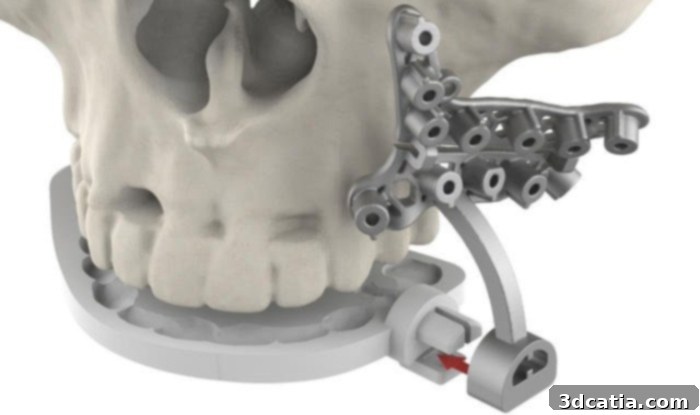
Easy-to-use connection sites, engineered with auditory and haptic feedback confirm proper connection of guides. (Photo Credit: 3D Systems)
The Ingenuity of Hybrid Material Design: Strength and Adaptability
The true innovation behind the VSP Hybrid Guides lies in their unique dual-material construction, a strategic combination that leverages the optimal properties of both nylon and titanium to maximize surgical performance and patient comfort. Titanium, a material universally recognized for its unparalleled strength, rigidity, and biocompatibility, forms the robust framework for the cutting and drilling elements of the guides. This ensures unwavering precision and stability during the critical phases of bone manipulation, allowing surgeons to execute complex osteotomies and drilling with supreme confidence. The inherent strength of titanium enables the creation of exceptionally thin yet durable guide profiles, further contributing to the overall ergonomic design.
Complementing titanium’s rigidity, nylon introduces a crucial element of adaptability, particularly vital for accurate tooth-based registration. Its inherent flexibility and biocompatible nature allow the nylon components to conform precisely and comfortably to the patient’s dentition, ensuring a secure and stable fit without placing undue stress on natural teeth or soft tissues. This precise tooth-based registration is a cornerstone of the system, guaranteeing that the surgical guide is perfectly aligned with the patient’s unique anatomy, thereby facilitating highly accurate surgical cuts and drill placements. This clever integration maintains the essential profile advantages of a rigid metallic guide while incorporating the adaptable, patient-friendly characteristics of a polymer for optimal fit and registration.
Dr. Neugarten provides further insight into this groundbreaking material synergy: “The new VSP Hybrid Guides are the next generation of occlusal-based surgical guides. To be able to combine two materials – nylon and titanium – to create cutting and predictive hole-drilling surgical guides that register to the dentition enables a precise and accurate surgical outcome for my patients.” His statement underscores the profound impact this hybrid approach has on the precision and predictability of personalized surgical instrumentation, marking a significant advancement in the field.
Streamlining Workflow: Intuitive Design and Digital Integration
Beyond their sophisticated material composition, VSP Hybrid Guides are meticulously engineered for seamless integration into the surgeon’s workflow, prioritizing ease of use and intuitive functionality. The guides feature robust, intuitive connection sites designed for effortless assembly, complete with auditory and haptic feedback mechanisms that confirm proper and secure attachment. This thoughtful design minimizes potential for error and reduces procedural delays, ensuring that the guides are consistently and correctly positioned even in high-pressure surgical environments.
A key benefit is the enhanced flexibility offered to surgeons, enabling them to design patient-specific instruments that incorporate multiple cutting and drilling locations onto a single occlusal-based guide. This advanced customization capability significantly streamlines the surgical process, reducing the need for numerous individual instruments and minimizing intraoperative adjustments. Such efficiencies are indispensable in complex maxillofacial surgeries where precision, time management, and an unobstructed surgical field are critical determinants of success.
Dr. Neugarten’s experience further highlights the powerful synergy achieved through digital integration: “Using the VSP Hybrid Guides together with Stryker’s Facial iD customized plates streamlines my workflow in surgery. It’s like using a satellite navigation system compared to a paper map. This ability to seamlessly transfer my digital treatment plans to the surgical arena allows me to provide the highest level of care for my patients.” This vivid analogy perfectly illustrates the transformative shift from conventional, less precise methods to a fully integrated, digitally-driven surgical approach. The compatibility with Stryker’s Facial iD customized plates establishes a comprehensive, end-to-end solution that spans from meticulous virtual planning to flawless surgical execution, all contributing to optimized patient outcomes.
3D Systems: A Legacy of Innovation in Personalized Medicine
3D Systems has solidified its position as a pioneering force in the personalized medicine space, building upon decades of expertise in medical imaging, sophisticated surgical simulation, and advanced 3D printing technologies. Their relentless pursuit of innovation has earned them significant accolades, including crucial FDA market clearances for various VSP solutions, affirming their unwavering commitment to the highest standards of quality, safety, and clinical efficacy. The VSP Hybrid Guides themselves are a prime example of this pioneering spirit, brought to fruition through a strategic and impactful partnership between 3D Systems and Stryker, another formidable leader in the medical technology industry.
This collaborative effort is particularly impactful as it guarantees seamless compatibility between the new hybrid guides and Stryker’s Facial iD system. This integration provides maxillofacial surgeons with an unparalleled, truly complete end-to-end solution, encompassing every stage from initial diagnostic imaging and comprehensive virtual surgical planning to the precise intraoperative placement of patient-specific guides and fixation plates. Such a cohesive and holistic approach effectively eliminates potential compatibility hurdles, significantly streamlining the entire surgical workflow, and equipping surgeons with a powerful, integrated toolkit engineered for optimal precision and highly predictable results.
Menno Ellis, executive vice president of healthcare solutions at 3D Systems, eloquently summarizes the strategic vision underpinning this latest offering: “With the introduction of VSP Hybrid Guides, we’ve elevated the capability of our renowned VSP surgical solutions portfolio to facilitate craniomaxillofacial procedures. In partnership with our expert biomedical engineers, surgeons can develop effective surgical plans and patient-specific devices that help improve patient outcomes.” This statement underscores 3D Systems’ enduring role not merely as a technology provider, but as an active and collaborative partner within the global surgical community, dedicated to collectively advancing the frontiers of patient care.
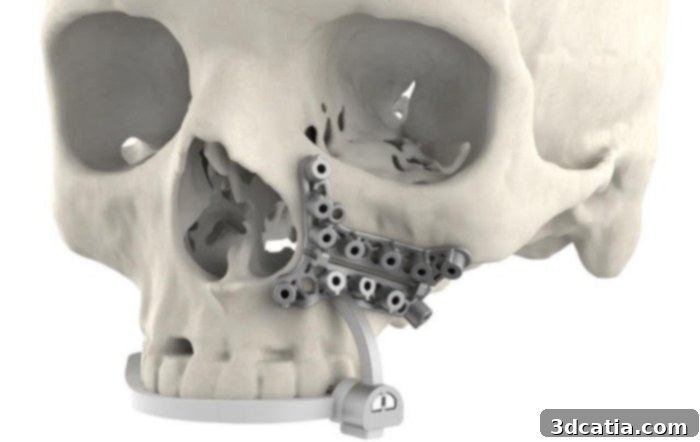
Slimmer profile guides provide easier placement in areas with limited exposure. (Photo Credit: 3D Systems)
The Future of Maxillofacial Surgery: Precision, Personalization, and Progress
The introduction of VSP Hybrid Guides represents a monumental stride in the ongoing evolution toward fully personalized and exceptionally precise surgical interventions. By harnessing the formidable capabilities of advanced 3D printing and cutting-edge material science, 3D Systems, in close collaboration with Stryker, is actively establishing new benchmarks for patient care within the complex field of maxillofacial surgery. These innovative guides not only dramatically enhance surgical accuracy and operational efficiency but also significantly contribute to improved patient safety and expedited recovery times, fundamentally transforming the entire surgical experience for both practitioners and patients alike.
As medical technology continues its rapid advancement, groundbreaking solutions such as the VSP Hybrid Guides exemplify the profound power of innovation to address the most intricate clinical challenges. They illuminate a clear path forward where meticulous digital planning, advanced manufacturing techniques, and deep clinical understanding converge seamlessly to deliver truly patient-centric healthcare. The ongoing evolution and adoption of such sophisticated tools promise a future where intricate surgical procedures are performed with even greater predictability, reduced invasiveness, and profoundly optimized outcomes, further solidifying 3D printing’s indispensable role in the modern medical landscape.
*Cover Photo Credit: 3D Systems