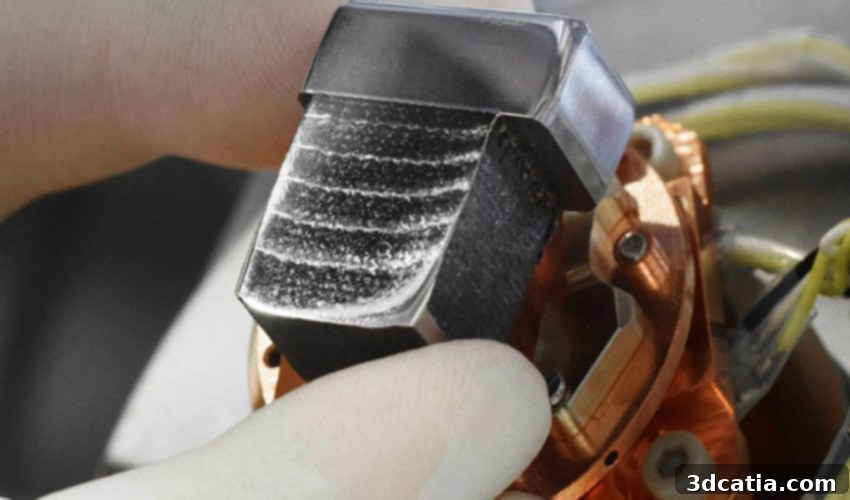
Revolutionizing Materials: 3D Printing Hard and Tough Damascus-Like Steel with Laser Technology
Damascus steel, a legendary material renowned for its exceptional properties, was historically forged into sword blades, valued for its unique combination of hardness and toughness. This ancient marvel is characterized by distinct patterns, resulting from its layered composition of varying iron alloys. Fast forward to the present, and a groundbreaking innovation from Germany is set to redefine how such advanced materials are produced. A collaborative team from the Max-Planck-Institut für Eisenforschung (MPIE) and the Fraunhofer Institute for Laser Technology has successfully pioneered a novel process that enables the layer-by-layer production of Damascus-like steel using state-of-the-art laser 3D printing. This represents a monumental leap in additive manufacturing, offering the potential to create materials with superior mechanical performance previously unattainable through conventional 3D printing methods. The ability to produce steel with the characteristic hard yet tough nature of Damascus steel through additive manufacturing opens doors to a multitude of high-demand applications, including critical aerospace components, advanced tooling, and high-performance machinery parts. Traditionally, other steels possessing similar strength and resilience have proven challenging or impossible to integrate into additive manufacturing workflows, leaving the full benefits of this versatile technique largely unexploited for such high-performance alloys. This new development addresses a significant gap in material science, paving the way for a new generation of engineered components.
The researchers meticulously explain the historical context behind the quest for optimal steel properties. In ancient times, when Damascus steel was the material of choice for superior swords, the primary method to influence the mechanical properties of iron alloys was through adjusting their carbon content. This limited blacksmiths to a binary choice: either producing steel that was soft yet tough, or hard yet brittle. Neither option offered the ideal combination for a weapon that needed to resist both impact and deformation. To overcome this fundamental limitation, European blacksmiths ingeniously developed a sophisticated technique involving the repeated folding and hammering of different alloy layers. This arduous process created many thin layers within the steel, meticulously blending the properties of the individual alloys to yield a material that was simultaneously hard and tough. This intricate layering process is precisely why traditional Damascus steel is instantly recognizable by its distinctive, often wavy or striped, pattern. Building upon this historical wisdom, the German teams embarked on extensive research and experimentation. Their efforts culminated in a remarkable achievement: developing a “Damascus steel” that, critically, consists of a *single* material, yet is engineered to possess alternating layers of specifically tailored **hard and ductile properties**. This innovative approach avoids the complexities of welding or bonding multiple different alloys, streamlining the manufacturing process while achieving the desired mechanical characteristics through sophisticated internal microstructural control.
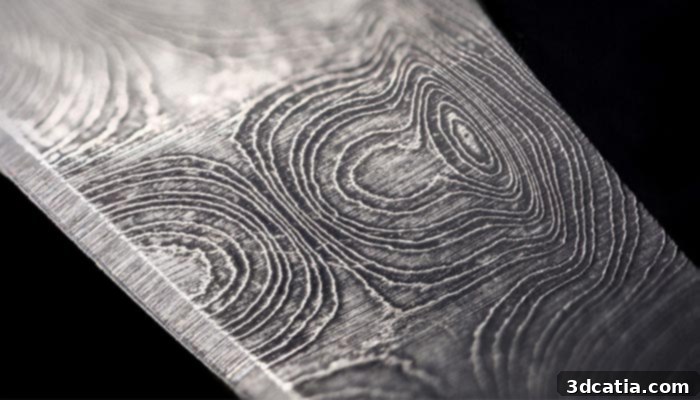
Damascus type steel is known for being hard yet tough because it is composed of layers of different iron alloys, it is usually recognized by its pattern.
Crafting a Metal Composite with Tunable Layer Hardness Through Additive Manufacturing
The initial and most crucial phase of this groundbreaking process involved the development of a specific alloy designed to inherently support the formation of the desired, varying mechanical properties. After extensive material science research, the team formulated an alloy primarily composed of iron, nickel, and titanium. This particular combination was selected for its metallurgical responsiveness to specific thermal treatments and its ability to form unique microstructures under controlled conditions. To precisely engineer the desired metal structures—alternating hard and ductile layers—the researchers devised an ingenious strategy: they intentionally interrupted the 3D printing process for a carefully controlled duration after the deposition and solidification of each new layer. This interruption proved to be the key to unlocking the material’s potential. Philipp Kürnsteiner, a post-doctoral researcher at MPIE and a central figure in this project, elaborated on the success: “We have succeeded in specifically modifying the micro-structure of the individual layers during 3D printing so that the final component has the desired properties – and all this without subsequent heat treatment of the steel.” This statement underscores a significant advantage of their method: the ability to achieve complex material properties in situ during the printing process, eliminating the need for time-consuming and often costly post-processing steps like traditional heat treatments or surface hardening techniques. This direct control over microstructure opens up new paradigms for material design and manufacturing efficiency.
The team utilized a laser-based additive manufacturing technique, drawing parallels with the established Laser Powder Bed Fusion (L-PBF) process. In this method, a high-energy laser beam selectively melts metallic powder, which then solidifies to form a solid layer of the desired part. Kürnsteiner further illuminated the pivotal mechanism behind their novel printing strategy: “Under certain conditions, small nickel–titanium micro-structures form. These, so-called precipitates, harden the material.” The precise control over these “certain conditions” is where the innovation truly lies. After the laser deposits and melts a layer of the iron-nickel-titanium alloy, the researchers deliberately halt the printing process. This interruption allows the freshly solidified metal layer to cool down significantly, specifically below a critical temperature of 195 °C. At this precise temperature, a crucial metallurgical transformation of the crystal structure occurs within the steel, preparing it for the next phase. Once this transformation has taken place, the subsequent layer is deposited. The act of depositing and melting the new layer inherently reheats the previously solidified and transformed layer. This controlled reheating triggers the formation of the minute nickel-titanium precipitates. These precipitates, dispersed within the metal matrix, act as strengthening agents, significantly increasing the hardness of that particular layer. Conversely, if the next layer is added immediately without the carefully timed cooling interruption, the preceding layer does not undergo the necessary crystal structure transformation or precipitate formation, thereby remaining in a softer, more ductile state. By meticulously alternating these printing strategies—with and without interruption—the researchers can precisely control the properties of each individual layer. The end result is a sophisticated composite material, where the final component is intrinsically formed from an intricate arrangement of layers, each possessing distinct and tailored mechanical properties, ranging from softer and more ductile to harder and more robust.
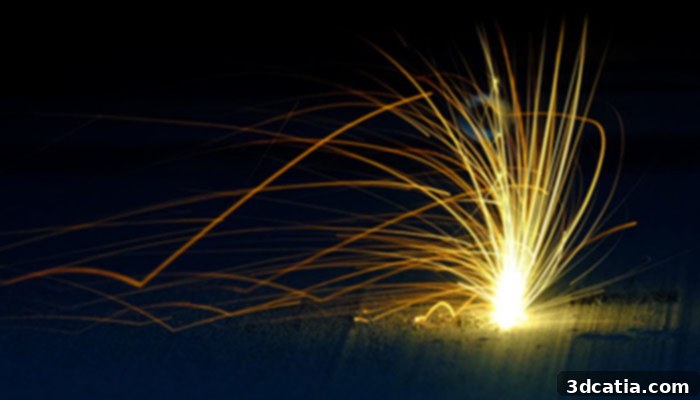
Layers with different properties can be created in a special alloy during 3D printing.
It is important to note that the formation and characteristics of these vital microstructures are not solely dependent on the cooling interruptions. The scientists emphasize that several other critical parameters within the 3D printing process can significantly influence the material’s final properties. Factors such as the laser’s energy input, its focus precision, and the printing speed all play a crucial role in controlling the nucleation and growth of precipitates, thereby affecting the hardness and ductility of each layer. During their experimental phase, the researchers successfully fabricated cube-shaped pieces, each with side lengths of a few centimeters. These simple geometric models served as foundational test objects for exploring the capabilities of the process, laying the groundwork for producing more complex geometries in the future. Eric Jägle, who leads the “Alloys for Additive Manufacturing” group at MPIE, proudly summarized the project’s success: “Thanks to our concept of local control, this was achieved in a single manufacturing step – without the additional process steps previously required for surface hardening such as nitriding.” This highlights a monumental achievement in material science and manufacturing: the integration of property customization directly into the additive manufacturing process. By eliminating secondary processing steps, the researchers have not only simplified the production of complex, high-performance materials but also significantly reduced the associated manufacturing costs and time. This advancement holds immense promise for industries demanding materials with superior and customizable mechanical properties, enabling the creation of components that are not just strong but also resilient, and perfectly optimized for their intended applications.
The implications of this breakthrough extend far beyond the laboratory. The ability to precisely engineer materials with varying hardness and toughness within a single component, and without post-processing, unlocks a new era for additive manufacturing. Industries like aerospace, medical devices, and high-performance automotive parts are constantly seeking lighter, stronger, and more durable materials. This 3D printed Damascus-like steel can offer unparalleled design flexibility, allowing engineers to create components where specific sections are optimized for impact resistance while others are designed for flexibility or wear resistance. This localized control over material properties will lead to parts with enhanced performance, extended lifespan, and ultimately, safer and more efficient systems. Furthermore, the innovative methodology itself provides a roadmap for future material development. Researchers can now explore other alloy systems and fine-tune printing parameters to achieve an even broader spectrum of tailored properties, pushing the boundaries of what advanced manufacturing can deliver. This is not merely an incremental improvement; it is a fundamental shift in how complex metal materials can be designed and brought to life, promising to transform numerous high-tech sectors.
*Cover Image Credits: Frank Vinken.
What are your thoughts on this revolutionary technique to create a metal composite with highly desirable hard yet tough properties? We invite you to share your insights and comments below, or join the conversation on our Facebook and Twitter pages! Don’t miss out on the latest advancements and discoveries in the world of 3D printing; remember to sign up for our free weekly Newsletter to receive all the cutting-edge news on progress, research, and inspiring entrepreneurs in additive manufacturing, delivered directly to your inbox!