
Neri Oxman and Stratasys: Pioneering Bio-Inspired 3D Printing for Sustainable Art and Architecture
In a groundbreaking collaboration that seamlessly blends art, science, and advanced manufacturing, acclaimed designer Neri Oxman and her renowned research group, The Mediated Matter Group, have partnered with leading additive manufacturing company Stratasys. This visionary alliance demonstrates the immense potential of 3D printing technology to unlock unparalleled opportunities in art and design. Their joint efforts have led to the creation of truly beautiful and functionally innovative 3D printed structures, each profoundly inspired by the intricate designs and inherent efficiencies found in nature. This ambitious project culminates in a remarkable collection of artifacts, crafted almost entirely from organic matter and ingeniously shaped through processes mimicking natural water dynamics. At the heart of this collaboration stand two monumental achievements: the towering, 5-meter high ‘AguaHoja’ frame and the intricately complex ‘Totem’ structure, both pushing the boundaries of what is possible at the intersection of material science and digital fabrication.
Neri Oxman, an architect, designer, and professor at the MIT Media Lab, is celebrated for her unique approach to design, often referred to as “material ecology.” Her work with The Mediated Matter Group explores how digital design and fabrication can integrate with biological processes and natural materials to create novel forms and functions. This philosophy underpins the entire project, aiming to redefine manufacturing by moving beyond the assembly of discrete parts to the growth of integrated material systems. The partnership with Stratasys was crucial in bringing these complex, bio-inspired visions to life, leveraging the precision and versatility of industrial 3D printing to work with novel material compositions and intricate geometries that defy traditional manufacturing methods. The projects not only serve as stunning artistic expressions but also function as tangible prototypes for future sustainable design and architectural innovation, paving the way for structures that are not only beautiful but also environmentally conscious and bio-integrated.
The Aguahoja I Pavilion: A Monument to Biopolymer Innovation
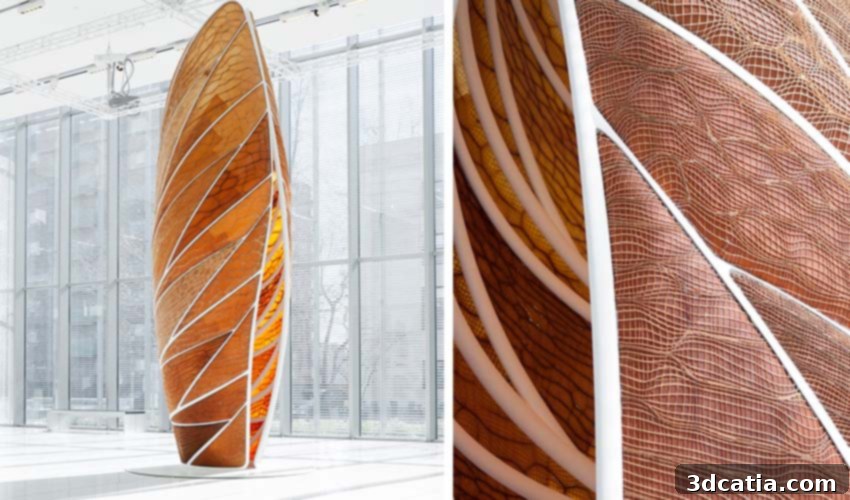
The ‘AguaHoja I’ pavilion stands as a testament to the power of biomaterials and large-scale additive manufacturing. This imposing, honey-colored cocoon structure is intricately composed of some of the most abundant biopolymers found on our planet. These biopolymers, such as cellulose, pectin, and chitin (derived from sources like trees, fruit peels, and insect exoskeletons, respectively), were carefully selected for their inherent structural properties, biodegradability, and sustainable sourcing. The vision for Aguahoja was to create an architectural skin that is not only robust but also responsive to its environment and capable of decomposing naturally, returning to the earth without leaving a harmful footprint. This radical approach challenges conventional building materials and methods, proposing a future where structures can be grown and then naturally reabsorbed by the environment.
Given the colossal size of the Aguahoja structure and its exceptionally complex, organic geometry – which mimics natural growth patterns and structural efficiencies – the selection of the right 3D printer was paramount. Stratasys’ F900 3D printer emerged as the ideal choice due to its industry-leading large building volume and robust FDM (Fused Deposition Modeling) technology. This allowed for the printing of substantial individual components, minimizing the need for numerous smaller parts and streamlining the fabrication process for such a monumental piece. However, the sheer scale and the delicate nature of the biopolymer components meant that the assembly of the structure presented its own unique set of engineering challenges. To overcome this, a number of innovative custom features were also designed and 3D printed. These specialized connectors and interlocking elements were precisely tailored to securely hold each individual component together, ensuring both the structural integrity and the aesthetic continuity of the pavilion.
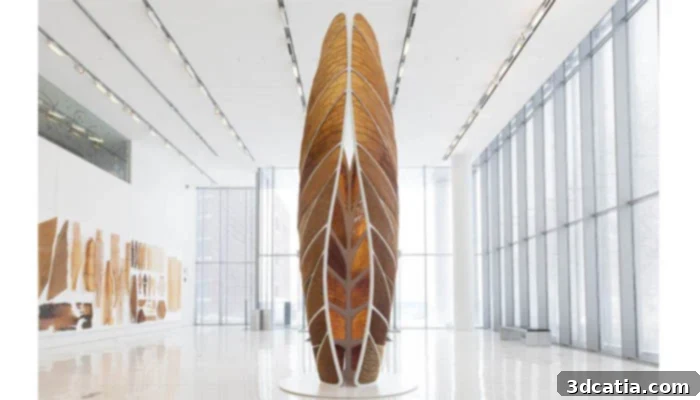
Front View of the Aguahoja Pavilion: A small opening is designed to enable one person to immerse him/herself in the multiscale legibility of both aesthetic and performative design considerations. | Credits: The Mediated Matter Group
Reflecting on this monumental undertaking, Neri Oxman articulated the critical role of Stratasys’ technology: “The support from Stratasys to the Aguahoja project offered my team and I the unique capability to design complex shapes that ensure the structure’s geometric stability, while also faithfully upholding the organic integrity that is central to the project’s theme. The ability to quickly iterate the design throughout the project using 3D printing enabled us to optimize the structure and aesthetics of the pavilion in a way not possible with traditional techniques.” This statement underscores a core tenet of Oxman’s work: the harmonious integration of structural performance with biological inspiration. The agility of 3D printing allowed for rapid prototyping and design refinement, enabling the team to fine-tune both the functional strength and the visual appeal of the pavilion, pushing the boundaries of sustainable architectural design.
The Totem Project: Harvesting Nature’s Pigments for Adaptive Architecture
The second ambitious project, aptly named the ‘Totem,’ delves into an equally fascinating realm: the ability of designers to chemically synthesize and manipulate melanin, often referred to as the ‘pigment of life.’ Melanin, renowned for its vital role in nature – from protecting skin against UV radiation to creating vibrant coloration in various species – possesses a remarkable array of optical, electronic, and structural properties. The Totem project seeks to harness these natural capabilities, proposing an innovative architectural structure that is environmentally responsive. This conceptual design features a melanin-infused, glass-like composite material, engineered to interact dynamically with its surroundings.
The ingenious design of the Totem incorporates a series of intricate channels within the glass-like structure. These channels, which house the various melanin compounds, were precisely 3D printed using a highly advanced transparent digital material from Stratasys. The unparalleled optical clarity and structural integrity of this material were crucial for the project, allowing for the precise containment of the melanin while ensuring that the visual details of the internal components remained perfectly discernible. This fusion of advanced additive manufacturing with groundbreaking material science represents a significant step towards creating active, responsive architectural skins that can adapt to changing environmental conditions, much like biological organisms do.
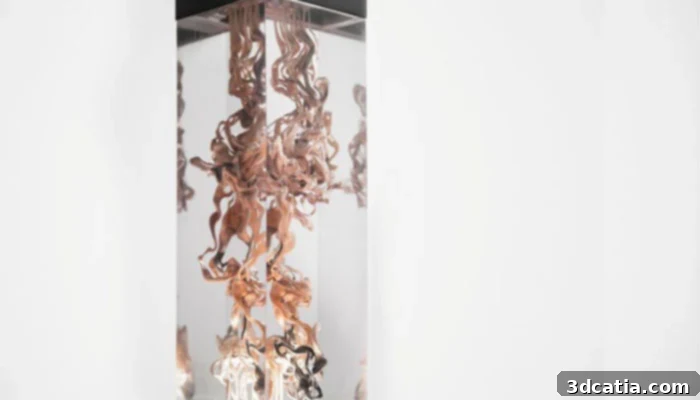
An image of the final Totem piece, which has been 3D printed to include six distinct liquid channels and pockets. Each pocket contains melanin from a different species, from bird to cuttlefish. Produced by Stratasys, Ltd. | Credits: Neri Oxman and The Mediated Matter Group
Neri Oxman further elaborated on the specific demands met by the advanced materials and technology: “One of the key criteria for Totem was the need to securely contain the melanogenic structure without compromising the ability to flawlessly promote every level of visual detail. As a result, we used an advanced transparent 3D printing material that can simulate the clarity of glass, enabling a clear visualization of the internal components and features.” This meticulous attention to detail highlights the project’s scientific rigor and artistic ambition. By incorporating melanin from diverse species – ranging from birds to cuttlefish – into distinct pockets, the Totem not only explores the vast potential of biomaterials but also celebrates the incredible biodiversity and evolutionary adaptation evident in nature’s own palette. This project opens new avenues for material design, demonstrating how biomimicry and advanced manufacturing can lead to the creation of materials that are not just aesthetically pleasing but also performative and inherently sustainable.
The Vision of Mediated Matter: Redefining Design and Manufacturing
The work undertaken by Neri Oxman and The Mediated Matter Group, in collaboration with Stratasys, represents a paradigm shift in how we conceive of design, manufacturing, and architecture. Their approach challenges the conventional industrial paradigm of assembly from discrete parts, advocating instead for a “design-to-production” framework that leverages the growth processes observed in nature. This philosophy, termed “material ecology,” seeks to blur the boundaries between natural and synthetic, material and form, and science and art. By focusing on fundamental material properties and integrating them with digital design tools and advanced fabrication technologies like 3D printing, they are paving the way for a future where products and buildings are not just constructed, but literally grown or synthesized, much like biological organisms.
Stratasys’ role in this visionary endeavor extends beyond merely providing 3D printers. The company’s commitment to material innovation and its robust technological platforms have been instrumental in enabling Oxman’s team to explore complex material composites and geometries that were previously unimaginable. The F900’s capacity for large-scale production and the development of specialized transparent digital materials underscore Stratasys’ position at the forefront of additive manufacturing. This collaboration highlights the critical importance of industry partnerships in pushing the boundaries of scientific research and artistic expression, demonstrating how advanced technologies can serve as powerful tools for addressing complex challenges in sustainability and material innovation.
These projects, Aguahoja and Totem, serve as compelling prototypes for future sustainable design. They inspire new approaches to architecture, product design, and material science, suggesting a future where our built environment is not only more efficient and aesthetically rich but also fundamentally more integrated with natural systems. From developing biodegradable structures that naturally decompose, to creating responsive skins that mimic biological functions, the implications of this work are far-reaching. It offers a glimpse into a world where design is less about imposing form and more about cultivating it, leading to a more harmonious relationship between human creation and the natural world.
You can find more information about these pioneering projects and the broader work of The Mediated Matter Group HERE.
What are your thoughts on this incredible fusion of bio-inspired design and advanced 3D printing technology? Do you believe these projects will shape the future of art, architecture, and sustainable manufacturing? Share your insights and comments below, or join the conversation on our Facebook and Twitter pages! Don’t miss out on the latest advancements and news in the world of 3D printing – be sure to sign up for our free weekly Newsletter, delivered directly to your inbox!