
3D Printing Breakthrough: Columbia University Researchers Grow Hair Follicles to Combat Hair Loss
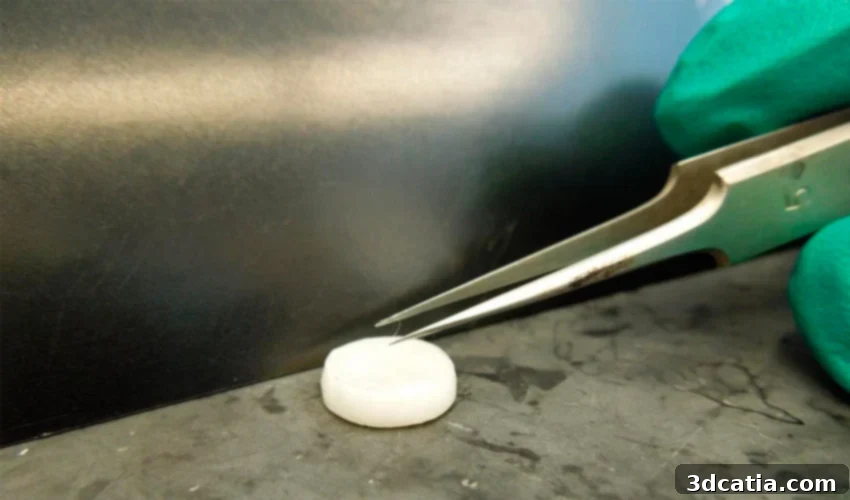
A groundbreaking advancement in regenerative medicine is emerging from Columbia University, where a dedicated team of researchers has successfully utilized the power of 3D printing technology to cultivate human hair follicles. This innovative approach involves creating highly intricate plastic molds, which then serve as ideal environments for growing hair. This development represents a monumental stride for the medical sector, particularly given the historical challenges associated with growing human hair under controlled laboratory conditions. While previous research has explored bioprinting hair directly, the Columbia researchers have pioneered a distinct methodology. Their focus is on 3D printing the precise molds that facilitate and stimulate the natural growth of hair follicles, offering a potentially more accessible and scalable solution.
Hair loss, or alopecia, affects millions worldwide, often leading to significant psychological distress and reduced quality of life. Current treatments, ranging from topical solutions like minoxidil to oral medications such as finasteride and surgical hair transplants, come with their own set of limitations. Hair transplants rely on existing donor hair, meaning they are not always viable for individuals with extensive hair loss or limited donor sites. Furthermore, these procedures can be costly, invasive, and may not always yield the desired density or natural appearance. The ability to grow an unlimited supply of healthy hair follicles in a lab setting could entirely circumvent these issues, revolutionizing the field of hair restoration.
3D Printing Molds: A Novel Strategy to Combat Hair Loss
The research team at Columbia University embarked on their journey by addressing a fundamental biological observation: human dermal papilla cells, which are crucial for hair growth and are typically found at the base of hair follicles, exhibit a marked resistance to proliferation and maintaining their inductive capacity when cultured in standard laboratory conditions. This stands in stark contrast to similar cells from animals like mice or rats, which tend to grow more readily in vitro. This inherent recalcitrance in human cells has historically posed a significant barrier to effective capillary reconstruction and graft procedures.
To ingeniously overcome this hurdle, the researchers engineered a specialized plastic mold. The design of this mold was meticulously crafted to emulate the natural micro-environment that normally sustains and stimulates hair follicle growth within the human body. This biomimetic approach is critical because the complex three-dimensional architecture and cellular interactions within a living tissue are incredibly difficult to replicate. The mold features an array of incredibly fine, microscopic peaks, each approximately half a millimeter in width. These miniature structures are the key; they provide the scaffolding and spatial cues necessary for the dermal papilla cells to retain their critical growth-inducing properties. The inherent precision and flexibility offered by 3D printing technology were absolutely indispensable for fabricating such intricate and minute geometries.
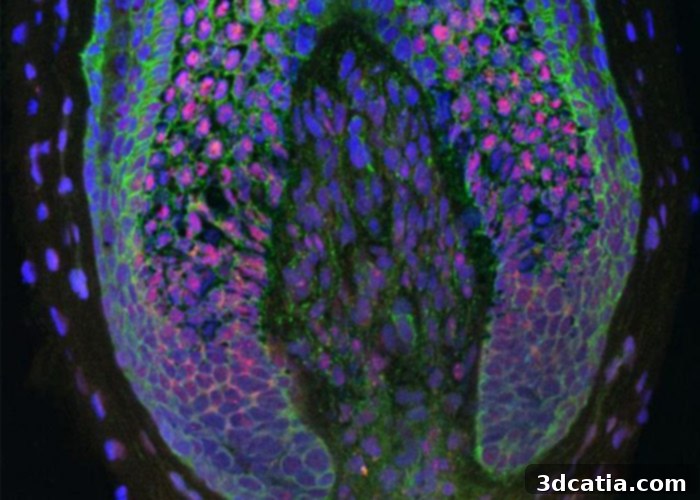
Cross section of a hair follicle | photo Credits: Angela Christiano / Columbia University Irving Medical Center
Angela Christiano, the visionary researcher who spearheaded this pivotal study, highlighted the transformative role of additive manufacturing. “Traditional manufacturing techniques were simply not capable of creating such finely detailed structures with the required precision and consistency. This work has therefore been greatly facilitated by the innovations inherent in 3D printing technology,” she explained. The ability of 3D printers to build complex objects layer by layer, directly from a digital design, allowed the team to achieve the exact micron-scale features essential for mimicking the natural dermal environment that supports hair growth.
The Cultivation Process and Technology Behind the Breakthrough
The methodology developed by the Columbia team is a testament to sophisticated tissue engineering. Following the creation of the specialized 3D-printed molds, the researchers initiated the cell culture process. They carefully positioned the human hair follicle cells, specifically the crucial dermal papilla cells, around the base of the microscopic peaks within the mold. Subsequently, keratin-producing cells – known as keratinocytes – which form the structural bulk of hair, were seeded above these dermal papilla cells. This strategic layering and placement are designed to replicate the natural interactions between these two cell types that are fundamental for healthy hair shaft formation in vivo.
After a meticulous three-week cultivation period, the initial signs of hair growth began to emerge within these engineered molds. This successful outcome demonstrated that the 3D-printed micro-environment effectively prompted the cells to organize and differentiate into nascent hair follicles capable of producing hair shafts. The molds themselves were produced using an accessible FDM (Fused Deposition Modeling) desktop 3D printer, specifically the Sindoh 3DWOX. The choice of an FDM printer underscores the potential for this technology to be scaled and replicated in various research and potentially clinical settings, leveraging readily available and relatively affordable additive manufacturing equipment.
The material used for 3D printing these molds would have been a biocompatible polymer, carefully selected to ensure it does not inhibit cell growth and can withstand the conditions of cell culture. The precision of FDM printing allowed for the creation of features small enough to influence cellular behavior at a microscopic level, guiding the cells to form organized structures that mimic natural hair follicles. This represents a significant leap forward compared to previous attempts that often struggled with maintaining the viability and inductive capacity of human dermal papilla cells over extended periods.
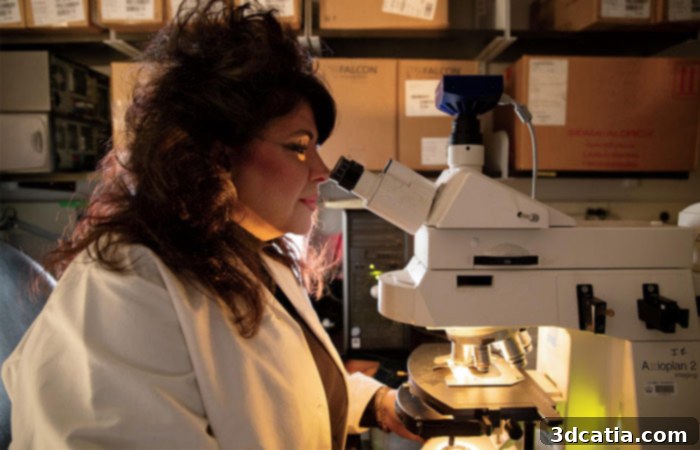
Angela Christiano leads the research work
Future Implications: Unlimited Hair for Transplants and Drug Discovery
The potential applications and broader impact of this research are truly transformative. Angela Christiano further elaborated on the long-term vision for this technology: “We can create a kind of ‘hair farm,’ that is, a network of hair that is properly designed and shaped so that it can be transplanted into the scalp of the same patient.” This vision addresses the most pressing limitation of current hair transplant procedures: the scarcity of donor hair. By cultivating an endless supply of genetically identical hair follicles from a small biopsy of a patient’s own cells, the procedure becomes autologous, virtually eliminating the risk of immune rejection and significantly expanding the eligibility for hair restoration. This means that individuals who previously had insufficient donor hair – such as those with extensive baldness, severe burns, or certain types of alopecia – could now be candidates for successful hair regrowth.
The impact extends beyond mere cosmetic enhancements. “Hair restoration thus becomes much more accessible for all patients, male or female. We will no longer be limited by the number of hair donors – as a general rule, it takes about 2000 healthy follicles to make a successful transplant,” Christiano stated. This advancement promises a future where hair transplants are not only more effective and natural-looking but also potentially more affordable due to scaled production and reduced surgical complexity. Imagine a future where a few hundred cells from a patient could be expanded to generate thousands of new hair follicles, ready for transplantation.
Moreover, the utility of these artificially grown follicles extends far into the pharmaceutical industry. These engineered hair follicles provide a highly accurate and physiologically relevant model for drug discovery and testing. Currently, much of the research into new hair growth drugs relies on animal models or less sophisticated cell cultures, which often fail to accurately predict human responses. The availability of functioning human hair follicles in a lab setting will enable pharmaceutical companies to more efficiently screen potential new drugs for hair growth, test their efficacy, and understand their mechanisms of action, potentially accelerating the development of novel and more effective treatments for various forms of hair loss, including androgenetic alopecia and alopecia areata.
This research represents a significant step towards a future where hair loss could become a treatable condition for everyone. By overcoming the biological barriers to human hair follicle regeneration in vitro, Columbia University researchers have opened new avenues for both therapeutic interventions and scientific exploration. The integration of 3D printing technology with advanced cell culture techniques positions this work at the forefront of regenerative medicine, promising hope for millions struggling with hair loss globally. You can find more information about this study HERE.
What are your thoughts on this groundbreaking research utilizing 3D printing to potentially put an end to hair loss? Do you foresee this technology becoming widely available for hair restoration in the near future? We invite you to share your insights and comments below, or engage with us on our Facebook and Twitter pages! For those eager to stay abreast of the latest innovations and news in the rapidly evolving world of 3D printing, remember to sign up for our free weekly Newsletter, delivering all essential updates straight to your inbox.