

Revolutionizing Anti-Counterfeiting: Advanced 3D Printing Technology for Unforgeable Security Labels
The global market has long been plagued by the pervasive issue of counterfeit goods, a multi-billion dollar illicit trade that poses significant economic, ethical, and safety challenges. According to alarming data from the OECD in 2019, the trade in fake products already constituted a substantial 3.3% of all world trade, and this figure has only shown a steady upward trajectory. From luxury fashion items to critical pharmaceuticals and intricate electronic components, the prevalence of these counterfeit articles has reached a point where their sophistication often makes them nearly indistinguishable from genuine products, even to trained eyes.
This burgeoning crisis not only inflicts severe financial losses upon legitimate businesses and entire economies but also erodes consumer trust and, in certain sectors, presents grave risks to public health and safety. Recognizing the urgent need for a more robust defense against this relentless tide of imitation, a visionary research team at the University of Hong Kong (HKU) has embarked on a pioneering project. Their focus is on developing an exceptionally precise additive manufacturing process designed to revolutionize the detection and removal of counterfeit products from circulation. This innovative approach promises a new era of brand protection and supply chain integrity.
The Global Scourge of Counterfeit Goods and Its Economic Impact
The economic ramifications of counterfeit goods are staggering and far-reaching. Beyond the direct financial hit to companies whose intellectual property is infringed upon, the illicit trade leads to lost tax revenues for governments, decreased investment in research and development, and job losses in legitimate industries. Industries such as luxury goods, automotive parts, electronics, pharmaceuticals, and even food products are particularly vulnerable. The “luxury brands” sector is perhaps the most visible victim, with counterfeit handbags, watches, and apparel flooding markets worldwide, causing billions in losses annually. However, the problem extends far beyond mere fashion; fake airplane parts can compromise aviation safety, counterfeit medicines can be ineffective or even harmful, and bogus electronics can pose fire hazards or simply fail, costing consumers significant money and trust while endangering lives.
The ease with which modern counterfeits are produced and distributed, often leveraging complex global supply chains and anonymous online marketplaces, makes combating this issue incredibly complex. Counterfeiters are becoming increasingly sophisticated, employing advanced manufacturing techniques to mimic original products so closely that traditional authentication methods struggle to keep pace. This growing challenge underscores the critical demand for breakthrough technologies that can offer a definitive, unforgeable, and scalable means of product verification. It is a battle that requires continuous innovation to protect consumers, preserve brand integrity, and safeguard global trade.
Limitations of Traditional Anti-Counterfeiting Measures
In an effort to protect their valuable products and intellectual property, companies have deployed a variety of anti-counterfeiting measures. These often include visible security features like holograms, unique serial numbers, watermarks, and security threads, as well as invisible ones like UV inks or micro-text. More recently, digital solutions such as Radio-Frequency Identification (RFID) tags and QR codes have gained popularity, aiming to link physical products to digital verification systems. However, many of these existing security concepts, while offering some level of protection, possess inherent vulnerabilities that skilled counterfeiters can exploit with relative ease.
Take, for instance, the widely adopted QR code. While convenient for consumers and businesses alike, their effectiveness as a robust anti-counterfeiting tool is often limited. Due to their relatively simple data encryption capacity and the widespread availability of printing technology, QR codes can be reproduced with alarming ease. A counterfeiter can simply copy a genuine QR code or generate a look-alike that directs consumers to a fake verification site, leading to misauthentication. This vulnerability highlights a fundamental weakness in many current systems: if the security feature itself can be easily replicated or circumvented, its ability to protect against fakes is severely compromised. It is precisely this critical gap in security that Dr. Ji Tae Kim, a leading expert in the mechanical engineering department at HKU and the head of the pioneering research team, aims to bridge with a revolutionary 3D printing process.

Dr. Ji Tae Kim (left) and Dr. Jihyuk Yang (right) (photo credits: HKU)
Introducing HKU’s Innovative 3D Printed Polarization-Encoded Anti-Counterfeiting Labels
Dr. Kim’s team has devised a novel method to detect and deter counterfeit products by utilizing a sophisticated 3D printing process to produce unique polarization-encoded anti-counterfeiting labels. This advanced technology moves beyond the limitations of flat, two-dimensional security features, offering a multi-layered approach to product authentication that is exceedingly difficult to replicate. The core innovation lies in embedding highly complex, unforgeable information directly into the physical structure of a tiny, three-dimensional label, leveraging the intricate properties of specific materials. This approach promises to deliver a new standard in brand protection, making it significantly harder for counterfeiters to operate.
Advantages of a 3D Label Versus a 2D Label to Identify Counterfeit Goods
The shift from a conventional 2D label to a sophisticated 3D label is not merely about adding an extra physical dimension; it fundamentally transforms the nature of the digital information that can be embedded and, crucially, the inherent complexity required to forge or tamper with it. In their groundbreaking research, meticulously detailed in a paper titled “Three-Dimensional Printing of Dipeptides with Spatioselective Programming of Crystallinity for Multilevel Anticounterfeiting,” the HKU team employed diphenylalanine (FF) as the foundational material. This ingenious choice allowed them to precisely 3D print dipeptides, which are fundamental chemical compounds composed of two amino acid residues. The researchers specifically chose dipeptides for their exceptional and unique intrinsic properties, which are absolutely crucial for this advanced anti-counterfeiting application.
Dr. Jihyuk Yang, the distinguished lead author of this pivotal study, highlighted two particularly important characteristics of dipeptides: their piezoelectricity and optical birefringence. These remarkable properties stem directly from their intricate crystalline nature. Piezoelectricity refers to the material’s ability to generate an electric charge in response to mechanical stress, offering a potential avenue for physical interaction. More critically for this application, optical birefringence describes how light splits into two components with different refractive indices when passing through the material, depending on its polarization. By meticulously controlling these properties at a microscopic level during the advanced 3D printing process, the HKU team can create security features that are virtually impossible for counterfeiters to reverse-engineer or reproduce using conventional, widely available methods, thus establishing a new benchmark in secure product authentication.
The Ingenuity of Nature-Driven Molecular Self-Assembly for High-Density Data Encryption
Dr. Ji Tae Kim elaborated on the intricate procedure of this novel 3D printing method, underscoring the pivotal role of nature-driven molecular self-organization. This remarkable natural phenomenon is meticulously controlled by the research team to enable the precise printing of multi-part 3D FF micropixels. The entire research endeavor places significant emphasis on these tiny micropixels, which are endowed with highly programmed crystallinity. This programmatic control over crystallinity is the undisputed key to achieving ultra-high-density data encryption, making these innovative labels exceptionally secure and virtually impenetrable to replication.
As Dr. Kim himself explained, the profound innovation lies in the synergistic combination of advanced 3D printing techniques with the inherent power of nature-driven molecular self-assembly. He stated, “Our new 3D printing method combined with nature-driven molecular self-assembly can print multi-segmented 3D FF micro-pixels with programmed crystallinity for high-density data encryption. By utilising different responses of the amorphous and crystalline segments to polarised light, a tiny single 3D pixel can encrypt a multi-digit binary code consisting of ‘0’ and ‘1’. The information capacity can be increased to 211 with a single eleventh-segmented freestanding pixel on a tiny 4 µm2 area which is 1000 times smaller than a hair strand.” This remarkable feat of engineering means that an incredibly small physical space, almost imperceptible to the naked eye, can hold an immense amount of encrypted data. This extreme miniaturization and complex information encoding render the labels virtually impossible to replicate or decipher without the specific knowledge and sophisticated tools required for their creation and verification, offering an unprecedented level of security.
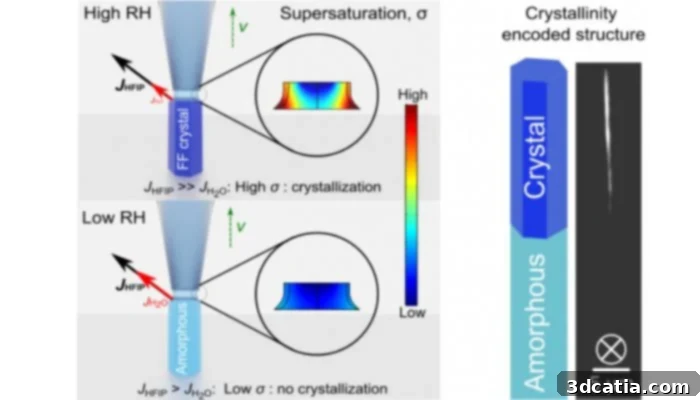
The scheme for 3D printing polarization-encoded 3D micropixels (photo credits: HKU).
Future Implications and the Promise of Unprecedented Security
The implications of this breakthrough 3D printing process are vast and far-reaching, promising to reshape the landscape of product authentication. The HKU team is highly confident that their innovation will significantly bolster security measures and enhance the prevention of counterfeiting across numerous industries in the foreseeable future. This cutting-edge technology offers the unparalleled advantage of allowing security labels to be fully customized and produced on-demand, anywhere and at any time. This exceptional flexibility is crucial for adapting to rapidly evolving threats and integrating seamlessly into existing supply chain logistics, ensuring robust information security from the point of manufacturing all the way to the end-consumer.
Imagine a future where every high-value product, from luxury watches and designer apparel to critical medical devices and essential automotive parts, carries an invisible, unforgeable 3D printed tag. These tags, embedded with high-density data through precise control of molecular crystallinity and polarization response, could be scanned by specialized devices to instantly authenticate a product’s origin and verify its legitimacy. This would provide an ironclad defense against illicit trade, protecting brands from revenue loss and reputational damage, and safeguarding consumers from dangerous or substandard goods. The ability to program crystallinity and utilize polarized light interaction provides a level of complexity that far surpasses current security features, making these labels incredibly resilient to even the most determined and technologically advanced counterfeiting attempts. This research represents a significant leap forward in additive manufacturing’s application, positioning it as a frontline tool in the global fight against intellectual property theft and consumer deception.
This pioneering project by HKU not only addresses a critical global challenge but also showcases the immense potential of advanced materials science combined with cutting-edge 3D printing technology. As counterfeit markets continue to grow in sophistication and scale, such innovative solutions are vital for safeguarding economic stability, promoting fair trade, and protecting consumers worldwide. The team’s work lays a foundation for future developments in secure product identification and opens new avenues for exploring the capabilities of additive manufacturing in security applications. To delve deeper into the specifics of HKU’s project and the scientific details, the full research paper is available HERE.
What are your thoughts on this groundbreaking 3D printing process designed to combat counterfeiting? We invite you to share your opinions and insights in the comments section below or join the conversation on our LinkedIn, Facebook, and Twitter pages! Don’t miss out on the latest advancements in additive manufacturing – remember to sign up for our free weekly Newsletter here to get all the top 3D printing news delivered straight to your inbox! You can also find an extensive collection of our videos and interviews on our dedicated YouTube channel.
*Cover Photo Credits: MDR