
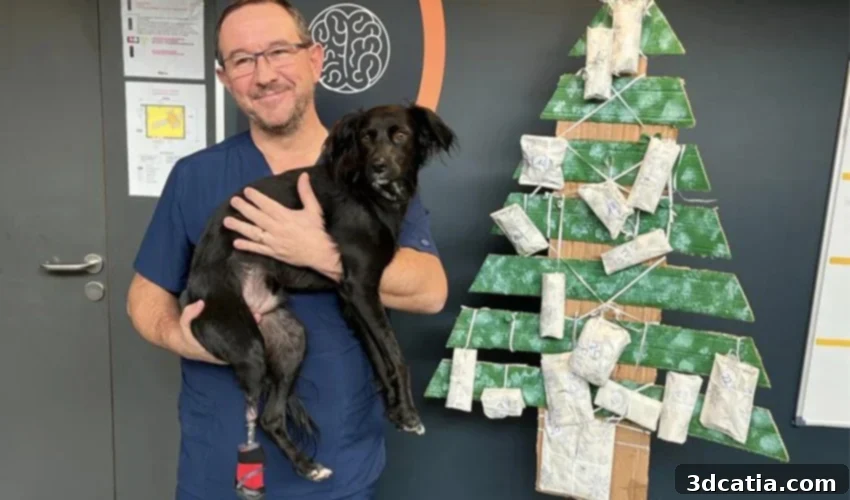
Revolutionizing Veterinary Care: The Life-Changing Power of 3D Printed Prosthetics
Additive manufacturing, commonly known as 3D printing, has emerged as a transformative force across numerous industries, with its impact on medicine being particularly profound. Among its many applications in healthcare, the creation of prostheses stands out as a critical advancement. The World Health Organization (WHO) estimates that a staggering 30 million people worldwide are in need of these life-altering devices. This significant demand underscores the immense importance of efficient, accessible, and highly effective manufacturing methods. Unlike traditional production techniques, 3D printing offers unparalleled advantages for prosthetics, enabling a level of customization previously unimaginable. These devices can be precisely tailored to fit individual patients, enhancing comfort, functionality, and overall integration. Furthermore, 3D-printed prostheses are often more cost-effective to produce and can be manufactured locally, significantly improving accessibility in various regions.
While the benefits for human patients are widely recognized, it’s not just people who can gain immensely from the innovations in 3D-printed prosthetics. In the rapidly evolving field of veterinary medicine, countless animals find themselves in need of prosthetic limbs due to accidents, congenital conditions, or disease. The ability to provide custom-fitted, durable, and affordable prostheses can dramatically improve an animal’s quality of life, allowing them to regain mobility, play, and interact with their families. Today, we delve into an inspiring case study from France, where a dog named Lucky received a cutting-edge 3D-printed prosthesis following a devastating car accident, showcasing the incredible potential of this technology in animal care.
Lucky’s Inspiring Journey: A Second Chance at Mobility
Lucky, a resilient four-legged companion, had already faced considerable adversity long before his unfortunate accident. As a young puppy, he was tragically abandoned by his owners, a common and heartbreaking fate for many animals. Thankfully, he was rescued and taken in by La Société Protectrice des Animaux (SPA), a dedicated French animal welfare organization. After receiving care and a chance at a new beginning, Lucky was finally adopted by a loving family in September 2021, bringing joy and companionship into their lives. However, fate dealt another cruel blow when, one day, a neighbor accidentally ran over Lucky’s paw. The severity of the injury necessitated immediate medical attention, leading his family to admit him to the prestigious Sirius Clinic, a specialized facility renowned for its expertise in complex surgeries and advanced veterinary treatments.
Upon Lucky’s arrival at the Sirius Clinic, his owners were naturally distraught and braced themselves for difficult news. The initial assessments suggested two primary courses of action: either a full amputation of the injured paw, which would drastically alter Lucky’s life, or an attempt to heal the wound through a lengthy, often painful, and prohibitively expensive conventional treatment regimen. Both options presented significant challenges, both emotionally for the family and physically for Lucky. However, a glimmer of hope emerged when a forward-thinking veterinarian at the clinic proposed a groundbreaking alternative. This innovative approach involved the direct grafting of a custom-designed, 3D-printed prosthesis onto Lucky’s existing bone, offering the possibility of preserving much of his limb and restoring natural mobility.
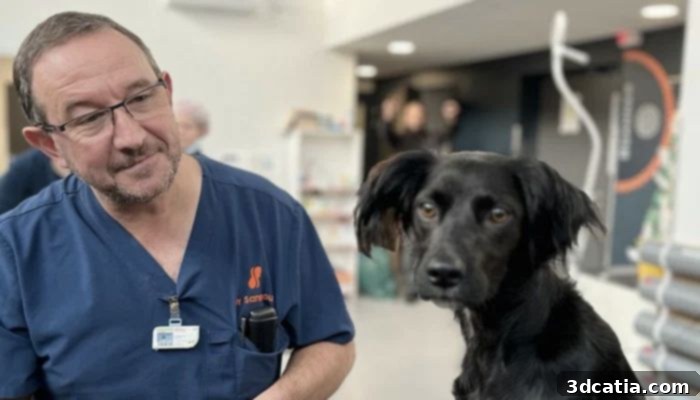
Dr. Frédéric Sanspoux, the veterinarian in charge of Lucky (photo credit: Sirius Clinic)
The Advanced Process of Osseointegrated Prosthetics
Pioneering Veterinary Solutions at Sirius Clinic
The Sirius Clinic has been at the forefront of innovative veterinary medicine, particularly in the realm of advanced surgical solutions. In 2020, it proudly became the first institution in France to successfully implant prostheses on amputated body parts in veterinary patients, marking a significant milestone in animal healthcare. Dr. Frédéric Sanspoux, a highly skilled veterinarian at the specialty clinic, was instrumental in Lucky’s treatment and eloquently described the intricate procedure. “We begin with a complete, high-resolution scan of the animal,” Dr. Sanspoux explained. This initial step is crucial for capturing the precise anatomy of the healthy limb, which then serves as a critical reference. “We use the shape of the healthy limb as a guide to accurately recreate the amputated leg in a kind of ‘mirror effect’,” he continued. This mirroring technique ensures that the prosthetic limb will be a perfect anatomical and functional match for the animal, optimizing balance and natural movement.
The Crucial Role of Osseointegration
The ultimate objective of such a sophisticated procedure is to enable the animal to regain the full range of mobility it possessed prior to the injury. To achieve this, the prosthesis must be integrated seamlessly and robustly into the bone structure. This is where the remarkable biological process known as ‘osseointegration’ comes into play. Dr. Sanspoux elaborated on this vital phenomenon: “There is a phenomenon called ‘osseointegration,’ which means that the bone ‘colonizes’ part of the prosthesis so that it becomes an integral part of the animal’s body.” Osseointegration involves the direct structural and functional connection between living bone and the surface of a load-bearing artificial implant. For Lucky’s prosthesis, this meant designing the implant with specific surface characteristics and using biocompatible materials that encourage bone cells to grow onto and into the prosthetic device, creating a stable and permanent attachment without the need for additional mechanical fasteners that could cause irritation or infection.
Collaboration and Cost Considerations
Executing such a complex and cutting-edge procedure requires a collaborative effort between various specialized entities. The Sirius Clinic partners with leading technology companies to bring these innovative solutions to life. For Lucky’s case, Ennoïa, a company specializing in advanced computational design, was responsible for creating the precise 3D computer model of the prosthesis based on the initial scans and the “mirror effect” principle. Following the digital design phase, the physical prosthesis itself was meticulously manufactured by 3D Med Labs, a company known for its expertise in medical-grade 3D printing. The surgical procedure, while groundbreaking and life-changing, came with a considerable cost of €4,000. However, in a testament to the increasing recognition of advanced veterinary care, this substantial sum was fully reimbursed by Lucky’s owners’ pet insurance company, making this transformative treatment accessible to them.
Recovery and Lasting Impact
While the promise of osseointegrated prosthetics is immense, there are inherent risks associated with such invasive surgical procedures, particularly the potential for severe inflammatory and infectious complications. These post-operative challenges can often hinder recovery or even lead to implant failure. Fortunately for Lucky, his surgery and subsequent recovery were remarkably smooth, and he was spared from any significant complications. His body integrated the 3D-printed prosthesis exceptionally well, allowing him to begin walking on his new limb just four months after the operation. This rapid and successful recovery highlights not only the efficacy of the 3D printing technology and the surgical skill but also Lucky’s incredible resilience and will to heal.
Today, Lucky is not merely a patient; he has become a beloved mascot for the Sirius Clinic. His journey serves as a powerful testament to the advancements in veterinary medicine and the life-changing potential of 3D-printed prosthetics. He embodies hope for countless other animals who might benefit from similar innovative treatments. Lucky’s story inspires veterinarians, researchers, and pet owners alike, demonstrating that even in the face of severe injury, a full and active life is often within reach thanks to cutting-edge technology.
The Broader Implications of 3D Printing in Veterinary Medicine
Lucky’s case is a prime example of a growing trend in veterinary medicine. The adoption of 3D printing is rapidly expanding beyond prosthetics to include custom surgical guides, anatomical models for pre-surgical planning, and even complex implants for various bone and joint conditions. This technology is democratizing access to highly customized medical solutions for animals, ensuring better fit, improved patient comfort, and often, more successful outcomes. The ability to create patient-specific devices means that veterinarians can address unique anatomical challenges that would be impossible with off-the-shelf components. Furthermore, the iterative design process allowed by 3D printing enables specialists to fine-tune designs digitally before physical production, minimizing errors and reducing surgical time.
The cost-effectiveness and localized production capabilities of 3D printing also signify a major step forward. For many pet owners, the financial burden of advanced medical procedures can be a significant barrier. By streamlining production and utilizing materials efficiently, 3D printing helps make these life-saving treatments more accessible. This not only benefits individual animals but also pushes the entire field of veterinary care forward, encouraging further research and development into new materials and applications. As the technology continues to evolve, we can anticipate even more sophisticated and integrated solutions that will enhance the quality of life for companion animals around the globe, turning once impossible scenarios into heartwarming success stories like Lucky’s.
What are your thoughts on Lucky’s incredible journey and the potential of 3D printed prosthetics in animal care? We invite you to share your comments below or engage with us on our LinkedIn, Facebook, and Twitter pages! Don’t miss out on the latest advancements in additive manufacturing—sign up for our free weekly Newsletter here to receive top 3D printing news directly in your inbox. You can also explore all our insightful videos on our YouTube channel.
*Cover photo credit: Sirius Clinic