
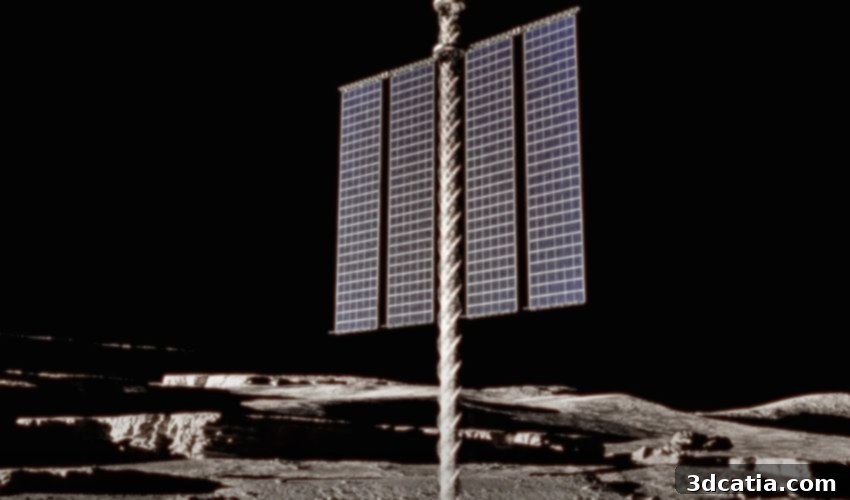
Pioneering Lunar Power: How a 3D-Printed Solar Tower is Revolutionizing Sustainable Moon Bases
The ambitious quest for a sustainable human presence beyond Earth, particularly on the Moon and Mars, hinges critically on establishing robust infrastructure. This foundational infrastructure includes self-sufficient power generation and reliable communication networks, which are vital components for any long-term extraterrestrial outpost. Recognizing these immense challenges, Foster + Partners, a distinguished British architecture firm, has embarked on a visionary collaboration with NASA and the US-based 3D printing specialist Branch Technology. Together, they have developed a groundbreaking concept: a 50-meter-high solar tower designed for autonomous construction on the lunar surface using state-of-the-art 3D printing techniques. This innovative project is not just about a singular structure; it represents a significant leap towards enabling permanent, self-sustaining human settlements in the cosmos.
Foster + Partners’ commitment to pioneering extraterrestrial architecture extends deeply into various research initiatives aimed at shaping our off-world future. The firm is also a pivotal member of a consortium founded by the European Space Agency (ESA), dedicated to exploring and validating the possibilities of additive manufacturing for constructing lunar dwellings. This dual involvement underscores their leading role in conceptualizing and designing the future of space habitation. Branch Technology, on the other hand, brings specialized expertise in large-scale additive manufacturing. They are renowned for developing advanced 3D printing systems that are uniquely suited for the harsh and demanding conditions of lunar applications. This powerful collaboration marries architectural innovation with cutting-edge manufacturing capabilities, setting a new standard for space infrastructure development.
The genesis of this groundbreaking solar tower concept lies within the prestigious Small Business Innovation Research (SBIR) program, an initiative championed by the National Aeronautics and Space Administration (NASA) to foster technological breakthroughs crucial for deep space exploration. Currently in an active development phase, the project offers a tangible and exciting glimpse into humanity’s projected future in space. For those eager to witness this vision firsthand, the “From Earth to Space and Back” exhibition at the Kennedy Center provides an unparalleled opportunity. Running until April 13, 2025, the exhibition captivates visitors with meticulously crafted scale models, intricate 3D-printed structures, and immersive films, inviting audiences of all ages to imagine a vibrant and thriving future for human civilization on the lunar surface or the challenging Martian landscape.
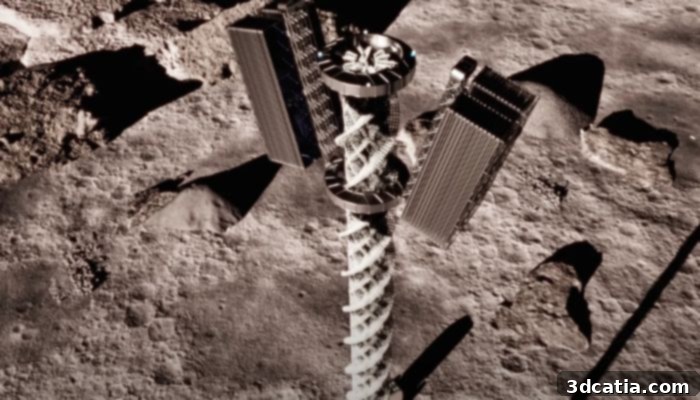
The design resembles a signpost and is 50 meters long in total. The fold-out solar panels are used to generate energy.
The primary objective of this revolutionary 3D-printed solar tower is to provide future Moon bases with an essential and continuous energy supply, alongside performing critical communication tasks. Envisioned as a permanent energy source, it will be indispensable for powering scientific missions, maintaining operational equipment, and ultimately supporting long-term human settlements on the Moon. Foster + Partners underlines that this solar tower is not an isolated project but rather an integral component of a much grander strategic vision for comprehensive lunar infrastructure. This expansive plan also encompasses the development of habitable, 3D-printed structures, concepts for which the firm has already presented in the past, demonstrating a holistic approach to building a self-sufficient and thriving lunar outpost.
What truly elevates this project to a remarkable status is its innovative approach to both design and construction methodologies. The 3D-printed solar tower is fundamentally structured around a spiral-shaped, additive-manufactured framework, from which an array of specialized solar panels are designed to gracefully unfold. These panels are strategically positioned to deploy from the tower’s uppermost platform, optimizing their exposure to direct sunlight for maximum energy generation efficiency, critical for lunar operations. A key technological breakthrough lies in the structure’s capability for autonomous construction. This is a particularly vital aspect for extraterrestrial infrastructure projects, where the logistical complexities, inherent risks, and prohibitive costs of extensive human presence make continuous human involvement impractical or impossible. Autonomous construction offers unparalleled advantages in terms of efficiency, safety, and scalability, paving the way for rapid and reliable infrastructure deployment in the unforgiving environments of space.
Additive manufacturing, more commonly known as 3D printing, presents a myriad of compelling benefits that are particularly transformative for constructing infrastructure in space. These advantages are crucial for making lunar and Martian colonization economically viable and operationally effective:
- In-Situ Resource Utilization (ISRU): One of the most significant benefits is the ability to directly utilize local extraterrestrial resources. For lunar construction, this means harnessing regolith – the layer of loose dust, soil, and fragmented rock that covers the Moon’s surface. By processing and shaping this readily available indigenous material, the project dramatically reduces the need to transport heavy construction materials from Earth. This approach leads to monumental cost savings and significantly decreases mission complexity, transitioning from a dependency on Earth-supplied resources to a self-sufficient, “build with what you find” paradigm.
- Reduced Transportation Costs and Mass: The cost of launching payloads into space is astronomically high, often tens of thousands of dollars per kilogram. Minimizing the mass that needs to be transported from Earth, especially for bulky structural components, translates into massive economic efficiencies. 3D printing allows for optimized designs that use less material while maintaining structural integrity, further reducing launch mass and making large-scale projects more feasible.
- Autonomous and Robotic Construction: As highlighted, 3D printing perfectly facilitates automated construction processes. Robotic systems, guided by pre-programmed instructions, can operate continuously and precisely in environments too hazardous, labor-intensive, or geographically remote for human crews. This ensures consistent quality, rapid deployment, and significantly enhances safety for human explorers by reducing their exposure to dangerous conditions.
- Design Freedom and Optimized Geometries: Additive manufacturing provides an unprecedented level of design freedom, enabling the creation of complex, organic geometries that would be impossible or prohibitively expensive to produce using traditional manufacturing methods. The spiral structure of the solar tower is a prime example, designed not only for structural integrity but also for efficient deployment and optimal energy capture in the unique lunar environment. This flexibility allows for truly optimized structures tailored to specific extraterrestrial challenges.
- Minimized Waste Production: Additive manufacturing inherently operates on a “material-on-demand” principle, depositing material only where it is needed. This results in significantly less waste compared to subtractive manufacturing processes. In closed-loop, resource-scarce environments like the Moon or Mars, a zero-waste or minimal-waste approach is not just an primary advantage but a critical necessity for long-term sustainability and resource management.
Norman Foster, the distinguished founder and CEO of Foster + Partners, eloquently articulates the profound evolution from imaginative dreams to present-day engineering realities. He explained, “The science fiction fantasies and inspirations of my youth are the project realities of today. Designing for space is about pushing the boundaries of innovation. The challenges we face in creating sustainable habitats on the Moon or Mars have inspired groundbreaking solutions for zero waste and zero emissions buildings on Earth. The technologies and materials developed for space exploration can revolutionize how we build and live in harsh climates, making our planet more resilient and sustainable.” Foster’s powerful statement underscores a crucial dual narrative: the extreme demands and constraints of space design serve as a potent catalyst for unparalleled innovation. The solutions engineered for extraterrestrial survival, such as principles of resource efficiency, waste reduction, and resilience, offer invaluable lessons and direct applications for addressing pressing global challenges, including climate change and sustainable urban development on Earth. His visionary perspective seamlessly connects the ambitious frontiers of space exploration with the immediate and vital needs of our home planet, demonstrating how cosmic endeavors can profoundly drive terrestrial progress and foster a more sustainable future for all.

The concepts of the 3D-printed settlements for the moon and Mars, which are built like capsules, can also be viewed at the exhibition in the Kennedy Center
Further enriching this futuristic vision, the exhibition at the Kennedy Center also prominently features detailed conceptual designs for 3D-printed lunar and Martian settlements. These innovative designs, often resembling self-contained capsules, exemplify ingenious solutions for creating livable and sustainable spaces under the most extreme extraterrestrial conditions. They integrate advanced life support systems, robust radiation shielding, and optimized internal layouts to ensure the well-being, comfort, and productivity of human inhabitants in alien environments. This comprehensive display perfectly complements the solar tower concept by presenting a holistic picture of what life beyond Earth could truly entail, moving beyond mere survival to the prospect of thriving human presence on other celestial bodies. It’s a compelling glimpse into the architectural ingenuity required for enduring space colonization.
The coming years are undoubtedly poised to witness a significant acceleration in the integration and implementation of advanced 3D printing technology for space applications. The 3D-printed solar tower, a collaborative triumph born from the synergy between NASA, Foster + Partners, and Branch Technology, offers a compelling and inspiring preview of what sustainable life on the Moon, and potentially Mars, could realistically look like. This project powerfully illustrates how innovative approaches to energy supply and critical infrastructure are absolutely central to realizing long-term space colonization and human expansion beyond Earth. The “From Earth to Space and Back” exhibition at the Kennedy Center plays a pivotal role in making these ambitious scientific and engineering concepts tangible and profoundly inspiring to a broad public audience, effectively transforming abstract future goals into accessible and exciting possibilities. As this dynamic partnership continues to evolve and push the boundaries of what is conceivable, the global community eagerly anticipates the remarkable breakthroughs and tangible progress it will undoubtedly bring forth in the ongoing journey of space exploration.
Irene Gallou, a Senior Partner at Foster + Partners, beautifully encapsulates the enduring dedication and collaborative spirit inherent in these visionary projects. She concludes, “For over a decade, we have been working with the latest technologies – and industry-leading collaborators – to design extra-terrestrial habitats and explore opportunities for life in space. The Kennedy Center festival is an incredible occasion to showcase this work, which has the potential to transform the way we live. We hope that visitors will be inspired to think creatively and consider new possibilities for an alternative future.” Her statement not only highlights the firm’s long-term commitment and strategic partnerships but also emphasizes the profound, transformative potential of their work – not solely for space, but for fundamentally altering human existence and our perception of sustainable living. By inviting creative thought and encouraging visitors to ponder alternative futures, the exhibition and the project itself serve as powerful catalysts for innovation and aspiration, reminding us that the boundaries of what’s possible are continually expanding, both on Earth and beyond.
You can find out more about the Foster + Partners exhibition HERE and if you are interested in the lunar colonization project, you can click HERE. If you want to see how the tower’s solar panels unfold, don’t miss this video below:
What do you think of this pioneering project and the innovative 3D-printed solar tower? How do you envision the future of lunar and Martian settlements with such advancements in additive manufacturing? Let us know in a comment below or on our LinkedIn, Facebook, and Twitter pages! Don’t forget to sign up for our free weekly Newsletter here, the latest 3D printing news straight to your inbox! You can also find all our videos on our YouTube channel. You can also find more news in the aerospace and defense sector HERE.
*All Photo Credits: Moos & Fog