
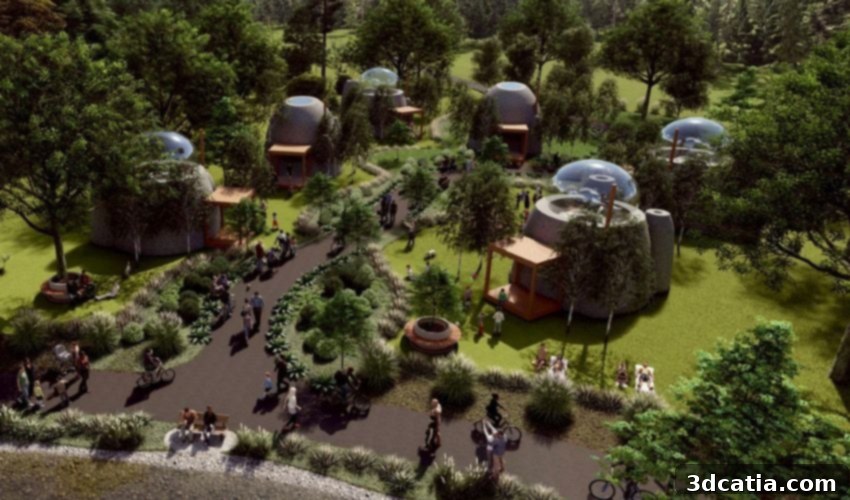
Dubbo Pioneers Sustainable Tourism: Australia’s First 3D Printed Eco-Holiday Park Revolutionizes Construction
A groundbreaking initiative is taking shape in Dubbo, Australia, promising to redefine the future of tourism and construction. Plans are well underway for the creation of Australia’s first-ever 3D printed holiday park, an ambitious project that will see a collection of innovative 3D-printed houses, modern public facilities, and a dedicated holiday camp featuring between 50 and 100 cabins. This visionary development will leverage the power of five state-of-the-art, large-scale 3D printers, pushing the boundaries of additive manufacturing in the built environment. Beyond its innovative construction method, this landmark holiday park is fundamentally rooted in an eco-centric design philosophy. Each cabin and structure is meticulously engineered not only to endure Australia’s often-harsh weather conditions but also to boast exceptional thermal stability and long-term durability, ensuring both comfort for guests and minimal environmental impact.
The pioneering force behind this project is Contour3D, an Australian 3D printing company with a clear vision: to position Australia at the forefront of additive manufacturing for the construction industry. Contour3D is no stranger to innovative building; they have successfully completed other notable projects, including a contemporary ‘granny flat’ in Sydney. However, the Dubbo holiday park represents their most significant undertaking yet, being the first large-scale development explicitly designed for the tourism sector. The choice of Dubbo, a vibrant city in New South Wales, is highly strategic. Nestled in the picturesque Great Western Plains region, Dubbo is a popular tourist destination, primarily renowned for the iconic Taronga Western Plains Zoo. The new 3D printed holiday park is strategically located to capitalize on this appeal, stretching across an expansive 12 hectares directly opposite the zoo. The inspiration for selecting Dubbo came directly to Contour3D CEO, Nick Holden, during a family holiday in the region, recognizing its immense potential for such a unique development. Given the sheer scale and scope of the project, specialized machinery is essential; the colossal 3D printers destined for the site stand an impressive 16 meters in height and span 25 meters in length, capable of constructing robust structures with unparalleled precision and speed.
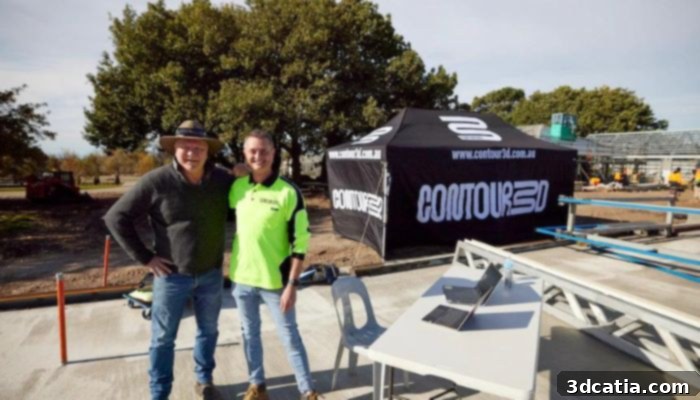
TV presenter Scott Cam (left) meets with Nick Holden on the site of 3D printed home build.(Photo credit: Contour3D)
The local government in the Dubbo region has enthusiastically embraced and strongly encourages this transformative project. Dubbo City Mayor, Matthew Dickinson, highlighted the widespread excitement surrounding the potential of 3D printing, noting that it is generating a ‘great deal of chatter’ among councilors. This keen interest stems from the technology’s promising application in addressing Australia’s pressing housing crisis, particularly the need for more affordable and efficient construction methods. The enthusiasm from local authorities is mirrored by significant interest from industry players. Mayor Dickinson revealed that the council has received an ‘unbelievable’ number of offers from various businesses eager to contribute to the park by printing the necessary components. This broad industry engagement underscores the growing recognition of additive manufacturing as a viable and attractive alternative to traditional building techniques. Furthermore, Mr. Holden estimates that the new 3D printed holiday park project could be between 20 to 30 percent cheaper than constructions employing conventional building methods. Such substantial cost savings are a major draw for governments and developers alike, who are constantly seeking innovative ways to reduce expenditures and deliver more value in public and private infrastructure projects. This economic advantage, combined with speed and sustainability, positions 3D printing as a powerful tool for future development.
The claims of significant cost and time efficiencies by Contour3D are not isolated. Builders and 3D printing businesses globally have consistently reported similar benefits for their respective projects, demonstrating the tangible advantages of additive manufacturing. A recent example from the UK showcases this potential vividly: Harcourt Technologies successfully constructed a sustainable and affordable housing project specifically designed to cater to low-income communities. They reported impressive results, attributing a 30% reduction in construction costs and a remarkable 50% increase in building speed directly to the use of additive manufacturing. For projects focused on social welfare, these savings are transformative, as they can be directly passed on to the consumers, making housing more accessible. If these efficiencies become a standardized norm across the construction industry, 3D printing could usher in a new era of lower-cost, high-quality housing, particularly benefiting those who are most in need. This is a crucial aspect for countries like Australia, grappling with increasing housing unaffordability. The Dubbo holiday park, while a tourism venture, serves as a powerful demonstration of what is possible, potentially paving the way for wider adoption in residential housing. Contour3D’s commitment to sustainable practices extends beyond the immediate cost savings. Their approach integrates locally sourced materials, significantly reducing transportation emissions and supporting local economies. The advanced thermal properties of 3D printed walls contribute to lower energy consumption for heating and cooling, further enhancing the eco-friendly credentials of the park. This blend of economic viability and environmental responsibility positions the Dubbo project as a benchmark for future sustainable development. For a deeper dive into this innovative project, Contour3D’s comprehensive report is available HERE on their official website.
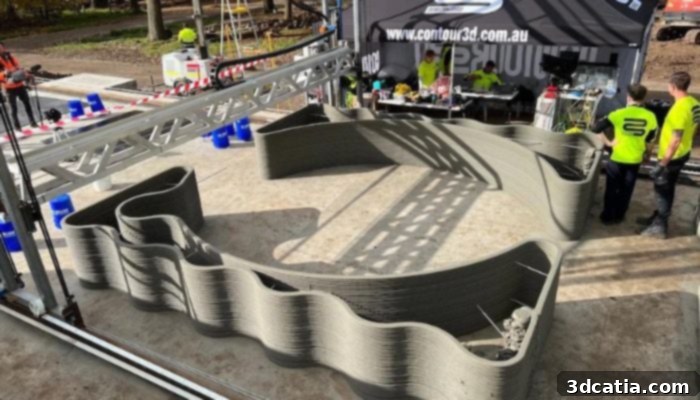
Photo Credits: Contour3D
The revolutionary application of 3D printing in construction, as demonstrated by the Dubbo Eco-Holiday Park, signals a significant shift in how we approach building for both commercial and residential purposes. This project highlights several key advantages of additive manufacturing:
- Reduced Material Waste: Unlike traditional construction which often generates substantial waste, 3D printing allows for precise material deposition, minimizing excess and promoting a more sustainable building process.
- Faster Construction Timelines: The automated nature of 3D printing significantly accelerates the building process, reducing labor costs and allowing projects to be completed in a fraction of the time.
- Enhanced Durability and Resilience: The layer-by-layer construction creates robust, monolithic structures that can withstand extreme weather conditions, making them ideal for the diverse Australian climate, including resistance to bushfires and cyclones in vulnerable areas.
- Design Flexibility: While practical in its current application, 3D printing also offers unparalleled design freedom, allowing for complex geometries and unique architectural forms that would be costly or impossible with conventional methods. This could lead to truly distinctive and memorable guest experiences at the holiday park.
- Economic Stimulus: The introduction of advanced manufacturing techniques can create new jobs in technology, engineering, and skilled labor, boosting local economies and fostering innovation.
Contour3D’s vision for the Dubbo holiday park extends beyond just building structures; it’s about crafting an immersive and sustainable experience for tourists while simultaneously showcasing the immense potential of 3D printing as a solution for broader societal needs. The decision to integrate an “eco-focus” into every aspect of the park, from design to material selection, reflects a growing global demand for environmentally responsible tourism. Guests can look forward to staying in cabins that are not only aesthetically pleasing and uniquely constructed but also designed to minimize their carbon footprint, offering a truly conscious travel choice. This pioneering effort positions Dubbo not just as a tourist hotspot, but as a hub of innovation for sustainable development in Australia. It’s a bold step towards a future where construction is faster, more affordable, and significantly more sustainable.
What do you think of this pioneering project? Would you be excited to stay in a uniquely 3D printed cabin that prioritizes eco-friendliness and modern design? We invite you to share your thoughts and opinions in a comment below or connect with us on our LinkedIn,Facebook, andTwitter pages! Don’t miss out on the latest advancements in additive manufacturing – sign up for our free weeklyNewsletter here, delivering the freshest 3D printing news directly to your inbox! You can also explore all our insightful videos on ourYouTube channel for more in-depth content.
*Cover Photo Credits: Contour3D