
Revolutionizing Healthcare: Materialise’s 3D Printing Innovations Transform Medicine in Plymouth, Michigan
Nestled within the Midwest region, the unassuming town of Plymouth, Michigan, despite its modest population of under ten thousand residents, has emerged as a crucial hub for the pioneering application of 3D printing in medicine. This quiet community is now at the forefront of a technological revolution in healthcare, thanks to the significant contributions of additive manufacturing powerhouse, Materialise. Demonstrating its commitment to advancing medical technology, Materialise recently undertook a substantial expansion of its North American operations in Plymouth. This past summer, the company augmented its existing facilities by over 16,000 square feet, a move that dramatically increased its capacity and capabilities. A key highlight of this expansion was the integration of state-of-the-art 3D printers specifically engineered to fabricate complex objects from robust titanium powder. This strategic enhancement underscores Materialise’s dedication to providing cutting-edge solutions for the medical sector, particularly in areas requiring high-strength, biocompatible materials.
Materialise, a global leader in additive manufacturing headquartered in Belgium, operates a comprehensive 3D printing service that serves as the backbone for its medical innovations. This service boasts a diverse fleet of industrial-grade printers, capable of working with an array of materials, from versatile polymers to durable metals. These advanced systems are meticulously utilized to develop a wide spectrum of 3D printed medical models, ranging from intricate anatomical replicas for surgical planning to functional implants designed for long-term patient care. The company’s relentless pursuit of scientific breakthroughs and its ability to translate these into tangible medical applications have fueled its rapid expansion. In recent years, Materialise has experienced remarkable growth, solidifying its reputation as a trusted partner in the healthcare industry. This growth is vividly reflected in the swift expansion of its North American headquarters in Plymouth, a testament to the increasing demand for their transformative 3D printing solutions.
Materialise’s impact on healthcare spans a broad and ever-evolving range of applications. Their expertise extends from the development of polymer-based dental appliances, primarily designed to meticulously align a person’s teeth, to the precision 3D printing of titanium plates essential for the healing and stabilization of complex bone fractures. Over the years, Materialise has meticulously crafted thousands of patient-specific models, which are invaluable for various medical procedures, including intricate implants, complex surgeries, and the prototyping of novel medical devices. These models are typically formed with unparalleled accuracy using high-resolution medical imaging data, such as detailed CT scans and Magnetic Resonance Imaging (MRIs). The ability to translate this complex anatomical data into physical, tangible models provides surgeons and medical teams with unprecedented insights into a patient’s unique anatomy.
Beyond diagnostic and preparatory models, Materialise has also spearheaded the creation of 3D printed surgical cutting guides. These innovative aids are precisely tailored to each patient’s anatomy, providing doctors with an exact roadmap for surgical incisions. By showing surgeons precisely where to make cuts, these guides significantly reduce surgery times, enhance surgical accuracy, and minimize potential complications. Furthermore, Materialise’s contributions extend to assisting with mobility and posture correction through custom-designed orthotic and prosthetic devices. The profound accuracy of their implants and medical models ultimately accelerates patients’ recovery times, enabling them to return to their normal lives sooner. Through these revolutionary applications, Materialise, alongside other pioneering companies in the field, is actively engaged in saving lives, improving patient outcomes, and fundamentally revolutionizing the landscape of modern healthcare.
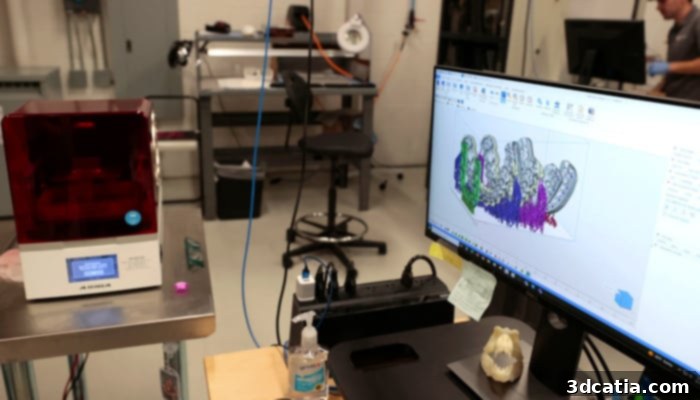
Medical 3D printed components can be personalized and edited prior to printing, ensuring optimal fit and function for individual patients.
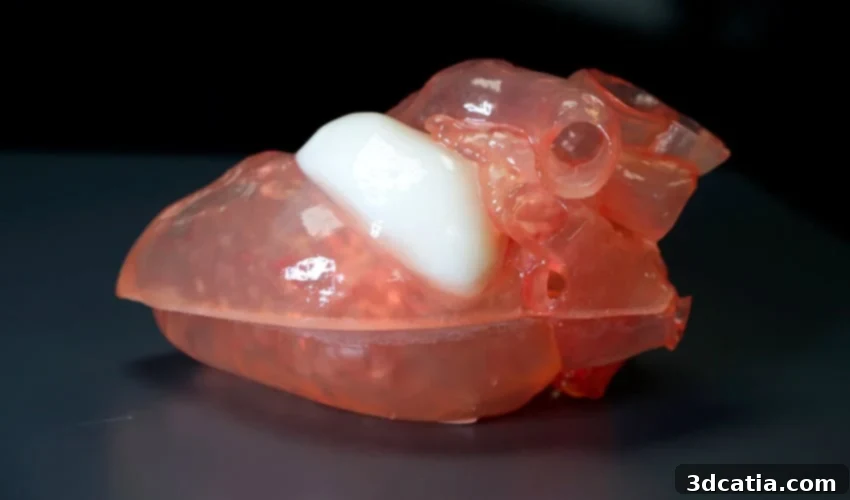
While reports often highlight groundbreaking advancements in 3D printing technology across various industries, the medical field uniquely showcases the tangible, often life-saving results directly experienced by patients. These results stem from the incredible precision and personalization that 3D printed medical components offer. Bryan Crutchfield, Vice President and General Manager for Materialise North America, shared a particularly compelling story that exemplifies this impact. He recounted a recent cooperative project between Materialise and Cincinnati Children’s Hospital, focusing on a pediatric patient named Brad who needed a complex heart tumor removed. Crutchfield explains, “The young man’s name was Brad, and he had a tumor for seven or eight years that they were monitoring. When he turned 16, they thought, ‘OK, the tumor is invasive enough. He’s old enough. We need to go in and take it out.’ We helped them by creating this pliable model.” This statement underscores the critical role Materialise played in transforming a daunting medical challenge into a manageable and ultimately successful surgical plan.
The creation of Brad’s precise 3D heart model proved to be an invaluable asset. Thanks to this advanced 3D modeling, the surgical team at Cincinnati Children’s Hospital was able to meticulously prepare for the operation with a far greater chance of success than would have been possible without this groundbreaking technology. The model allowed surgeons to visualize Brad’s unique cardiac anatomy, understand the tumor’s exact location, and anticipate potential complications before even entering the operating room. Crutchfield elaborated on the critical discovery made during this meticulous planning phase: “What they discovered through the model was that once they removed the tumor, there would not be enough tissue left to reconstruct his heart. So, in his case, they didn’t crack his chest open and surgically remove it. What they did instead was they went in minimally invasively and they did a thermal ablation.” This revelation fundamentally altered the surgical strategy, preventing a potentially devastating outcome and guiding the team toward a less invasive, yet equally effective, solution.
This case perfectly illustrates the primary function of 3D printed medical models: to empower medical professionals to identify the most efficient and least invasive methods to treat patients, thereby optimizing outcomes and minimizing recovery times. However, their utility extends far beyond surgical planning. These lifelike models also serve as powerful communication tools. They enable doctors to explain complex procedures more clearly and comprehensively to patients and their families, fostering a deeper understanding and alleviating anxiety. For medical students and aspiring surgeons, 3D printed anatomical models offer an unparalleled educational resource. Instead of relying solely on two-dimensional diagrams in textbooks or computer screens, students can physically interact with realistic organ models, gaining a profound spatial perspective and tactile understanding of human anatomy. This immersive learning experience is crucial for developing the nuanced skills required for complex surgical interventions.
The consistent development and refinement of these sophisticated medical models and prototypes are progressively shaping the future of medicine. As 3D modeling and printing technology continues to advance, the next generation of doctors and surgeons will be equipped with even more precise tools, enabling them to operate with unprecedented accuracy and confidence. This technological evolution promises a future where personalized medicine becomes the standard, where complex surgical challenges are routinely overcome with innovative solutions, and where patient care is optimized at every stage. Materialise’s pioneering efforts in Plymouth, Michigan, are a vibrant example of this future taking shape, demonstrating how cutting-edge additive manufacturing can profoundly enhance human health and well-being. The implications are vast, impacting not only individual patients but also pushing the boundaries of medical education and surgical training globally.
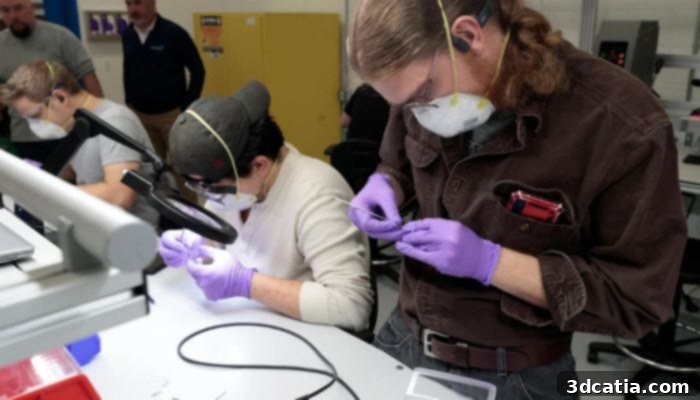
Post-processing is a crucial step in all 3D printed objects, and even more critical when for medical use, ensuring sterility and precision.
What are your thoughts on Materialise North America’s significant expansion and their impactful contributions to medical 3D printing? We invite you to share your perspectives in a comment below or engage with us on our LinkedIn, Facebook, and Twitter pages! Don’t miss out on the latest advancements and news in additive manufacturing – remember to sign up for our free weekly Newsletter here, delivering the freshest 3D printing updates straight to your inbox! You can also explore all our insightful videos and interviews on our dedicated YouTube channel, where we delve deeper into the transformative world of 3D printing.
*All Photo Credits: Eric Seals, Detroit Free Press